Sihagiri in the Culavamsa: Kassapa I's rock palace at Sigiriya
.jpg)
TL;DR — The Culavamsa says Kassapa fled to Sihagiri, cleared the land, walled it and built a lion staircase; the Central Cultural Fund dates his reign 477 to 495.
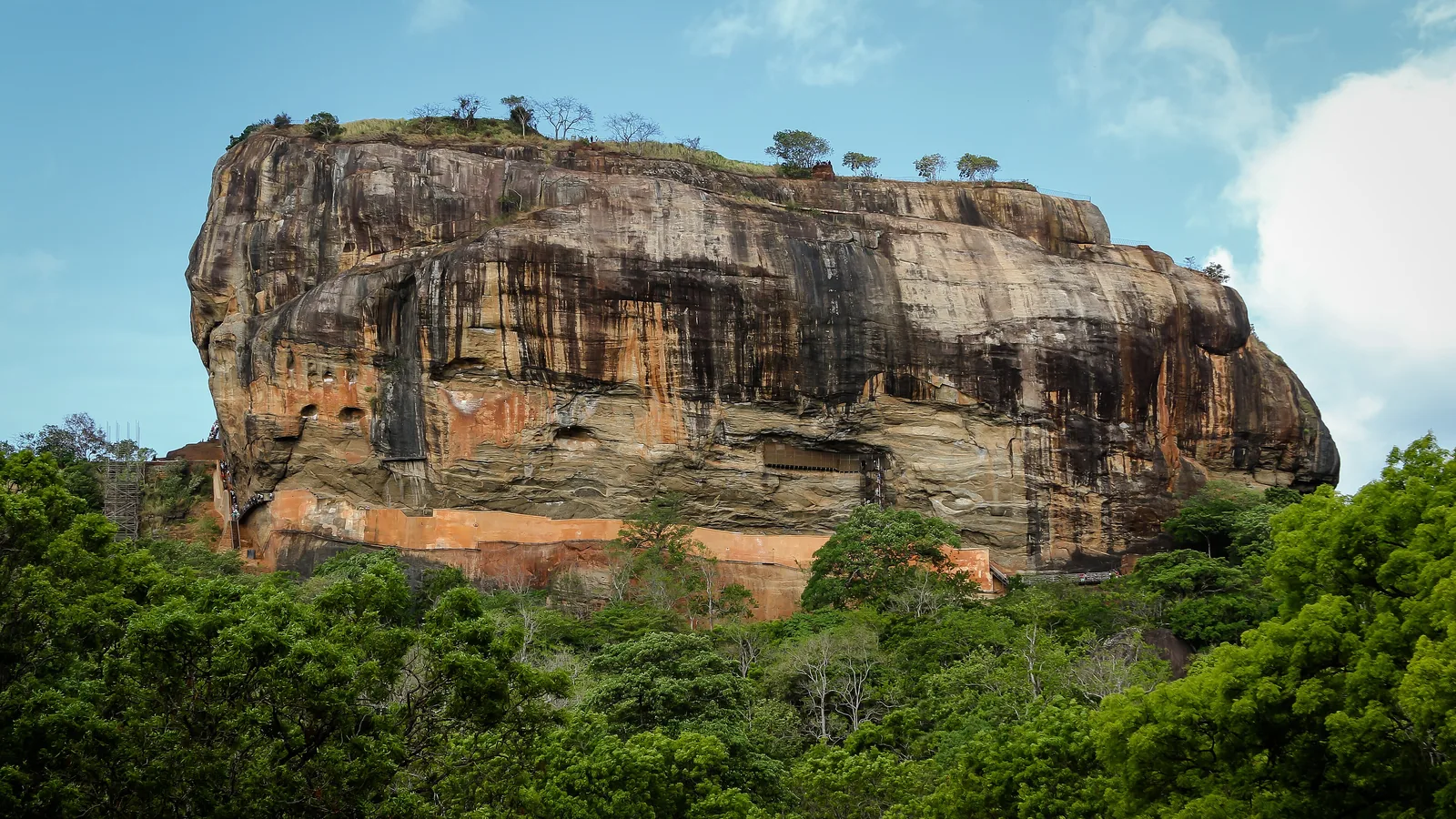
The Pali chronicle Culavamsa records why a Sri Lankan king built a fortress on a rock: “he betook himself through fear to Sihagiri which is difficult of ascent for human beings. He cleared (the land) round about, surrounded it with a wall and built a staircase in the form of a lion. Thence it took its name (of Sihagiri).” Wilhelm Geiger’s 1929 translation places the rock “about 38 miles S. E. of Anuradhapura and ten miles N. E. of Dambulla in the Central Province.” The Central Cultural Fund, which revived archaeological work there in 1982, dates Kassapa’s reign 477 to 495.
Quick facts
- When
- 477-495 (Kassapa I's reign, Central Cultural Fund dates); 1890 (Department of Archaeology founded); 1894 (Bell's survey of Sigiriya, CCF dates); 1897 (frescoes found); 1940-1956 (Paranavitana as Archaeological Commissioner); 1956 (Sigiri Graffiti published); 1982 (Central Cultural Fund project begins)
- Where
- Sihagiri, the rock now called Sigiriya, in the North Central Province of Sri Lanka, about 38 miles southeast of Anuradhapura
- Who
- King Dhatusena; his son Kassapa I; his other son Moggallana I; the Pali chronicler(s) of the Culavamsa, translated by Wilhelm Geiger; H.C.P. Bell, first Commissioner of Archaeology; Senerat Paranavitana, Archaeological Commissioner 1940-1956
- Outcome
- Kassapa built a walled enclosure and a lion-shaped staircase at Sihagiri and ruled from it for 18 years; Moggallana returned from India, defeated him in battle, and Kassapa took his own life. Moggallana converted Sihagiri back into a Buddhist monastery
Dhatusena's two sons
The chronicle opens the succession dispute with this line: “Dhatusena had two sons: Kassapa by a mother of unequal birth and the mighty Moggallana by a mother of equal caste.” A nephew of the king, holding the office of senapati, had a grievance: Dhatusena had put his mother, the king’s own sister, to death. This nephew, the chronicle states, “estranged him from his father, won over his subjects and took the ruler prisoner alive.” Dhatusena died in the plot that followed, and Kassapa took the throne.
The lion staircase at Sihagiri
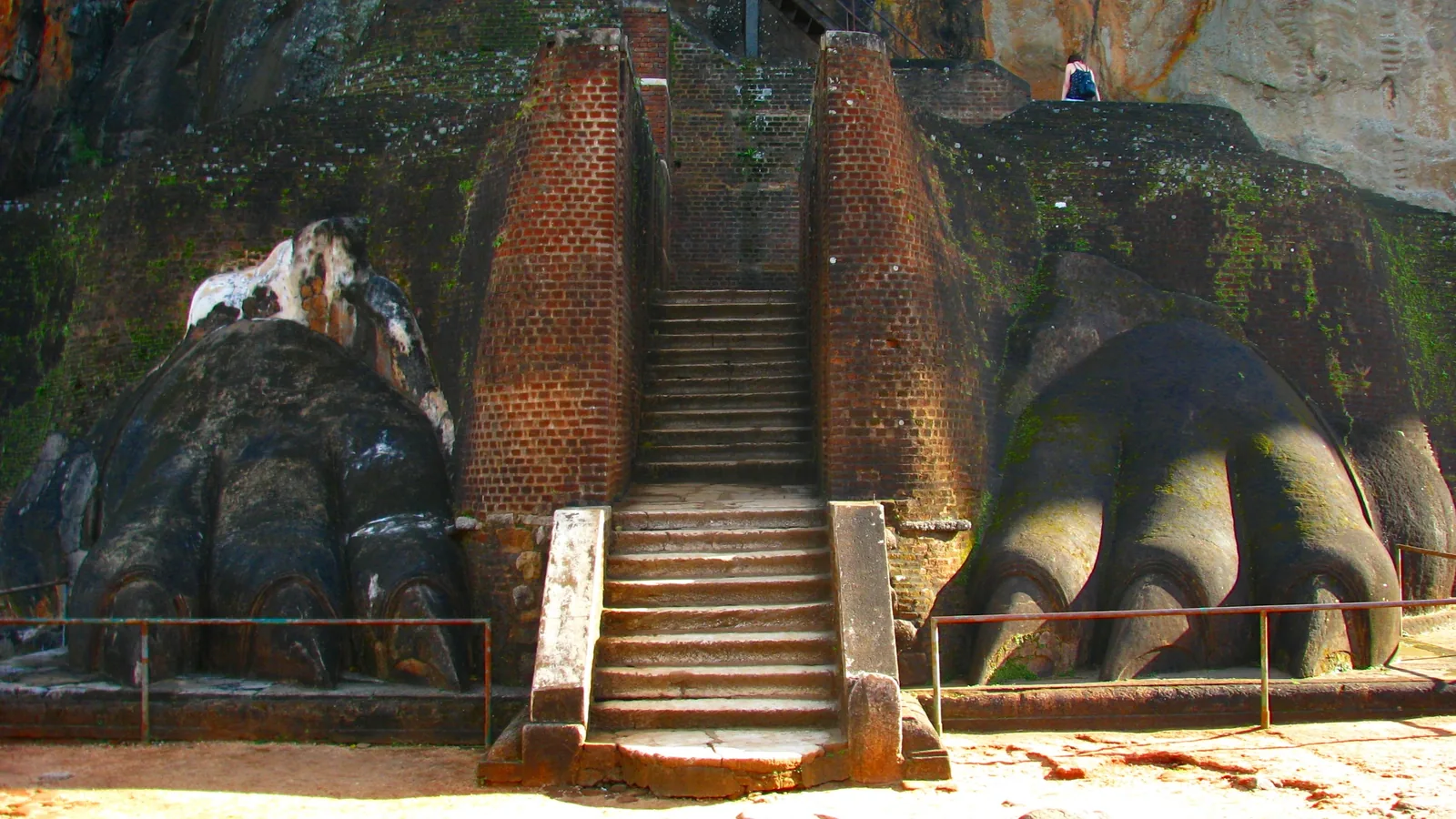
The Culavamsa states that Kassapa “sent forth his groom and his cook” against his half-brother Moggallana but could not kill him, and it was fear of Moggallana that drove him to the rock. There he cleared the ground, built a surrounding wall and raised the staircase in the shape of a lion, from which the site took its name. Geiger’s translation notes that the structure “had in fact the form of a recumbent lion, perhaps of the fore part of the body. It was made of brick,” with a door between the two paws leading through the lion’s body to the stairway; only the claws survive today, and the ascent in Geiger’s time was made “by means of a steep iron ladder.” The chronicle describes the palace Kassapa built there as one “worthy to behold, like another Alakamanda,” the mythical city of the god of wealth Kuvera, adding that he “dwelt there like the god Kuvera.” The Central Cultural Fund credits Paranavitana with a reading along the same lines, writing that Sigiriya “reflects the sensuousness of a pleasure-loving king, who modeled the city on the mythical Alakamanda of the god Kuvera.”
The chronicle also records a change in Kassapa after he had built at Sihagiri: “Kassapa began to rue the deed he had done and with the thought: how can I be saved? he performed many meritorious works,” planting gardens around the city gates and founding new monasteries named for his two daughters and himself. Geiger’s introduction places the Culavamsa as the continuation of the earlier Mahavamsa, and his footnotes cross-check its figures against other Sinhalese texts; on Dhatusena’s 18-year reign, he notes that “Pujav. Rajav. and Rajaratn. all give the same number,” referring to three other chronicles.

Moggallana's return and the mirror wall's graffiti
Eighteen years after Kassapa took the throne, the Culavamsa records that “the royal hero Moggallana came hither at the information of the Nigganthas with twelve distinguished friends from Jambudipa and collected troops.” In the battle that followed, Kassapa’s own troops broke and fled. Kassapa took his own life on the battlefield. After his victory, Moggallana gave two monasteries that had stood at Sihagiri, Dalha and Dathakondanna, to the Dhammaruci and Sagali sects, returning the rock to Buddhist use. The Central Cultural Fund states that Moggallana “opted not to rule from Sigiriya and he converted it again into a Buddhist monastery,” a phase the Fund says “appears to have lasted up to the 12th-13th centuries A.D.”
The rubble path below the rock is bordered by a wall the Central Cultural Fund calls the Mirror Wall, “so named due to the mirror-like appearance of its polished surface.” The Fund’s account gives visitors “from the 7th century to the 19th century A.D.,” while dating the verses they left “from the 7th - 13th centuries A.D.” The Fund credits Paranavitana, whom it calls “the foremost authority on the subject,” with reading, interpreting and publishing 685 of these verses in two volumes titled Sigiri Graffiti. A Department of Archaeology roster of commissioners lists Paranavitana’s term as 1940 to 1956, the same year that book appeared, and states he was “the first Sri Lankan to be appointed the head of the Department.” Cambridge Core’s Journal of the Royal Asiatic Society carries a bibliographic record of a 1957 review of the work, listing Volume I as introduction and plates and Volume II as text, translation, notes and a glossary of 472 pages.
The frescoes and three readings of them
The paintings on the rock face, part way up the ascent, survive today as 19 female figures, though the Central Cultural Fund notes that “the Sigiriya graffiti verses reveal a startling fact about their original number. According to these, there were as many as 500 damsels gracing the whole of the plastered rock-face.” Three named scholars read the paintings three different ways, by the Fund’s account. H.C.P. Bell held that they depict the women of Kassapa’s harem on their way to worship at the nearby Pidurangala shrine. Ananda Coomaraswamy took the figures for female deities or apsaras. Paranavitana held that the golden or ochre-tinted figures represent lightning, Vajjukumari, and the dark-tinted figures thunder, meghalata, a reading drawn from classical literary tradition. The Fund also cites Roman and Indo-Roman coins and Sassanian-dynasty earthenware found in the excavations, and three graffiti verses, numbered 219, 221 and 230, that name silk from China, as evidence of contact beyond the island.
Bell's survey and the water gardens
The Department of Archaeology’s own history page dates its founding to July 7, 1890, when Governor Arthur Gordon directed Bell “to commence archaeological operations of the North Central Province,” a day the Department calls “the official birthday of scientific archaeology in the Island,” and it states that murals were discovered at Sigiriya and Polonnaruwa in 1897. The Central Cultural Fund’s own page gives a different figure for work specifically at Sigiriya, stating that “In 1894 H.C.P. Bell… initiated archaeological research at Sigiriya,” with further research in the 1930s and 1940s under Paranavitana. Below the rock, the Fund describes Water Garden No. 1 as having “four symmetrically arranged ‘L’-shaped ponds, creating an island in the middle,” a layout it calls a charbagh, adding that “this specimen seems to be the most ancient one extant in the world today.” The Central Cultural Fund revived archaeological work at Sigiriya in 1982 as part of the Cultural Triangle program.
Key facts
- The Culavamsa states that Kassapa “cleared (the land) round about, surrounded it with a wall and built a staircase in the form of a lion. Thence it took its name (of Sihagiri).”
- The Central Cultural Fund dates Kassapa’s reign 477 to 495 and his father Dhatusena’s reign 459 to 477.
- Dhatusena died after his son’s plot against him; the chronicle states he ruled 18 years before his death.
- Kassapa built a palace at Sihagiri the chronicle compares to Alakamanda, the city of the god Kuvera.
- Moggallana returned from India after 18 years with troops and defeated Kassapa, who took his own life on the battlefield.
- The Department of Archaeology dates its own founding to July 7, 1890, and the discovery of the Sigiriya frescoes to 1897; the Central Cultural Fund dates Bell’s survey of Sigiriya itself to 1894.
- Paranavitana served as Archaeological Commissioner from 1940 to 1956 and published Sigiri Graffiti, reading 685 verses from the Mirror Wall, in 1956.
- Bell, Ananda Coomaraswamy and Paranavitana gave three separate readings of the rock’s fresco figures: harem women, female deities, and personifications of lightning and thunder.
FAQ
When did Kassapa I reign at Sigiriya?
The Central Cultural Fund, which revived archaeological work at the site in 1982, dates his reign 477 to 495. The Culavamsa states he ruled 18 years before Moggallana defeated him.
Why is the site called Sihagiri?
The Culavamsa says the name comes from the staircase Kassapa built at the site in the form of a lion. Geiger's translation describes the surviving structure as brick, in the shape of a recumbent lion, with a door between its paws leading to the stairway.
Who read the Mirror Wall graffiti verses?
Senerat Paranavitana, Archaeological Commissioner from 1940 to 1956, read, interpreted and published 685 of the verses in his two-volume Sigiri Graffiti in 1956. The Central Cultural Fund calls him the foremost authority on the subject.
Sources
- Wilhelm Geiger (translator), Culavamsa: Being the More Recent Part of the Mahavamsa, Part I (Pali Text Society, 1929 Indian edition), chapters 38-39, via Internet Archive.
- Central Cultural Fund, Sigiriya Project official page, "Sigiriya - History and Development."
- Department of Archaeology, Sri Lanka, "Sigiriya" page.
- Department of Archaeology, Sri Lanka, "History" page.
- Journal of the Royal Asiatic Society (Cambridge Core), review record of S. Paranavitana, Sigiri Graffiti, Vol. 89 (1957).
Cite this article
- APA
- Our Earth's History. (2026, September 27). Sihagiri in the Culavamsa: Kassapa I's rock palace at Sigiriya. Our Earth's History. https://ourearthshistory.com/south-asia/classical/sigiriya-kassapa-i-477-495-mirror-wall-graffiti-paranavitana-1956/
- Chicago
- Our Earth's History. “Sihagiri in the Culavamsa: Kassapa I's rock palace at Sigiriya.” Our Earth's History, September 27, 2026. https://ourearthshistory.com/south-asia/classical/sigiriya-kassapa-i-477-495-mirror-wall-graffiti-paranavitana-1956/.
- MLA
- “Sihagiri in the Culavamsa: Kassapa I's rock palace at Sigiriya.” Our Earth's History, 27 Sep. 2026, https://ourearthshistory.com/south-asia/classical/sigiriya-kassapa-i-477-495-mirror-wall-graffiti-paranavitana-1956/.
Text licensed CC BY-NC-ND 4.0. Found an error? Tell us.