'Carving done by the ivory-workers of Vedisa': who paid for Sanchi

TL;DR — Ivory-carvers from Vidisha signed one panel of Sanchi’s south gateway; some 800 other inscriptions name the monks, nuns, bankers and merchants who paid for the rest.
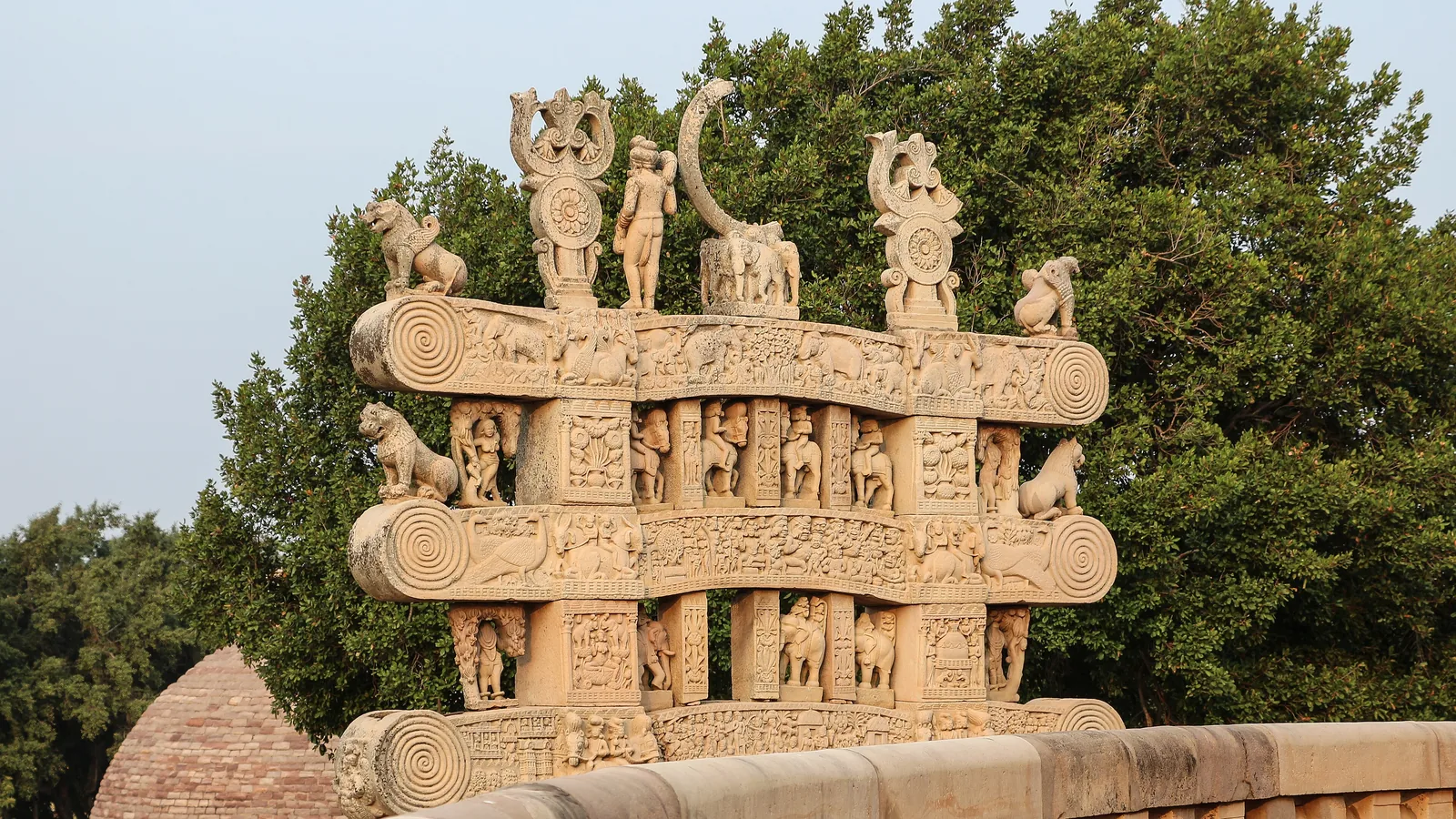
“Vedisakehi damtakarehi rupakammam katam.” The line is cut on the lowest panel of the west pillar of the south gateway of the Great Stupa at Sanchi, and N. G. Majumdar’s 1940 translation reads: “Carving done by the ivory-workers of Vedisa (Vidisa).” Vedisa, now Vidisha, was the town about five miles from the hill, in what is now Madhya Pradesh in central India, and its ivory-carvers were the only makers on the monument who put their name on their work. Around them, on railings and gateways raised between the 2nd and 1st centuries BC, are the short donor records that Sir John Marshall and Majumdar numbered from 15 to 827 in 1940. Monks and nuns, bankers, a royal scribe, a trooper and one Greek gave the parts. Only one record on the gateways names a king.
Quick facts
- When
- Brick stupa and pillar under Ashoka, 3rd century BC · stone casing in the 2nd century BC · four gateways about the 1st century BC · rediscovered 1818 · dug 1822 and 1851 · cleared and repaired 1912-1919
- Where
- Sanchi hill, about five miles from Vidisha (Vedisa, later Bhilsa), in what is now Madhya Pradesh, central India
- Who
- The ivory-workers of Vedisa; Ananda, son of Vasithi, foreman of King Satakarni's artisans; General Taylor, Captain Johnson, Alexander Cunningham, F. C. Maisey; Sir John Marshall and N. G. Majumdar
- Outcome
- A monument whose railings and gateways carry short donor records numbered 15 to 827 in the 1940 catalog, only one of which names its carvers
A dancer, a heavenly orchestra and a vine border
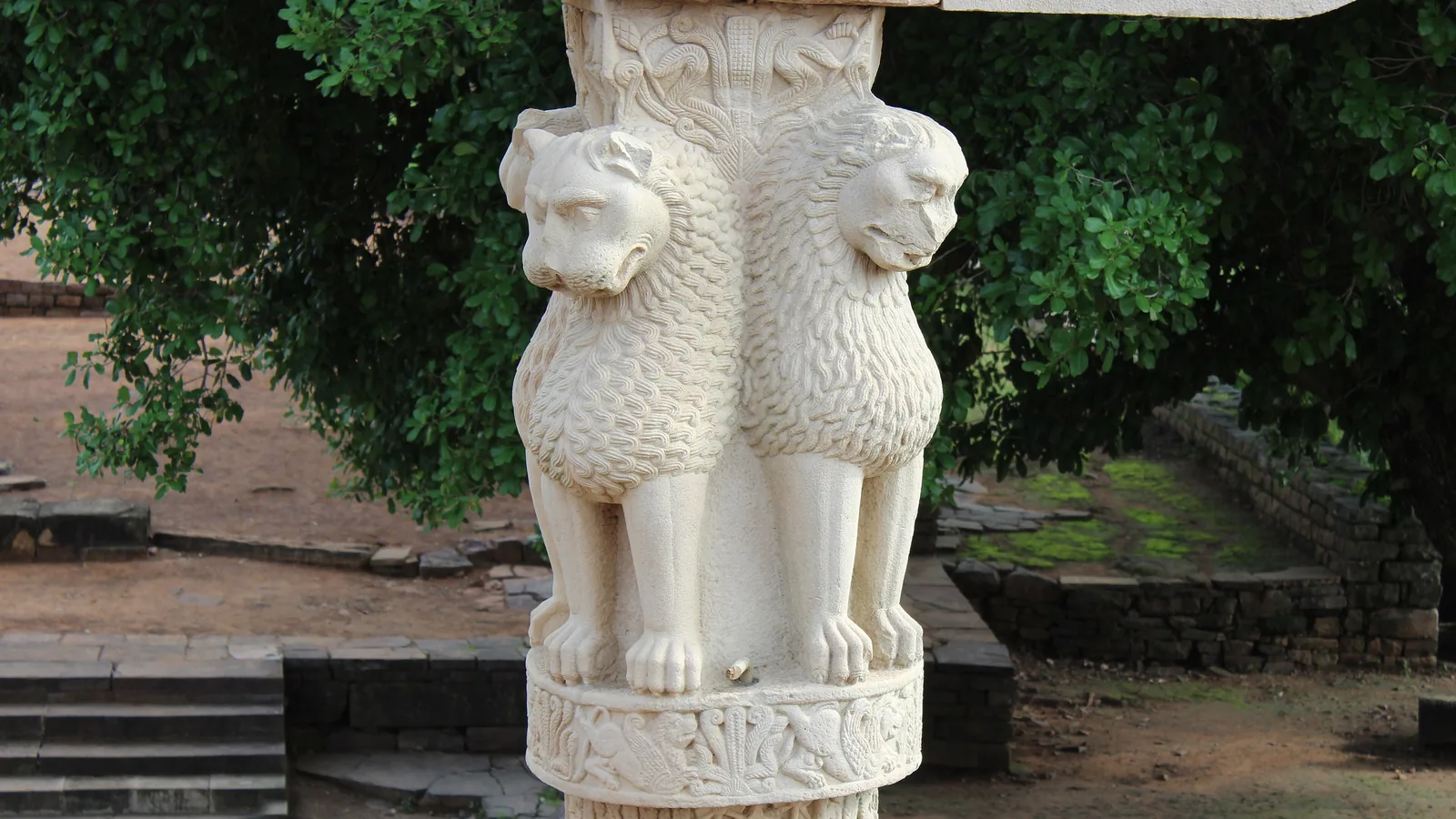
The signed panel shows the gods of the Trayastrimsa heaven worshipping the cut hair and headdress of the Bodhisattva. Alfred Foucher, describing Plate 18 in the second volume of the 1940 report, picked out “the orchestra of heavenly nymphs and the contorsions of the lovely dancer with the heavy plaits,” framed by a border of vine with grapes. Marshall wrote that the panel “affords an instructive illustration of how perfectly these craftsmen could adapt their technique to stone.”
Alexander Cunningham copied the line in 1851 and printed it in 1854 as his No. 189, admitting defeat: “I cannot even make a guess as to its meaning.” Georg Bühler read it in Epigraphia Indica in 1894 as “The workers in ivory of Vedisa have done the carving,” and took the collective gift as a sign that the carvers formed a guild. Foucher summed up: the inscriptions on the railings and gateways “reveal no artist’s name,” and only this pillar was written down as the work, as well as the gift, of its makers.
Eight hundred names on the railings
Marshall and Majumdar’s chapter on the votive inscriptions covers Nos. 15 to 827, most of them a few words long: a name, a hometown, the word danam, “gift.” Donors who called themselves monks or nuns numbered “over two hundred in all.” The epithet upasaka, lay worshipper, appears in four inscriptions and its female form upasika in 15. Bankers (sethi) are mentioned 19 times and merchants (vanija) five times, and the list runs on to a royal scribe, a surveyor, a trooper, masons, a cloak-seller and a weaver. “Even a foreigner, a Greek (Yona) from Svetapatha, participated in these donations.” A banker named Nagapiya of Kurara paid for a whole pillar of the east gateway and, with his son Sagha, for one of the west.
The east gateway also carries a curse on anyone who “dismantles, or causes to be dismantled, an arch or a rail of this Kakanava,” the hill’s ancient name: he shall incur the sin “of the murderers of mothers, murderers of fathers, murderers of Arhats.” Bühler, working from impressions taken by J. Burgess in 1889 and A. Führer in 1889-90, found 110 fewer on Stupa 1 and 27 fewer on Stupa 2 than Cunningham had printed in 1854, and 41 on the first and five on the second that Cunningham had never recorded. He blamed stones lost in repairs.
Ashoka's brick mound and the edict against schism
The stupa the donors enlarged began as a brick mound built under Ashoka in the 3rd century BC, with a stone pillar near its south entrance. On that pillar the king had an edict cut, and Majumdar’s translation includes the sentence: “the monk or nun who creates a division in the Samgha shall be made to put on white robes and to reside out of the (Samgha) residence.” Ashoka’s edicts elsewhere in India speak of conquest and remorse; the Sanchi copy deals only with discipline inside the Buddhist order.
About the middle of the 2nd century BC, under one of the Shunga kings, the brick stupa was cased in stone, given a terrace and three stone balustrades, and enlarged to a dome “over 120 ft.” wide and “about 54 ft.” high. The four gateways “were to be added by the Andhras a century later.” Long habit, Marshall wrote of the carvers, “always prevented them from breaking openly with traditional usage and showing the Buddha otherwise than symbolically,” by a tree, a wheel, a throne or a stupa.

Taylor in 1818, and the diggers who came after
When General Taylor came upon the hill in 1818, three of the four gateways “were still standing erect, and the southern one was lying where it had fallen; the great dome was intact.” In 1822 Captain Johnson, the Assistant Political Agent in Bhopal, “opened the Great Stupa from top to bottom on one side, and left a vast breach in it,” which Marshall blamed for the later collapse of the west gateway. Cunningham and Captain F. C. Maisey dug at Sanchi, in Cunningham’s words, “in January and February of the present year,” 1851, and lifted relic caskets from Stupas 2 and 3; Marshall judged that their “hasty excavations” had “contributed to the general spoliation of the site.”
The clearing of the jungle, the excavation of the monasteries around the stupa and the protection of “the hundreds of loose sculptures and inscriptions lying on the site” were, as Marshall put it, “left for the writer to carry out between the years 1912 and 1919.” Casts of the reliefs had gone abroad earlier; the Victoria and Albert Museum in London holds a plaster panel from one of the gateways, 30 inches high, accessioned in 1872.
Two readings of one line, and a handover in 1958
The top beam of the south gateway, facing the stupa, carries the only royal name on the gateways. Cunningham printed it in 1854 as “Gift of Ananda, son of the neophyte Vasishtha, in the reign of Sri Satakarni,” and gave that reign as AD 19 to 37. Majumdar’s 1940 edition reads the same word, avesanisa, as a title: “The gift of Ananda, son of Vasithi, the foreman of the artisans of the Rajan Siri Satakarni.” A neophyte had become the king’s master craftsman. Which Satakarni is meant is unsettled; dates given by scholars for his reign range from the middle of the 2nd century BC to AD 37, with Marshall and Majumdar arguing for the middle of the 1st century BC.
Some of the caskets Cunningham and Maisey lifted in 1851 went to England in Maisey’s collection, and the Victoria and Albert Museum bought them in 1921. Its record for a steatite casket from Stupa 2 at Sanchi states that two pieces of calcined bone “were handed over to Mr Perera, Deputy High Commissioner for Ceylon,” in the United Kingdom on January 27, 1958, and the other two to Professor M. S. Sundaram of the Indian High Commission on June 18, 1958, “the Ministry of Education in London having suggested that all Buddhist relics from Sanchi and Sonari still in the V&A should be offered to the Indian Government.” The bone from a casket found at Sonari, six miles southwest of Sanchi, and the ash and piece of wood from its container went the same way. The empty caskets stayed in London; the names on the railings stayed on the hill.
Key facts
- The inscription “Vedisakehi damtakarehi rupakammam katam,” on the lowest panel of the west pillar of the south gateway, is No. 400 in Marshall and Majumdar’s 1940 catalog and No. 345 in Lüders’s list; Majumdar translated it “Carving done by the ivory-workers of Vedisa.”
- Cunningham printed the same line in 1854 as his No. 189 and wrote that he could not guess its meaning; Bühler read it in 1894 as “The workers in ivory of Vedisa have done the carving.”
- Marshall and Majumdar’s chapter of votive inscriptions runs from No. 15 to No. 827; the ground balustrade of the Great Stupa alone carries Nos. 15 to 363.
- Self-described monks and nuns among the donors number over 200; the epithet upasaka occurs in four inscriptions and upasika in 15; bankers are mentioned 19 times and merchants five times.
- Bühler’s comparison of the 1889-90 impressions with Cunningham’s plates found 110 fewer inscriptions on Stupa 1 and 27 fewer on Stupa 2, and 41 and five not in Cunningham’s book.
- Marshall gave the enlarged Shunga-period dome a diameter of over 120 feet and a height of about 54 feet, and placed the four gateways a century later, under the Andhras.
- Cunningham read the south gateway’s royal inscription as the gift of the son of a “neophyte” and dated Satakarni’s reign AD 19-37; Majumdar in 1940 read the word as “foreman of the artisans.”
- V&A object records state that bone from the Sanchi and Sonari caskets was handed to a representative of Ceylon on January 27, 1958, and to a representative of India on June 18, 1958.
FAQ
Who carved the gateways of the Great Stupa at Sanchi?
Only one panel says. The lowest panel on the east face of the south gateway's west pillar is inscribed as the carving of the ivory-workers of Vedisa, the guild of the town now called Vidisha. No other inscription on the railings or gateways names an artist, though Marshall thought the same craftsmen carved several other fine panels.
Who paid for the Sanchi stupa?
Not a single king. Marshall and Majumdar's 1940 catalog numbers the site's votive inscriptions from 15 to 827, and they record gifts by more than 200 monks and nuns, by bankers, merchants, a royal scribe, a surveyor, a trooper, masons, a weaver and one Greek. The one royal name on the gateways, Satakarni, appears in the record of a gift by his foreman's son.
When were the Sanchi gateways built?
Marshall placed the stone casing of the stupa about the middle of the 2nd century BC and the four gateways about a century later, under the Andhra (Satavahana) kings. The south gateway names King Satakarni, whose reign scholars have dated anywhere from the mid-2nd century BC to AD 19-37.
Sources
- Sir John Marshall and Alfred Foucher, The Monuments of Sanchi, vol. I (Text), with the inscriptions edited and translated by N. G. Majumdar (Calcutta, 1940); chapters I, III, XIX and XXI; full text at the Internet Archive.
- Sir John Marshall and Alfred Foucher, The Monuments of Sanchi, vol. II (Plates 1-67), descriptions of Plates 18 and 19, the pillars of the Southern Gateway; full text at the Internet Archive.
- Alexander Cunningham, The Bhilsa Topes; or, Buddhist Monuments of Central India (London, 1854), preface and chapter XVI, inscriptions Nos. 189 and 190; full text at the Internet Archive.
- G. Bühler, 'Votive Inscriptions from the Sanchi Stupas,' Epigraphia Indica, vol. II (Calcutta, 1894), pp. 87-116, inscription No. 200; full text at the Internet Archive.
- Victoria and Albert Museum, collections record IM.218-1921, relic casket from Stupa 2 at Sanchi, object history (V&A Collections API).
- Victoria and Albert Museum, collections record IM.219-1921, relic container from Stupa 2 at Sonari, object history (V&A Collections API).
- Victoria and Albert Museum, collections record IM.221-1921, relic casket from Stupa 2 at Sonari, object history (V&A Collections API).
- Victoria and Albert Museum, collections record IM.222-1921, relic casket from Stupa 2 at Sonari, object history (V&A Collections API).
- Victoria and Albert Museum, collections record REPRO.1872-113, plaster cast of a relief panel from a Sanchi gateway (V&A Collections API).
Cite this article
- APA
- Our Earth's History. (2026, September 22). 'Carving done by the ivory-workers of Vedisa': who paid for Sanchi. Our Earth's History. https://ourearthshistory.com/south-asia/classical/sanchi-great-stupa-gateways-ivory-workers-inscription/
- Chicago
- Our Earth's History. “'Carving done by the ivory-workers of Vedisa': who paid for Sanchi.” Our Earth's History, September 22, 2026. https://ourearthshistory.com/south-asia/classical/sanchi-great-stupa-gateways-ivory-workers-inscription/.
- MLA
- “'Carving done by the ivory-workers of Vedisa': who paid for Sanchi.” Our Earth's History, 22 Sep. 2026, https://ourearthshistory.com/south-asia/classical/sanchi-great-stupa-gateways-ivory-workers-inscription/.
Text licensed CC BY-NC-ND 4.0. Found an error? Tell us.