'A veritable Roman town': Arikamedu and the Arretine sherds of 1945
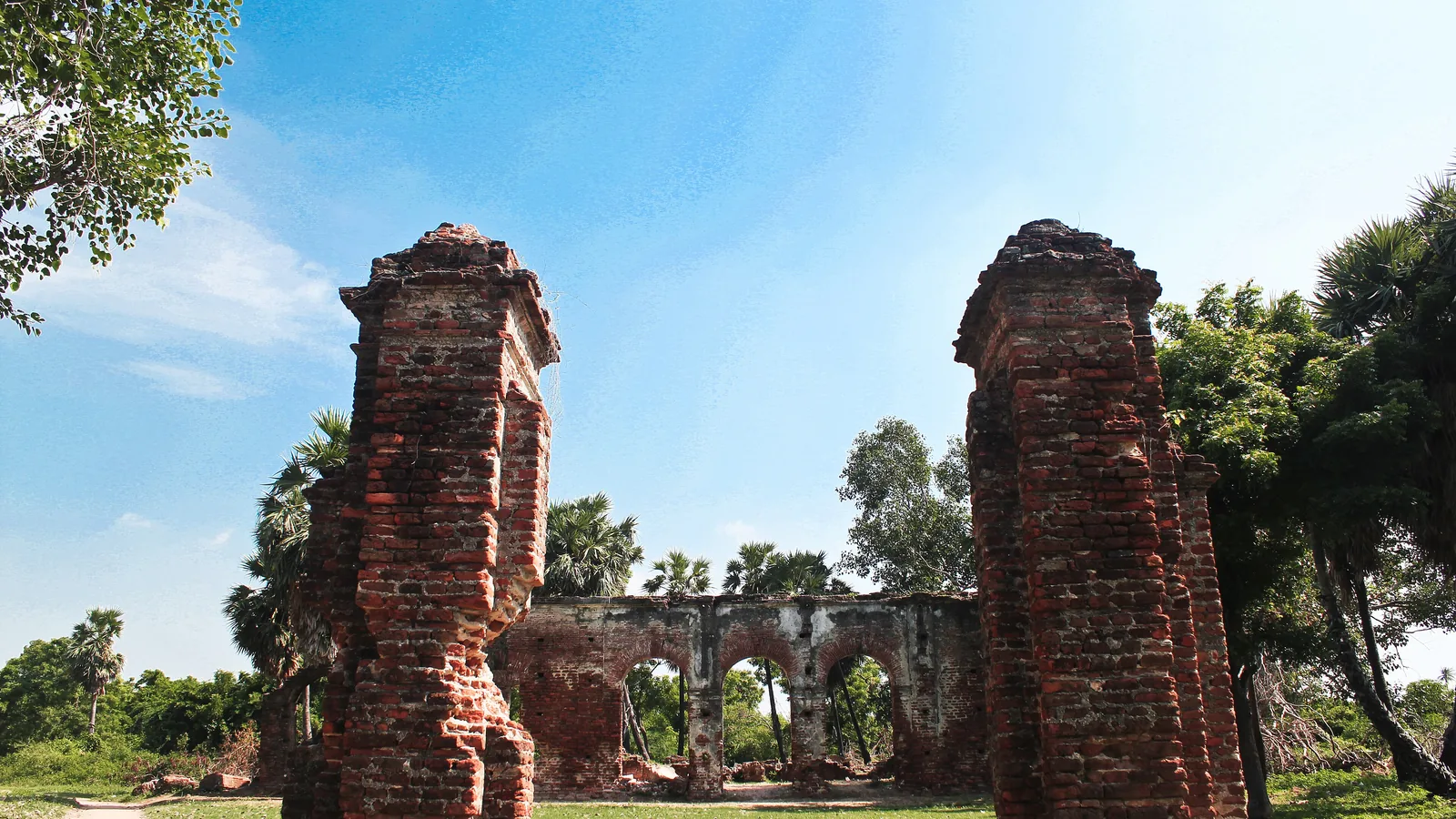

TL;DR — Wheeler’s 1945 dig at Arikamedu, south of Pondicherry, produced Italian Arretine ware he dated AD 20-50; later excavators argued the port was older, perhaps 2nd century BC.
Mortimer Wheeler’s 1946 report on Arikamedu, a mound about three kilometers south of Pondicherry on the Coromandel coast, begins the site’s history with a Frenchman’s exclamation. Gabriel Jouveau-Dubreuil, a professor in the town, had collected beads that children picked up on the riverbank since 1937, and, Wheeler wrote, “One of the gems is reported to bear a head of Augustus in intaglio, and this induced Mr. Jouveau-Dubreuil to exclaim ‘Nous avons là une véritable ville romaine.’” Wheeler never saw the gem; it had gone to a museum in Hanoi. What he found in 1945 was red-glazed tableware made in Italy, Mediterranean wine jars and Roman lamps on the east coast of India, and he dated the Italian ware to AD 20-50. Reviews of the next excavation report, in 1998, recorded the site’s beginnings pushed, without a firm answer, toward the 2nd century BC.
Quick facts
- When
- Beads collected from 1937 · first dig 1941 · Wheeler's excavation April to June 1945 · Arretine ware dated AD 20-50 by Wheeler · Casal's seasons 1947-48 · Begley and Raman's three seasons 1990-92 · Pattanam excavations from 2007
- Where
- Arikamedu, on the Ariyankuppam river about three kilometers south of Pondicherry on the Coromandel coast of what is now Tamil Nadu, India; Muziris and Nelcynda on the Malabar coast; Coimbatore district
- Who
- Gabriel Jouveau-Dubreuil, a Pondicherry professor; Brother L. Faucheux; Mortimer Wheeler, Director General of Archaeology in India, with A. Ghosh and Krishna Deva; Jean-Marie Casal; Vimala Begley and K. V. Raman; the anonymous author of the Periplus; Pliny the Elder
- Outcome
- The first western trading station in India identified by excavation; Wheeler's dating of AD 20-50 for its Arretine pottery; a reopened question, after 1996, of whether the site began about the 2nd century BC
Beads from a riverbank, 1937 to 1941
In 1941, according to André Tchernia’s 1998 review in the journal Topoi, Jouveau-Dubreuil was the first to propose that Arikamedu was the Podouke of the Periplus of the Erythraean Sea, a Greek merchant’s sailing guide of the 1st century AD. That year Brother L. Faucheux of Pondicherry and R. Surleau, the town’s public works chief, opened the first trenches. Wheeler’s verdict on them was four words, “The excavators ignored stratification,” and it explains why he came.
As Director General of Archaeology in India he obtained leave from the French governor, L. Bonvin, and the Archaeological Survey of India worked at Arikamedu in April, May and June 1945 with A. Ghosh and Krishna Deva. The editorial note in Ancient India called them “the burning months.”
Eighteen sherds and three decades: Wheeler's dating
The Northern Sector held a building “upwards of 150 feet long, built about A.D. 50 on the former foreshore,” a warehouse in Wheeler’s reading, soon flooded and abandoned. The Southern Sector, 10 feet above flood level, was occupied for a century or more from the mid-1st century AD; its brick tanks and walled courtyards, he conjectured, served the finishing of muslin.
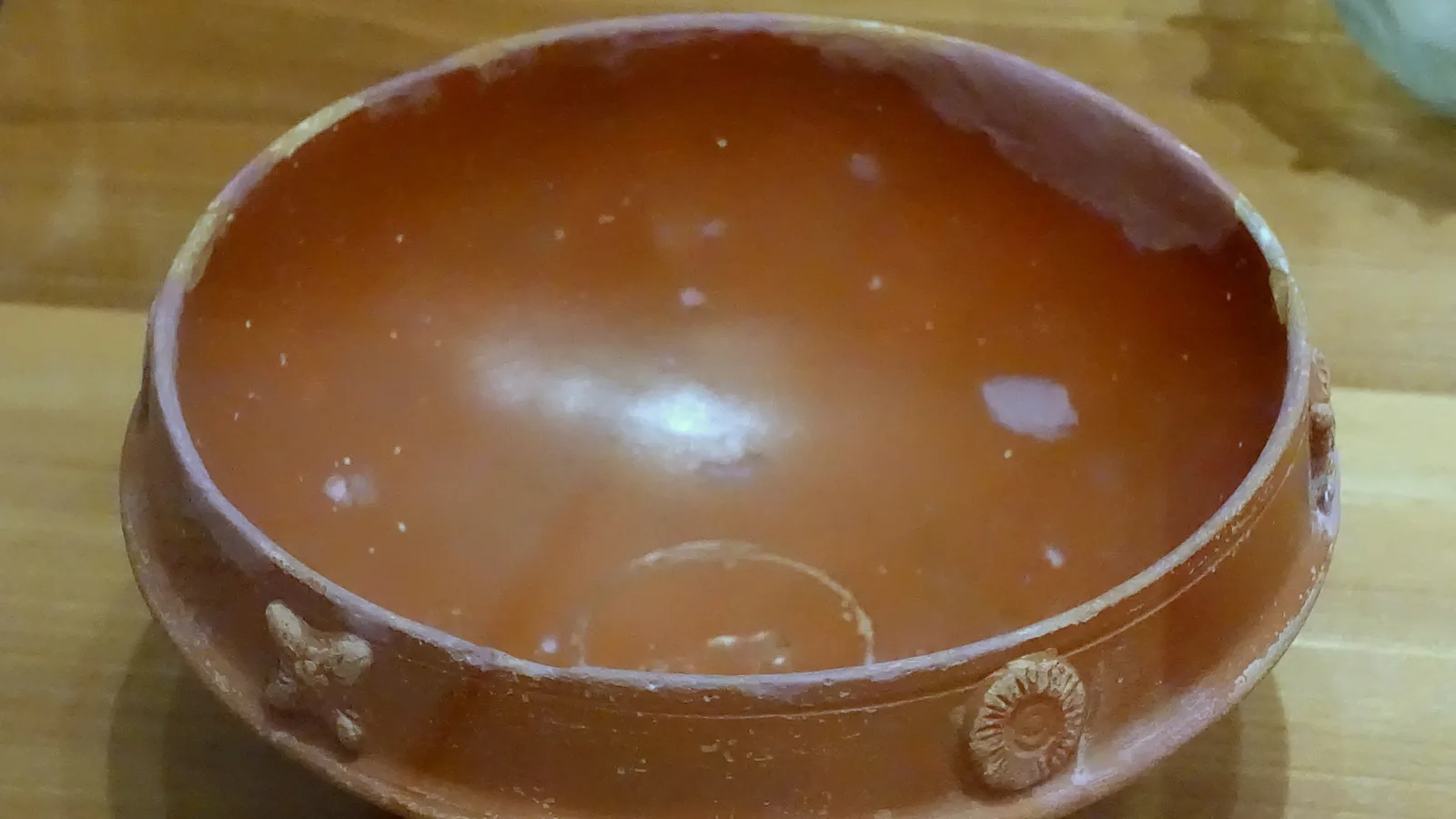
The date rested on the Arretine ware, whose production, by the European studies then available, ended about AD 50. In cutting AK II, 13 of the 18 Arretine sherds lay in one stratum. Wheeler called the argument “necessarily somewhat subjective,” then set it down: “I have proposed therefore A.D. 20-50 as the inclusive period for the Arretine pottery at Arikamedu.” Beneath the lowest Arretine level lay eight feet of silt that still held amphora sherds, so in his reading Mediterranean trade reached the place before the tableware did.

Poduca on the Periplus, Pondicherry on the map
Wilfred H. Schoff’s 1912 translation of the Periplus lists the east-coast harbors in section 60: “the most important are, in order as they lie, first Camara, then Poduca, then Sopatma,” and “the greatest part of what is brought at any time from Egypt comes here.” Schoff’s note reads: “This is probably intended for Puduchcheri, ‘new town,’ the modern Pondicherry,” while “Yule, following Lassen, prefers Pulikat.” He added that “there is no evidence that Pondicherry existed at the time of the Periplus.” Nothing had yet been dug.
Wheeler answered in an appendix: the site’s position fit the order in the Periplus and in Ptolemy, and a Roman emporium beside Pondicherry gave the old equation “fresh and perhaps conclusive weight.” The west coast in the same text was busier. Section 54 says Muziris “abounds in ships sent there with cargoes from Arabia, and by the Greeks,” with Nelcynda, of the Pandian kingdom, about 500 stadia on, and section 57 credits a pilot named Hippalus with first laying “his course straight across the ocean” on the southwest wind that took his name.
Pliny's sesterces and the coin hoards of Coimbatore
Pliny the Elder, writing in the AD 70s, gave the trade a price. In Book VI of the Natural History, in the Bostock and Riley translation, he set out the route from Egypt because “in no year does India drain our empire of less than five hundred and fifty millions of sesterces, giving back her own wares in exchange, which are sold among us at fully one hundred times their prime cost.” In Book XII he widened the count: “At the very lowest computation, India, the Seres, and the Arabian Peninsula, withdraw from our empire one hundred millions of sesterces every year.” The Periplus names what came back for the coin: pepper above all, then pearls and ivory, silk cloth and tortoise-shell.
The silver he complained of turns up in the ground: Wheeler’s first appendix listed Roman coin finds: at Kattanganni in Coimbatore district, 233 denarii of Augustus and Tiberius; at Vellalur nearby, 522 denarii from Augustus to Claudius in a pot. He wrote of “the great cluster of coins, particularly hoards, of the first century A.D. in the Coimbatore district,” and explained it by the beryl mines there and by the Ponnani valley, a road between the Malabar and Coromandel coasts. The Tamil poems said the same from the other side. In one, as Wheeler printed it, “the beautifully built ships of the Yavanas came with gold and returned with pepper, and Muziris resounded with the noise.”
Six seasons, then Begley: the site grows older
Tchernia counted six campaigns between 1941 and 1950: Faucheux, Wheeler, soundings by Henri Marchal in 1946, then Jean-Marie Casal, whose paper to the Académie des Inscriptions in 1949 reported the seasons of 1947 and 1948. From 1990 to 1992 Vimala Begley’s team from the University Museum in Pennsylvania dug there again with K. V. Raman’s archaeologists from the University of Madras, and the first volume of their report appeared at Pondicherry in 1996.
Jean-François Salles, reviewing it in Arts asiatiques in 1998, called the site “the Podukê of the Periplus” without qualification, and found the rereading of the old finds “décevante,” disappointing, because questions Begley had raised got no clear answer, among them the birth of the site “vers le IIe s. av. J.-C.,” about the 2nd century BC. Both reviewers were waiting for a second volume announced for 1997 or 1998.
On the Malabar coast the search for Muziris moved to Pattanam, where the Kerala Council for Historical Research began excavating in 2007. Sixty-one trenches over eight seasons, about 1 percent of the mound, produced brick architecture, a wharf with bollards and non-Indian pottery, and the Muziris Heritage Project describes a settlement from the 2nd century BC to the 10th century AD, with the name Muziris stated as a possibility. Wheeler’s Arretine sherds still sit inside their three decades; the ports on either coast now carry dates on both sides of them.
Key facts
- Arikamedu lies on the right bank of the Ariyankuppam river, about three kilometers south of Pondicherry on the Coromandel coast (Tchernia 1998).
- Gabriel Jouveau-Dubreuil began collecting beads found by local children in 1937; one gem was reported to carry a head of Augustus in intaglio (Wheeler 1946).
- The first trenches were opened in 1941 by Brother L. Faucheux and R. Surleau; the same year Jouveau-Dubreuil first proposed the site as the Podouke of the Periplus (Wheeler 1946; Tchernia 1998).
- The Archaeological Survey of India under Wheeler excavated from April to June 1945 with A. Ghosh and Krishna Deva.
- Wheeler proposed “A.D. 20-50 as the inclusive period for the Arretine pottery at Arikamedu”; 13 of the 18 Arretine sherds from cutting AK II came from one stratum.
- Pliny’s Natural History VI.26, in the Bostock and Riley translation, says that in no year did India drain the empire “of less than five hundred and fifty millions of sesterces”; XII.41 gives 100 million for India, the Seres and Arabia together.
- Wheeler’s coin list records 233 denarii of Augustus and Tiberius from Kattanganni and 522 denarii from Augustus to Claudius from Vellalur, both in Coimbatore district.
- Six campaigns ran from 1941 to 1950; Begley and Raman’s three seasons of 1990-92 were published in 1996, and Salles’s review recorded the unresolved question of a start about the 2nd century BC.
FAQ
What did Mortimer Wheeler find at Arikamedu in 1945?
Sherds of Arretine ware from Italy, Mediterranean amphorae, Roman lamps and glass, two Greco-Roman intaglio gems, a building over 150 feet long he identified as a warehouse, and courtyards with brick tanks he thought were used for finishing muslin.
Is Arikamedu the Poduca of the Periplus?
Schoff in 1912 placed Poduca at Pondicherry but said the identification was conjectural. Jouveau-Dubreuil proposed Arikamedu in 1941, Wheeler in 1946 found the position consistent and gave the equation "perhaps conclusive weight," and Salles in 1998 used the name without qualification.
How much did Pliny say Rome spent on Indian goods?
In Book VI of the Natural History he wrote that India drained the empire of at least 550 million sesterces a year, in the Bostock and Riley translation; in Book XII he put India, the Seres and Arabia together at 100 million a year.
Sources
- R. E. M. Wheeler, A. Ghosh and Krishna Deva, Arikamedu: An Indo-Roman Trading-station on the East Coast of India, Ancient India no. 2 (Archaeological Survey of India, July 1946), pp. 17-124, with the editorial notes on p. 1 and Appendix I (Roman coins) and Appendix III (the ancient name); full text at the Internet Archive.
- The Periplus of the Erythraean Sea: Travel and Trade in the Indian Ocean by a Merchant of the First Century, translated and annotated by Wilfred H. Schoff (New York, 1912), sections 53-60 and the notes to section 60; full text at the Internet Archive.
- Pliny the Elder, The Natural History, Book VI, chapter 26, translated by John Bostock and H. T. Riley (London, 1855), Perseus Digital Library.
- Pliny the Elder, The Natural History, Book XII, chapter 41, translated by John Bostock and H. T. Riley (London, 1855), Perseus Digital Library.
- Jean-Marie Casal, Les fouilles de Virapatnam-Arikamedu, Comptes rendus des séances de l'Académie des Inscriptions et Belles-Lettres 93, no. 2 (1949), pp. 142-147; abstract on Persée.
- André Tchernia, Arikamedu et le graffito naval d'Alagankulam, review of Vimala Begley et al., The Ancient Port of Arikamedu: New Excavations and Researches 1989-1992, vol. 1 (1996), Topoi 8, no. 1 (1998), pp. 447-463; Persée.
- Jean-François Salles, review of Vimala Begley (ed.), The Ancient Port of Arikamedu: New Excavations and Researches 1989-1992, Volume One, Arts asiatiques 53 (1998), pp. 123-124; Persée.
- Kerala Tourism, Muziris Heritage Project, Historical Sites: Pattanam (Kerala Council for Historical Research excavations from 2007).
- Kerala Tourism, Muziris Heritage Project, History: Sangam poems, Ptolemy, the Peutinger Table and the Muziris papyrus.
Cite this article
- APA
- Our Earth's History. (2026, September 22). 'A veritable Roman town': Arikamedu and the Arretine sherds of 1945. Our Earth's History. https://ourearthshistory.com/south-asia/classical/arikamedu-roman-trade-arretine-ware-periplus/
- Chicago
- Our Earth's History. “'A veritable Roman town': Arikamedu and the Arretine sherds of 1945.” Our Earth's History, September 22, 2026. https://ourearthshistory.com/south-asia/classical/arikamedu-roman-trade-arretine-ware-periplus/.
- MLA
- “'A veritable Roman town': Arikamedu and the Arretine sherds of 1945.” Our Earth's History, 22 Sep. 2026, https://ourearthshistory.com/south-asia/classical/arikamedu-roman-trade-arretine-ware-periplus/.
Text licensed CC BY-NC-ND 4.0. Found an error? Tell us.