A Tiberius aureus in tomb 3: the six graves of Tillya Tepe, 1978
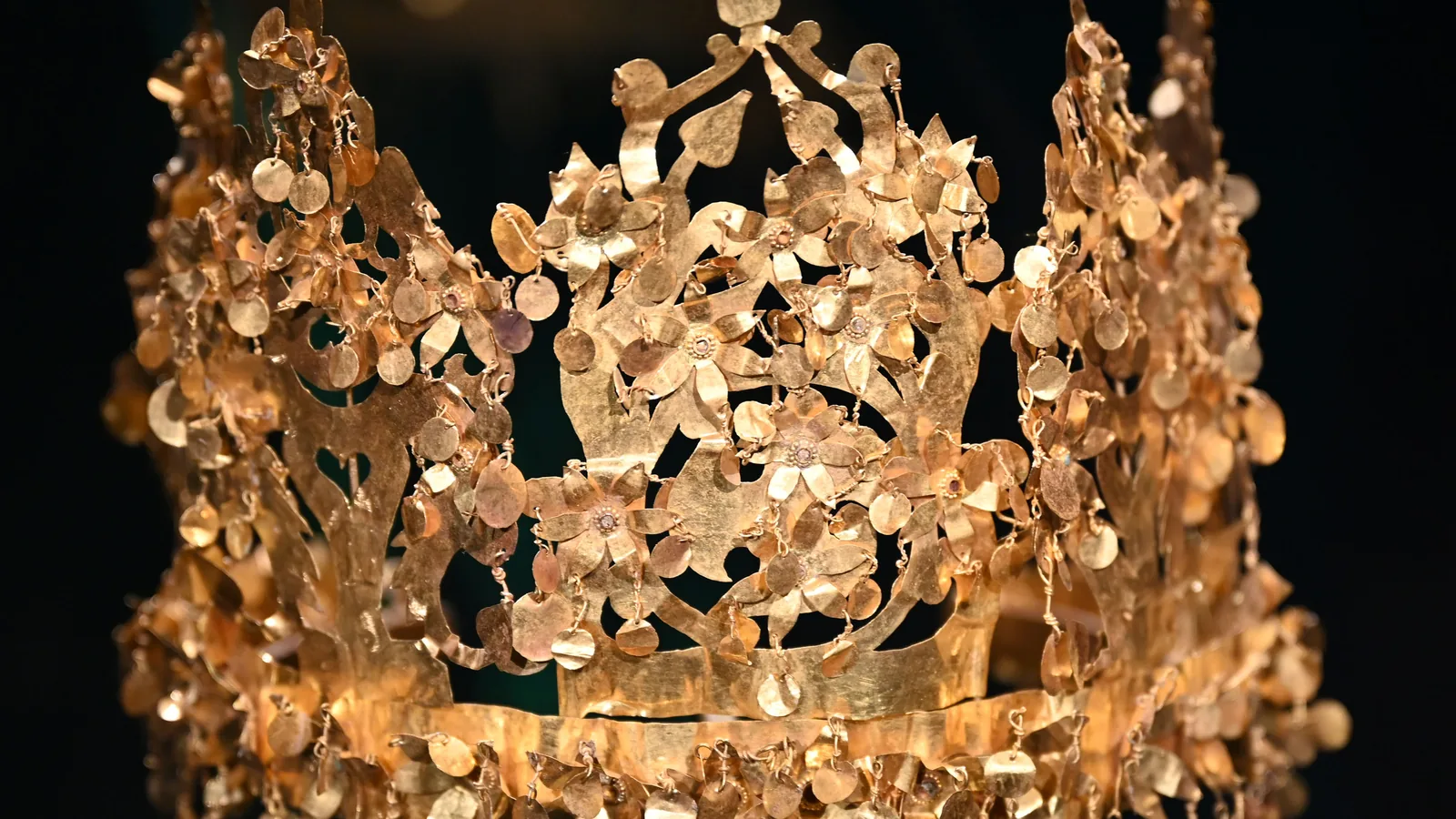

TL;DR — From November 15, 1978, Sarianidi’s team found six unlooted graves at Tillya Tepe, one with a Tiberius aureus and about 20,000 gold objects overall.
“Ces tombes furent repérées à partir du 15 novembre 1978 alors que l’équipe de V.I. Sarianidi voulait reprendre la fouille de « la colline de l’or » (Tilia-Tépé), site de l’âge du bronze découvert par elle en 1969,” wrote Karl Jettmar in a 1988 review for Arts asiatiques. These tombs began to be located from November 15, 1978, while Viktor Sarianidi’s team meant to resume digging at “the hill of gold,” a Bronze Age site the same team had found in 1969. Pierre Leriche, in the Encyclopaedia Iranica entry on pre-Islamic Bactria, places the find “in the Šebergān district, a site in one of several oases along the Sar-e Pol river west of Bactra.” Iranica spells the site Ṭelā Tepe; the usual English form is Tillya Tepe, near the town of Sheberghan.
Quick facts
- When
- November 15, 1978 (tombs first located); first century BC to first century AD (Iranica dating); second quarter of the first century AD (Francfort's dating of the burial)
- Where
- Tillya Tepe, in the Sheberghan district of northern Afghanistan, an oasis site on the Sar-e Pol river west of Bactra
- Who
- Viktor Sarianidi, leading the Soviet-Afghan archaeological expedition; Luc Buchet, who examined the bones in Kabul in 1979; Henri-Paul Francfort, who published the fullest study in 2011
- Outcome
- Six graves, five women and one man, were found unlooted and excavated as a single simultaneous burial; the man's grave held royal regalia that Francfort could not assign to one dynasty with certainty
Five women, one man, and one burial event
Henri-Paul Francfort’s study in Topoi divides the find into two groups, “les cinq tombes féminines” and “la tombe masculine,” five female graves and one male grave. He describes the whole complex as a single event: “TTP est une sépulture multiple simultanée qui a été installée en une fois à une date probablement proche du deuxième quart du Ier s. p. C.” Tillya Tepe is a simultaneous multiple burial, laid down at once at a date probably close to the second quarter of the first century AD, he wrote. Iranica gives a wider bracket for the objects themselves: “All the items can be dated from the first century B.C. and first century A.D.” Jettmar’s 1988 review adds a claim about the tombs’ condition: “Les six tombes princières découvertes en cet endroit n’avaient pas été pillées.” The six princely tombs found at this spot had not been looted, he wrote.
A coin struck at Lyon dates the grave
Three coins anchor the burial in time. Francfort wrote of tomb 3: “L’aureus de Tibère frappé à Lyon en 21 p. C., trouvé dans la tombe n° 3, donne un terminus post quem.” The Tiberius aureus struck at Lyon in AD 21, found in tomb 3, gives a terminus post quem, he wrote, meaning the grave cannot be older than that coin. Tomb 6 held a Parthian coin of Phraates IV with a countermark, and tomb 2 held an obol of Heraios, a nomad ruler who called himself “tyrannos,” identified by E. Zeimal in 1983.
Twenty thousand gold objects reach Kabul
Jettmar’s review, reporting on Sarianidi’s 1983 book on the find, gives the scale of the gold: “V.I. Sarianidi réussit finalement à apporter à Kaboul et à déposer au musée les 20 000 objets, la plupart en or (en grande majorité des appliques cousues sur les vêtements d’apparat), découverts au cours de la fouille.” Sarianidi succeeded in bringing to Kabul and depositing in the museum the 20,000 objects, most of them gold, mostly appliques sewn onto ceremonial garments, that the excavation had produced, Jettmar wrote. Iranica describes the range of styles in one sentence: “The workmanship attests the continuing impact of Greek culture (e.g., buckles with figures of Ares or Dionysos in his chariot), the strength of Bactrian traditions akin to the art of the steppes (e.g., scabbards with encrusted dragon ornamentations, ear pendants in animal style), and the presence of East Asian influences (e.g., Chinese mirrors, Mongoloid features of human figures).” Iranica also records the comparison the find prompted: “The extraordinary profusion of the finds of jewelry and gold artifacts, often encrusted with precious stones, in these tombs has prompted comparison with the treasure of Peter the Great in the Hermitage Museum at Leningrad.”
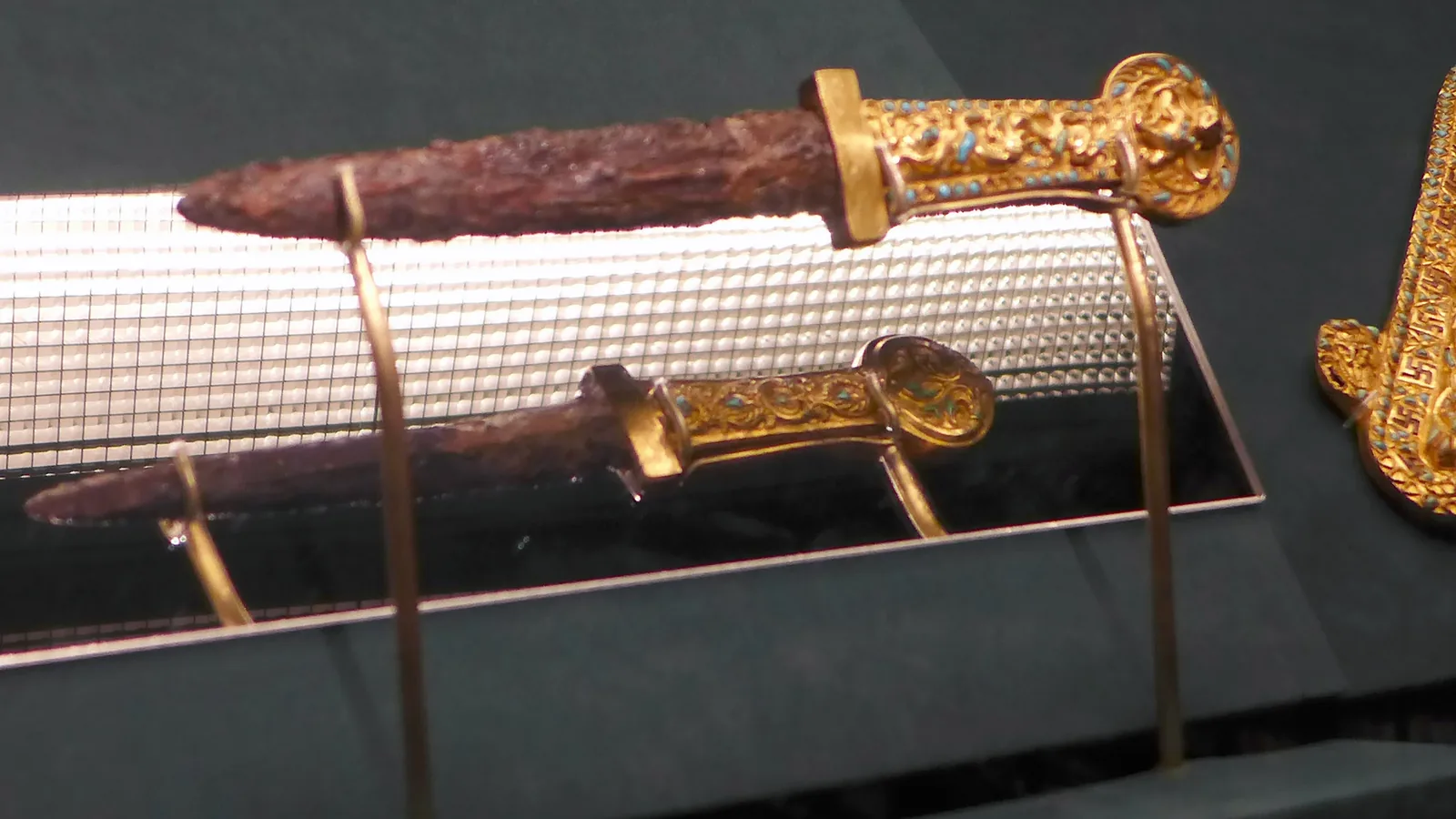

The man in tomb 4
Tomb 4 held the single male burial, and Francfort catalogued its regalia: a torque in the Gondophares style, a cameo in the style of the petty kings of western Bactria and a folding “chaise curule.” Luc Buchet, at Sarianidi’s request, gave the bones a quick look in Kabul in 1979, and Francfort called that the only record available: “ce sont les seules informations anthropologiques disponibles.” Francfort placed the man’s age “vers l’âge de 20-30 ans (?),” around 20 to 30 years old, keeping the question mark that marks his own uncertainty about the estimate.
Three published positions differ on who lay in that grave. Leriche, in Iranica, called the tombs “probably attributable” to Sacaraucae chiefs. G. A. Pugačenkova and L. I. Rempel’, in a 1986 paper Jettmar summarized, faulted Sarianidi for underplaying the site’s Parthian and Saka connections. Francfort himself declined to choose between ethnic labels, writing only of a “roi anonyme,” an anonymous king, and of “cet homme puissant qui voulait apparaître comme un roi,” this powerful man who wanted to appear as a king. For how such a man came to hold objects in three regional royal styles at once, Francfort set out three routes: spoils of war, gifts from an established dynasty or imitation of one, and closed the question with four words: “Nous avons le choix.”
A bank vault in the presidential palace
Carla Grissmann’s Iranica entry on the Kabul Museum records what happened to the gold after the dig: “In 1979 the Soviet-Afghanistan Archaeological Expedition brought the fabulous Bactrian Gold treasure from Tillya Tepe to the Kabul Museum; but, owing to the Soviet takeover, it was never exhibited.” In the autumn of 1989, Grissmann wrote, the hoard was moved again, to “the Central Bank Treasury in the Presidential Palace.” Her entry adds, with no date or name attached: “The Tillya Tepe Bactrian Gold treasure was found intact in the bank vault at the Presidential Palace.” Sarianidi died on December 23, 2013, and G. L. Bonora’s 2018 review in Topoi listed the sites of his career: “Altyn-depe and Tillya-Tepe in Afghanistan, and Ulug-depe in southern Turkmenistan.”
Key facts
- Jettmar’s 1988 review dates the discovery to November 15, 1978, when Sarianidi’s team meant to resume digging the Bronze Age site found in 1969.
- Iranica places Tillya Tepe in the Sheberghan district, on the Sar-e Pol river west of Bactra, and itself spells the name Ṭelā Tepe.
- Francfort (2011) divides the find into five female tombs and one male tomb, laid down as a single burial near the second quarter of the first century AD.
- The tomb 3 aureus of Tiberius, struck at Lyon in AD 21, gives Francfort’s terminus post quem for the burial.
- Tomb 6 held a countermarked Parthian coin of Phraates IV; tomb 2 held an obol of the nomad ruler Heraios, identified by E. Zeimal in 1983.
- Jettmar’s review reports about 20,000 gold objects, mostly appliques for ceremonial dress, brought to the Kabul Museum.
- Francfort catalogued a Gondophares-style torque, a western Bactrian cameo and a folding chair among the tomb 4 regalia, and called the occupant an anonymous king.
- Grissmann’s Iranica entry states the hoard reached the Kabul Museum in 1979, was never exhibited, moved to the Central Bank Treasury in the Presidential Palace in autumn 1989, and was later found intact there, with no date given for that finding.
FAQ
When was Tillya Tepe discovered?
Karl Jettmar's 1988 review states that the tombs began to be located from November 15, 1978, when Viktor Sarianidi's team returned to a Bronze Age site it had first found in 1969.
How many tombs were found at Tillya Tepe?
Six: Henri-Paul Francfort's 2011 study analyzes five female tombs and one male tomb as a single simultaneous burial, and his 2020 paper again uses the phrase "six tombes." Jettmar's 1988 review states that all six princely tombs were unlooted.
What coin dates the Tillya Tepe burial?
An aureus of the Roman emperor Tiberius, struck at Lyon in AD 21 and found in tomb 3. Francfort (2011) uses it as the terminus post quem, the earliest possible date, for the burial.
Sources
- Pierre Leriche, "BACTRIA i. Pre-Islamic Period," Encyclopaedia Iranica.
- Carla Grissmann, "KABUL MUSEUM," Encyclopaedia Iranica, published September 15, 2009.
- Henri-Paul Francfort, "Tillya Tépa (Afghanistan). La sepulture d'un roi anonyme de la Bactriane du Ier siecle p.C.," Topoi. Orient-Occident 17/1 (2011), pp. 277-347.
- Henri-Paul Francfort, "Sur quelques vestiges et indices nouveaux de l'hellenisme dans les arts entre la Bactriane et le Gandhara," Journal des savants 2020, n. 1, pp. 3-114.
- Karl Jettmar, review of Viktor I. Sarianidi, Afghanistan: les tresors des rois anonymes, Arts asiatiques 43 (1988), pp. 170-172.
- G. L. Bonora, review, Topoi 22/2 (2018), pp. 693-704.
Cite this article
- APA
- Our Earth's History. (2026, September 23). A Tiberius aureus in tomb 3: the six graves of Tillya Tepe, 1978. Our Earth's History. https://ourearthshistory.com/central-asia/classical/tillya-tepe-november-15-1978-six-tombs-tiberius-aureus-bactrian-gold-vault/
- Chicago
- Our Earth's History. “A Tiberius aureus in tomb 3: the six graves of Tillya Tepe, 1978.” Our Earth's History, September 23, 2026. https://ourearthshistory.com/central-asia/classical/tillya-tepe-november-15-1978-six-tombs-tiberius-aureus-bactrian-gold-vault/.
- MLA
- “A Tiberius aureus in tomb 3: the six graves of Tillya Tepe, 1978.” Our Earth's History, 23 Sep. 2026, https://ourearthshistory.com/central-asia/classical/tillya-tepe-november-15-1978-six-tombs-tiberius-aureus-bactrian-gold-vault/.
Text licensed CC BY-NC-ND 4.0. Found an error? Tell us.