Mithradatkert: the Parthian fortress at Old Nisa and its ivory rhyta
.jpg)
TL;DR — Ostraca gave a Parthian fortress near Ashgabat its name, Mithradatkert. Its Square House held about fifty ivory rhyta that scholars still argue were made for the court or looted from a Greek city.
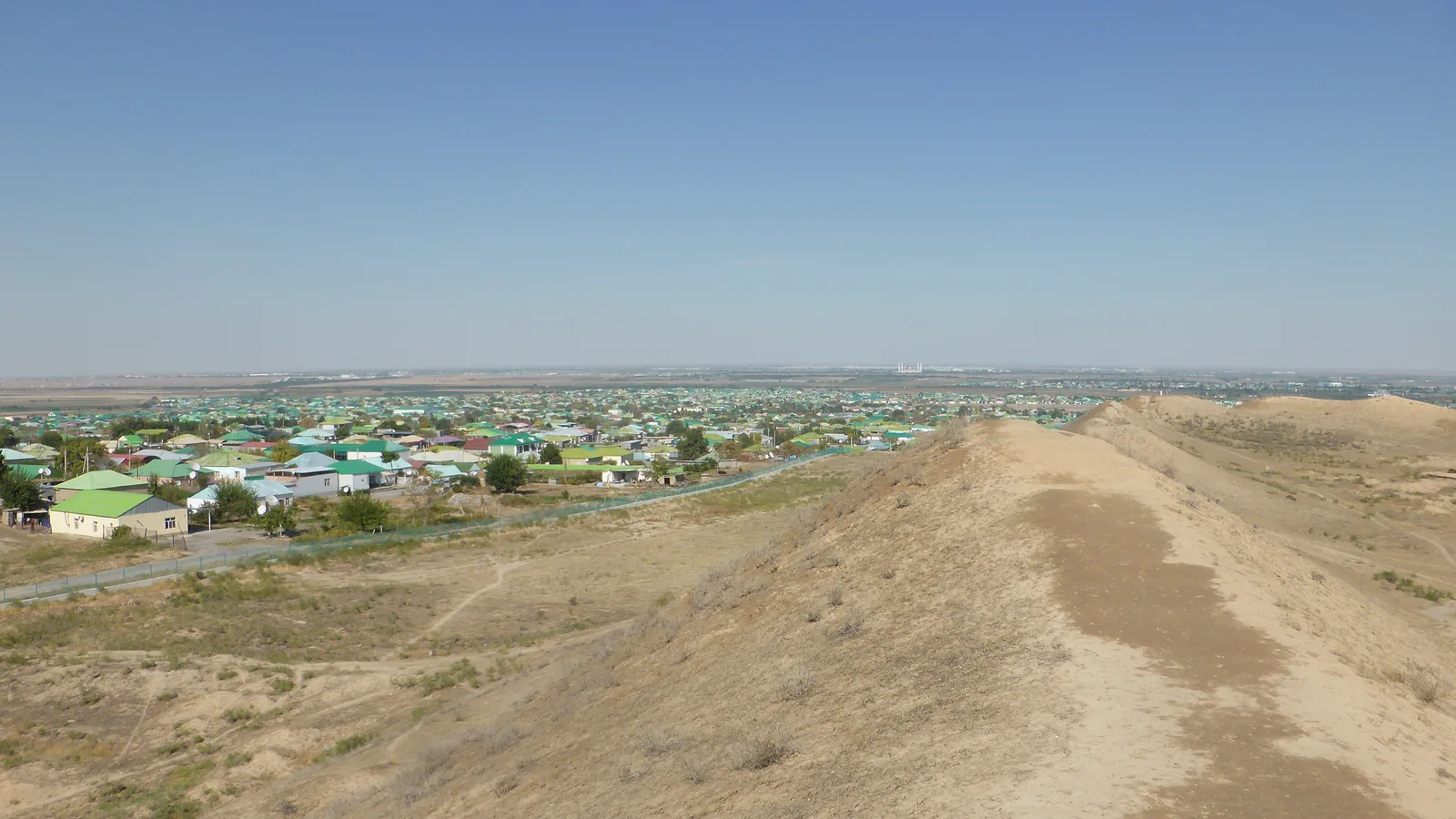
Encyclopaedia Iranica calls Old Nisa, a fortress 18 kilometers west of Ashgabat in Turkmenistan, “a ceremonial center for the rulers of the Arsacid dynasty.” Ostraca found beside its largest building gave the fortress its ancient name, Mithradatkert, “the fortress of Mithradates.” Soviet excavators found about fifty carved ivory rhyta on a clay bench there, in 1948 and 1949 by the Académie des Inscriptions’ account, along with marble statues including Aphrodite and Dionysus. A Round Hall nearby, 17 meters across, has been proposed as a shrine to the Arsacid king Mithradates I. Scholars disagree on whether the rhyta were made for the Parthian court or taken from a Greek city, and the royal tombs an ancient geographer placed at Nisa have never been located.
Quick facts
- When
- YuTAKE excavated the site "after the war" (Encyclopaedia Iranica) and, by the Turin Center's own account, from 1949; the ivory rhyta were found in 1948-49 (Académie des Inscriptions et Belles-Lettres); the Italian mission re-excavated the Round Hall in 1990-1996 and 1999; southwest-sector ostraca date the buildings there to the late second to early first century BC; the 2026 season ran April 25 to May 28
- Where
- Old Nisa, beside the village of Bagir, 18 kilometers west of Ashgabat, Turkmenistan, at the foot of the Kopet Dagh
- Who
- M. E. Masson, who led the postwar YuTAKE excavation; Antonio Invernizzi and Carlo Lippolis of the Turin Center for Archaeological Research; G. A. Koshelenko; V. N. Pilipko; Paul Bernard
- Outcome
- Ostraca identified the fortress as Mithradatkert; about fifty ivory rhyta from the Square House are still argued over as court-made or looted; the Round Hall's reading as a royal shrine depends on a disputed portrait identification; the royal tombs Isidore of Charax mentioned at Nisa have not been found
Mithradatkert
Old Nisa sits at the foot of the Kopet Dagh, the mountain chain dividing the Iranian plateau from the Turkmen plain, immediately east of the village of Bagir; a second complex, New Nisa, lies just west of the same village, according to Encyclopaedia Iranica. Fieldwork began before the Second World War, when A. Marushchenko dug test trenches across the site, but Iranica records that “the results of this research, however, were never published.” The Turin Center traces fragments of painted clay statues in the Round Hall to those prewar soundings, made by Marushchenko and Ershov between 1934 and 1936 and left on the trench floor. Iranica states that full excavation began only “after the war,” under M. E. Masson and the South-Turkmenistan Archaeological Complex Expedition, YuTAKE; the Turin Center gives 1949 as the year that digging started. Excavation later passed to V. M. Masson, then to G. A. Koshelenko and an Ashgabat Institute of History expedition running since 1979. Two teams now share the site: the Turin Center, directed by Antonio Invernizzi and Carlo Lippolis, and a Turkmen state department led by V. N. Pilipko.
1948-49: the ivory rhyta of the Square House
The building the excavators called the Square House centered on a courtyard ringed by a wooden colonnade. Iranica describes its original purpose as “apparently official,” a place of assembly and banqueting, before it became, perhaps in the first century AD, a treasury for furnishings, weapons, ceramics and coins. Among objects that had “eluded attempts of looting in ancient times,” Iranica singles out “the group of carved ivory rhytons which lay in one of the rooms, on the bench where they had been stored.” The Comptes rendus of the Académie des Inscriptions et Belles-Lettres records that Soviet archaeologists uncovered about fifty of these drinking horns there in 1948 and 1949, standing 30 to 60 centimeters tall and holding one to one and a half liters; the Turin Center likewise places roughly fifty ivory rhyta in fragments above the room’s clay benches. Their carved terminal figures mix Greek and Iranian imagery, including a winged, horned lion-griffin and an androcephalous humpbacked bull. One horn bears an inscription invoking Hestia, the Greek goddess of the hearth, which Koshelenko cited in 1967 to support a ritual reading, and Iranica dates the corpus to the second and first centuries BC.
"Made for a Greek clientele": the rhyta debate
Iranica reads the rhyta as “certainly intended for ritual use in the ceremonies, banquets, and libations that took place in Old Nisa,” fitting them into the life of the Arsacid court. Paul Bernard argued otherwise in a 1986 presentation to the Académie des Inscriptions et Belles-Lettres. Where earlier readings saw the Muses with Hephaestus on rhyton 47’s frieze, Bernard reread the scene as “dix femmes de lettres, dix poétesses entourant Hésiode,” ten women of letters surrounding Hesiod. “Un sujet si purement grec ne pouvait parler qu’à un Grec cultivé,” he wrote: a subject so purely Greek could speak only to an educated Greek. Bernard concluded that the rhyta were not made for the Parthian court but for a Greek clientele, representing “un butin raflé dans quelque ville grecque,” loot seized from some Greek city during a war of conquest.
The Round Hall
A short distance from the Square House stands a separate structure, the Round Hall: a circular inner room 17 meters across set inside walls that form a square, its masonry preserved, the Turin Center records, to a height of more than four meters. Iranica states that YuTAKE virtually completed its excavation, leaving only the sculptural fragments on the floor for the Italian mission to recover in 1990-1996 and 1999. An early reconstruction by G. A. Pugachenkova gave the hall a cylindrical drum topped by a dome, but Iranica reports that this “does not stand up to a detailed study of the residual brick structures,” pointing instead, in more recent study credited to Masturzo, to a vault with a continuous elliptical outline rising from the floor. Koshelenko proposed reading the complex as a mausoleum for a major Arsacid figure, a hypothesis the Turin Center says is supported by Invernizzi’s identification of a fragmentary portrait there as Mithradates I; Iranica frames the same idea conditionally, writing that the hall’s statues “suggest a mausoleum for the regal cult… if the identification of the head as a portrait of this king is correct.” Iranica adds that nothing found at Nisa can be shown to belong to the royal Arsacid tombs the geographer Isidore of Charax mentioned there; those tombs, it states, “still remain to be discovered.”
Forty ostraca and a 2026 season
In the southwest quarter, under excavation by the Italian mission since 2007, workers recovered more than forty ostraca recording deliveries of wine, flour and oil, plus about a hundred lumps of clay bearing seal impressions, the Turin Center reports. Dated ostraca place the two buildings there in use from roughly the end of the second century BC to the start of the first. Since 2019 the mission has also worked a northern sector, where a public building rests on large stone footings; in 2024 the team set aside digging there for a three-dimensional laser scan made with the Politecnico di Torino. The Turin Center states that its 2026 mission ran April 25 to May 28, directed by Carlo Lippolis, continuing work in that sector. The Capitoline Museums in Rome opened “Antiche Civiltà del Turkmenistan,” drawing on Nisa finds dated to the second century BC through the first century AD, on October 25, 2025, curated by Claudio Parisi Presicce, Barbara Cerasetti, Carlo Lippolis and Mukhametdurdy Mamedov with Turkmenistan’s Ministry of Culture, ISMEO and the University of Turin; it ran through April 12, 2026.
Key facts
- Encyclopaedia Iranica describes Old Nisa, 18 kilometers west of Ashgabat, as “a ceremonial center for the rulers of the Arsacid dynasty.”
- Ostraca found beside the Square House gave the fortress its ancient name, Mithradatkert, “the fortress of Mithradates.”
- Prewar test trenches by A. Marushchenko went unpublished; the Académie des Inscriptions record dates the rhyta find to 1948-49, and the Turin Center dates the start of YuTAKE digging to 1949.
- About fifty ivory rhyta, 30 to 60 centimeters tall, were found stacked on a clay bench in the Square House in 1948-49.
- One rhyton bears an inscription invoking Hestia, cited by Koshelenko in 1967 to support a ritual use for the vessels.
- Paul Bernard argued in 1986 that rhyton 47 shows ten women of letters around Hesiod and that the set was loot from a Greek city, against Iranica’s reading of the rhyta as court ritual vessels.
- The Round Hall, 17 meters across, has been read as a possible mausoleum for Mithradates I, a reading both Iranica and the Turin Center present as conditional on a disputed portrait identification.
- The Turin Center’s 2026 season at Old Nisa ran from April 25 to May 28, and the Capitoline Museums’ exhibition on Turkmenistan’s ancient civilizations runs from October 25, 2025, to April 12, 2026.
FAQ
What does the name Mithradatkert mean?
Ostraca recovered in rooms beside the Square House at Old Nisa gave archaeologists the fortress's ancient name, Mithradatkert, which Encyclopaedia Iranica translates as "the fortress of Mithradates," probably the first Parthian king of that name.
Were the Nisa ivory rhyta made for the Parthian court?
Encyclopaedia Iranica reads them as ritual vessels used in ceremonies, banquets and libations at Old Nisa. Paul Bernard argued in 1986 that their Greek iconography points instead to a Greek clientele and that the corpus was loot taken from a Greek city.
Have the royal tombs of Nisa been found?
No. Encyclopaedia Iranica states that nothing excavated at Old Nisa can be shown to belong to the royal Arsacid tombs that the geographer Isidore of Charax described at the site, and that they remain undiscovered.
Sources
- Antonio Invernizzi, "NISA," Encyclopaedia Iranica (Encyclopaedia Iranica Foundation, published January 1, 2000, updated November 18, 2016). Used for the site's location and function, the excavation sequence, the Square House, the rhyta's ritual reading, the Hestia inscription, the Round Hall and the missing tombs of Isidore of Charax.
- "Livres offerts," Comptes rendus des seances de l'Académie des Inscriptions et Belles-Lettres 130-4 (1986), pp. 755-761, via Persee. Used for the 1948-49 discovery date and dimensions of the rhyta and for Paul Bernard's 1986 reading of rhyton 47 and his case that the rhyta were loot from a Greek city.
- Centro Ricerche Archeologiche e Scavi di Torino (CRAST), University of Turin, "Nisa" project page. Used for the 1949 start date of YuTAKE excavation, the rhyta count and findspot, the Round Hall dimensions, the southwest-sector ostraca and the identification of a portrait as Mithradates I.
- CRAST, "Missione Archeologica Turkmenistan 2026" (news, posted May 29, 2026). Used for the dates and direction of the 2026 excavation season.
- CRAST, "'Antiche Civiltà del Turkmenistan' ai Musei Capitolini" (news, posted October 23, 2025). Used for the dates, curators and partner institutions of the Capitoline Museums exhibition.
Cite this article
- APA
- LETTER. (2026, September 28). Mithradatkert: the Parthian fortress at Old Nisa and its ivory rhyta. Our Earth's History. https://ourearthshistory.com/central-asia/classical/old-nisa-mithradatkert-parthian-fortress-ivory-rhyta/
- Chicago
- LETTER. “Mithradatkert: the Parthian fortress at Old Nisa and its ivory rhyta.” Our Earth's History, September 28, 2026. https://ourearthshistory.com/central-asia/classical/old-nisa-mithradatkert-parthian-fortress-ivory-rhyta/.
- MLA
- LETTER. “Mithradatkert: the Parthian fortress at Old Nisa and its ivory rhyta.” Our Earth's History, 28 Sep. 2026, https://ourearthshistory.com/central-asia/classical/old-nisa-mithradatkert-parthian-fortress-ivory-rhyta/.
Text licensed CC BY-NC-ND 4.0. Found an error? Tell us.