A Corinthian capital on the Oxus: the Greek city of Ai Khanoum

TL;DR — A French mission dug a walled Greek city with a theater, gymnasium and Delphic maxims at the Oxus-Kokcha junction until 1978; nomads burned it about 145 BC.
Ai Khanoum, a Greek city at the junction of the Oxus and Kokcha rivers in northern Afghanistan, came to light in 1961 on a royal hunting trip by Laurianne Martinez-Sève’s account; Encyclopaedia Iranica dates the find of a Corinthian capital there to 1963. The French Archaeological Delegation in Afghanistan, under Paul Bernard, excavated it until 1978 and found a palace with a treasury, a gymnasium, a theater for about 5,000 people, three temples of non-Greek plan, and the tomb of a man named Kineas with a stele of maxims copied at Delphi. Founded under the Seleucid kings in the early third century BC, the city was burned around 145 BC, when the king Eucratides I was killed by his own son. Its objects, thought lost in the years of conflict that followed, came out of a vault in Kabul in 2004.
Quick facts
- When
- Founded in the early 3rd century BC under the Seleucids · independent Bactrian kingdom from about 250 BC · Eucratides I reigned about 170–145 BC · city attacked about 145 BC · found 1961 or 1963 · excavated 1965–1978 · objects recovered in Kabul 2004 · Washington exhibition 2008
- Where
- The junction of the Oxus (Amu Darya, here the Darya-i Pandj) and the Kokcha, on the northern border of Afghanistan with Tajikistan
- Who
- Paul Bernard and Daniel Schlumberger of the French Archaeological Delegation in Afghanistan; Kineas, the probable founder; Clearchus, who set up the maxims; Eucratides I, the Greco-Bactrian king
- Outcome
- A walled city with a palace, gymnasium, mud-brick theater and three non-Greek temples was burned and stripped about 145 BC; its finds were shown in Paris, Washington and New York from 2006 to 2009
A capital in the king's hunting ground
The site sits where the Kokcha meets the Darya-i Pandj, the upper Amu Darya, on the border between Afghanistan and Tajikistan; the Uzbek name means “Lady Moon,” according to Bernard’s 1987 entry in Encyclopaedia Iranica. Martinez-Sève, writing in Electrum in 2015, put the discovery in 1961 “during a hunting expedition by the king of Afghanistan” and the start of excavation in 1964. Nancy Hatch Dupree, in the same encyclopedia, wrote that “a large Corinthian capital was brought to DAFA’s attention” in 1963 and that Daniel Schlumberger led the work until 1965, then Bernard.
Bernard’s 1967 report to the Académie des Inscriptions covered the second campaign, September to December 1966, and named 1965 as the first. The city, he wrote, “se présente avant tout comme une cité grecque mais avec des traits propres à l’Orient” (presents itself above all as a Greek city, but with traits proper to the East). That season his team cleared a courtyard of 136 by 108 meters ringed by Corinthian colonnades, the south one thrown down by an earthquake. Dupree recorded that archaeological research in Afghanistan “virtually ceased after the Soviet intervention in 1979.”
Which Alexandria, if any
Martinez-Sève dated the foundation to the early third century BC, with the city proper developing no earlier than the reign of Antiochus I (281 to 261 BC). Bernard proposed in 1978 that the site was the Alexandria Oxiana listed by Ptolemy; Martinez-Sève, following Claude Rapin’s reconstruction of the route Alexander took in 329 to 327 BC, answered that the river the Greeks called the Oxus was the Wakhsh, not the Darya-i Pandj on which Ai Khanoum stands, so “there is little chance that it was the Alexandria Oxiana of the literary tradition.” Jona Lendering of Livius.org named Kampyr Tepe in Uzbekistan as a likelier candidate.
Porticoes of the Greeks, temples of the East
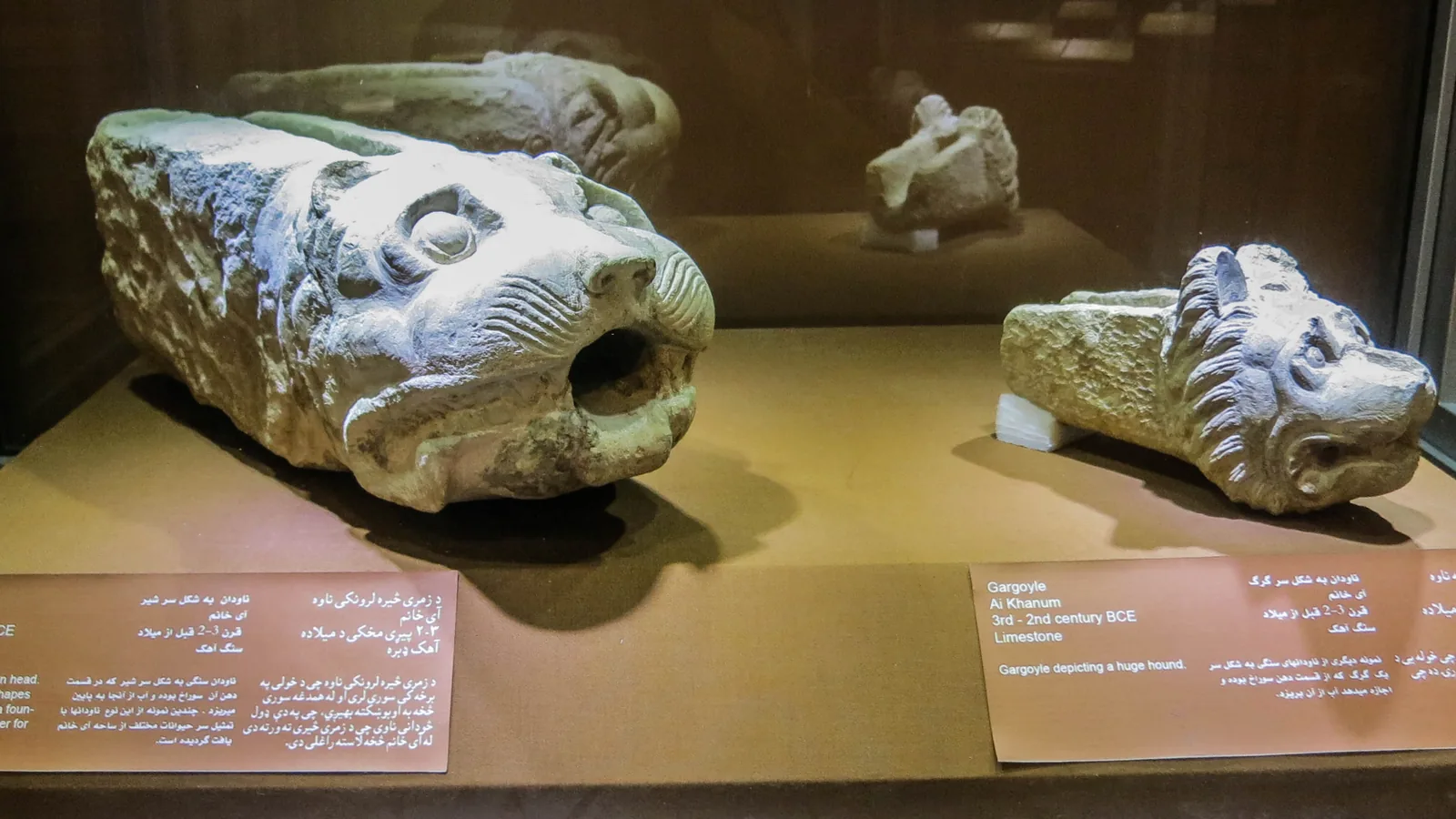
The walled area was roughly triangular, 1,800 by 1,600 meters in Bernard’s Iranica entry, or about 2 kilometers long and 600 meters wide in Lendering’s description. Inside lay a lower town with most of the buildings and an acropolis on a hill, undug as of 1987. The gymnasium, “of colossal proportions” in Bernard’s words, covered a square of about one hectare and had baths. The theater was built entirely of mud brick, as large as the one at Babylon; Martinez-Sève gave its diameter as 85 meters and its capacity as nearly 5,000. A fountain spout carved as a character from Greek comedy showed, Bernard wrote, that the plays were Greek.
The temples were not. Three were found, none with a Greek plan. One stood on a three-stepped platform, its walls cut with indented recesses, which Bernard compared with Parthian temples at Dura Europos. The palace, probably the governor’s, filled the middle of the lower town, over seven hectares according to Martinez-Sève. Its treasury held storage jars carrying Greek accounts, lapis lazuli from Badakhshan, and fragments of Greek literary papyri.
Kineas, Clearchus and the words from Delphi
The oldest and plainest of the funerary monuments inside the walls held a man named Kineas, who Bernard wrote “may have been the city’s founder.” Martinez-Sève added that the name is well attested in Thessaly and that his body lay in a sarcophagus inside. An inscription by one Clearchus names the precinct as the temenos of Kineas and records that he set up a stele of maxims copied at Delphi; some, for lack of room, were cut into the base. Lendering prints the base text: “These wise words of ancient men are set up, / utterances of famous men, in holy Delphi. / Clearchus copied them carefully and set them up, / shining from afar, in the sanctuary of Cineas.”
The maxims that survive on the fragment read, “As a child, be orderly, / As a youth, be self-controlled, / As an adult, be just, / As an old man, be of good counsel, / When dying, be without sorrow.” Since Louis Robert’s 1968 edition, this Clearchus has usually been taken for Clearchus of Soli, Aristotle’s pupil; Martinez-Sève wrote, “I for one am very doubtful,” on grounds of chronology.
Eucratides, the fire, and a vault in Kabul
Eucratides I reigned from 170 to 145 BC in Bernard’s Iranica entry, or from about 171 to 148 BC in Martinez-Sève’s chronology. Bernard credited him with the largest gold coin of antiquity, a 20-stater piece in the Cabinet des Médailles in Paris, and with the last building phase at the palace. On his return from India, Bernard wrote, he was assassinated by his own son; Martinez-Sève cites Justin for the killing.
The city fell about 145 BC (Martinez-Sève), 150 (Iranica) or 135 (Livius), to nomad groups the sources name differently: steppe invaders in Bernard’s entry, Sacae and later Yuezhi in Lendering’s, and nomads joined “probably also by Bactrian populations” in Martinez-Sève’s, who read the wrecking of the palace and of the large cult statue in the indented-recess temple as a strike at Greek emblems. A fire set in several places at once gutted the city, its buildings were demolished, and its stone and metal were carried off; the Greek administration withdrew south of the Hindu Kush.
The National Gallery of Art in Washington, which showed 228 objects lent by the National Museum of Afghanistan from May 25 to September 7, 2008, recorded that many “were assumed to have been lost during the years of conflict in Afghanistan but were recovered from a vault under the Presidential Palace, Kabul, in 2004.” The loan had opened at the Musée Guimet in Paris on December 6, 2006, and closed at the Metropolitan Museum of Art in New York on September 20, 2009; Bernard’s voice was on the Washington audio guide.
.jpg)
Key facts
- Ai Khanoum lies at the junction of the Kokcha and the Darya-i Pandj, the upper Amu Darya, on the Afghanistan–Tajikistan border (Martinez-Sève, 2015).
- The find is dated to 1961, on a royal hunt, by Martinez-Sève, and to 1963, when a Corinthian capital reached DAFA, by Dupree in Encyclopaedia Iranica.
- Bernard’s 1967 report names 1965 as the first season and September to December 1966 as the second; Martinez-Sève gives 1964 to 1978 for the excavation.
- The walled area measured about 1,800 by 1,600 meters (Bernard, Iranica) or 2 kilometers by 600 meters (Livius).
- The mud-brick theater was 85 meters across and held nearly 5,000 people (Martinez-Sève).
- The palace treasury held storage jars with Greek accounts, lapis lazuli and fragments of Greek literary papyri (Bernard, Iranica).
- Clearchus set up a stele of Delphic maxims in the precinct of Kineas; the base text and five maxims survive in translation on Livius.org.
- Eucratides I reigned 170 to 145 BC (Bernard) or about 171 to 148 BC (Martinez-Sève); the city was attacked about 145 BC.
FAQ
Who discovered Ai Khanoum?
By Martinez-Sève's account, the site came to notice in 1961 during a hunting expedition of the king of Afghanistan. Dupree wrote in Encyclopaedia Iranica that a large Corinthian capital from the site was brought to the French Archaeological Delegation in 1963. Schlumberger and then Bernard led the excavations.
Was Ai Khanoum founded by Alexander the Great?
No. Martinez-Sève dated the foundation to the early third century BC under the Seleucids, with the city proper developing under Antiochus I. Bernard proposed in 1978 that it was Ptolemy's Alexandria Oxiana; Martinez-Sève and Lendering both doubted the identification.
What happened to the finds from Ai Khanoum?
Many were assumed lost during the conflict in Afghanistan after 1979 but were recovered from a vault under the Presidential Palace in Kabul in 2004, according to the National Gallery of Art, which showed 228 objects from four Afghan sites in 2008 during a tour that ran from Paris in 2006 to New York in 2009.
Sources
- Encyclopaedia Iranica — Paul Bernard, "ĀY ḴĀNOM" (Vol. III, Fasc. 2, pp. 124–126; published December 15, 1987; updated January 9, 2017).
- Encyclopaedia Iranica — Nancy Hatch Dupree, "AFGHANISTAN viii. Archaeology" (Vol. I, Fasc. 5, pp. 525–544; published December 15, 1983).
- Encyclopaedia Iranica — Paul Bernard, "EUCRATIDES" (Vol. IX, Fasc. 1, pp. 63–64; published December 15, 1998).
- Persée — Paul Bernard, "Deuxième campagne de fouilles d'Aï Khanoum en Bactriane," Comptes rendus des séances de l'Académie des Inscriptions et Belles-Lettres 111/2 (1967), pp. 306–324.
- Livius.org — Jona Lendering, "Ai Khanum" (2006; last modified August 6, 2020).
- Laurianne Martinez-Sève, "Ai Khanoum and Greek Domination in Central Asia," Electrum 22 (2015), pp. 17–46, via Internet Archive.
- National Gallery of Art, Washington — "Afghanistan," past exhibition page (May 25 – September 7, 2008).
Cite this article
- APA
- Our Earth's History. (2026, September 22). A Corinthian capital on the Oxus: the Greek city of Ai Khanoum. Our Earth's History. https://ourearthshistory.com/central-asia/classical/ai-khanoum-greek-city-oxus-afghanistan/
- Chicago
- Our Earth's History. “A Corinthian capital on the Oxus: the Greek city of Ai Khanoum.” Our Earth's History, September 22, 2026. https://ourearthshistory.com/central-asia/classical/ai-khanoum-greek-city-oxus-afghanistan/.
- MLA
- “A Corinthian capital on the Oxus: the Greek city of Ai Khanoum.” Our Earth's History, 22 Sep. 2026, https://ourearthshistory.com/central-asia/classical/ai-khanoum-greek-city-oxus-afghanistan/.
Text licensed CC BY-NC-ND 4.0. Found an error? Tell us.