Arzhan 2 in Tuva: a man, a woman, 14 horses and 40 pounds of gold
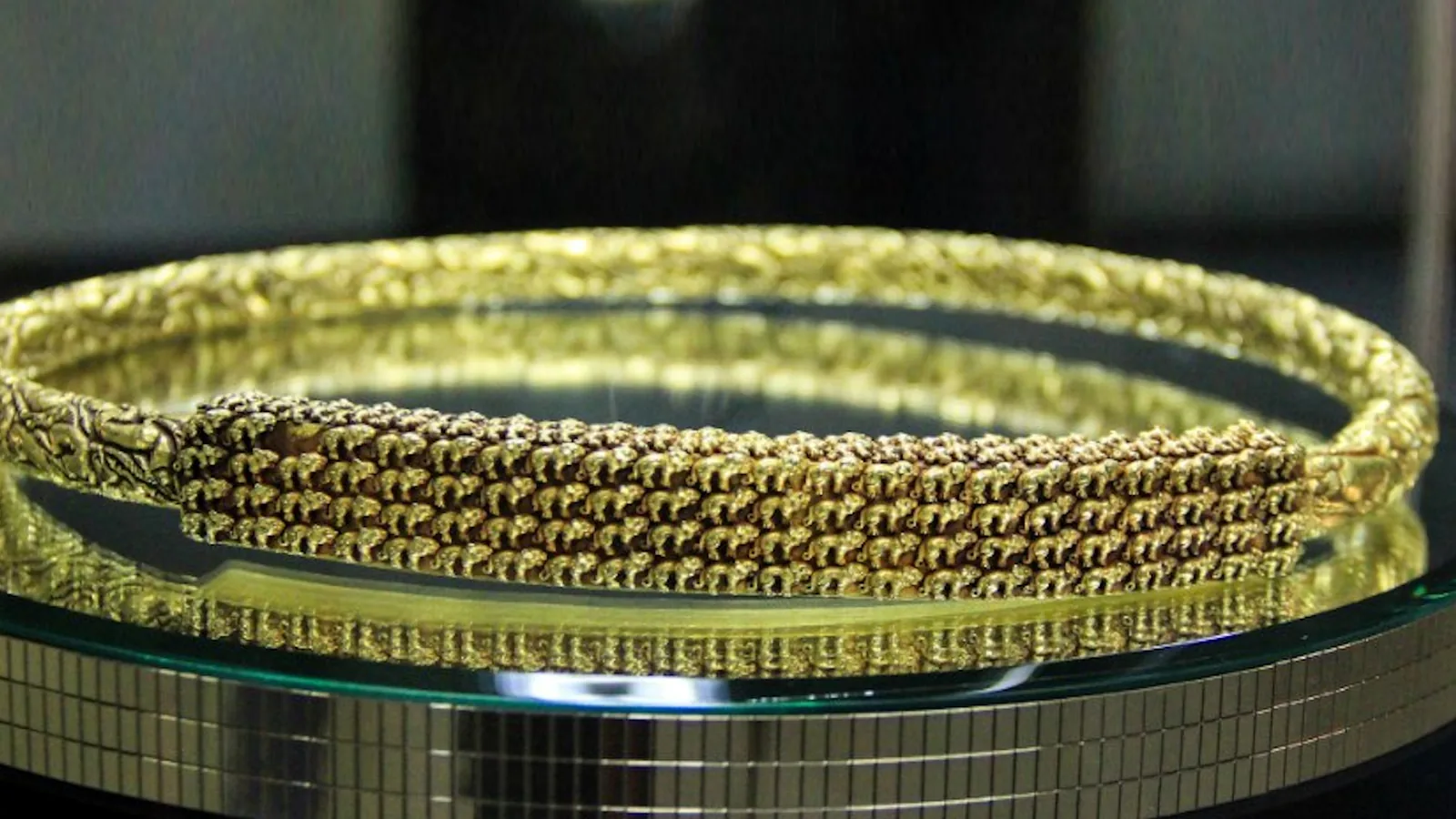

TL;DR — A man and a woman lay under the Arzhan 2 mound in Tuva, 7th century BC, with 33 other people, 14 horses and more than 40 pounds of gold.
A man and a woman lay under the Arzhan 2 burial mound in Tuva, southern Siberia, with the remains of 33 other people, 14 horses and more than 40 pounds of gold. Archaeology magazine reported those contents in January 2021, when a Russian team published reconstructions of the couple’s faces. The mound belongs to the Aldy-Bel stage of Tuva’s Iron Age, the seventh to sixth century BC. In the same Uyuk valley stands Arzhan 1, which a 2017 genome study in Nature Communications called “the earliest Scythian kurgan,” and a still older mound named Tunnug 1. Between them the valley holds the oldest royal graves of the Scythian world.
Quick facts
- When
- Arzhan stage 9th/8th century BC · Aldy-Bel stage 7th–6th century BC (Arzhan 2) · Tunnug 1 first surveyed 2017, first excavated 2018 · faces reconstructed 2021
- Where
- Uyuk valley, Tuva Republic, southern Siberia, in what is now Russia; the mounds Arzhan 1, Arzhan 2 and Tunnug 1
- Who
- Mikhail Gryaznov (Arzhan 1 report, 1980); Konstantin Chugunov, Hermann Parzinger and Anatoli Nagler (Arzhan 2 report, 2010); Gino Caspari and Timur Sadykov (Tunnug 1); Askold Ivantchik (Encyclopaedia Iranica)
- Outcome
- An unrobbed chamber with a man, a woman, 33 other people, 14 horses and more than 40 pounds of gold; the earliest Scythian kurgans lie in Tuva, and a still older mound, Tunnug 1, is under excavation
Three stages in the Uyuk valley
Large Early Iron Age mounds crowd the river terraces of the Uyuk valley, on the upper Yenisei north of Mongolia; Gino Caspari, Timur Sadykov and their co-authors wrote in 2019 that the valley “has been dubbed the Siberian ‘Valley of the Kings’.” Their paper divided the Scythian material culture of Tuva into three periods: an early Arzhan stage in the ninth or eighth century BC, an Aldy-Bel stage in the seventh to sixth century BC, and a Uyuk-Sagalyn period in the fifth to third century BC.
For decades the first of those stages rested on a single monument. Arzhan 1, excavated by Mikhail Gryaznov and published in his 1980 report Kurgan Arzhan, “effectively defined an entire period by itself,” in the words of the 2019 paper, as the only monument of the formative period at the end of the ninth or start of the eighth century BC.
Gold on the clothes of two people
Arzhan 2 belongs to the second stage, and its chamber was never robbed. The excavation report by Konstantin Chugunov, Hermann Parzinger and Anatoli Nagler appeared in Mainz in 2010. Archaeology magazine, drawing on The Siberian Times, gives the inventory: a man and a woman whose 2,600-year-old remains were found in 1997, in a wooden chamber that “also contained the remains of 33 other people, including five children, and the remains of 14 horses that had been adorned with gold, bronze, and iron trappings.” The couple wore clothing “encrusted with more than 40 pounds of gold decorations.” Researchers from the Miklukho-Maklai Institute in Moscow and the Institute of Archaeology and Ethnography in Novosibirsk thought them a Scythian king and queen.
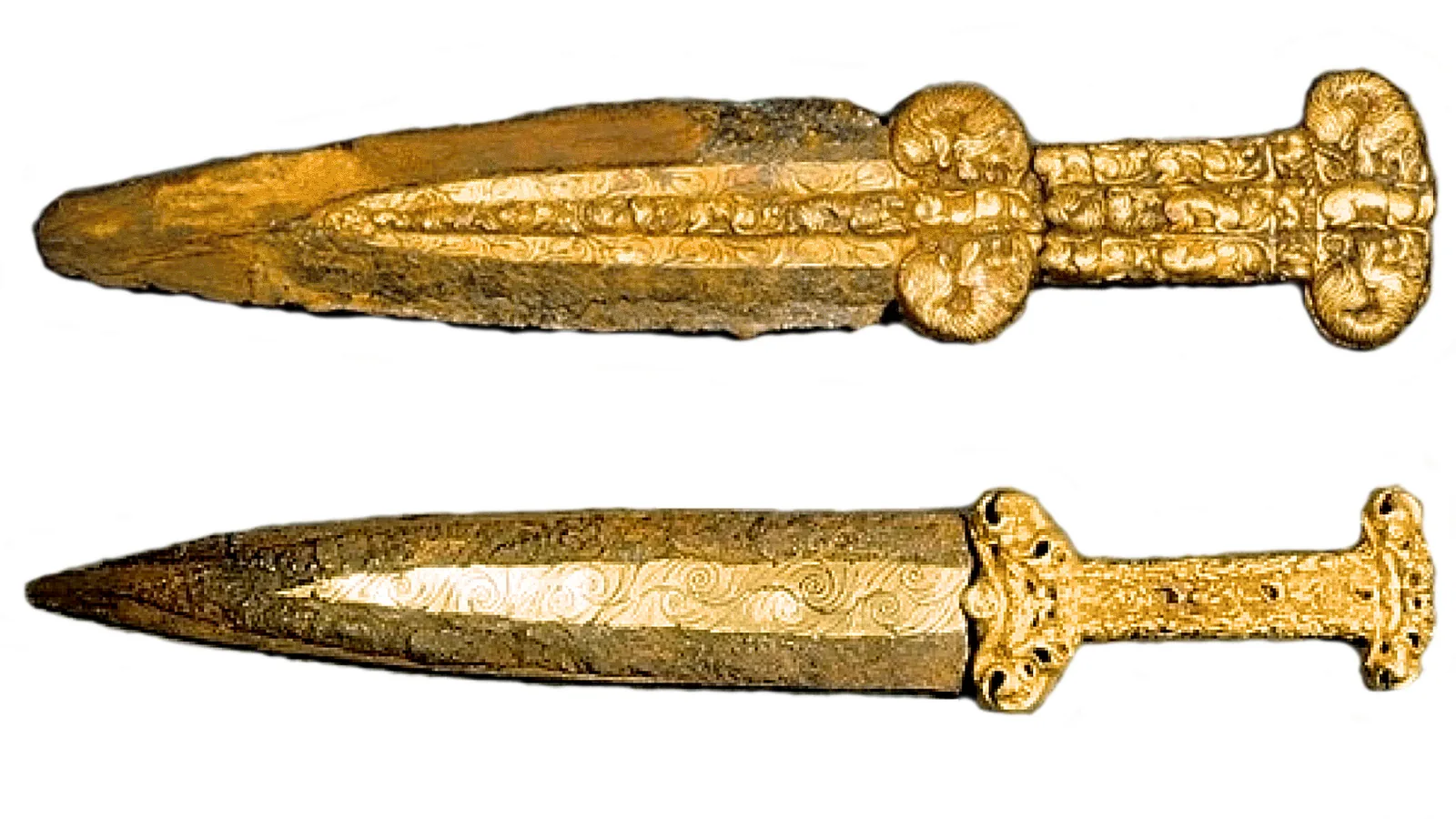
The 2017 genome study sampled two people from the mound and assigned them to the Aldy Bel culture, seventh to sixth century BC. Yan Liu and colleagues, studying gold from a fourth- to third-century BC tomb at Xigoupan in Inner Mongolia for Heritage Science in 2021, set beside it “gold plaques in the form of panthers from Arzhan II, South Siberia.” Such appliqués, they wrote, were widespread in the steppes, from “the princely kurgans in Arzhan II (seventh century BCE)” to Taksai I and Issyk in Kazakhstan, “where prestige gold was used as a symbol of status and power amongst the highly mobile populations.”
.jpg)
Where the animal style began, by three accounts
Those panthers belong to the Scythian animal style, and where that style first took shape is disputed. Askold Ivantchik set out the positions in the Encyclopaedia Iranica. Mikhail Artamonov, and Mariya Pogrebova with Dmitrii Raevskii, held that the style formed in Eastern Europe under Near Eastern influence during the Scythian campaigns of the seventh century BC. Ivantchik called “the more well-founded hypothesis” the view of Karl Jettmar, Georg Kossack and Andrei Alekseev that it took shape in the eastern part of the Eurasian steppes, partly under the influence of Chinese art, “borne out by the greater age of the eastern sites containing objects worked in the Animal Style (Arzhan burial mound).” A third position, the “polycentric” theory of Elena Perevodchikova in 1994, had the style evolve independently in the west under the Near East and in the east under the Karasuk culture and the Ordos bronzes.
The dates favor the east. In Eastern Europe, Ivantchik wrote, the emergence of Early Scythian culture “to the second half of the 8th century appears to have been most convincingly substantiated,” later than the Arzhan stage in Tuva. Martina Unterländer and colleagues put the same argument in the 2017 genome paper: the Black Sea steppe was originally taken for the Scythian homeland until Terenozhkin proposed a Central Asian origin, and the evidence for an eastern origin includes Arzhan 1, eastern kurgans dated older than western ones, and animal-style elements “dated to the tenth century BCE” in the Yenisei region and what is now China.
Tunnug 1, the mound they call Arzhan 0
Arzhan 1 lost its place as the oldest known mound in 2017. That year, the 2019 paper records, “a first survey at the royal burial mound Tunnug 1 established that this tomb was the earliest known so far.” The team worked from satellite images, a drone-built 3D model and first samples of preserved wood. Caspari and three co-authors published it in 2018 as “Tunnug 1 (Arzhan 0).” A first excavation campaign followed in 2018, and a geomagnetic survey of about 27,000 square meters found what the ground hid: “a central rectangular burial chamber seems to connect to radial features which split the monument into uneven sectors,” and around the mound ran “a well-constructed circular ring consisting of dozens of smaller round stone platforms.” The mound was probably divided by larch logs, as Arzhan 1 was, but its central feature measured 18 by 19 meters, against roughly 10 by 10 for the outer wooden chamber of Arzhan 1. People of the Kokel culture, third to fourth century AD, were later buried on its edge, as a 2024 parasite study of their graves records.
In the same years the Arzhan 2 couple got faces. The Moscow and Novosibirsk team used laser scanning and photogrammetry to build 3D models of the skulls, rebuilt the parts that had not survived and sculpted the faces in clay, Archaeology magazine reported in January 2021. The frozen tombs of Pazyryk in the Altai kept felt and skin; Arzhan 2 kept gold and bone. Its man and woman, with their 14 horses, lay in the valley where the Scythian sequence begins, and the mound that came before them is now being dug.
Key facts
- The unrobbed chamber of Arzhan 2 held a man and a woman with the remains of 33 other people, including five children, and 14 horses with gold, bronze and iron trappings (Archaeology magazine, January 2021, citing The Siberian Times).
- The couple’s clothing was encrusted with more than 40 pounds of gold decorations; researchers in Moscow and Novosibirsk took them for a Scythian king and queen.
- Scythian material culture in Tuva falls into an Arzhan stage (ninth/eighth century BC), an Aldy-Bel stage (seventh to sixth century BC) and a Uyuk-Sagalyn period (fifth to third century BC) (Caspari et al., 2019).
- Arzhan 1, published by Mikhail Gryaznov in 1980, is “considered the earliest Scythian kurgan” (Unterländer et al., Nature Communications, 2017); its central chamber’s outer wood construction measured roughly 10 by 10 meters.
- The Arzhan 2 excavation report by Konstantin Chugunov, Hermann Parzinger and Anatoli Nagler was published in Mainz in 2010; two individuals from the mound, A10 and A17, gave genome-wide data in 2017.
- Gold plaques in the form of panthers from Arzhan 2 are compared with prestige gold from Taksai I, Issyk and Inner Mongolia (Liu et al., Heritage Science, 2021).
- Tunnug 1, called “Arzhan 0,” was first surveyed in 2017, first excavated in 2018, and shows a central rectangular chamber of 18 by 19 meters with radial divisions and an outer ring of stone platforms.
FAQ
Where is Arzhan 2?
In the Uyuk valley of the Tuva Republic, southern Siberia, in what is now Russia, near the older mound Arzhan 1 and the still older Tunnug 1. The valley's Early Iron Age mounds earned it the name the Siberian "Valley of the Kings."
How old is the Arzhan 2 burial?
Seventh to sixth century BC. The mound belongs to the Aldy-Bel stage of Tuva's Iron Age; the Heritage Science study of 2021 dates its princely kurgans to the seventh century BC, and Archaeology magazine describes the remains as 2,600 years old.
Is Arzhan 1 really the oldest Scythian kurgan?
It was the oldest known for decades and is still called the earliest Scythian kurgan in the 2017 genome study. Since 2017, however, the survey and excavation of Tunnug 1 in the same valley have established that mound as older, which is why its excavators named it Arzhan 0.
Sources
- Archaeology magazine (Archaeological Institute of America) — Jessica Esther Saraceni, "Researchers Reconstruct Royal Scythian Faces" (January 10, 2021), citing The Siberian Times.
- Gino Caspari, Timur Sadykov, Jegor Blochin, Jörg Fassbinder et al., "Integrating Remote Sensing and Geophysics for Exploring Early Nomadic Funerary Architecture in the 'Siberian Valley of the Kings'," Sensors 19, no. 14 (2019), at PubMed Central.
- Encyclopaedia Iranica — Askold Ivantchik, "SCYTHIANS" (published April 25, 2018).
- Martina Unterländer, Friso Palstra, Iosif Lazaridis et al., "Ancestry and demography and descendants of Iron Age nomads of the Eurasian Steppe," Nature Communications 8, 14615 (March 3, 2017).
- Yan Liu, Rui Li, Junchang Yang, Ruiliang Liu, Guoxing Zhao and Panpan Tan, "China and the steppe: technological study of precious metalwork from Xigoupan Tomb 2 (4th–3rd c. BCE) in the Ordos region, Inner Mongolia," Heritage Science 9, no. 46 (April 26, 2021).
- Sergey Slepchenko, Timur Sadykov, Daria Fomicheva, Jegor Blochin et al., "Parasites provide evidence for fish consumption among Iron Age Siberian pastoralists," Scientific Reports 14, 23551 (October 9, 2024), at PubMed Central.
Cite this article
- APA
- Our Earth's History. (2026, September 22). Arzhan 2 in Tuva: a man, a woman, 14 horses and 40 pounds of gold. Our Earth's History. https://ourearthshistory.com/central-asia/ancient/arzhan-2-tuva-scythian-gold-grave/
- Chicago
- Our Earth's History. “Arzhan 2 in Tuva: a man, a woman, 14 horses and 40 pounds of gold.” Our Earth's History, September 22, 2026. https://ourearthshistory.com/central-asia/ancient/arzhan-2-tuva-scythian-gold-grave/.
- MLA
- “Arzhan 2 in Tuva: a man, a woman, 14 horses and 40 pounds of gold.” Our Earth's History, 22 Sep. 2026, https://ourearthshistory.com/central-asia/ancient/arzhan-2-tuva-scythian-gold-grave/.
Text licensed CC BY-NC-ND 4.0. Found an error? Tell us.