Only a local ancestry: the Xiaohe mummies and the 2021 genome study

TL;DR — A 2021 Nature genome study found the Xiaohe mummies of the Tarim Basin were an isolated local population, not migrants from the steppe, Bactria or the mountain corridor.
“[T]he Early–Middle Bronze Age Tarim individuals contain only a local ancestry.” The sentence stands in the abstract of a paper Fan Zhang and co-authors published in Nature in 2021, after recovering 18 genomes from Bronze Age burials in Xinjiang, in what is now northwestern China. Thirteen came from the Tarim Basin, dated between 2100 and 1700 BC. Their DNA was modeled as about 72% ancient North Eurasian, a Siberian Ice Age lineage, and about 28% ancient Northeast Asian, with no share from the Afanasievo herders of the steppe, the oasis towns of Bactria and Margiana or the Inner Asian Mountain Corridor. The earliest Tarim cultures, the authors wrote, “appear to have arisen from a genetically isolated local population that adopted neighbouring pastoralist and agriculturalist practices.” The cemetery behind that finding had been reached in 1934 by a Swedish archaeologist following a 72-year-old guide who promised a thousand coffins.
Quick facts
- When
- April 29, 1934 (Bergman and Söderbom leave camp to search for Ordek's cemetery) · 1939 (Bergman's report published in Stockholm) · summer 1988 (Victor H. Mair sees the mummies in Ürümqi) · 2002–2005 (Chinese re-excavation of Xiaohe) · 2021 (Nature genome study) · 2024 (Cell study of kefir cheese DNA)
- Where
- A sand hill beside the watercourse Bergman named "The Small River" (Xiaohe), a branch of the Qum-darya in the Lop desert of the Tarim Basin, in what is now Xinjiang, northwestern China; about 120 km west-southwest of Loulan
- Who
- Ordek, Sven Hedin's former servant; Folke Bergman and Georg Söderbom of the Sino-Swedish Expedition; Victor H. Mair of the University of Pennsylvania; Fan Zhang and co-authors (Nature, 2021); Liu and co-authors (Cell, 2024)
- Outcome
- Bergman recorded 120 coffins, eight in situ. The 2021 study modeled the Tarim individuals as about 72% ancient North Eurasian and 28% ancient Northeast Asian, with no Afanasievo, Bactria-Margiana or mountain-corridor ancestry, and read them as an isolated local population that took up dairying and cereal farming from its neighbors
April 29, 1934: the search for "a thousand" coffins
In April 1934 Sven Hedin, the Swedish explorer, was traveling by canoe down the Konche-darya and Qum-darya when he met Ordek, a former servant, then 72, who in 1900 had helped him find the Loulan ruins. Ordek said that 15 or 20 years earlier, hunting for treasure in the sands east of the lower Tarim, he “had come across a hill covered with ‘a thousand’ coffins.” Folke Bergman, the expedition’s archaeologist, set down the story and his doubts in one paragraph: “Now the Turki expressions ‘one thousand’ and ‘ten thousand’ are not to be taken literally.” Ordek, he added, had mixed “his fantastic tale” with things remembered from Loulan.
On April 29, 1934, Bergman and Georg Söderbom left the main camp near the Charchaq hills with Ordek as guide. Sandstorms hampered the search. Ordek contradicted himself and blamed supernatural powers for the cemetery’s “disappearance,” until Söderbom persuaded him to start again from the south, from the old course of the lower Tarim. After nearly a month, with shepherds showing the way, he located the site. Bergman named the watercourse that branched off the Qum-darya “The Small River,” which became Xiaohe in Chinese, and called the hill Cemetery 5, or “Ordek’s necropolis.”
Grave 5A: a young man under a wool mantle
Bergman’s report, Archaeological Researches in Sinkiang, published in Stockholm in 1939, records what the hill held. “There had been altogether 120 coffins in this burial place,” he wrote, but “only eight could be located in situ.” More than 100 standing posts appeared on his plan; “I counted seventy-five fallen posts.” Of the oar-shaped wooden monuments, 14 stood and 15 lay prostrate.
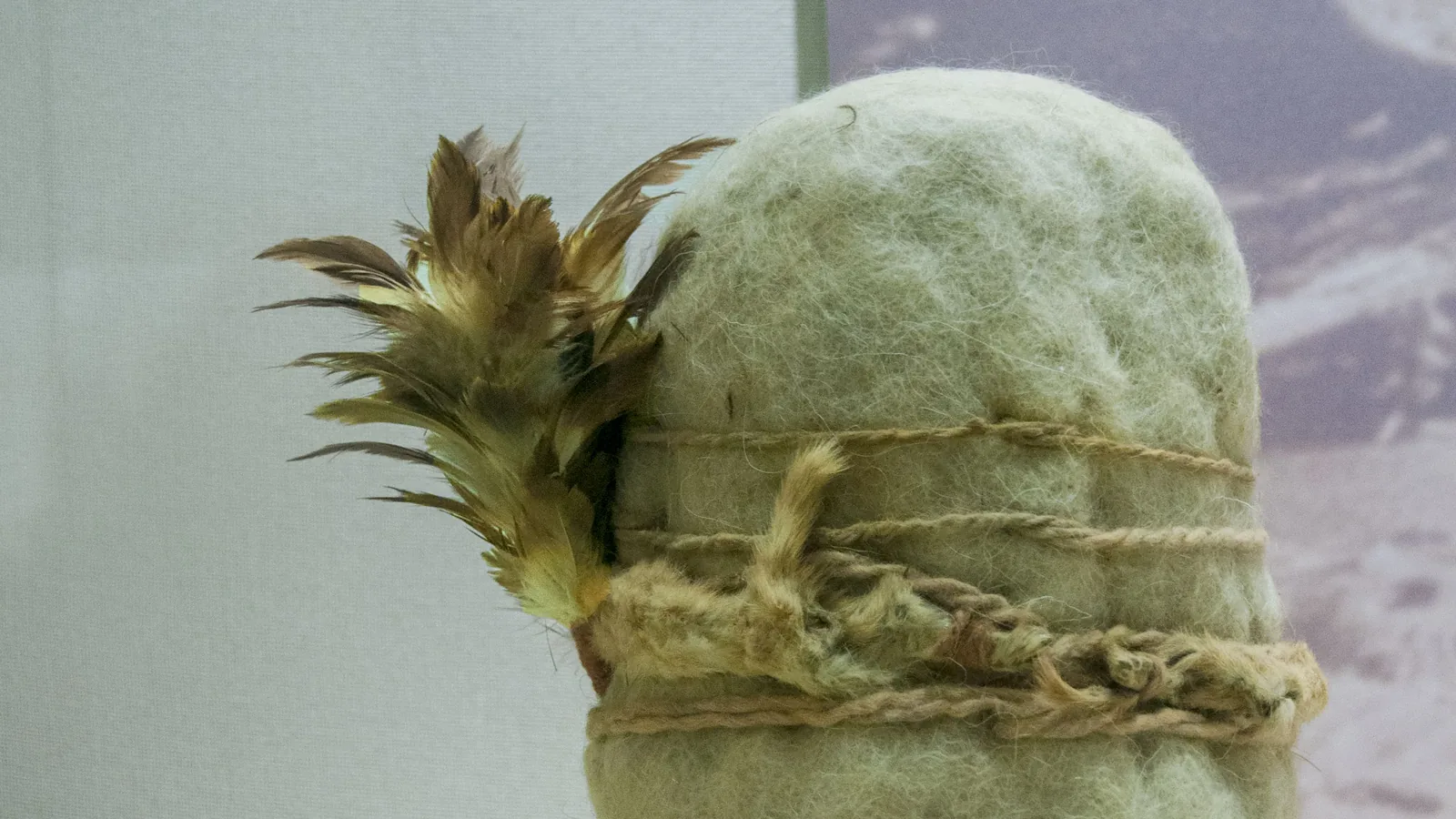
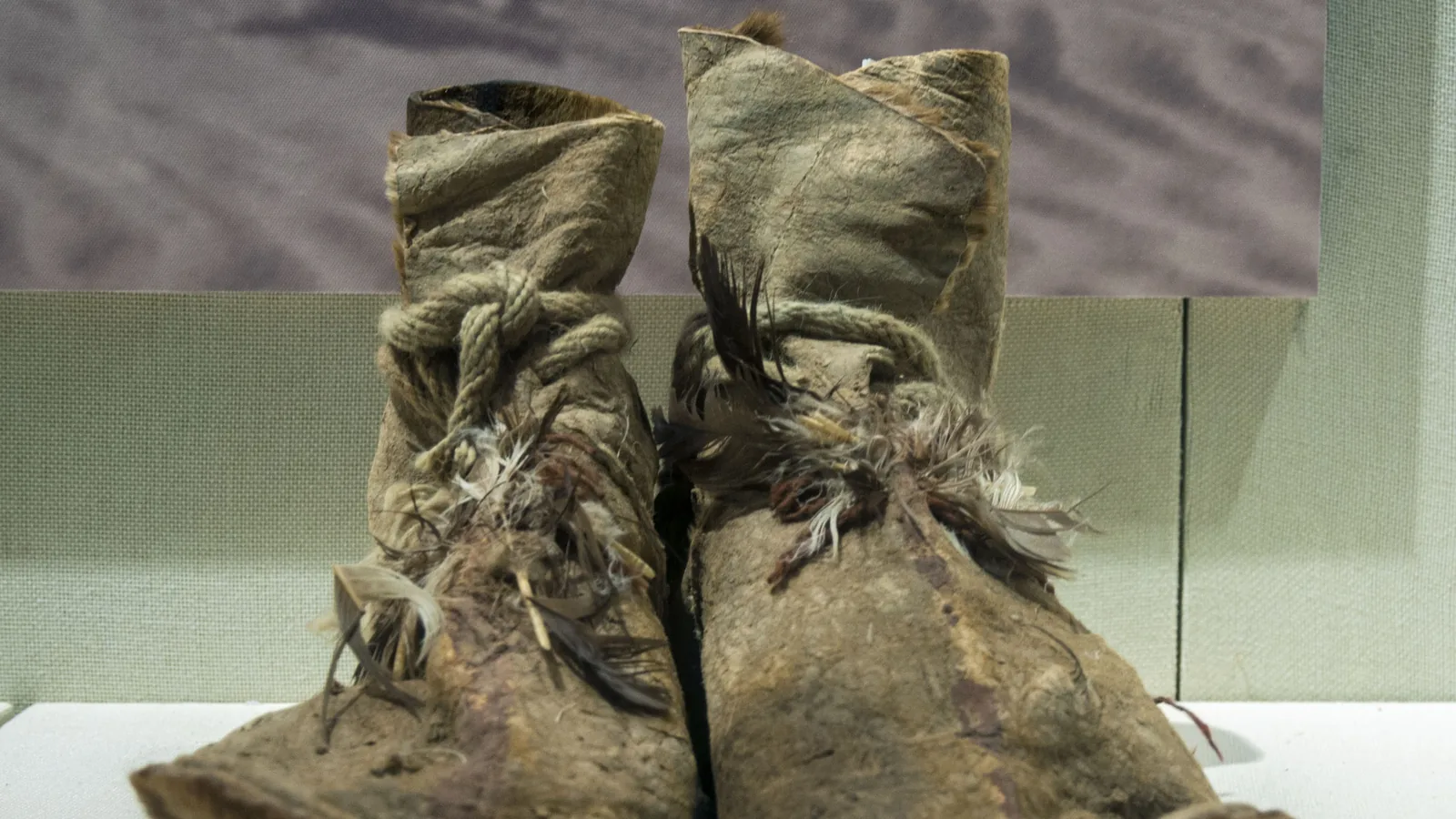
The one intact coffin he excavated, Grave 5A, had been assembled over the dead man where he lay, without nails or dowels, and sealed under tight-fitting hides. Inside lay a mummified young man, 170 cm long, head to the east. Except for the face and feet he was wrapped in “a coarse mantle of yellowish-white wool” measuring 210 by 155 cm, one edge tied into a small bag of wheat grains. He wore a large rounded head-dress of thick white felt with five feathered pegs on the left side, and ox-hide moccasins, hair still on, tied at the ankles with feathers in the knots; “This footgear had never been in actual use.” At his right thigh stood a small woven basket closed with white felt, holding a dried substance that Hj. Ljungh identified as a porridge of millet. Over the front of the body lay grains of wheat and twigs of Ephedra.

Ürümqi, 1988, and the lid of a boat coffin
Victor H. Mair of the University of Pennsylvania wrote in the Penn Museum’s magazine Expedition in 2016 that the mummies first entered his consciousness in the summer of 1988, when a newly opened gallery of mummies at the regional museum in Ürümqi left him stunned. Chinese archaeologists reopened the site in the early years of this century, in Mair’s phrase. In Expedition in 2010 Mair described Small River Cemetery 5 as a sand mound 7 m high with five layers of burials, from which more than 30 well-preserved mummies had come. The most famous, the woman called “The Beauty of Xiaohe,” was found wearing a white hat when the cover of her boat coffin was removed; Mair dated her to about 1800 to 1500 BC. He also described six wooden surrogate mummies, leather sewn on for skin, hair and mustache, all male, and offered, as speculation, that they stood in for men who died away from home.
Three hypotheses and 18 genomes
Zhang and colleagues sampled 33 Bronze Age individuals from the Dzungarian and Tarim basins and obtained genome-wide data from 18. Five, from Early Bronze Age Dzungaria, carried mostly Afanasievo steppe ancestry; the 13 from the Tarim Basin did not. Radiocarbon dates on the lowest layers gave 2135–1939 BC at Gumugou, 1884–1736 BC at Xiaohe and 1785–1664 BC at Beifang, a span the paper’s Extended Data summarizes as about 2000–1800 BC; the authors grouped these sites as the Xiaohe horizon.
Three older explanations were tested by name. One held that herders descended from the Afanasievo, speakers of an early form of Tocharian, came south through Dzungaria to found the Xiaohe horizon; a second traced the mummies to the Bactria–Margiana oasis culture; a third to the Inner Asian Mountain Corridor. “Our results do not support previous hypotheses for the origin of the Tarim mummies,” the abstract states. The mummies’ “so-called Western physical features,” the authors wrote, probably came from the Pleistocene ancient North Eurasian gene pool, and their “extreme genetic isolation” set them apart from the Dzungarian, mountain-corridor and Chemurchek populations.
Milk in the teeth, kefir in the coffins
The same paper reports milk proteins in the dental calculus of seven individuals from the basal layers at Xiaohe, evidence of dairy herding from the settlement’s founding, about 2000–1800 BC. The authors called the Xiaohe population “culturally cosmopolitan”: it made cheese from ruminant milk by a kefir-like fermentation, grew wheat, barley and millet, and buried Ephedra twigs with its dead, as the oasis cultures of Central Asia did. What it did not borrow was the boat-shaped coffin under cattle hide, marked in front by a wooden pole for a woman or an oar-shaped plank for a man.
Bergman’s report went to press in 1939 with the coffins counted and Grave 5A described down to the feathers in its moccasin strings. Another layer came in 2024, when Liu and co-authors reported in Cell that ancient DNA from Bronze Age kefir cheese in the Xiaohe cemetery, about 3,500 years old, showed “an additional spreading route of kefir from Xinjiang to inland East Asia.”
Key facts
- Sven Hedin met his former servant Ordek, aged 72, on the Qum-darya in April 1934; Ordek described a hill covered with “a thousand” coffins, an expression Bergman wrote was “not to be taken literally” (Bergman 1939).
- On April 29, 1934, Bergman and Georg Söderbom left the main camp near the Charchaq hills to search for the site; the search took nearly a month (Bergman 1939).
- Bergman named the watercourse “The Small River” and the burial hill Cemetery 5, “Ordek’s necropolis”; he recorded 120 coffins, eight in situ, more than 100 standing posts, 75 fallen posts, and 14 standing and 15 fallen oar-shaped monuments (Bergman 1939).
- Grave 5A held a young man 170 cm long wrapped in a wool mantle of 210 by 155 cm, with a white felt head-dress, unworn ox-hide moccasins, a basket with millet porridge, and wheat grains and Ephedra twigs over his body (Bergman 1939).
- Victor H. Mair saw the mummies in the regional museum in Ürümqi in the summer of 1988; he described Small River Cemetery 5 as a 7 m sand mound with five layers of burials and more than 30 well-preserved mummies (Expedition 2010, 2016).
- The 2021 Nature study obtained genome-wide data from 18 of 33 sampled individuals; the lowest layers date to 2135–1939 BC at Gumugou, 1884–1736 BC at Xiaohe and 1785–1664 BC at Beifang (Zhang et al. 2021).
- Tarim individuals were modeled as about 72% ancient North Eurasian (Afontova Gora 3) and about 28% ancient Northeast Asian; models using Afanasievo, Bactria–Margiana or mountain-corridor sources failed (Zhang et al. 2021).
- Milk proteins were found in the dental calculus of seven individuals from the basal layers at Xiaohe; in 2024 a Cell study reported ancient DNA of kefir cheese from the cemetery, about 3,500 years old (Zhang et al. 2021; Liu et al. 2024).
FAQ
Where did the Tarim mummies come from, according to the 2021 study?
From the Tarim Basin itself. Zhang and co-authors modeled the earliest Xiaohe-horizon individuals as a mixture of about 72% ancient North Eurasian and 28% ancient Northeast Asian ancestry, with no contribution from Afanasievo steppe herders, the Bactria–Margiana oasis culture or the Inner Asian Mountain Corridor.
Who found the Xiaohe cemetery?
Folke Bergman of the Sino-Swedish Expedition reached it in 1934, guided by Ordek, a former servant of Sven Hedin who said he had seen the site 15 or 20 years earlier. Bergman published the finds in Stockholm in 1939. Chinese archaeologists re-excavated the site between 2002 and 2005.
How old is the Xiaohe cemetery?
The lowest layer at Xiaohe is radiocarbon dated to 1884–1736 BC; the related lowest layer at Gumugou dates to 2135–1939 BC. Mair dated the Beauty of Xiaohe to about 1800 to 1500 BC, and the kefir cheese studied in 2024 is about 3,500 years old.
Sources
- Fan Zhang et al., "The genomic origins of the Bronze Age Tarim Basin mummies," Nature 599 (2021), 256–261, abstract page.
- Fan Zhang et al., "The genomic origins of the Bronze Age Tarim Basin mummies," full text with Extended Data and Methods, PubMed Central PMC8580821.
- Folke Bergman, Archaeological Researches in Sinkiang, Especially the Lop-nor Region (Stockholm, 1939), chapter 3, "Ancient Remains along The Small River," full text on the Internet Archive.
- Liu et al., "Bronze Age cheese reveals human-Lactobacillus interactions over evolutionary history," Cell 187, no. 21 (2024), abstract as indexed by Europe PMC (EMBL-EBI).
- Victor H. Mair, "Ancient Mummies of the Tarim Basin: Discovering Early Inhabitants of Eastern Central Asia," Expedition 58, no. 2 (Penn Museum, 2016).
- Victor H. Mair, "The Mummies of East Central Asia," Expedition 52, no. 3 (Penn Museum, 2010).
Cite this article
- APA
- Our Earth's History. (2026, September 22). Only a local ancestry: the Xiaohe mummies and the 2021 genome study. Our Earth's History. https://ourearthshistory.com/central-asia/ancient/xiaohe-cemetery-tarim-mummies-2021-genome-isolated/
- Chicago
- Our Earth's History. “Only a local ancestry: the Xiaohe mummies and the 2021 genome study.” Our Earth's History, September 22, 2026. https://ourearthshistory.com/central-asia/ancient/xiaohe-cemetery-tarim-mummies-2021-genome-isolated/.
- MLA
- “Only a local ancestry: the Xiaohe mummies and the 2021 genome study.” Our Earth's History, 22 Sep. 2026, https://ourearthshistory.com/central-asia/ancient/xiaohe-cemetery-tarim-mummies-2021-genome-isolated/.
Text licensed CC BY-NC-ND 4.0. Found an error? Tell us.