A spade left in the Lop desert: Sven Hedin finds Loulan, March 1900

TL;DR — Ordek forgot a spade at a Lop Nor ruin on March 28, 1900, and going back for it he found a second site; 1901’s documents named it Loulan.
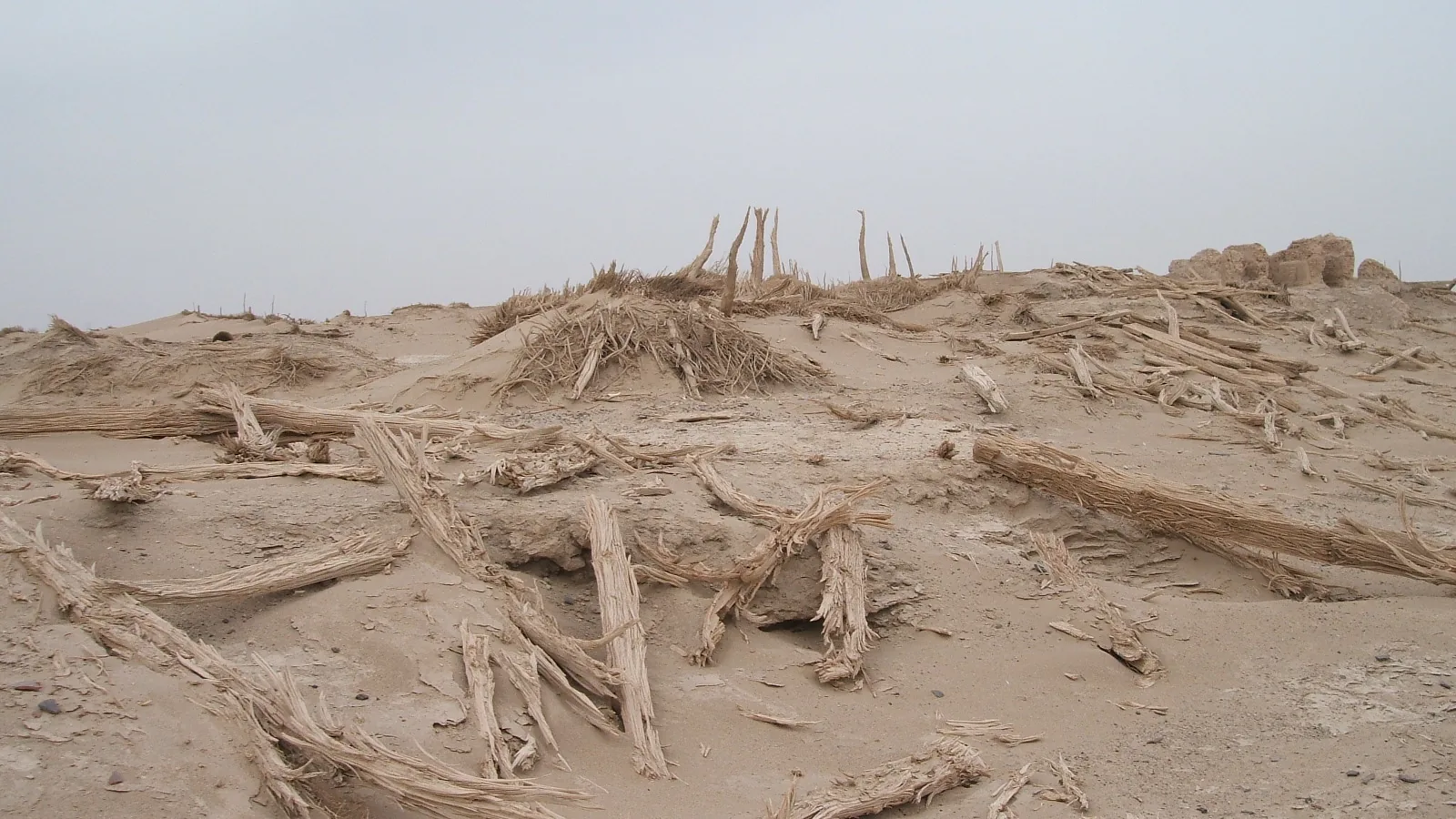
“About three o’clock in the afternoon Ordek and Chernoff, who were leading the way on foot, seeking out the easiest path to travel by, suddenly stopped and shouted back that they had come to the ruins of two or three houses.” Sven Hedin wrote that line in Central Asia and Tibet, his account of the second expedition he led across the Tarim basin from 1899 to 1902. The date was March 28, 1900, during a crossing of the Lop desert. Two of the three houses could still be measured, and the party found pottery fragments, an iron hatchet, a few Chinese coins and a carved wooden panel showing a soldier and a garlanded figure.
Quick facts
- When
- March 28, 1900 (first ruin found; Ordek's spade and second ruin) · March 2 to 9, 1901 (return and excavation; documents found March 8) · April 1934 (Hedin's canoe trip) · April 2024 (Xinhua/SCIO report on the site today)
- Where
- the Lop Nor desert between Altimish-bulak and Camp No. XVII, and the Loulan ruins themselves, now in Ruoqiang County, Xinjiang
- Who
- Sven Hedin; Ordek and Chernoff; Karl Himly; George Macartney; Aurel Stein; Ferdinand von Richthofen; Nikolai Przhevalsky; Li Wenying and Feng Jing of the Xinjiang Institute of Cultural Relics and Archeology and the Loulan Museum
- Outcome
- the second ruin, excavated in March 1901, produced Chinese paper documents and wooden tablets naming the place Lou-lan, dated by a preliminary reading to the third and early fourth centuries. Hedin used the find to argue that Lop Nor was a migratory lake, a position he said he confirmed by canoe in 1934. The 1901 documents are kept in Stockholm's Museum of Ethnography, and the ruin is now a protected site with a museum, opened in 2011.
Ordek's spade, March 28, 1900
That night the caravan moved twelve and a half miles south and camped. Digging for water, the men found they had left a spade behind. “They discovered that they had left the spade at the ruins, and Ordek, who was responsible for having left it behind, at once proposed to go back and fetch it,” Hedin recorded. Short of water, Hedin let him go alone on horseback, “bidding him stick closely to our trail.” The name is also written Ördek. Two hours after Ordek set out, a gale rose from the northeast and blew through the following day, “whirling up the sand before it.” Hedin expected him to give up the spade and turn back. Instead, Ordek reappeared the next evening, man and horse exhausted from a thirty-six-mile ride, “walking, leading his horse, and carrying his spade.” Lost in the storm, he had reached a marker tower and near it found “several houses, richly decorated with carved panels,” and had carried two carved panels back himself because his horse would not take them, the ropes cutting his shoulders. “How I blessed that spade, and, above all, Ordek for forgetting it,” Hedin wrote. The year’s plans, he decided at once, had to be recast around a return to the site.
March 1901: the return
Hedin’s party set out again with seven camels on March 2, 1901, reached a clay tower on March 3, and on March 6 sent five men to search out the previous year’s camp and the ruin Ordek had found; Shagdur, one of them, returned successfully by nine that night. On March 7 the party reached the site at eight in the morning: eight houses, three of which could be measured, in a layout Hedin compared to a Chinese government office, a yamen, and took for a Buddhist temple, where a wooden statue, its head and arms preserved, came out of the ground. On March 8, with the storm still blowing, the men were digging the least promising of three rooms in a mudbrick building shaped like a stable when, about two feet down in the innermost room, they struck what Hedin called “a dust-heap or ‘kitchen-midden.’” It held, he wrote, “over 200 strips of paper, containing writing, and 42 tablets of wood, resembling small flat rulers in shape.”
Documents that named the place Lou-lan
Hedin sent the find to the German scholar Karl Himly in Wiesbaden. Himly’s reading, which Hedin printed in full, dated most papers to “264-270 a.d.” and read the place-name on tablets and paper alike: “The name Lou-lan occurs both on the wooden tablets and on the fragments of paper, and in such a connection as to leave no doubt that this was the name of the place.” One fragment carried the year 310. Himly also noted one non-Chinese tablet, “resembling the Kharoshthi script of Dr. Stein.” The Digital Silk Road project’s rare-book page on Hedin, from the National Institute of Informatics, dates the documents “from around 265 to 330” and gives the local name as Kroraina, rendered Lou-lan in Chinese. The Sven Hedin Foundation’s Collections page states that the 1901 papers and wooden documents “are kept in the Ethnographic Museum in Stockholm,” distinct from the Khotan material Hedin gathered in 1896, which the foundation notes came from the forger Islam Akhun. Encyclopaedia Iranica sums up the discovery: “In March 1900, in this conjunction, his expedition made its most important archeological discovery, that of Lou Lan. One year later this site was explored, and important objects and documents were collected.” Aurel Stein, in his second expedition of 1906-08, also worked at Loulan, per Iranica’s entry on Stein.

A lake that would not stay put
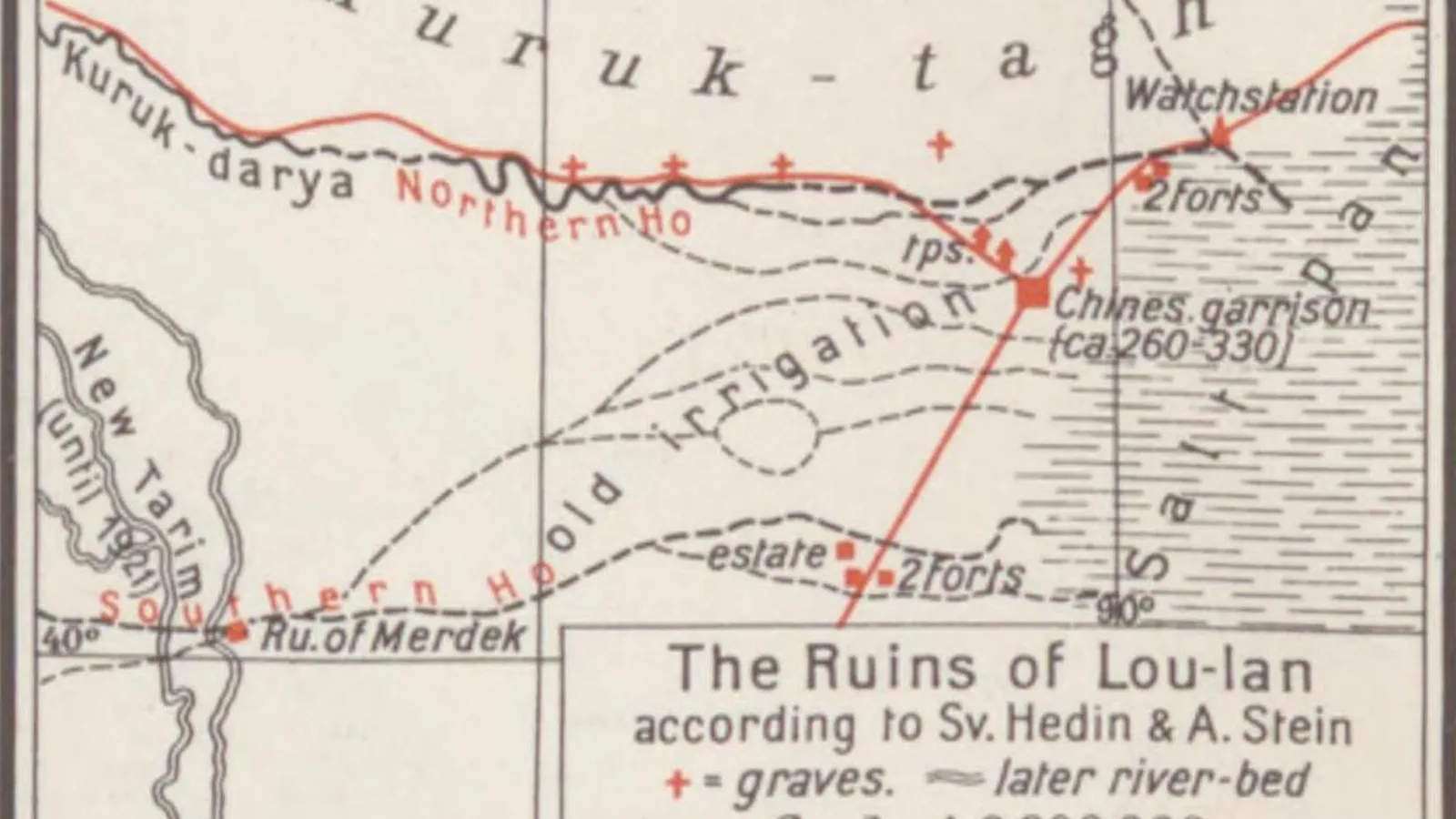
Hedin had already argued, from an earlier expedition in the 1890s, that Lop Nor was a migratory lake, “basing my inference on the fact of the almost uniform level of the whole of that region.” The Digital Silk Road page traces the dispute to two other men: the Russian explorer Nikolai Przhevalsky, who surveyed the lower Tarim in 1876-77 and identified two lakes he found as Lop Nor, and Hedin’s teacher Ferdinand von Richthofen, who rejected that because Chinese sources described Lop Nor as a saltwater lake, while Przhevalsky’s lakes were fresh and lay some 400 kilometers south of the position on Chinese maps. Hedin measured a two-meter altitude difference between Loulan and the southern lake of Kara-Koshun, evidence he took to mean a river on such flat ground could shift course easily. In April 1934, told that the lower Tarim had changed course since 1921, Hedin returned and paddled the new channel by canoe. “It was bracing to trace the muddy river route into that desert that I had luckily been able to conquer 34 years ago,” he wrote in The Wandering Lake, recognizing it as “the floor of this same river” his caravan had crossed in March 1900.
Loulan in 2024
Xinhua’s report, published by China’s State Council Information Office in April 2024, describes the ruin today: a roughly square settlement covering about 108,000 square meters, its tallest structure a Buddhist stupa about 10.4 meters high, and nearby the “three-room house,” which the report calls “a structure deemed to be a government office,” where the slips and papers came out of the ground. Feng Jing, director of the Loulan Museum, says the documents found there show that “Loulan city used to be the seat of the office of the top official dispatched by the central government to govern the Western Regions.” The Loulan Museum in Ruoqiang County opened in 2011 and holds 5,717 items, six rated first-class relics.
Key facts
- On March 28, 1900, Ordek and Chernoff found the ruins of two or three wooden houses while crossing the Lop desert; two could be measured.
- That night the party discovered Ordek had left a spade at the ruin; he rode back alone and, lost in a storm, found a second, more decorated ruin.
- The 1901 excavation ran from March 2 (departure) through March 9, with documents found in a rubbish heap on March 8: over 200 paper strips and 42 wooden tablets.
- Karl Himly’s preliminary reading dated most documents to 264-270 AD, with one paper fragment dated 310, and read the place-name Lou-lan on both tablets and paper.
- The Digital Silk Road project’s Hedin page gives the documents’ span as roughly 265 to 330 and the local name of the site as Kroraina.
- The Sven Hedin Foundation states the 1901 Loulan documents are kept in Stockholm’s Ethnographic Museum and are distinct from the forged 1896 Khotan material.
- Hedin’s wandering-lake theory rested on a dispute between Nikolai Przhevalsky, who placed Lop Nor at two freshwater lakes, and Ferdinand von Richthofen, who rejected that on grounds of salinity and a roughly 400-kilometer position gap.
- Xinhua’s 2024 report gives the site’s area as about 108,000 square meters, the surviving stupa’s height as 10.4 meters, and says the Loulan Museum, opened in 2011, holds 5,717 items.
FAQ
Why did Ordek go back to the ruins alone in 1900?
He had forgotten a spade there. Hedin let him ride back for it alone despite the risk, because the camp was short of water and needed the tool.
What did the 1901 documents identify the site as?
Chinese paper documents and wooden tablets from a rubbish heap, read preliminarily by Karl Himly, named the site Lou-lan and dated most of the material to 264-270 AD, with one fragment dated 310.
Where are the 1901 Loulan documents now?
The Sven Hedin Foundation states they are held in the Ethnographic Museum in Stockholm, separate from the forged Khotan material Hedin had gathered in 1896.
Sources
- Sven Hedin, Central Asia and Tibet: Towards the Holy City of Lassa, vols. I and II (London: Hurst and Blackett, 1903)
- Hakan Wahlquist, "HEDIN, SVEN," Encyclopaedia Iranica
- Encyclopaedia Iranica, "STEIN, (Marc) Aurel"
- National Institute of Informatics, "Hedin, the Man Who Solved the Mystery of the Wandering Lake: Lop Nor and Lou-lan," Silk Road in Rare Books
- The Sven Hedin Foundation, "Collections"
- State Council Information Office of China, "Loulan demystified: A rare glimpse of Xinjiang history," Xinhua, April 10, 2024
Cite this article
- APA
- Our Earth's History. (2026, September 27). A spade left in the Lop desert: Sven Hedin finds Loulan, March 1900. Our Earth's History. https://ourearthshistory.com/central-asia/modern/loulan-march-1900-sven-hedin-lost-spade-ordek-excavation-1901/
- Chicago
- Our Earth's History. “A spade left in the Lop desert: Sven Hedin finds Loulan, March 1900.” Our Earth's History, September 27, 2026. https://ourearthshistory.com/central-asia/modern/loulan-march-1900-sven-hedin-lost-spade-ordek-excavation-1901/.
- MLA
- “A spade left in the Lop desert: Sven Hedin finds Loulan, March 1900.” Our Earth's History, 27 Sep. 2026, https://ourearthshistory.com/central-asia/modern/loulan-march-1900-sven-hedin-lost-spade-ordek-excavation-1901/.
Text licensed CC BY-NC-ND 4.0. Found an error? Tell us.