Sputnik 1: 83.6 kilograms, one orbit every 96 minutes, October 4, 1957

TL;DR — On October 4, 1957, at 22:28:34 Moscow time, an R-7 rocket launched from Tyuratam, in the Kazakh steppe, put Sputnik 1, an 83.6-kilogram sphere, into a 96.17-minute orbit.
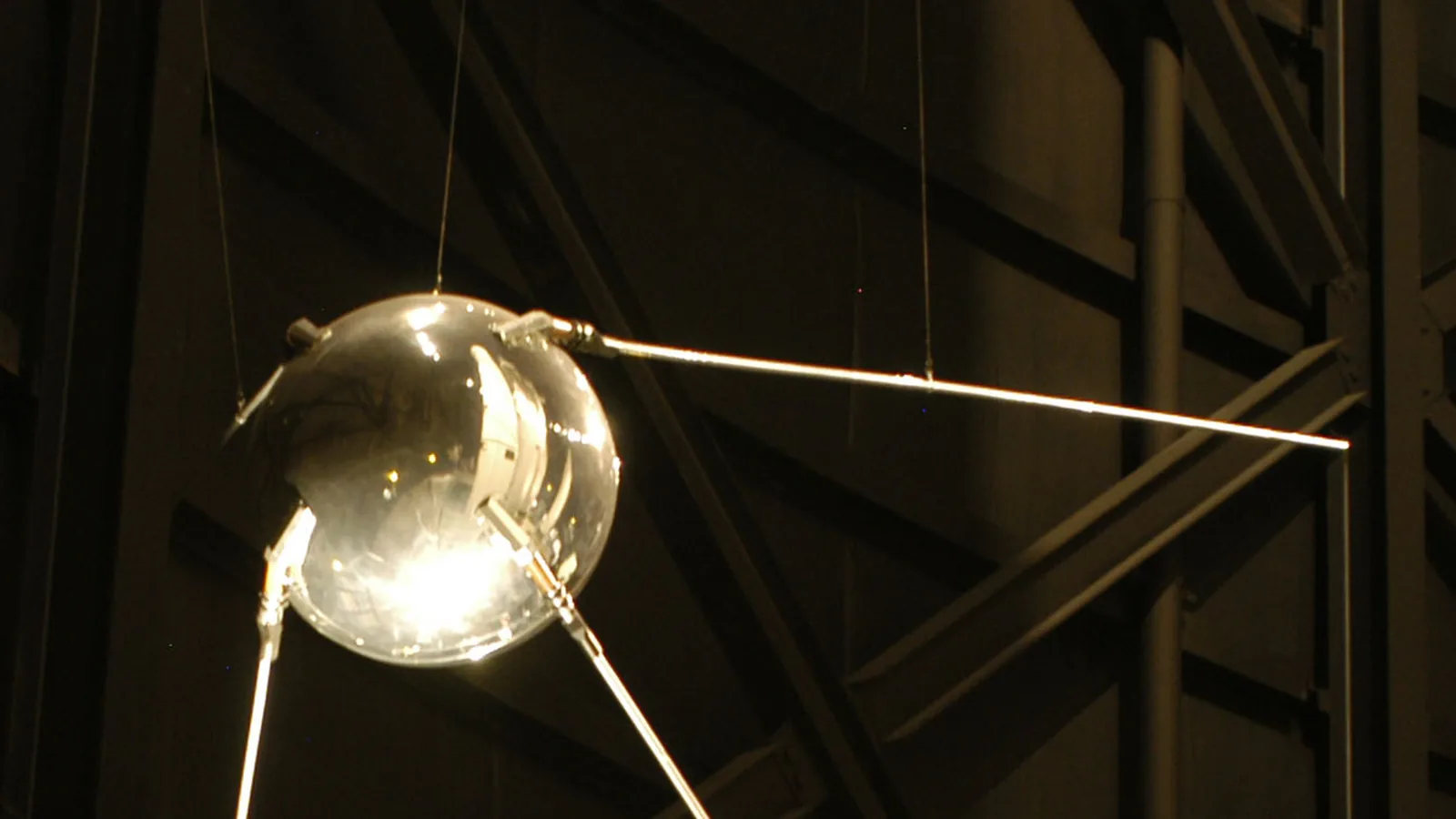
“On October 4, 1957, this first satellite was successfully launched in the USSR.” So read the communique of the Soviet news agency TASS, printed in Pravda on the morning of October 5. The launch itself had come at 22:28:34 Moscow time the evening before, from the missile range at Tyuratam in the Kazakh Soviet Socialist Republic, a site NASA’s spacecraft catalog lists as Tyuratam (Baikonur Cosmodrome). The satellite was a polished aluminum sphere 58.0 centimeters across and 83.6 kilograms in mass, which circled the Earth every 96.17 minutes and sent radio pulses for three weeks. Its orbit decayed on January 4, 1958; by then the United States was on its way to NASA and a federal education law.
Quick facts
- When
- October 4, 1957, 22:28:34 Moscow time (launch) · October 5, 1957 (TASS communique in Pravda) · October 10, 1957 (339th meeting of the U.S. National Security Council) · November 3, 1957 (Sputnik 2) · January 4, 1958 (orbit decayed) · July 29, 1958 (National Aeronautics and Space Act signed) · September 2, 1958 (National Defense Education Act) · April 12, 1961 (Vostok 1)
- Where
- The Tyuratam range in the Kazakh Soviet Socialist Republic, cataloged by NASA as Tyuratam (Baikonur Cosmodrome); the Coordination-Computation Center in Moscow; the Soviet embassy in Washington; the White House
- Who
- Sergey Pavlovich Korolev, Chief Designer of OKB-1; Mikhail S. Khomyakov, lead designer of PS-1; Vasiliy F. Ryabikov, chairman of the State Commission; Nikita S. Khrushchev; Dwight D. Eisenhower; Allen Dulles; John Foster Dulles; Laika; Yuri A. Gagarin
- Outcome
- A 58.0-centimeter sphere of 83.6 kilograms orbited every 96.17 minutes and transmitted for three weeks; it reentered on January 4, 1958, after about 1,400 orbits. The United States created NASA in July 1958 and passed the National Defense Education Act in September 1958
Ignition at 22:28:34, Moscow time
The rocket was a modified R-7, the intercontinental ballistic missile built by Sergey Pavlovich Korolev’s Experimental Design Bureau No. 1 (OKB-1), which had first flown successfully on August 21, 1957. According to Asif A. Siddiqi’s account for the NASA History Office, the 272,830-kilogram booster lifted off at exactly 22:28:34 Moscow time on October 4, its five engines producing about 398 tons of thrust. A tank-emptying system failed at T+16 seconds and the main engine cut off one second early; the satellite still separated at T+324.5 seconds.
Engineers waited in a van near the pad, and when the Kamchatka station reported a signal, Korolev cut off the cheering: “Hold off on the celebrations. The station people could be mistaken.” The beeps came back after one orbit. The Coordination-Computation Center in Moscow put that orbit at a perigee of 228 kilometers and an apogee of 947 kilometers, with an inclination of 65.6 degrees and a period of 96.17 minutes.
Two hemispheres, four antennas, three batteries
Sputnik 1 was PS-1, Simple Satellite No. 1, and its lead designer was Mikhail S. Khomyakov. Siddiqi describes an aluminum alloy sphere made from two hemispherical casings, filled with nitrogen at 1.3 atmospheres, holding three silver-zinc batteries and two D-200 radio transmitters. Of the 83.6 kilograms, 51.0 kilograms was power supply. Four whip antennas trailed from it, two of 2.4 meters and two of 2.9 meters.
NASA’s NSSDCA catalog gives the transmitters’ frequencies as 20.005 and 40.002 megahertz, about 15 and 7.5 meters in wavelength, sent in alternating groups of 0.3 seconds, and monitored “with intense interest around the world.” The transmitters ran for three weeks, until the chemical batteries failed; the silent sphere was then tracked optically until its orbit decayed 92 days after launch, on January 4, 1958, after about 1,400 orbits.
A communique with no name in it
The TASS text that Vasiliy F. Ryabikov, the chairman of the State Commission, had written said that “the first artificial satellite in the world has been created” and told readers that the flight “can be observed in the rays of the rising and setting Sun with the aid of very simple optical instruments.” Siddiqi writes that it was not the headline of the day in Pravda. Nikita S. Khrushchev’s own recollection, as Siddiqi quotes it, was flat: “I congratulated the entire group of engineers and technicians on this outstanding achievement and calmly went to bed.” Siddiqi reads that as a leader who had not yet grasped the propaganda value of the launch.
The communique named no designer. Korolev appeared in print only under the title Chief Designer of Rocket-Space Systems, and his first article in Pravda, on December 12, 1957, carried the pseudonym Professor K. Sergeyev.
Washington counts in pounds
Roger D. Launius of the NASA History Office describes the news reaching a reception at the Soviet embassy in Washington on the evening of October 4, where Lloyd Berkner, the American delegate to the International Geophysical Year, congratulated “our Soviet colleagues.” John P. Hagen, head of the American Vanguard satellite project, went pale.
The record of the 339th meeting of the National Security Council, on October 10, 1957, is a record of guesswork. Allen Dulles, the director of Central Intelligence, told the meeting the Soviets had fired the satellite from the Tyura Tam range and that it was “believed to weigh between 165 and 185 pounds.” The minutes also note the statement President Dwight D. Eisenhower had issued at his press conference on October 9, built on a draft from John Foster Dulles, the secretary of state, which called the launch an event whose “importance should not be exaggerated.” On the weight, Eisenhower interrupted to say that the vice president of the Soviet Academy of Sciences had informed Dr. Bronk, of the National Academy of Sciences, that someone in Washington had a decimal point out of place; the minutes record that no one questioned the estimate.

Laika, an agency and a law
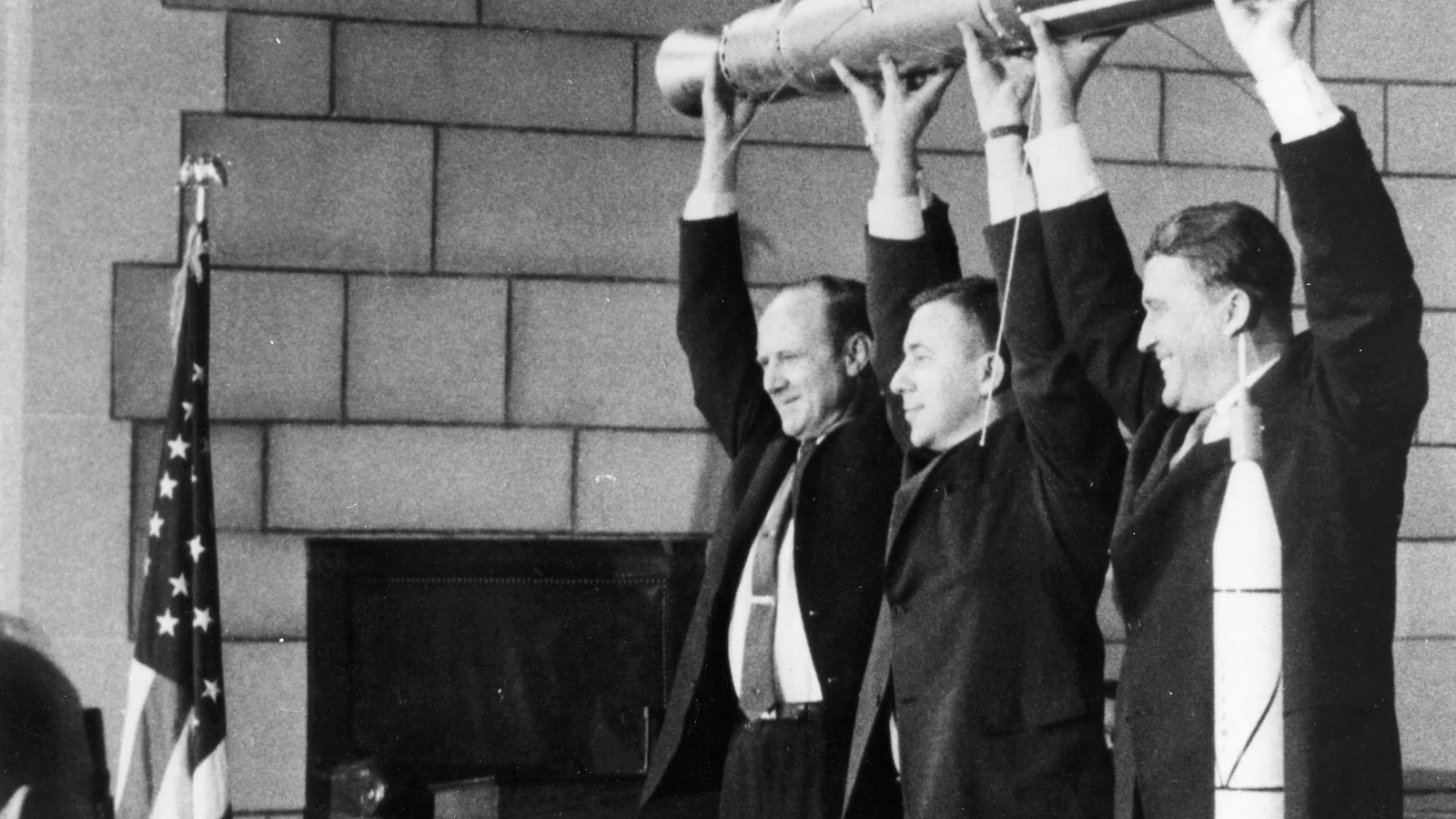
The second Sputnik went up on November 3, 1957, 508.3 kilograms by the NASA chronology, carrying the dog Laika. In Washington the response took the form of legislation. Eisenhower signed the National Aeronautics and Space Act on July 29, 1958, and the new agency, NASA, started work on October 1, 1958. On September 2, 1958, he signed Public Law 85-864, the National Defense Education Act, whose section 101 opens: “The Congress hereby finds and declares that the security of the Nation requires the fullest development of the mental resources and technical skills of its young men and women.” The next sentence spoke of a present emergency, without naming it.
NASA’s catalog entry for Vostok 1 gives its launch date as April 12, 1961, and its launch site, in the same words used for Sputnik 1, as Tyuratam (Baikonur Cosmodrome); Yuri A. Gagarin made one orbit and landed about 26 kilometers southwest of Engels, 1 hour 48 minutes after launch. Three and a half years separate the 83.6-kilogram sphere from the first person in orbit, and both left the same stretch of Kazakh steppe on the same family of rocket.
Key facts
- Sputnik 1 was launched at 22:28:34 Moscow time on October 4, 1957, from the Tyuratam range in the Kazakh SSR, listed by NASA’s NSSDCA catalog as Tyuratam (Baikonur Cosmodrome).
- The launch vehicle was a modified R-7 intercontinental ballistic missile of Korolev’s OKB-1; its five engines gave about 398 tons of thrust, and the satellite separated at T+324.5 seconds.
- The satellite was an aluminum sphere 58.0 centimeters in diameter with a mass of 83.6 kilograms, of which 51.0 kilograms was power supply.
- Its initial orbit, computed in Moscow, was 228 by 947 kilometers, inclined 65.6 degrees, with a period of 96.17 minutes.
- Two transmitters sent pulses on 20.005 and 40.002 megahertz, about 15 and 7.5 meters in wavelength, for three weeks.
- The orbit decayed on January 4, 1958, 92 days after launch, after about 1,400 orbits.
- Sputnik 2, 508.3 kilograms, carried the dog Laika into orbit on November 3, 1957.
- The United States signed the National Aeronautics and Space Act on July 29, 1958, and the National Defense Education Act on September 2, 1958; Vostok 1 left Tyuratam on April 12, 1961.
FAQ
Where was Sputnik 1 launched from?
From the R-7 missile test range at Tyuratam, in the Kazakh Soviet Socialist Republic. NASA's spacecraft catalog records the site as Tyuratam (Baikonur Cosmodrome), placing it about 370 kilometers southwest of the small town of Baikonur, and uses the same site name for Vostok 1 in 1961.
How long did Sputnik 1 transmit and stay in orbit?
The NSSDCA catalog states that the transmitters worked for three weeks, until the chemical batteries failed. The inactive sphere was tracked by telescope until its orbit decayed on January 4, 1958, 92 days after launch.
What did the United States do after Sputnik?
The National Security Council took up the satellite on October 10, 1957. Congress passed the National Aeronautics and Space Act, signed July 29, 1958, and the National Defense Education Act, signed September 2, 1958, which funded student loans and instruction in science, in mathematics and in modern foreign languages.
Sources
- NASA History Office — Asif A. Siddiqi, "Korolev, Sputnik, and The International Geophysical Year" (launch time, R-7, PS-1 construction, orbit figures, the TASS communique of October 5, 1957, and Khrushchev's recollection).
- NASA NSSDCA Master Catalog — "Sputnik 1," NSSDCA/COSPAR ID 1957-001B (launch site, diameter, mass, frequencies, wavelengths, three weeks of transmission, decay on January 4, 1958).
- NASA NSSDCA Master Catalog — "Vostok 1," NSSDCA/COSPAR ID 1961-012A (launch date April 12, 1961; launch site Tyuratam (Baikonur Cosmodrome); landing 26 km southwest of Engels after 1 hour 48 minutes).
- NASA History Office — Roger D. Launius, "Sputnik and the Origins of the Space Age" (the Soviet embassy reception of October 4, 1957; the 96-minute orbit; Sputnik 2 and Laika; the National Aeronautics and Space Act signed July 29, 1958; NASA operating from October 1, 1958).
- NASA History Office — "Chronology of Sputnik/Vanguard/Explorer Events 1957-58" (Sputnik 1, 83.6 kg, October 4, 1957; Sputnik 2, 508.3 kg, with the dog Laika, November 3, 1957).
- Dwight D. Eisenhower Library, Ann Whitman File, NSC Series, Box 9 — "Discussion at the 339th Meeting of the National Security Council, Thursday, October 10, 1957," memorandum of October 11, 1957; transcribed by the NASA History Office.
- Dwight D. Eisenhower Library, John Foster Dulles Papers — John Foster Dulles to James C. Hagerty, October 8, 1957, with "Draft Statements on the Soviet Satellite," October 5, 1957; transcribed by the NASA History Office.
- U.S. Department of State, Office of the Historian — "Milestones: 1953–1960 — Sputnik, 1957."
- U.S. Government Publishing Office, govinfo — Public Law 85-864, National Defense Education Act of 1958, September 2, 1958, 72 Stat. 1580, Title I, section 101.
Cite this article
- APA
- Our Earth's History. (2026, September 22). Sputnik 1: 83.6 kilograms, one orbit every 96 minutes, October 4, 1957. Our Earth's History. https://ourearthshistory.com/central-asia/contemporary/sputnik-1957-baikonur-first-satellite/
- Chicago
- Our Earth's History. “Sputnik 1: 83.6 kilograms, one orbit every 96 minutes, October 4, 1957.” Our Earth's History, September 22, 2026. https://ourearthshistory.com/central-asia/contemporary/sputnik-1957-baikonur-first-satellite/.
- MLA
- “Sputnik 1: 83.6 kilograms, one orbit every 96 minutes, October 4, 1957.” Our Earth's History, 22 Sep. 2026, https://ourearthshistory.com/central-asia/contemporary/sputnik-1957-baikonur-first-satellite/.
Text licensed CC BY-NC-ND 4.0. Found an error? Tell us.