A beast, a deer and a sun on a madrasa: the Sher-Dor, Samarkand
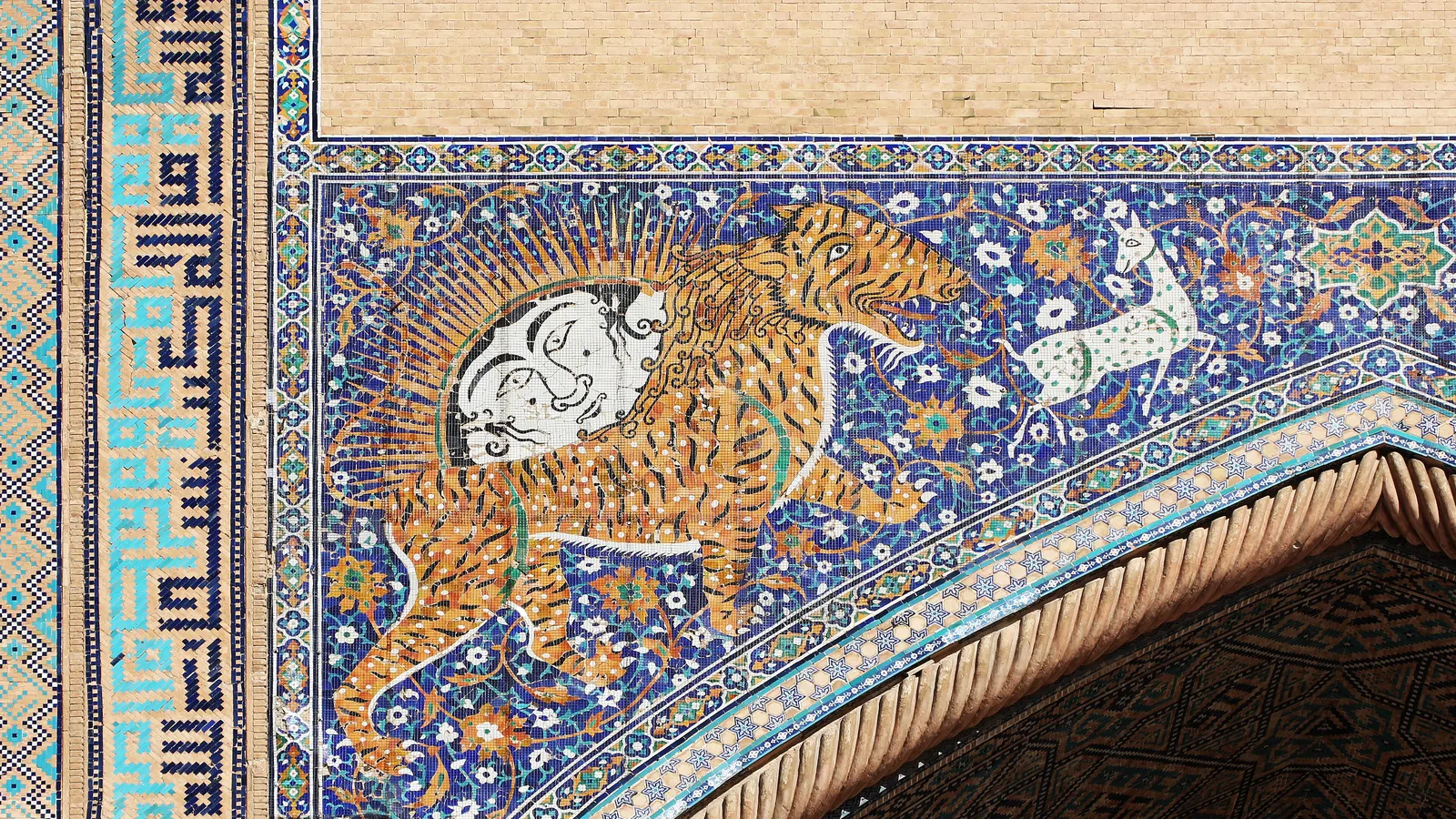

TL;DR — The Sher-Dor madrasa in Samarkand carries a portal mosaic of a beast chasing deer under a human-faced sun, built for governor Yalangtush Bahadur and completed in 1636.
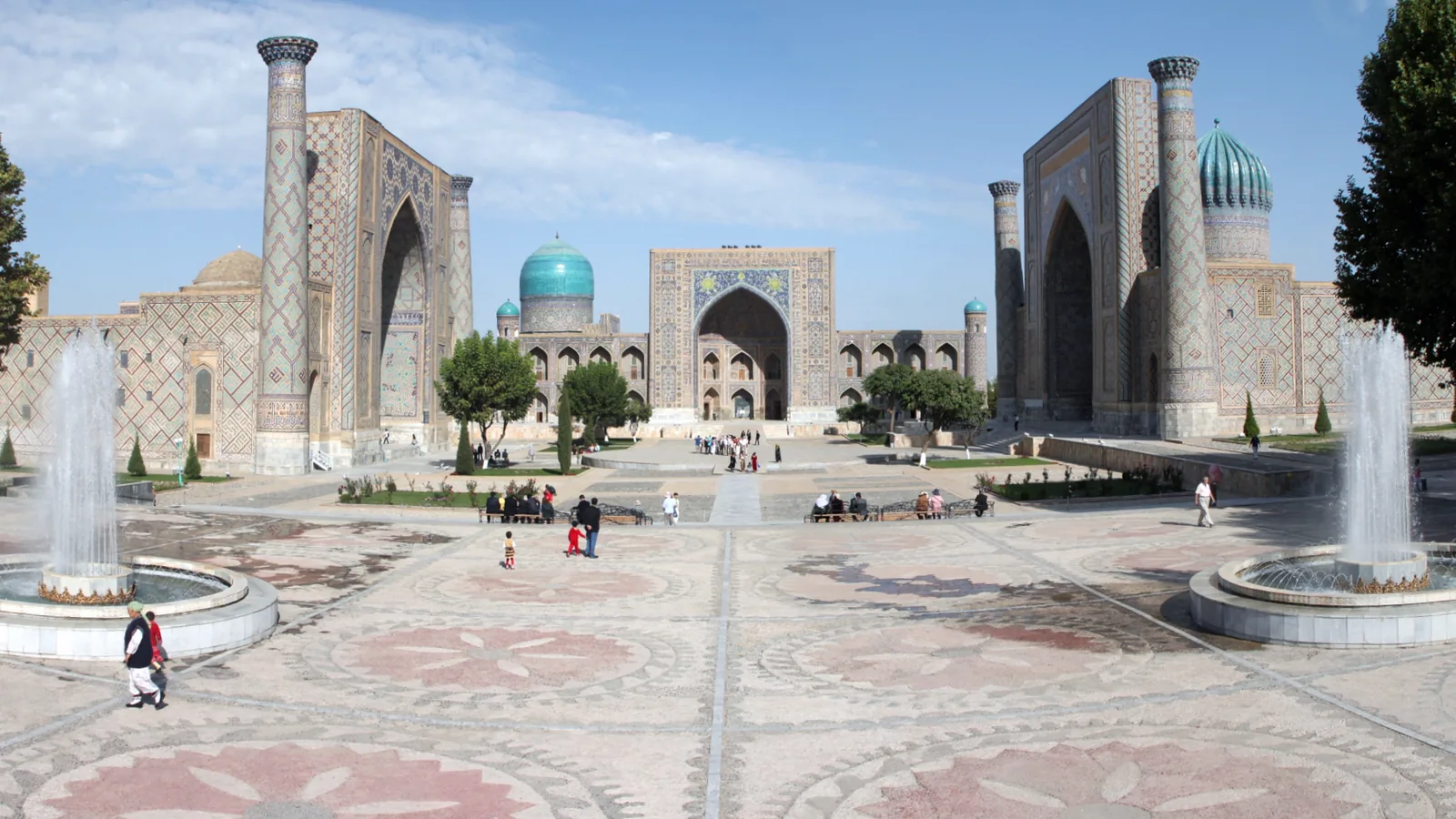
Encyclopaedia Iranica dates the Registan Square’s completion to a specific year: “the Registān square received its final form with three madrasas in 1660.” The second of those three buildings, the Sher-Dor madrasa, stands across the square from the older Ulugh Beg madrasa and carries a portal mosaic whose animal the sources name differently. It was built for Yalangtush Bahadur, governor of Samarkand under the Astrakhanid dynasty, whom the Center of Islamic Civilization in Uzbekistan (ICCU) describes as “a prominent representative of the Uzbek noble family of the Ashtarkhanids” active in the first half of the seventeenth century.
Quick facts
- When
- 1619 or 1616 (construction began, sources differ) to 1636 (completed) · 1660 (Registan reaches its final form with three madrasas) · 1925 (first Soviet-era restoration begins) · 1982 (Registan unveiled after reconstruction) · November 2024 (US-funded facade restoration announced) · June 2026 (first stage of that restoration completed)
- Where
- Registan Square, Samarkand, in what is now Uzbekistan
- Who
- Yalangtush Bahadur, governor of Samarkand under the Astrakhanid dynasty; the architect named Abdu Jabbor by one Uzbek institution and Abdulzhabbor by another; Boris N. Zasypkin, who led the 1925 restoration; Konstantin S. Kriukov, who led the later Soviet reconstruction
- Outcome
- The madrasa's portal mosaic of a beast chasing deer under a human-faced sun survived without agreement, even between Uzbekistan's own state institutions, on the animal's species, the craftsman's name or the year construction began, while the building itself passed from a nomad winter stable in the 1720s to a Soviet-rebuilt monument by 1982 and a US-funded restoration project in progress since 2024
Yalangtush Bahadur, governor and military commander
Iranica’s account of Central Asian politics places Yalangtush Bi Alchin in service under Emamqoli Khan by about 1612, calling him “the premier military administrator of the first half of the century.” In 1622 he destroyed the fort at Shafelan and led Toqay-Timurid forces onto Herat territory. His political weight outlasted his patron: when Nadr-Mohammad Khan later handed Balkh to a rival and folded Yalangtush’s own estate into the transfer, Yalangtush led the faction that turned against him. That faction “persuaded Abd-al-Aziz to take Bukhara and force his father to return to Balkh,” and Abd-al-Aziz was proclaimed khan of Transoxania near Khojand on April 27, 1645. ICCU also reprints an older account by the Uzbek historian Mahmudhoja Behbudi, according to which Yalangtush built the Sher-Dor and the neighboring Tilla-Kari with spoils from conquering Khorasan and Mashhad, a claim Iranica’s independent political narrative does not confirm.
Two start dates, one finish
ICCU dates the start of construction to 1619 and gives its reasoning as abjad numerology: “the names Yalangtosh (816) and Bahodir (212) sum to 1028 in the Hijri calendar, corresponding to the Gregorian year 1619.” Uzbekistan’s National Tourism Board states the same span, that the madrasa “was built by order of Ashtarkhanid Yalantgush Bahadur on the site of the dismantled khanaka of Ulughbek in 1619-1636.” Elena G. Paskaleva of Leiden University, writing in The Newsletter of the International Institute for Asian Studies in 2023, gives a different start: “the Shir Dar Madrasa (1616-1636), the second oldest monument on Registan Square.” All three sources agree on 1636 as the year the building was finished. ICCU adds that the madrasa was built with no mosque of its own, and that its southwest classroom took on the role of a shrine because it stands, on the outside, next to the mausoleum of Imam Muhammad ibn Ja’far al-Sadiq.
The beast, the deer and the sun
ICCU describes the portal mosaic as “a reddish-golden lion chasing a white deer,” with the sun “depicted in an almond-shaped circle with deer-like eyes, its face bordered with golden light,” against “a deep blue background, using turquoise and golden paints.” The tourism board’s page for the same building describes a different animal: “a scene of a fantastic beast hunting in the guise of a snow leopard on a white gazelle in the rays of the rising sun.” ICCU explains the sun-and-lion pairing through astronomy rather than religion: “In classical Muslim astronomy, the sun’s presence in the Leo constellation… signifies a lucky and auspicious time,” and it reads the human face in the sun as a caution about mortality rather than a religious figure. ICCU also credits the madrasa’s name to the mosaic itself, “because of this marvelous image, the madrasa received the name Sherdor,” meaning possessing lions, while the tourism board says the building was meant to carry Yalangtush’s own name until “the people called the building ‘Sherdor’” instead.
Craftsmen, dimensions and a neighboring madrasa
The two Uzbek institutions also diverge on who made the decoration. ICCU credits “the famous architects master Abdu Jabbor and the tile maker Avaz Samarkandi,” while the tourism board names the architect Abdulzhabbor but attributes the decoration to “the master Muhammad Abbas” instead of Avaz Samarkandi. ICCU’s own page carries two room counts side by side: a modern description puts the madrasa at “70 by 57 meters… 52 rooms in total,” while its reprint of Behbudi’s account gives “82 arshins from west to east, 95 arshins from north to south… containing 64 cells.” The Sher-Dor stands opposite the Ulugh Beg madrasa and shares the square with the Tilla-Kari madrasa-mosque, which the ICCU dates to 1646-1660 on the site of a demolished khanaka, bathhouse and caravanserais.

Nomad stables, engineers and two restorations decades apart
Iranica records the square’s later decline: “A sharp decline occurred in the eighteenth century, with Kazakh inroads, dynastic strife, and eventually an occupation by Nader Shah’s army in 1740-47,” and by the 1720s the city was so empty that “the madrasas on the Registan were turned into winter stables by nomads.” The Sher-Dor’s first documented modern restoration came in 1925 under Boris N. Zasypkin, whose approach Paskaleva describes as combining “restorations aiming at supporting the ancient fabric of a monument and reconstructions substituting its lost structural parts,” using original fired brick and local alabaster. Decades later, Konstantin S. Kriukov led different work across the square: Paskaleva writes that he “believed that the exterior decoration was a sheer garment worn by the construction itself,” and that the reinforced concrete domes his team added were meant to withstand “the frequent tremblors of Central Asian earthquakes.” In 1982, Paskaleva writes, “the Registan was revealed to the Soviet public in its presumed former glory.”
Gazeta.uz reported on November 14, 2024, that Uzbekistan’s Cultural Heritage Agency won “a $500,000 US Ambassador’s Fund grant” to conserve the Sher-Dor’s facade, carried out “with the technical support of the International Institute for Central Asian Studies” under a bilateral heritage protection agreement signed in 2023. Yuz.uz reported on June 4, 2026, that the first of three planned stages of that restoration was complete, aimed at preserving “unique mosaics, majolica, decorative elements and kufic inscriptions.”
Key facts
- Encyclopaedia Iranica dates the Registan’s completion as a three-madrasa square to 1660.
- The Center of Islamic Civilization in Uzbekistan and Uzbekistan’s National Tourism Board both date the Sher-Dor’s construction to 1619-1636 based on abjad numerology; Elena G. Paskaleva of Leiden University gives 1616-1636 instead.
- ICCU describes the portal mosaic’s animal as a lion; Uzbekistan’s National Tourism Board describes it as a snow leopard.
- ICCU credits the tilework to Avaz Samarkandi; the tourism board credits it to Muhammad Abbas.
- ICCU’s own page gives two room counts for the madrasa: 52 in a modern description and 64 in its reprint of Mahmudhoja Behbudi’s earlier account.
- By the 1720s the Registan’s madrasas were used as winter stables by nomads, according to Encyclopaedia Iranica.
- Boris N. Zasypkin began the Sher-Dor’s first modern restoration in 1925; Konstantin S. Kriukov’s later reconstruction, including reinforced concrete domes, preceded the Registan’s public unveiling in 1982.
- A US Ambassador’s Fund grant of $500,000, announced in November 2024, funded a new facade restoration whose first stage was completed in June 2026.
FAQ
Who built the Sher-Dor madrasa?
Yalangtush Bahadur, the governor of Samarkand under the Astrakhanid dynasty in the first half of the seventeenth century, ordered its construction on Registan Square, opposite the earlier Ulugh Beg madrasa.
What animal is shown on the Sher-Dor's portal?
Sources disagree. The Center of Islamic Civilization in Uzbekistan describes "a reddish-golden lion chasing a white deer," while Uzbekistan's National Tourism Board describes the same mosaic as a fantastic beast "in the guise of a snow leopard" hunting a gazelle.
When was the Sher-Dor madrasa completed?
In 1636. Sources differ on when construction began, with Uzbek state institutions citing 1619 and Leiden University researcher Elena G. Paskaleva citing 1616, but all agree on the 1636 completion date.
Sources
- Encyclopaedia Iranica, Frantz Grenet, "SAMARQAND i. History and Archaeology"
- Encyclopaedia Iranica, "CENTRAL ASIA vi. In the 16th-18th Centuries"
- Center of Islamic Civilization in Uzbekistan, "What does the lion image in Sherdor Madrasa mean?"
- Uzbekistan National Tourism Board, "Sher-Dor Madrassah"
- Elena G. Paskaleva, "The Restored Splendours of Timurid Samarqand," The Newsletter 95, International Institute for Asian Studies, Summer 2023
- Gazeta.uz, "Facade of historic Sher-Dor Madrasah in Samarkand to be restored with US support," November 14, 2024
- Yuz.uz, "The first stage of restoration of the facade of the Sherdor Madrasah on Registan Square has been completed," June 4, 2026
Cite this article
- APA
- LETTER. (2026, September 28). A beast, a deer and a sun on a madrasa: the Sher-Dor, Samarkand. Our Earth's History. https://ourearthshistory.com/central-asia/early-modern/sher-dor-madrasa-samarkand-registan-yalangtush-tiger-portal/
- Chicago
- LETTER. “A beast, a deer and a sun on a madrasa: the Sher-Dor, Samarkand.” Our Earth's History, September 28, 2026. https://ourearthshistory.com/central-asia/early-modern/sher-dor-madrasa-samarkand-registan-yalangtush-tiger-portal/.
- MLA
- LETTER. “A beast, a deer and a sun on a madrasa: the Sher-Dor, Samarkand.” Our Earth's History, 28 Sep. 2026, https://ourearthshistory.com/central-asia/early-modern/sher-dor-madrasa-samarkand-registan-yalangtush-tiger-portal/.
Text licensed CC BY-NC-ND 4.0. Found an error? Tell us.