Babur's memoir: from losing Samarkand to taking Delhi, 1497–1526

TL;DR — Babur lost Samarkand three times, took Kabul in October 1504 “without a fight,” and beat Ibrahim Lodi at Panipat on April 20, 1526, with roped carts and two cannon.
“It was in the last ten days of the Second Rabi’ (Oct. 1504 AD.) that without a fight, without an effort, by Almighty God’s bounty and mercy, I obtained and made subject to me Kabul and Ghazni and their dependent districts.” So wrote Zahir al-Din Muhammad Babur, a Timurid prince of 21 who had lost every town he held in Central Asia, in the memoir known as the Baburnama, quoted here in Annette Beveridge’s translation of 1921. From Kabul, on April 20, 1526, by his own dating, he destroyed the army of Sultan Ibrahim Lodi at Panipat, north of Delhi, and the dynasty later called Mughal began. He died at Agra on December 26, 1530; about 1544 his widow carried his body back to a garden in Kabul.
Quick facts
- When
- February 14, 1483 (born) · June 1494 (ruler of Fergana at 11) · 1497 to 1512 (Samarkand won and lost three times) · October 1504 (Kabul taken) · April 20, 1526 (Panipat, by his own dating) · December 26, 1530 (died at Agra) · about 1544 (reburied in Kabul)
- Where
- Fergana and Samarkand, in what is now Uzbekistan; Kabul and Ghazni, in what is now Afghanistan; Panipat, Delhi and Agra on the plain of northern India
- Who
- Zahir al-Din Muhammad Babur, a fifth-generation descendant of Timur; his father Umar Shaikh Mirza; the Uzbek ruler Shaybani Khan; Shah Ismail of Iran; Muqim Arghun of Kabul; the gunner Ustad Ali Quli; Sultan Ibrahim Lodi of Delhi; his son Humayun; his daughter Gulbadan; the translator Annette Beveridge
- Outcome
- A Timurid prince driven out of Central Asia by the Uzbeks made Kabul his base in 1504, destroyed the Delhi sultanate's army at Panipat in 1526 and founded the dynasty later called Mughal; his body went back to a Kabul garden about 1544
Fergana, 1494: a ruler at eleven
“In the month of Ramzan of the year 899 (June 1494) and in the twelfth year of my age, I became ruler in the country of Farghana,” the first sentence reads. Babur had been born on February 14, 1483. His father, Umar Shaikh Mirza, ruled Fergana, the valley on the upper Syr Darya, and died at the fort of Akhsi on June 8, 1494, in a fall the son recorded in one line: he “flew, with his pigeons and their house, and became a falcon.”
Fritz Lehmann, in the Encyclopaedia Iranica entry on Babur (1988), described the arena the boy inherited: Timurid cousins with no succession law fought one another for Khorasan and Central Asia while the Uzbeks under Shaybani Khan took their lands. Against Shaybani, Lehmann wrote, Babur “learned his trade as a military leader in a long series of losing encounters.”
Samarkand won and lost three times, 1497 to 1512
Samarkand, Timur’s capital, was “the first prize he sought,” in Lehmann’s words. Babur took the city and lost it, was driven out of Andijan, the capital of Fergana, and passed three spells among the shepherd tribes, in 1497 to 1498, 1501 to 1502 and 1503 to 1504.
The last attempt came after Shaybani was killed in battle against Shah Ismail, the Safavid ruler of Iran, in 1510. From October 1511 to May 1512 Babur held Samarkand for the third time, “but as a client of Shah Esmāʿīl,” Lehmann wrote, on terms that required him to profess the Shia faith in public and wear the dress of the Safavid troops. His kinsmen did not accept it; his cousin Mirza Haydar “exulted at the Uzbek defeat of Bābor.” After that, in Lehmann’s reading, “he must have sensed that his chance to regain Samarqand was irretrievably lost.”
Kabul, October 1504: a base he meant to leave
The turn south had come earlier. In June or July 1504, at 21, Babur “alone among the Timurids of his generation, opted to leave the Central Asian arena, in which he had lost everything,” Lehmann wrote. He set out for Khorasan and changed course for Kabul, held by Muqim Arghun. Muqim offered to surrender, the memoir records, and on the morning of the handover the crowd at the gate rioted. Babur “got to horse, had two or three persons shot, two or three cut in pieces, and so stamped the rising down.” Then comes the sentence about a town won “without a fight.”
He liked the place. Xavier de Planhol’s Iranica entry on Kabul collects the memoir’s praise: “mountain, river, city, lowland in one,” with a climate of which “if the world has another so pleasant, it is not known.” Lehmann wrote that Babur still saw Kabul as a temporary base until 1512; then he turned to India, because Kabul’s resources could not support his nobles and troops.
Panipat, April 20, 1526: seven hundred carts and two cannon
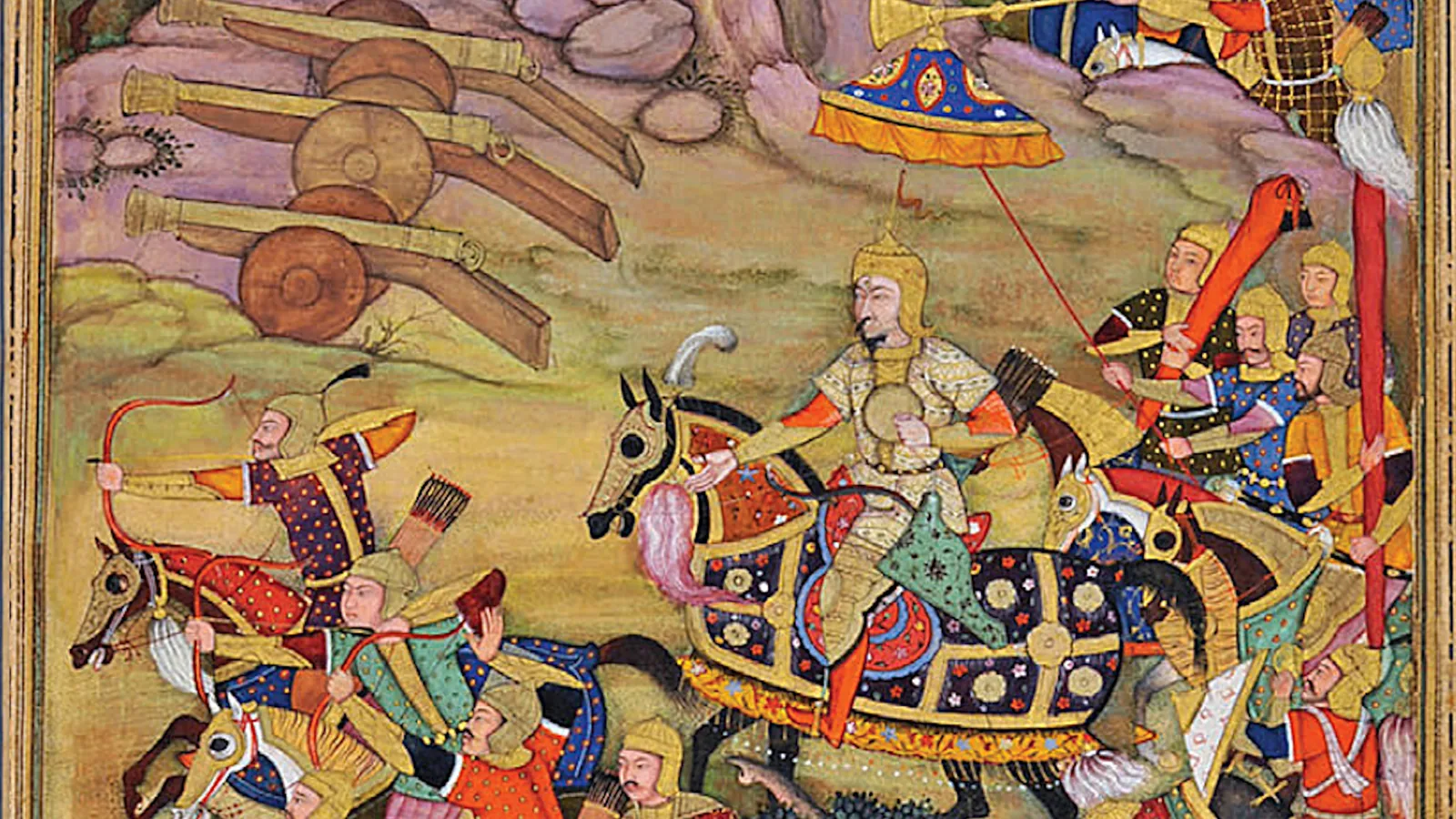
The army crossed the Indus on December 16, 1525, counted at the boats as 12,000 “great and small, good and bad, retainer and non-retainer.” Against them, “people estimated the army opposing us at 100,000 men,” with about 1,000 elephants. Babur ordered every man to collect carts; 700 were brought in. Ustad Ali Quli was told to join them “in Ottoman fashion, but using ropes of raw hide instead of chains,” with five or six mantelets between each pair for the matchlockmen to fire from. Lehmann wrote that the Ottoman experts had only two cannon at Panipat.
The battle came “on Friday the 8th of Rajab,” which Beveridge’s margin dates April 20. Ibrahim’s right and left were “massed in such a crowd that they could neither move forward against us nor force a way for flight,” and by noon “that armed mass was laid upon the earth.” Babur gave two counts of the dead in one paragraph: “Five or six thousand men were killed in one place close to Ibrahim. Our estimate of the other dead, lying all over the field, was 15 to 16,000, but it came to be known, later in Agra from the statements of Hindustanis, that 40 or 50,000 may have died in that battle.” At afternoon prayer Tahir Tibri found Ibrahim’s body in a heap of dead and brought in his head.

"A country of few charms": Agra, 1526 to 1530, and the garden in Kabul
“Hindustan is a country of few charms,” Babur wrote of his new country. “Its people have no good looks . . . there are no good horses, no good dogs, no grapes, musk-melons or first-rate fruits, no ice or cold water.” In a letter to Khwaja Kalan about Kabul, copied into the memoir in February 1529, he wrote: “Boundless and infinite is my desire to go to those parts.”
The diary breaks off in the autumn of 1529. Later court writers, his daughter Gulbadan and Akbar’s chronicler Abu’l-Fazl, recorded that when his son Humayun fell gravely ill in 1530, Babur walked around the sickbed and offered his own life for his son’s, then sickened himself; Beveridge’s translator’s note gives the story from those two sources only. Babur died at Agra on Monday, December 26, 1530; his body was laid in a garden there. His will asked for Kabul, and for a grave open to the sky with no building over it.
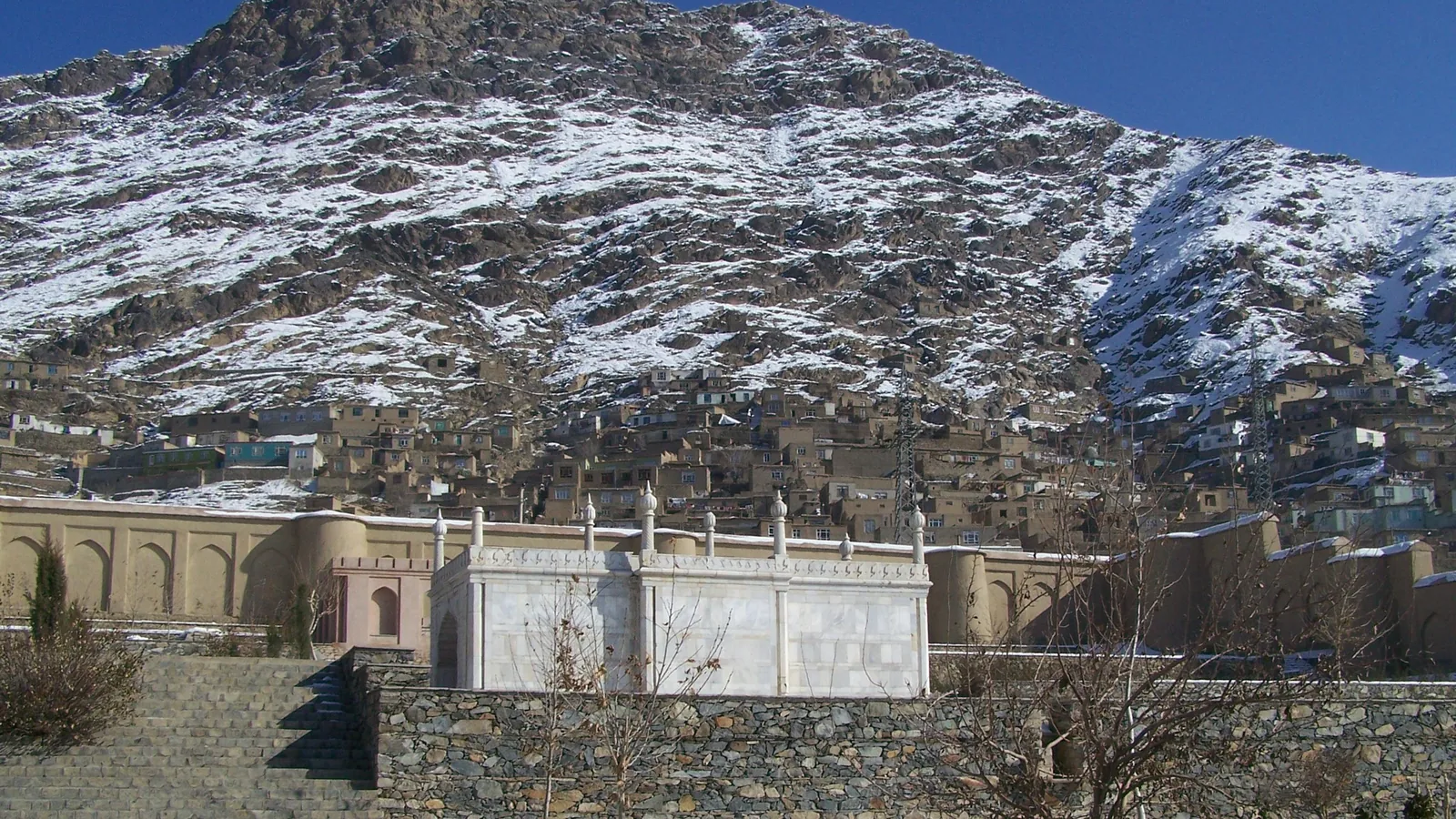
His widow moved the body to Kabul around 1544, according to the Afghan submission to UNESCO’s Tentative List in 2009. The garden, Bagh-e Babur, lies on the Sher Darwaza hill southwest of the old city, about 11.5 hectares on 15 terraces, one of the gardens Babur laid out after 1504. Excavators found older brick-vaulted tombs beneath the tomb platform, possibly of his Timurid kin. The Aga Khan Trust for Culture restored the terraces from 2003 and handed the garden back in 2008. The prince who lost Samarkand three times and won Delhi in a morning rests where he asked to, above the Kabul River.
Key facts
- Babur was born on February 14, 1483, and became ruler of Fergana in June 1494, aged 11, on his father’s death (Baburnama, vol. I, with Beveridge’s note).
- Lehmann counts three spells of wandering (1497 to 1498, 1501 to 1502, 1503 to 1504) and dates his third and last hold on Samarkand to October 1511 to May 1512, as a client of Shah Ismail.
- Kabul and Ghazni were taken from Muqim Arghun in the last ten days of Rabi II 910, October 1504, “without a fight, without an effort” (Baburnama, vol. I).
- The army that crossed the Indus on December 16, 1525, was counted at 12,000; Ibrahim’s was estimated at 100,000 with about 1,000 elephants (Baburnama, vol. II).
- Seven hundred carts were roped together with raw hide in “Ottoman fashion” at Panipat; Lehmann gives only two cannon.
- Panipat was fought on Friday, 8 Rajab 932, April 20, 1526, by the memoir’s dating; Babur’s own figures for the dead were 15,000 to 16,000 on the field, later raised to 40,000 to 50,000 by reports at Agra.
- Babur died at Agra on December 26, 1530; his widow moved his body to Bagh-e Babur in Kabul around 1544 (UNESCO Tentative List, 2009).
FAQ
How many times did Babur lose Samarkand?
Three. Lehmann's Iranica entry dates the last occupation to October 1511 to May 1512, held as a client of the Safavid Shah Ismail; after that Babur gave up the city for good.
What weapons did Babur use at Panipat in 1526?
Seven hundred carts tied together with raw-hide ropes, mantelets between them for matchlockmen, and, by Lehmann's count, two cannon served by his Ottoman experts. Babur's memoir puts the enemy at about 100,000 men and 1,000 elephants.
Where is Babur buried?
In Bagh-e Babur, a terraced garden on the Sher Darwaza hill in Kabul. He died at Agra in 1530 and was first buried there; UNESCO's Tentative List entry states that his widow moved the body to Kabul around 1544.
Sources
- Internet Archive — The Bābur-nāma in English (Memoirs of Bābur), vol. I, translated from the original Turki text by Annette Susannah Beveridge (London, 1921), full text.
- Internet Archive — The Bābur-nāma in English (Memoirs of Bābur), vol. II, translated by Annette Susannah Beveridge (London, 1921), full text with the translator's notes on 1529 to 1530.
- Encyclopaedia Iranica — Fritz Lehmann, "BĀBOR, ẒAHĪR-AL-DĪN MOḤAMMAD" (December 15, 1988; updated February 22, 2013).
- Encyclopaedia Iranica — Xavier de Planhol, "KABUL ii. Historical Geography" (September 15, 2009; updated July 13, 2016).
- UNESCO World Heritage Centre, Tentative Lists — "Bagh-e Babur," ref. 5469, submitted by the Permanent Delegation of Afghanistan, November 2, 2009.
- UNESCO World Heritage Centre — "Afghanistan," States Parties page listing the Tentative List entries.
Cite this article
- APA
- Our Earth's History. (2026, September 21). Babur's memoir: from losing Samarkand to taking Delhi, 1497–1526. Our Earth's History. https://ourearthshistory.com/central-asia/early-modern/babur-memoir-samarkand-kabul-delhi-1526/
- Chicago
- Our Earth's History. “Babur's memoir: from losing Samarkand to taking Delhi, 1497–1526.” Our Earth's History, September 21, 2026. https://ourearthshistory.com/central-asia/early-modern/babur-memoir-samarkand-kabul-delhi-1526/.
- MLA
- “Babur's memoir: from losing Samarkand to taking Delhi, 1497–1526.” Our Earth's History, 21 Sep. 2026, https://ourearthshistory.com/central-asia/early-modern/babur-memoir-samarkand-kabul-delhi-1526/.
Text licensed CC BY-NC-ND 4.0. Found an error? Tell us.