Humble servant of the Emperor of All the Russias: Khiva, August 1873
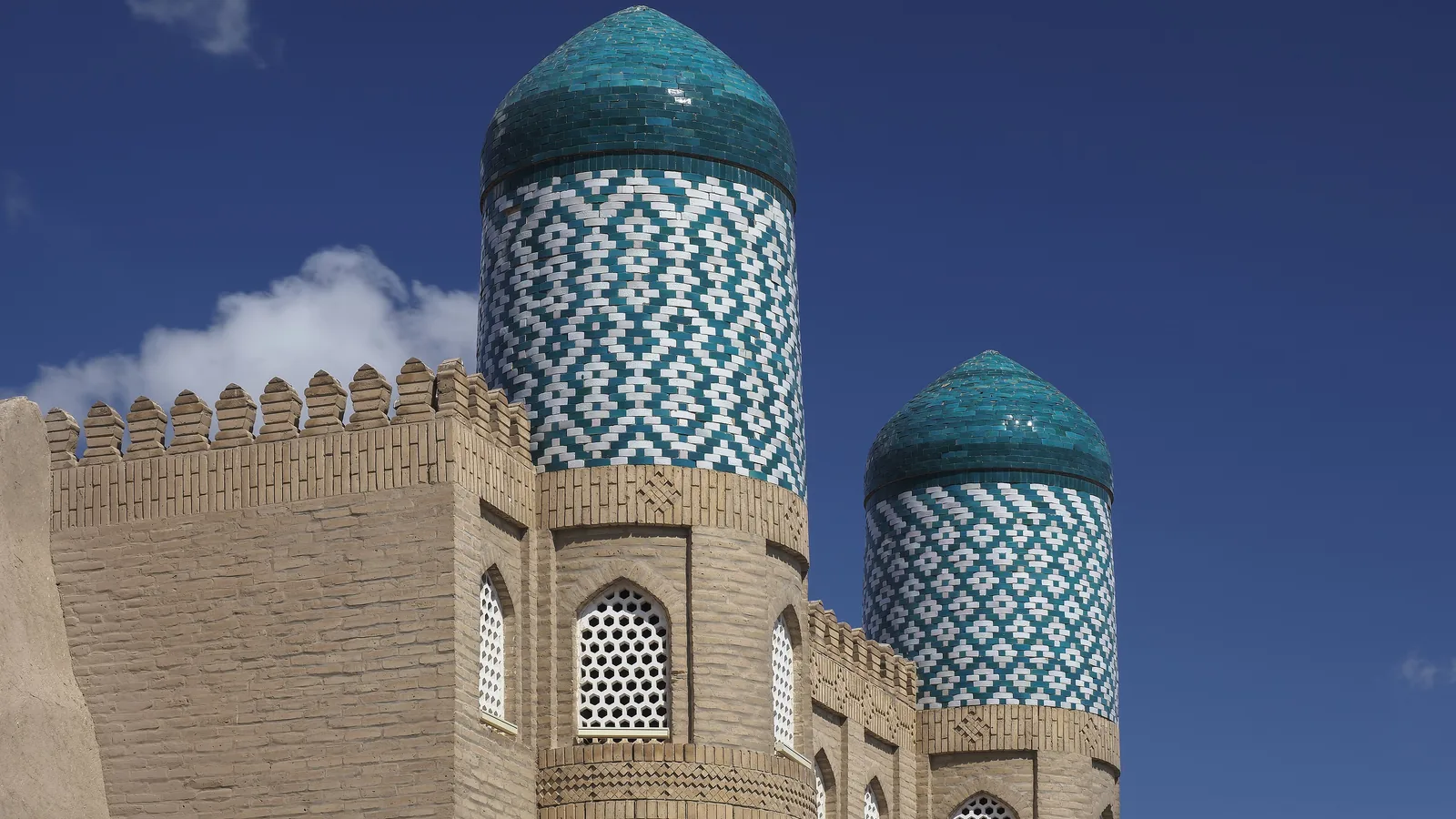
,_Itchan_Kala,_Khiva.jpg)
TL;DR — In August 1873 the khan of Khiva declared himself the “humble servant” of the Russian emperor, ceded the right bank of the Amu Darya and owed 2,200,000 rubles.
“Said Muhamed Rahim Bogadur Khan, declares himself the humble servant of the Emperor of All the Russias.” So begins Article 1 of the treaty that closed the Russian campaign against Khiva, as J. A. MacGahan of the New York Herald printed it in 1874. Russian troops under K. P. von Kaufman, governor-general of Turkestan, entered the city on May 29, 1873 by the Julian calendar that the Encyclopaedia Iranica uses, June 10 by the Gregorian calendar that MacGahan used; the two run twelve days apart. The khan came to Kaufman’s camp on June 14 (June 2), proclaimed the end of slavery on June 24 (June 12), and in August signed 18 articles that gave Russia the right bank of the Amu Darya, the navigation of the river and a war indemnity of 2,200,000 rubles.
Quick facts
- When
- December 1839 to February 20, 1840 (Perovsky's winter march from Orenburg fails) · May 4, 1873 (Markozov's Caspian column turns back) · June 9 and 10, 1873 (fight at the walls; Kaufman enters Khiva; May 29 by the Julian calendar) · June 14 / June 2 (the khan submits) · June 24 / June 12 (slavery abolished by proclamation) · July 1873 (Golovachev's raid on the Yomut) · August 23 or 24, 1873 (treaty signed; August 12 Julian) · December 1, 1873 (first indemnity payment due)
- Where
- Khiva, on the lower Amu Darya in what is now Uzbekistan; Orenburg, Tashkent, Mangyshlak and Chikishlar on the Atrek, the four starting points; the Ust-Urt plateau; the Atrek river route to Persia; the House of Commons at Westminster
- Who
- K. P. von Kaufman, governor-general of Turkestan; Mohammad Rahim II, khan of Khiva; Vasily Perovsky; Verevkin, Lomakin, Markozov and Golovachev; J. A. MacGahan of the New York Herald; Viscount Enfield, under-secretary for foreign affairs; Count Shuvaloff and Earl Granville
- Outcome
- The khan declared himself the "humble servant" of the Russian emperor, ceded the right bank of the Amu Darya, granted navigation of the river to Russian vessels only, confirmed the abolition of slavery and owed a war indemnity of 2,200,000 rubles, the first installment due December 1, 1873
Orenburg, December 1839
The previous Russian attempt had frozen on the steppe. Vasily Perovsky, governor of Orenburg, left the town about December 1, 1839, with what MacGahan gives as “a body of about 5000 men, with twenty-two guns and a transport train of 10,000 camels.” By mid-December the thermometer read 32 degrees below zero Reaumur. By February 1, 1840, at Ak-Bulak on the Ust-Urt plateau, fewer than 5,000 camels were left and 236 men had died, and Perovsky turned back; the troops reached Fort Emba on February 20. Iranica’s entry on Khiva says the column returned “having advanced only half the way.”
Yuri Bregel’s Iranica entry on Central Asia lists Russia’s grievances: Khiva’s reach into the Kazakh steppe, the plundering of Russian caravans and the Russian slaves held in the khanate. A mission under N. P. Ignatiev in 1858 “gave no results.” Russia stormed Tashkent in 1865, took Samarkand in May 1868 and made peace with Bukhara that June. From 1867 Kaufman held the new governorate-general of Turkestan with “the right to wage wars, conduct diplomatic negotiations, and conclude conventions and treaties with the neighboring states at his own discretion,” a power that earned him the nickname “Half-Emperor.”
Four columns and the questions in the Commons
In 1873 MacGahan counted “four different columns, starting from as many different points of the compass, more than a thousand miles apart”: Kaufman’s own from Tashkent, Verevkin’s from Orenburg, Lomakin’s from Mangyshlak on the Caspian, and Markozov’s from the Caspian shore by the Atrek, which ran short of water and on May 4 turned back. Iranica’s Khiva entry counts three directions, Bukhara, Orenburg and Mangyshlak. Verevkin’s guns bombarded the northern gate on June 9; Kaufman, ten miles off, entered by the Hazar-Asp gate the next day.
In the House of Commons on March 21, 1873, Viscount Enfield, under-secretary for foreign affairs, said he “had every reason to believe that neither English nor Russian representatives of the Press would be allowed to accompany the Expedition to Khiva”; MacGahan went anyway. On April 1 Enfield told Viscount Mahon that the government did “not intend sending either Captain Wellesley, the Military Attaché at St. Petersburg, or any other British Officer.” On June 12 the Foreign Office had “no official information” on a reported Russian move into the Atrek valley.
The khan on foot, June 14
Mohammad Rahim II had fled to the Turkmen. On June 14 he rode into his own garden, dismounted and “came forward on foot, taking off his tall sheepskin hat, and bowing low.” He climbed a carpeted brick platform and knelt before Kaufman.
After the occupation, MacGahan wrote, “open war arose between the slaves and their masters.” Persian slaves robbed Khivans, and a court-martial hanged two Persians for robbery, an act that many of Kaufman’s officers “strongly condemned.” Kaufman then ordered the khan to proclaim the end of slavery, and criers read it through the streets on June 24. No precise count existed. MacGahan gathered that about 30,000 Persians lived in Khiva, 27,000 of them slaves, while the dignitary Mat-Murad, who owned 400 himself, put the total at “only 3000 or 4000.” Iranica gives two figures for those freed, more than 5,000 in a Khorezmian history and fewer than 2,000 in a Russian source. Of three convoys of about 500 each sent toward Persia, those by Kinderly Bay and Krasnovodsk arrived; others “who went by the Attrek, fell into the hands of the Tekki-Turcomans, and perished miserably.” Iranica, citing Bregel’s study of 1961, records the same attack.
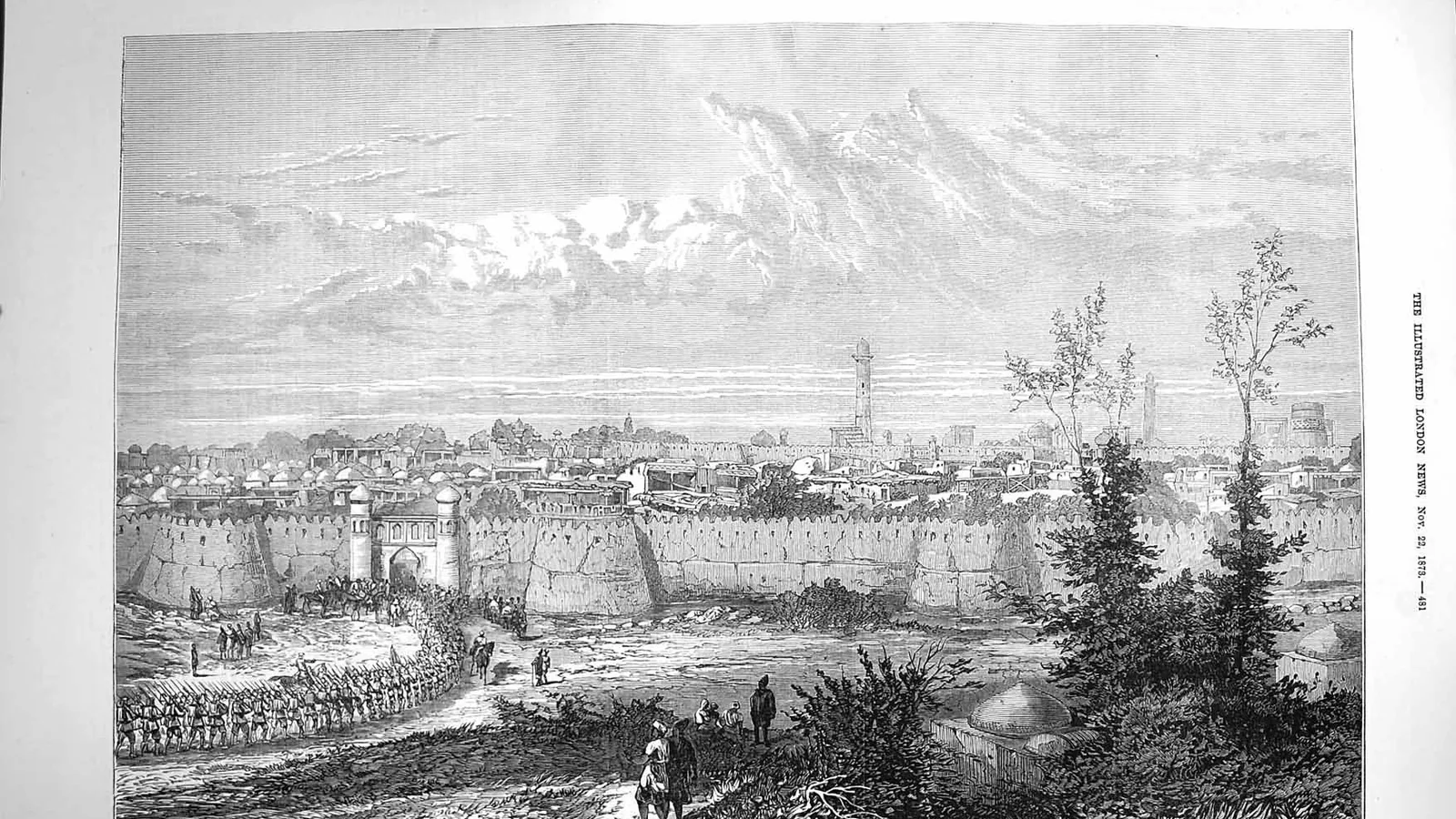

Kaufman's 300,000 rubles from the Yomut
Kaufman stayed two and a half months. The Yomut Turkmen, in Iranica’s words, “were not in a hurry to release their slaves and to pay to the Russians the considerable fine imposed by Kaufman.” MacGahan gives the fine: 300,000 rubles, due in two weeks. In July Kaufman sent General Golovachev against them. Iranica calls it “a brutal punitive raid against Khivan Turkmen, slaughtering hundreds of them and destroying their settlements.” MacGahan, who rode with the column, wrote after the fight of July 27 that “the power of the Yomud Turcomans was broken.”
Article 1 to Article 18, and a promise to Earl Granville
MacGahan dates the signing to “the 23rd of August”; Iranica’s Central Asia entry gives August 24, and its Khiva entry August 12, the same day by the Julian calendar. Article 3 reads: “The right bank of the Amu, with all the neighbouring territories which formerly belonged to Khiva, pass from the possession of the Khan to Russia, with all the peoples who inhabit them, including the nomads.” Article 5: “The navigation of the Amu is accorded exclusively to Russian vessels.” Article 17 kept “the emancipation of the slaves, as well as the prohibition against slavery in all future time,” in full force. Article 18 levied “a war indemnity of 2,200,000 rubles,” payable with interest at five percent, 100,000 rubles a year at first and 200,000 a year from 1881. On the ceded bank Russia set up the Amu Darya Department at Fort Petro-Aleksandrovsk.
MacGahan’s own sum was a guess: a frontier “advanced 300 miles farther south” and “80,000 square miles of territory” annexed. On the British side he wrote: “I do not know what were the exact terms of the agreement entered into by Count Shuvaloff and Earl Granville. It is, I believe, generally understood that the Russians simply agreed not to annex any territory south of the Oxus.” The khan kept his throne on the left bank, and the same treaty, MacGahan wrote, “reduced the Khan to the most complete state of vassalage.” The War Office’s map of the expedition, FO 925/1989, is in the National Archives at Kew. Article 18 fixed the time for the first payment: December 1, 1873.
Key facts
- Perovsky’s expedition left Orenburg about December 1, 1839, with about 5,000 men, 22 guns and 10,000 camels; it reached Fort Emba on the way back on February 20, 1840 (MacGahan). Iranica says it advanced “only half the way.”
- Kaufman, governor-general of Turkestan from 1867, could wage war and sign treaties “at his own discretion” and was nicknamed “Half-Emperor” (Iranica, Central Asia vii).
- MacGahan counted four columns in 1873, from Tashkent, Orenburg, Mangyshlak and the Caspian shore; Markozov’s Caspian column turned back on May 4. Iranica’s Khiva entry counts three directions.
- Kaufman entered Khiva on June 10, 1873 (May 29 Julian); the khan submitted on June 14 (June 2); slavery was abolished by proclamation on June 24 (June 12).
- MacGahan’s local estimate was about 30,000 Persians in Khiva, 27,000 of them slaves; Iranica gives more than 5,000 freed in a Khorezmian history and fewer than 2,000 in a Russian source.
- Three convoys of about 500 freed Persians each set out; those who went by the Atrek “fell into the hands of the Tekki-Turcomans, and perished miserably” (MacGahan).
- Kaufman fined the Yomut Turkmen 300,000 rubles (MacGahan) and in July sent Golovachev on a raid that Iranica says killed hundreds.
- The treaty, signed August 23 (MacGahan) or August 24 (Iranica; August 12 Julian), ceded the right bank of the Amu Darya, reserved the river to Russian vessels and levied 2,200,000 rubles, first payment December 1, 1873.
FAQ
When did Russia capture Khiva?
Kaufman entered Khiva on June 10, 1873, by the Gregorian calendar; the Encyclopaedia Iranica gives the same day as May 29 by the Julian calendar then used in Russia. The fighting at the walls took place on June 9.
Did the Treaty of Gandemian abolish slavery in Khiva?
The khan proclaimed the abolition on June 24, 1873 (June 12 Julian), before the treaty. Article 17 of the treaty, signed in August, confirmed "the emancipation of the slaves, as well as the prohibition against slavery in all future time."
How much did Khiva have to pay Russia in 1873?
Article 18 levied a war indemnity of 2,200,000 rubles, payable in installments with interest at five percent, starting at 100,000 rubles a year and rising to 200,000 a year from 1881, with the first payment due December 1, 1873.
Sources
- Encyclopaedia Iranica, Paolo Sartori and Yuri Bregel, "KHIVA," vol. XVI, fasc. 5, pp. 530-539, published December 14, 2020: the 1839/40 expedition, the three directions of advance, the Julian dates of May 29, June 2, June 12 and August 12, 1873, the Golovachev expedition, the two counts of freed slaves, the Amu Darya Department at Petro-Aleksandrovsk.
- Encyclopaedia Iranica, Yuri Bregel, "CENTRAL ASIA vii. In the 18th-19th Centuries," section on the Russian conquest: Russian grievances before 1839, the Ignatiev mission of 1858, Tashkent 1865, Samarkand and the Bukhara peace of 1868, Kaufman's powers and the nickname "Half-Emperor," Krasnovodsk 1869, the capture of Khiva on June 10, the July raid, the treaty of August 24, 1873.
- J. A. MacGahan, Campaigning on the Oxus, and the Fall of Khiva (New York: Harper and Brothers, 1874), full text on the Internet Archive: Perovsky's march of 1839-40, the four columns, the fight of June 9 and the entry of June 10, the khan's submission on June 14, the two Persians hanged, the proclamation of June 24, the slave estimates, the convoys, the Yomut fine of 300,000 rubles, the signing on August 23 and the full text of the 18 articles, the Shuvaloff-Granville passage.
- Historic Hansard, UK Parliament, "CENTRAL ASIA. RUSSIAN EXPEDITION TO KHIVA. QUESTION," HC Deb 21 March 1873, vol. 214, c. 1962: Viscount Enfield's answer that neither English nor Russian representatives of the press would be allowed to accompany the expedition.
- Historic Hansard, "RUSSIA. CENTRAL ASIA. THE KHIVA EXPEDITION. QUESTION," HC Deb 1 April 1873, vol. 215, c. 399: Viscount Enfield's answer to Viscount Mahon that no British officer, Captain Wellesley included, would accompany the expedition.
- Historic Hansard, "CENTRAL ASIA. THE ATTREK VALLEY. QUESTION," HC Deb 12 June 1873, vol. 216, c. 841: Mr. Bourke's question on the Atrek valley and the Foreign Office answer of "no official information."
- The National Archives, Kew, Discovery catalogue, record C3818553, FO 925/1989: "Khiva and surrounding country to illustrate the Russian expedition in 1873, with account of force employed. 45 miles to one inch. War Office." (Foreign Office Library, Maps and Plans, 1873).
Cite this article
- APA
- Our Earth's History. (2026, September 22). Humble servant of the Emperor of All the Russias: Khiva, August 1873. Our Earth's History. https://ourearthshistory.com/central-asia/modern/khiva-1873-kaufman-treaty-slavery-abolished/
- Chicago
- Our Earth's History. “Humble servant of the Emperor of All the Russias: Khiva, August 1873.” Our Earth's History, September 22, 2026. https://ourearthshistory.com/central-asia/modern/khiva-1873-kaufman-treaty-slavery-abolished/.
- MLA
- “Humble servant of the Emperor of All the Russias: Khiva, August 1873.” Our Earth's History, 22 Sep. 2026, https://ourearthshistory.com/central-asia/modern/khiva-1873-kaufman-treaty-slavery-abolished/.
Text licensed CC BY-NC-ND 4.0. Found an error? Tell us.