Kume Kunitake's 1878 record of the Iwakura Mission, 1871-1873

TL;DR — Kume Kunitake published the Iwakura Mission’s official record in 1878; Tsuda Ume, age six, sailed with it and later founded a school in Tokyo.
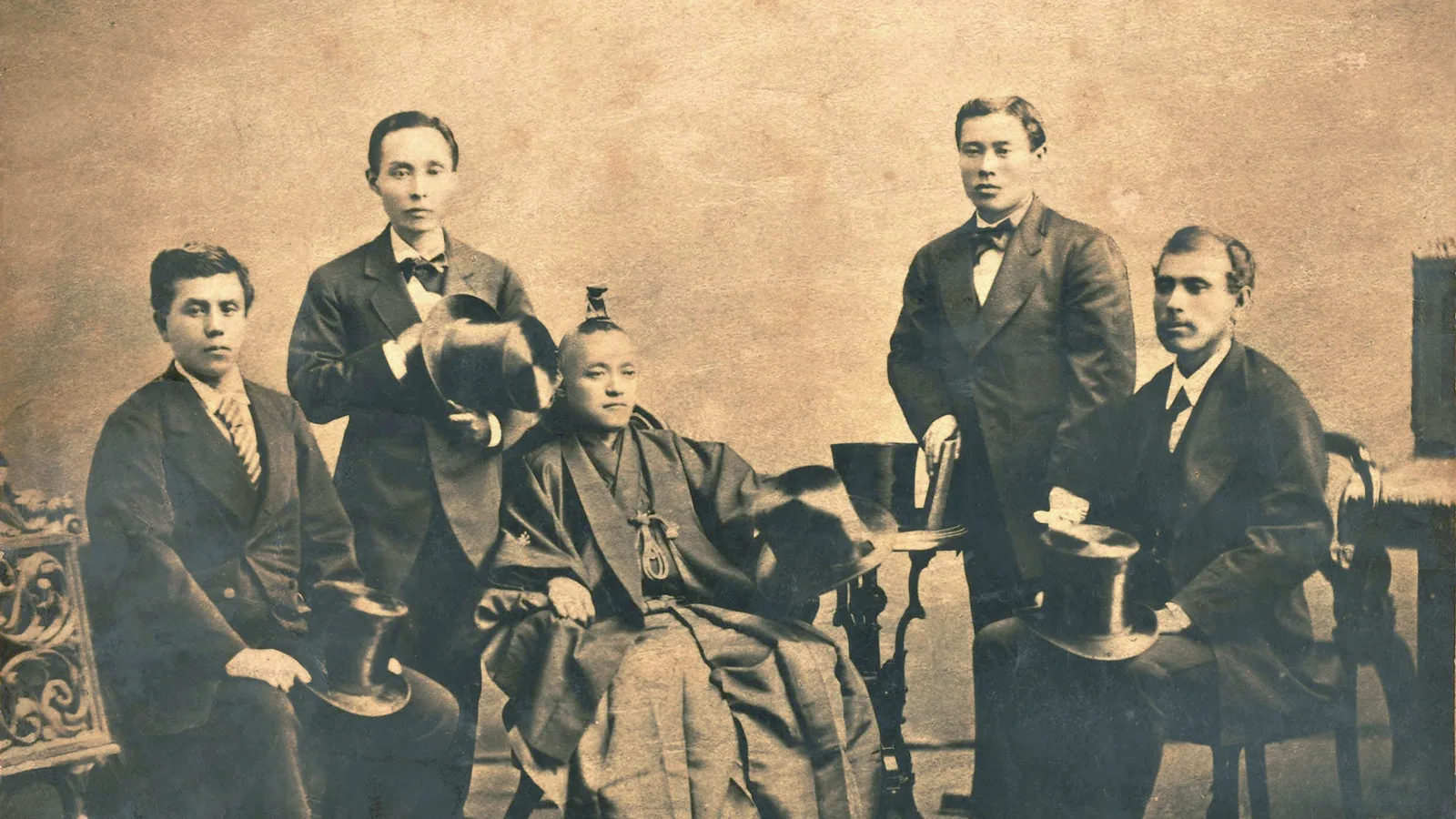
The Iwakura Mission left Japan in December 1871, the National Diet Library’s “Modern Japan in archives” records, “led by Iwakura Tomomi serving as ambassador plenipotentiary.” Kido Takayoshi, Okubo Toshimichi and Ito Hirobumi went along as deputy ambassadors, and the mission, the library adds, “lasted approximately two years, making a circuit of the United States, Britain, France, Eastern Europe, and Russia, etc.” Its purpose, the library states, “was to make preparations for treaty revisions and to conduct an investigation of various countries’ institutions and cultures.” A deputy ambassador ordered a draft constitution in Germany during the tour, the secretary Kume Kunitake edited a five-volume official account published in 1878, and a six-year-old girl named Tsuda Ume sailed with the party.
Quick facts
- When
- December 1871 (mission departs Yokohama) · winter 1872 (Kido orders Aoki's draft constitution) · July 1873 (Kido's constitution proposal to the government) · 1873 (Nubar Pasha's advice at Constantinople; Tsuda's baptism) · 1878 (Kume's Beio Kairan Jikki published) · 1888 (Kume becomes Imperial University professor) · 1892 (Kume's censure and resignation) · 1900 (Tsuda founds Joshi Eigaku Juku) · August 16, 1929 (Tsuda dies)
- Where
- Yokohama; Berlin; Constantinople; Tokyo; San Francisco; Georgetown, near Washington; Bryn Mawr, Pennsylvania; Kamakura
- Who
- Iwakura Tomomi; Kido Takayoshi; Aoki Shuzo; Kume Kunitake; Tsuda Ume; Thomas Hunt Morgan; Nubar Pasha
- Outcome
- Kido's constitution proposal reached the government in July 1873; Kume's official record of the mission was published in five volumes in 1878; Tsuda Ume founded a women's English school in 1900, the forerunner of Tsuda University
A constitution ordered from Germany, 1872
While the mission’s deputy ambassadors were still touring Europe, in the winter of 1872 Kido Takayoshi ordered Aoki Shuzo, then living in Germany, to draft a constitution, the National Diet Library’s page on Aoki’s conception of a constitution records. Aoki, who had studied under the German constitutional scholar Rudolf von Gneist, wrote a document titled Dai Nippon Seiki, together with a separate paper listing his reasons. The following year, in July 1873, two months before the mission returned to Japan, Kido presented the government with his own Kenpo Seitei no Kengensho, or Proposal for the Formulation of a Constitution, based on Aoki’s list of reasons, the library states. In a 1980 article in the journal Kokusai Seiji, the historian Toshihiko Mori described the mission’s own membership as a product of factional rivalry: Okubo Toshimichi, of the Satsuma faction and the Ministry of Finance, according to Mori’s English abstract, “succeeded to isolate Kido from the government as a vice-ambassador of the mission.”
Kume Kunitake's account of the mission
Kume Kunitake was born in 1839 in the castle town of Saga, the third son of the Saga domain retainer Kume Kunisato and his wife Waka, and studied at the domain school Kodokan and at the shogunate’s Shoheizaka Gakumonjo before serving the former daimyo Nabeshima Naomasa, according to the Kume Museum. He traveled as secretary to the Iwakura Mission through what the museum’s page calls twelve countries and compiled the mission’s report afterward. The National Diet Library Search bibliographic database lists the resulting book, Tokumei Zenken Taishi Beio Kairan Jikki, edited by Kume, published by Hakubunsha in Tokyo, with 1878 as its date of issue; its first volume, subtitled the section on the United States of America, ran to 27 preliminary pages, 18 pages of illustrations and 397 pages of text. The Kume Museum describes the finished work as valued for “its broad-ranging observation and elevated prose.”
1892: censure, then a second career
Kume went on to compile national history at the Grand Council of State’s history bureau, the Kume Museum records, and in 1888 became a professor at the Imperial University’s college of letters, now the Faculty of Letters of the University of Tokyo. In 1892 what the museum calls a “censure incident” forced his resignation. The museum’s archive page states that Kume, working from a positivist method to correct what he judged errors in earlier historical scholarship, had published views overturning accepted opinion, among them that “the Taiheiki is of no use to historical scholarship” and that “Shinto is an old custom of worshipping heaven”; that page does not itself name which publication triggered the 1892 resignation. After leaving the university, Kume became a lecturer, and from 1911 a professor, at Tokyo Senmon Gakko, the school founded by Okuma Shigenobu that was renamed Waseda University in 1902.
'Useful advice about mixed court': a stop in Constantinople
At Constantinople in 1873, according to Sayoko Fukushima’s 1980 article in the journal Oriento, the Egyptian foreign minister Nubar Pasha “gave useful advice about mixed court to a member of Iwakura Mission,” and Egypt’s rules for mixed courts were translated into Japanese in 1874. Fukushima’s article does not name the mission member who received the advice. The same article states that when Japan later demanded treaty revision from each country, “Great Britain made decision to set up a mixed court for Japan as like Egypt.”
Six years old: Tsuda Ume's crossing
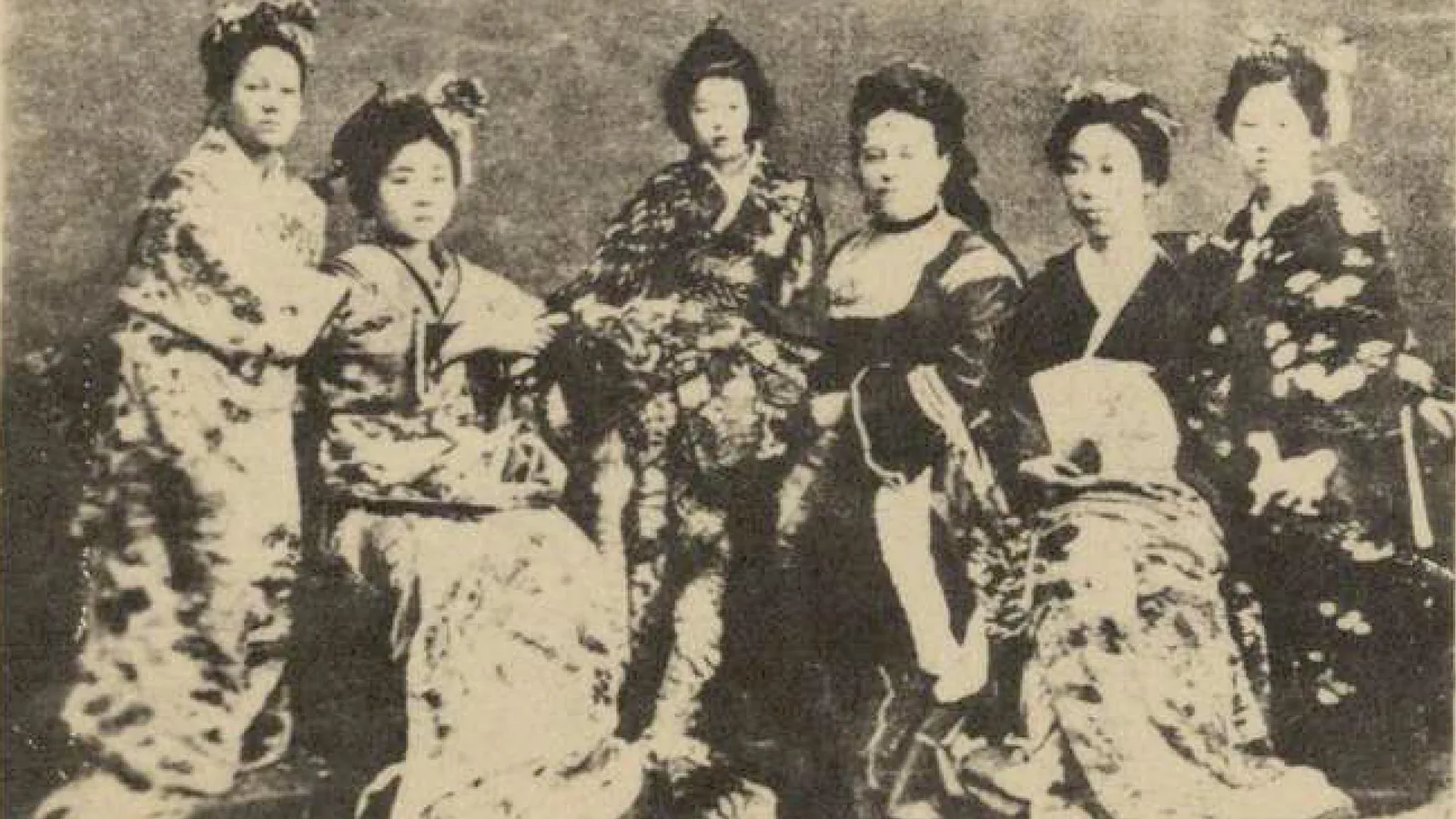
Among the party that left Yokohama in December 1871 was a six-year-old girl, Tsuda Ume, the youngest of five girls recruited by the Hokkaido Colonization Board as Japan’s first female students sent abroad, according to Tsuda University’s official history. The ship carrying the group, the America Maru, reached San Francisco in January 1872, and Tsuda, after passing through Chicago, was placed in the Georgetown, near Washington, home of the Lanman family 70 days after leaving Japan, the university’s account states. In the spring of 1873 she told the Lanmans she wished to be baptized; the baptism took place on July 13 of that year at the Old Swedes’ Church, in Upper Merion near Bridgeport outside Philadelphia, where the officiating priest had originally planned an infant baptism but administered an adult one instead because, the university’s history records, “she was so composed.” She returned to Japan in November 1882, after eleven years of American schooling. In 1889 she enrolled at Bryn Mawr College, where, the historian Yasushi Furukawa wrote in a 2010 article in Kagakushi Kenkyu, she majored in biology rather than the “teaching method” for which the Japanese government had granted her leave, even though her employer, the Peeresses School in Tokyo, “officially banned science education for noble women.” Under Thomas Hunt Morgan, later a Nobel laureate, she carried out research on the development of frog eggs that appeared as a joint paper in a British scientific journal in 1894, Furukawa’s article states. Furukawa’s abstract adds that Tsuda gave up “a possibly great career as a biologist in American academe” because she judged a scientific career in Meiji Japan closed to women, and chose instead to build an English school for women. She founded that school, the Joshi Eigaku Juku, forerunner of Tsuda University, in 1900, and died at her villa in Kamakura on August 16, 1929, at the age of 64, Tsuda University’s history states.

Key facts
- The National Diet Library records that the Iwakura Mission departed Japan in December 1871 with the stated purpose “to make preparations for treaty revisions and to conduct an investigation of various countries’ institutions and cultures.”
- In the winter of 1872, Kido Takayoshi ordered Aoki Shuzo, in Germany, to draft a constitution titled Dai Nippon Seiki; Kido submitted his own constitution proposal to the government in July 1873.
- Toshihiko Mori’s 1980 article in Kokusai Seiji states that Okubo Toshimichi “succeeded to isolate Kido from the government as a vice-ambassador of the mission.”
- Kume Kunitake, born in Saga in 1839, served as the mission’s secretary and edited its official report, published in 1878 by Hakubunsha in Tokyo.
- Kume became a professor at the Imperial University’s college of letters in 1888 and resigned in 1892 after a censure incident; he later taught at Tokyo Senmon Gakko, renamed Waseda University in 1902.
- At Constantinople in 1873, Egyptian foreign minister Nubar Pasha gave a mission member advice on mixed courts, and Egypt’s mixed-court rules were translated into Japanese in 1874, Sayoko Fukushima’s 1980 article states.
- Tsuda Ume, age six, sailed with the mission in December 1871 and was placed in a Georgetown household near Washington 70 days after leaving Japan, according to Tsuda University’s history.
- Tsuda studied biology at Bryn Mawr College under Thomas Hunt Morgan in 1889-1892, founded the Joshi Eigaku Juku in 1900, and died on August 16, 1929.
FAQ
What was the Iwakura Mission's stated purpose?
The National Diet Library's "Modern Japan in archives" gives the purpose as preparing for treaty revisions and investigating the institutions and cultures of the countries the mission visited; its own page on the mission does not record a treaty revision achieved.
Who wrote the official record of the mission?
Kume Kunitake, the mission's secretary, edited the report, published as Tokumei Zenken Taishi Beio Kairan Jikki in five volumes by Hakubunsha in Tokyo, with 1878 given as the date of issue in the National Diet Library Search bibliographic record.
Who was Tsuda Ume?
Tsuda Ume was the youngest of five girls recruited by the Hokkaido Colonization Board to study abroad; she left Japan with the Iwakura Mission at age six in December 1871, studied biology at Bryn Mawr College, and founded the Joshi Eigaku Juku, forerunner of Tsuda University, in 1900.
Sources
- National Diet Library, "Modern Japan in archives" - 1-7 Iwakura Mission
- National Diet Library, "Modern Japan in archives" - 1-6 AOKI Shuzo's Conception of a Constitution
- Toshihiko Mori, "Iwakura mission and Takayoshi Kido," Kokusai Seiji (The Japan Association of International Relations), no. 66, 1980, pp. 128-147
- Kume Museum, biographical page on Kume Kunitake
- Kume Museum, archive page on Kume Kunitake
- National Diet Library Search, bibliographic record for Tokumei Zenken Taishi Beio Kairan Jikki, vol. 1
- Sayoko Fukushima, "Consular Courts and Japan during the Early Meiji Era," Oriento (The Society for Near Eastern Studies in Japan), vol. 23, no. 2, 1980, pp. 99-116
- Tsuda University, official history page ("The History of Tsuda")
- Yasushi Furukawa, "Umeko Tsuda and Biology: A Historical Perspective of Science and Gender," Kagakushi Kenkyu (History of Science Society of Japan), vol. 49, no. 253, 2010, pp. 11-21
Cite this article
- APA
- LETTER. (2026, September 28). Kume Kunitake's 1878 record of the Iwakura Mission, 1871-1873. Our Earth's History. https://ourearthshistory.com/east-asia/modern/iwakura-mission-1871-1873-kume-record-1878-tsuda-ume/
- Chicago
- LETTER. “Kume Kunitake's 1878 record of the Iwakura Mission, 1871-1873.” Our Earth's History, September 28, 2026. https://ourearthshistory.com/east-asia/modern/iwakura-mission-1871-1873-kume-record-1878-tsuda-ume/.
- MLA
- LETTER. “Kume Kunitake's 1878 record of the Iwakura Mission, 1871-1873.” Our Earth's History, 28 Sep. 2026, https://ourearthshistory.com/east-asia/modern/iwakura-mission-1871-1873-kume-record-1878-tsuda-ume/.
Text licensed CC BY-NC-ND 4.0. Found an error? Tell us.