Hiroshima, August 6, 1945: 70,000 dead by one count, 237,000 by another
.jpg)
TL;DR — Little Boy burst over Hiroshima at 8:16:02 on August 6, 1945. The US Strategic Bombing Survey counted 70,000 dead; the City of Hiroshima counts 237,000; two other institutions fall between.
The Enola Gay began its takeoff roll from Tinian at 2:45 a.m. on August 6, 1945, and by the Atomic Heritage Foundation’s timeline released the 9,700-pound Little Boy at 8:15:15 Hiroshima time from 31,060 feet. Forty-four seconds later, at 8:16:02, the bomb exploded above the city. The statement issued in Washington that day in President Harry S. Truman’s name said that “That bomb had more power than 20,000 tons of T.N.T.” The Strategic Bombing Survey, on the ground that autumn, estimated 70,000 dead. The foundation counts 90,000 to 166,000 in four months, the US Department of Energy 200,000 or more after five years, and the City of Hiroshima 237,000. Each figure counts a different thing.
Quick facts
- When
- July 16, 1945 (first test of an atomic weapon) · July 26, 1945 (Potsdam ultimatum) · August 6, 1945 (takeoff 2:45 Tinian time, release 8:15:15, burst 8:16:02 Hiroshima time; Truman's statement) · August 9, 1945 (Nagasaki) · August 15, 1945 (surrender broadcast) · October 14 to November 26, 1945 (US Strategic Bombing Survey on site) · May 1947 (survey published) · 1949 (Tange group wins park competition) · August 24, 1955 (museum opens)
- Where
- Hiroshima, on the delta of the Ota River at the northwestern corner of the Inland Sea, Honshu, Japan; the aiming point was the Aioi Bridge; the Industrial Promotion Hall stood about 160 meters from the hypocenter on the Motoyasu River; Tinian in the Mariana Islands
- Who
- Paul Tibbets, pilot, and Thomas Ferebee, bombardier, of the Enola Gay; President Harry S. Truman; Secretary of War Henry Stimson; the US Strategic Bombing Survey's Physical Damage Division; Jan Letzel, architect of the Industrial Promotion Hall; Kenzo Tange's group; Shogo Nagaoka, first director of the Peace Memorial Museum
- Outcome
- A city with an estimated 245,000 people on August 6 by the survey's count lost about 60,000 of 90,000 buildings; the dead are counted at 70,000 (survey, 1947), 90,000 to 166,000 in four months (Atomic Heritage Foundation), 200,000 or more after five years (US Department of Energy) and 237,000 directly or indirectly (City of Hiroshima)
Sixteen hours ago: the statement and the yield
The Truman Library’s copy of the statement opens: “SIXTEEN HOURS AGO an American airplane dropped one bomb on Hiroshima, an important Japanese Army base.” The library’s note explains that the text was drafted before Truman left Germany, that Secretary of War Henry Stimson was authorized to release it, and that Truman learned of the drop from a message handed to him aboard the U.S.S. Augusta on the way home from Potsdam. The statement tied the attack to the ultimatum of July 26: “Their leaders promptly rejected that ultimatum.”
The foundation’s main page describes Little Boy as “a uranium gun-type bomb that exploded with about thirteen kilotons of force”; its own timeline gives 12.5 to 18 kilotons with a best estimate of 15. The survey wrote that the bomb exploded “in the air 2,000 feet above a post office slightly northwest of the heart of the city,” and recorded that four Japanese measurements averaged 1,970 feet. The Hiroshima Peace Memorial Museum’s history gives approximately 600 meters. The foundation’s timeline puts it at 1,968 feet above Dr. Shima’s clinic, 550 feet from the aiming point, the T-shaped Aioi Bridge chosen by the bombardier Thomas Ferebee.
A city of 245,000, or of 280,000 to 290,000
The survey’s Physical Damage Division worked in Hiroshima from October 14 to November 26, 1945, and published in May 1947. It described the seventh largest city in Japan, with a wartime peak population of 380,000 “but five completed evacuations and a sixth in progress had reduced this figure to an estimated 245,000 by 6 August 1945.” The foundation starts from a different base: 280,000 to 290,000 civilians and 43,000 soldiers.
The survey gave “approximately 60,000 of 90,000 buildings over an area of 9.5 square miles” as totally or severely damaged. The foundation’s timeline repeats 60,000 of 90,000; its main page says 70,000 of 76,000 buildings damaged or destroyed, 48,000 of them razed.
Four counts of the dead
The survey wrote: “The dead were estimated at 70,000, with an equal number injured.” The team had arrived ten weeks after the bomb. The Atomic Heritage Foundation writes that “between 90,000 and 166,000 people are believed to have died from the bomb in the four-month period following the explosion.” The same page reports that the Department of Energy “has estimated that after five years there were perhaps 200,000 or more fatalities,” and that the City of Hiroshima “has estimated that 237,000 people were killed directly or indirectly by the bomb’s effects, including burns, radiation sickness, and cancer.” The four numbers stop the clock at different hours: November 1945, the end of 1945, five years on, and no closing date at all.
The later counts rest on the people the city calls Hibakusha, which its English pages gloss as Atomic Bomb Survivors. The Radiation Effects Research Foundation, in its own words “a US-Japan cooperative research institute that investigates the health effects of atomic bomb radiation for peaceful purposes,” holds the Atomic Bomb Casualty Commission’s general report of 1947.
On August 9 the 21-kiloton plutonium bomb Fat Man was dropped on Nagasaki, where the foundation estimates 263,000 people were present and 40,000 to 75,000 died immediately. On August 15 Hirohito announced the decision to surrender over the radio, and the foundation’s timeline records that many Japanese were hearing the Emperor’s voice for the first time.
160 meters from the hypocenter
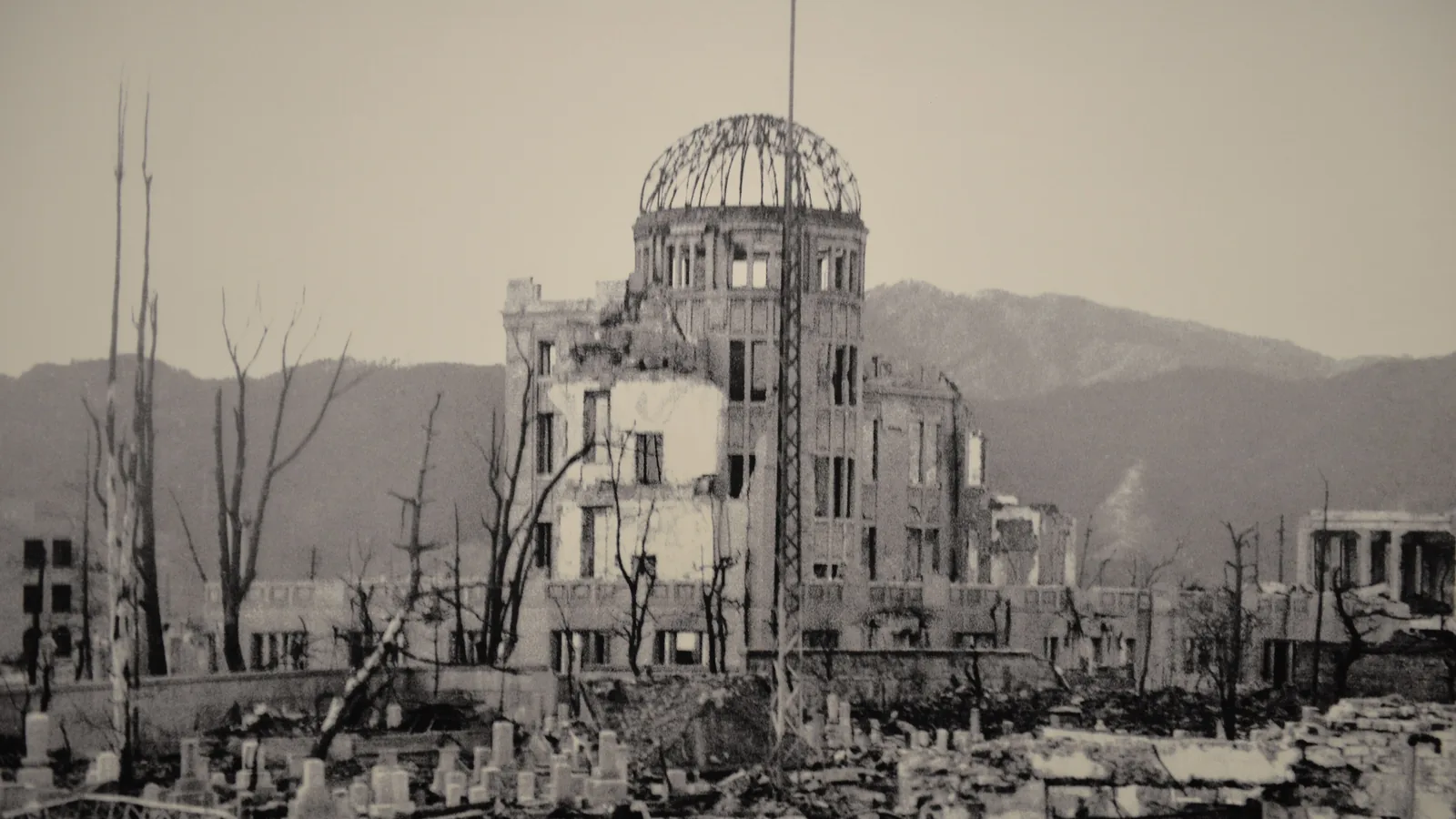
The Industrial Promotion Hall stood on the bank of the Motoyasu River, and the City of Hiroshima’s pages put it “approximately 160 meters northwest of the hypocenter.” The foundation’s timeline places the same building 525 feet southwest of it, the same distance in the opposite quarter. The architect Jan Letzel designed it for Hiroshima Prefecture; construction began in 1914 and the three-story brick building opened the following year. On August 6, 1945, the city records, “Everyone working in the building at the time perished instantly,” while the central part of the structure stood because the blast came from almost directly above. The City Council voted to preserve the ruin in 1966, and in December 1996 the city’s page records the Atomic Bomb Dome becoming “a common heritage of the human race.”
A competition in 1949, a museum in 1955
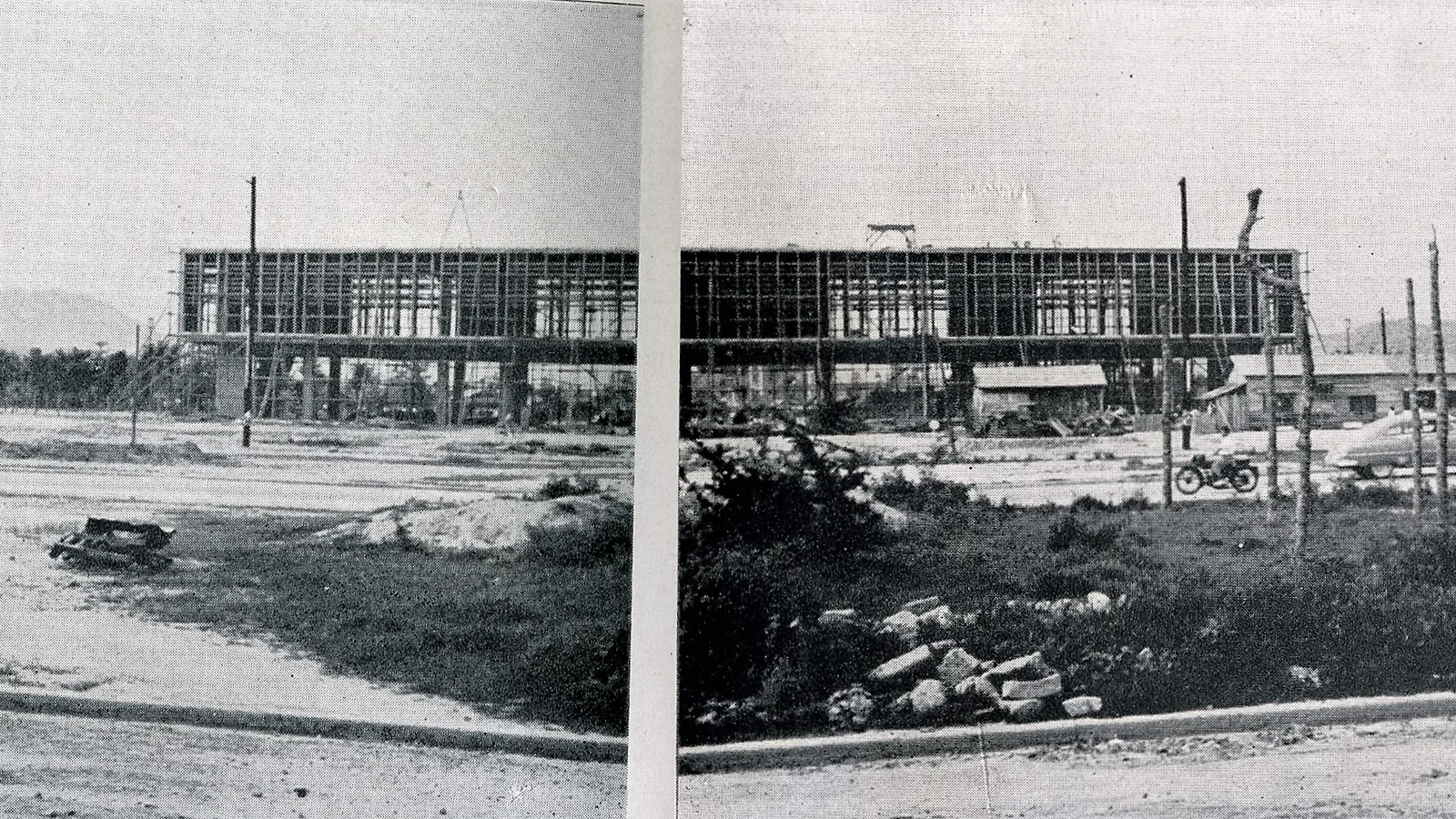
The museum’s own history dates the Peace Memorial City Construction Law to August 6, 1949, and records that the proposal of Kenzo Tange’s group won the design competition for Peace Memorial Park that year. A month later the first public display of bomb debris, collected by the geologist Shogo Nagaoka, opened in the Central Public Hall. Construction of the museum began in February 1951. The municipal bylaw was issued on August 6, 1955, and on August 24, 1955 the Hiroshima Peace Memorial Museum opened with Nagaoka as its first director.
Every year on August 6 the City of Hiroshima holds a Peace Memorial Ceremony at which the mayor issues a Peace Declaration, and its 2022 ceremony carried video messages from Hibakusha. Since September 9, 1968, when France tested a hydrogen bomb, the city has sent a formal letter of protest to the state responsible for every nuclear test; its count stands at 615 letters against more than 2,000 tests since July 16, 1945.
The bomb that Truman’s statement measured at more than 20,000 tons is now assessed by the foundation at 13 or 15 kilotons, and its dead are counted at 70,000, 90,000 to 166,000, 200,000 or 237,000 depending on which institution is asked and when it stopped counting. The times of the mission, 2:45, 8:15:15 and 8:16:02, come from one source, the foundation’s timeline; the survey’s report gives the drop as “at 0816 hours.”

Key facts
- The Enola Gay began its takeoff roll from Tinian at 2:45 a.m. on August 6, 1945; Little Boy, 9,700 pounds, was released at 8:15:15 Hiroshima time from 31,060 feet and exploded at 8:16:02 (Atomic Heritage Foundation timeline).
- Truman’s statement of August 6, 1945 said the bomb “had more power than 20,000 tons of T.N.T.”; the foundation gives about 13 kilotons on one page and 12.5 to 18 kilotons, best estimate 15, on its timeline.
- Burst height: about 2,000 feet above a post office (US Strategic Bombing Survey), 1,970 feet as the average of four Japanese findings (same report), approximately 600 meters (Peace Memorial Museum).
- Population: a wartime peak of 380,000 reduced by five completed evacuations and a sixth in progress to an estimated 245,000 on August 6 (survey); 280,000 to 290,000 civilians and 43,000 soldiers (foundation).
- Buildings: about 60,000 of 90,000 over 9.5 square miles totally or severely damaged (survey); 70,000 of 76,000 damaged or destroyed, 48,000 razed (foundation main page).
- Dead: 70,000 with an equal number injured (survey, published May 1947); 90,000 to 166,000 in the four months after the explosion (foundation); 200,000 or more after five years (Department of Energy, as reported by the foundation); 237,000 directly or indirectly (City of Hiroshima, as reported by the foundation).
- The Industrial Promotion Hall, designed by Jan Letzel and opened in 1915, stood approximately 160 meters northwest of the hypocenter; everyone inside died (City of Hiroshima).
- Kenzo Tange’s group won the Peace Memorial Park competition in 1949; museum construction began in February 1951; the museum opened on August 24, 1955 with Shogo Nagaoka as director (museum history).
FAQ
How many people died at Hiroshima?
No single number exists. The US Strategic Bombing Survey, on site from October 14 to November 26, 1945, estimated 70,000 dead and as many injured. The Atomic Heritage Foundation counts 90,000 to 166,000 deaths in the four months after the bomb, reports the US Department of Energy's estimate of 200,000 or more after five years, and reports the City of Hiroshima's figure of 237,000 killed directly or indirectly, including by burns, radiation sickness and cancer.
How powerful was the Hiroshima bomb?
Truman's statement of August 6, 1945 said it had "more power than 20,000 tons of T.N.T." The Atomic Heritage Foundation's later assessment is about 13 kilotons on its main page and 12.5 to 18 kilotons, with a best estimate of 15, on its mission timeline. The burst height is given as about 2,000 feet by the Strategic Bombing Survey and approximately 600 meters by the Peace Memorial Museum.
What is the Atomic Bomb Dome?
The ruin of the Hiroshima Prefectural Industrial Promotion Hall, a brick exhibition hall designed by the architect Jan Letzel, begun in 1914 and opened in 1915. The City of Hiroshima places it approximately 160 meters northwest of the hypocenter; the central part survived because the blast came from almost directly above. The City Council resolved to preserve it in 1966.
Sources
- Harry S. Truman Presidential Library and Museum, Public Papers, no. 93: "Statement by the President Announcing the Use of the A-Bomb at Hiroshima," August 6, 1945, with the library's note on drafting and release.
- Atomic Heritage Foundation, National Museum of Nuclear Science and History, "Bombings of Hiroshima and Nagasaki, 1945" (yield, population, casualty estimates, Nagasaki).
- Atomic Heritage Foundation, National Museum of Nuclear Science and History, "Hiroshima and Nagasaki Bombing Timeline" (mission times, altitudes, burst height, August 15 broadcast).
- United States Strategic Bombing Survey, Physical Damage Division, The Effects of the Atomic Bomb on Hiroshima, Japan, vol. I (dates of survey October 14 to November 26, 1945; published May 1947), National Library of Medicine copy, full text on the Internet Archive.
- City of Hiroshima, "The Atomic Bombing" (the Industrial Promotion Hall, approximately 160 meters from the hypocenter).
- City of Hiroshima, "The Story of the Atomic Bomb Dome" (Jan Letzel, construction from 1914, preservation resolution of 1966, December 1996).
- Hiroshima Peace Memorial Museum, "Museum History" (burst at approximately 600 meters; the 1949 competition; construction from February 1951; opening August 24, 1955).
- City of Hiroshima, "Peace Declaration" (the annual Peace Memorial Ceremony of August 6).
- City of Hiroshima, "Letters of Protest, etc." (protests against nuclear tests since September 9, 1968; the count of 615).
- City of Hiroshima, "Peace Memorial Ceremony" (video messages from Hibakusha, Atomic Bomb Survivors, at the 2022 ceremony).
- Radiation Effects Research Foundation, "Historical Materials" (the foundation's description of itself; the Atomic Bomb Casualty Commission General Report 1947).
Cite this article
- APA
- Our Earth's History. (2026, September 22). Hiroshima, August 6, 1945: 70,000 dead by one count, 237,000 by another. Our Earth's History. https://ourearthshistory.com/east-asia/contemporary/hiroshima-august-6-1945-how-the-dead-are-counted/
- Chicago
- Our Earth's History. “Hiroshima, August 6, 1945: 70,000 dead by one count, 237,000 by another.” Our Earth's History, September 22, 2026. https://ourearthshistory.com/east-asia/contemporary/hiroshima-august-6-1945-how-the-dead-are-counted/.
- MLA
- “Hiroshima, August 6, 1945: 70,000 dead by one count, 237,000 by another.” Our Earth's History, 22 Sep. 2026, https://ourearthshistory.com/east-asia/contemporary/hiroshima-august-6-1945-how-the-dead-are-counted/.
Text licensed CC BY-NC-ND 4.0. Found an error? Tell us.