Ten o'clock at Panmunjom, July 27, 1953: an armistice with no end date
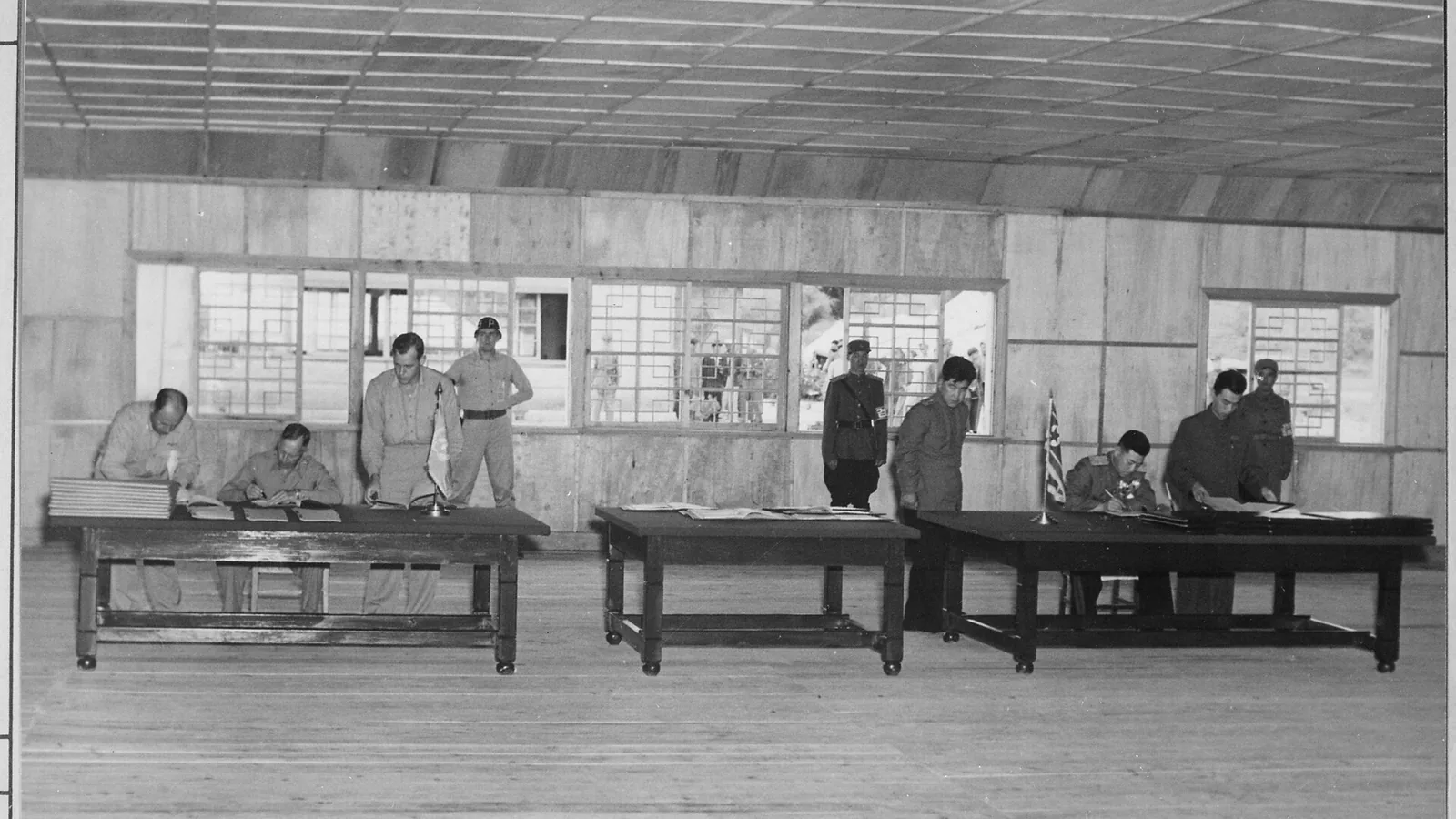
TL;DR — The armistice text names no state as a party. Harrison and Nam Il signed it at Panmunjom on July 27, 1953, at 10 a.m.; Clark countersigned that afternoon at Munsan-ni.
“Agreement between the Commander-in-Chief, United Nations Command, on the one hand, and the Supreme Commander of the Korean People’s Army and the Commander of the Chinese People’s volunteers, on the other hand, concerning a military armistice in Korea.” That is the opening line of the document the National Archives holds as Treaties and Other International Agreements Series #2782. Lt. Gen. William K. Harrison Jr., for the United Nations Command, and Gen. Nam Il, for the Korean People’s Army and the Chinese People’s Volunteers, signed it at Panmunjom at 10 a.m. on July 27, 1953. Its stated purpose, the text goes on, was “an armistice which will insure a complete cessation of hostilities and of all acts of armed force in Korea until a final peaceful settlement is achieved.”
Quick facts
- When
- July 10, 1951 (negotiations open) · April 1, 1953 (voluntary repatriation agreed) · July 27, 1953, 10 a.m. Korea time (signing at Panmunjom) · July 27, 1953, 10 p.m. (cease-fire takes effect)
- Where
- Panmunjom, Korea (signing); Munsan-ni (General Clark's countersignature)
- Who
- Lt. Gen. William K. Harrison Jr. (United Nations Command); Gen. Nam Il (Korean People's Army and Chinese People's Volunteers); Gen. Mark W. Clark (United Nations Command, countersignature)
- Outcome
- A military demarcation line, a 4-kilometer-wide demilitarized zone, a Military Armistice Commission and a Neutral Nations Supervisory Commission were established, along with a two-track process for prisoner repatriation. The Republic of Korea did not sign. The text states it remains in effect until superseded by a peaceful settlement.
July 10, 1951: two years of talks over prisoners
Delegations from both sides met for the first time on July 10, 1951, according to historian Frank Jones, writing for the U.S. Army War College’s War Room. Jones records that within seventeen days they agreed on an agenda covering four issues: “the location and demarcation of a truce line and demilitarized zone; arrangements of a ceasefire and armistice, including a Military Armistice Commission . . . and a supervisory organization . . .; release and repatriation of prisoners of war; and recommendations to the concerned governments regarding translating the truce into a peace settlement.” Jones traces early progress: a provisional demarcation line agreed in November 1951, terms for a political conference in February 1952, and the supervisory-commission question largely settled by April 1952.
Prisoner repatriation became the main obstacle. The United States insisted, as a matter of principle, that repatriation be voluntary, and Jones writes that “in October 1952, the UNC negotiators broke off negotiations over a lack of progress regarding the repatriation of prisoners.” Agreement did not come until April 1, 1953, when, in Jones’s words, “the Chinese-Korean coalition” accepted voluntary repatriation of prisoners of war. On the length of the talks the two federal accounts differ: the National Archives gives “158 meetings spread over two years and 17 days,” while Jones counts “nearly 200 negotiating sessions and 400 hours of discussions” over the same span. In June 1953, President Syngman Rhee ordered the unilateral release of North Korean prisoners who had refused repatriation. The State Department’s published chapter summary for this period records that the release suspended the Panmunjom negotiations, and that a mission led by Walter Robertson preceded their resumption.
The demarcation line and a 4-kilometer zone
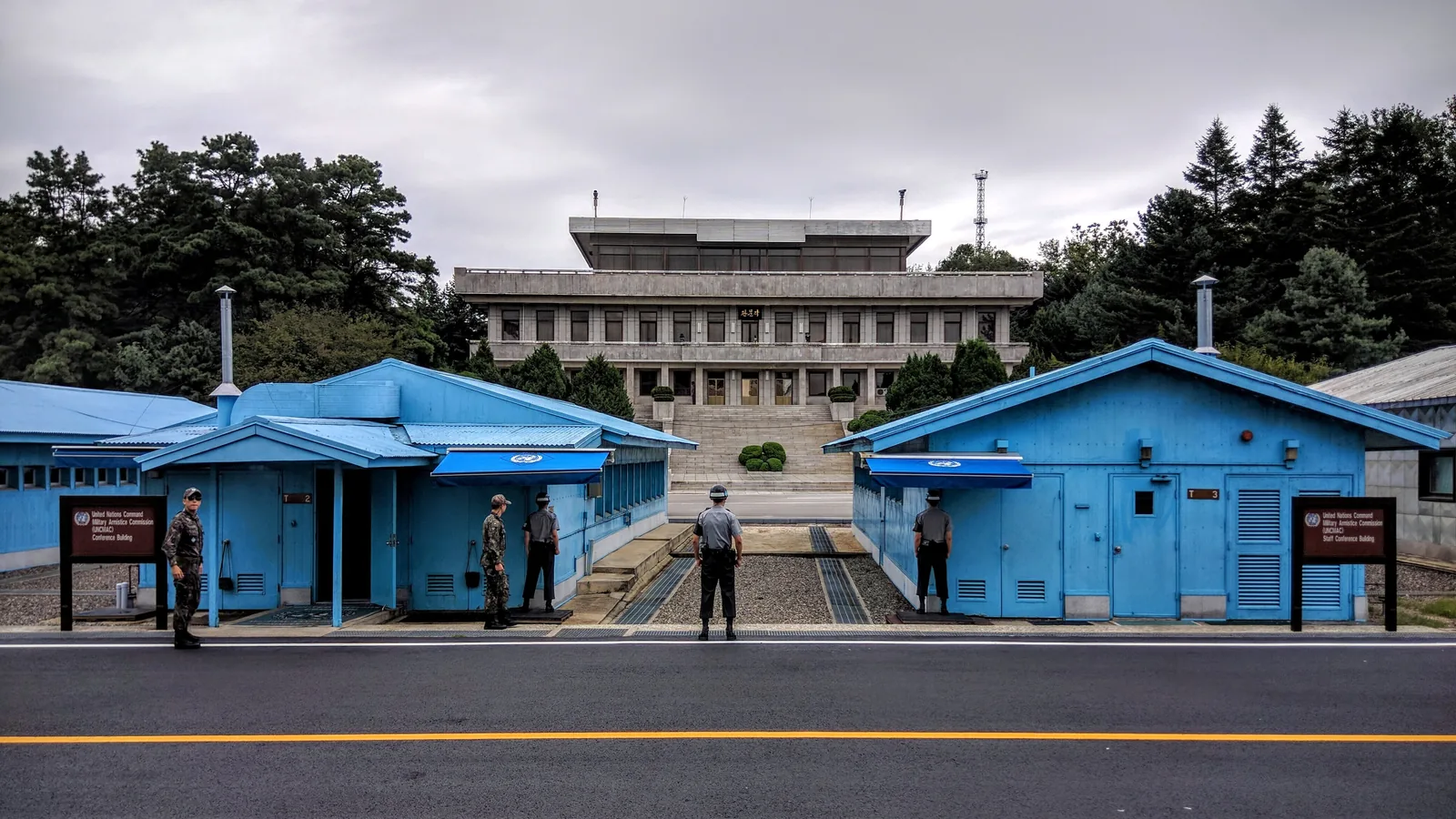
Article 1 of the agreement fixed the line: “A military demarcation line shall be fixed and both sides shall withdraw two (2) kilometers from this line so as to establish a demilitarized zone between the opposing forces.” The National Archives summarizes the effect as forces withdrawing “from a 4,000-meter-wide zone, establishing the Demilitarized Zone as a buffer between the forces.” A separate article ordered commanders to enforce “a complete cessation of all hostilities in Korea by all armed forces under their control . . . effective twelve (12) hours after this armistice agreement is signed.” Article 63 set the remaining provisions to take effect “at 2200 hours on 27 July 1953.”
_Joint_Security_Area_(JSA)_Looking_Into_North_Korea_(28819154694).jpg)
Ten officers, four neutral nations
Article 19 established a Military Armistice Commission “composed of ten (10) senior officers, five (5) of whom shall be appointed by the Commander-in-Chief, United Nations Command, and five (5) of whom shall be appointed jointly by the Supreme Commander of the Korean People’s Army and the Commander of the Chinese People’s Volunteers.” Article 36 set up a Neutral Nations Supervisory Commission of four officers, two nominated by the United Nations Command “namely, SWEDEN and SWITZERLAND,” and two nominated by the Korean People’s Army and the Chinese People’s Volunteers “namely, POLAND and CZECHOSLOVAKIA.” A related article gave prisoner exchange its own machinery: “Within sixty (60) days after this agreement becomes effective each side shall . . . directly repatriate and hand over in groups all those prisoners of war in its custody who insist on repatriation.” Prisoners who did not want to return left military custody for a Neutral Nations Repatriation Commission instead.
Harrison and Nam Il sign; Clark countersigns at Munsan-ni
Harrison and Nam Il finished signing at 10:12 a.m. Korean time, at a building constructed for the ceremony at Panmunjom. A State Department editorial note in Foreign Relations of the United States records that “they did not exchange words.” The three texts of the agreement, in English, Korean and Chinese, were declared “equally authentic.” That afternoon, the same note continues, “General Clark, with his top military advisers and a representative of the Republic of Korea Army in attendance, countersigned the document” at Munsan-ni. No representative of the Republic of Korea signed the agreement itself; only a representative of its army attended Clark’s countersignature. For twelve hours after the Panmunjom ceremony, the State Department’s account continues, “artillery and mortar fire continued at the front, United Nations Command planes attacked North Korean targets, and the United States Navy continued its offshore shelling of the North Korean coast.” At 10 p.m. that fighting stopped and the armistice began.
"No nation is a signatory": a document without a state
The National Archives describes the result as “purely a military document—no nation is a signatory to the agreement.” Its final page lists the two signers by title, not by government: “NAM IL . . . General, Korea People’s Army, Senior Delegate, Delegation of the Korean People’s Army and the Chinese People’s Volunteers” and “WILLIAM K. HARRISON, JR. . . . Lieutenant General, United States Army, Senior Delegate, United Nations Command Delegation.” The agreement set no closing date for itself. Article 62 states that its articles and paragraphs “shall remain in effect until expressly superseded either by mutually acceptable amendments and additions or by provision in an appropriate agreement for a peaceful settlement at a political level between both sides.”
Key facts
- Negotiations opened July 10, 1951; the National Archives counts 158 meetings over two years and 17 days, while the Army War College’s Frank Jones counts nearly 200 sessions and 400 hours over the same span.
- The Chinese-Korean side accepted voluntary repatriation of prisoners of war on April 1, 1953, after talks had broken off in October 1952 over that issue.
- Article 1 of the agreement fixed a military demarcation line and a 2-kilometer withdrawal by each side, forming a 4-kilometer-wide demilitarized zone.
- The Military Armistice Commission has ten members, five appointed by the United Nations Command and five jointly by the Korean People’s Army and the Chinese People’s Volunteers.
- The Neutral Nations Supervisory Commission has four members, from Sweden and Switzerland on one side and Poland and Czechoslovakia on the other.
- Prisoners who insisted on repatriation were to be handed over within sixty days; those who did not were placed with a Neutral Nations Repatriation Commission.
- Lt. Gen. William K. Harrison Jr. and Gen. Nam Il signed at Panmunjom at 10:12 a.m. on July 27, 1953; Gen. Mark W. Clark countersigned that afternoon at Munsan-ni.
- The National Archives calls the agreement “purely a military document” with no state as a signatory; Article 62 states it remains in effect until superseded by a peaceful settlement.
FAQ
Did South Korea sign the Korean Armistice Agreement?
No. The Republic of Korea is not a signatory. The State Department's editorial note records that only "a representative of the Republic of Korea Army" attended General Clark's countersignature at Munsan-ni on the afternoon of July 27, 1953.
When was the Korean Armistice Agreement signed?
At 10 a.m. Korea time on July 27, 1953, at Panmunjom, where Lt. Gen. William K. Harrison Jr. and Gen. Nam Il finished signing at 10:12 a.m. Its provisions, other than one paragraph, took effect at 2200 hours that same day.
How wide is the demilitarized zone created by the armistice?
Article 1 set it at 4 kilometers: each side withdrew 2 kilometers from the fixed military demarcation line, and the National Archives describes the result as a "4,000-meter-wide zone."
Sources
- National Archives and Records Administration (NARA), Milestone Documents: "Armistice Agreement for the Restoration of the South Korean State" (1953), full transcript; cited as Treaties and Other International Agreements Series #2782, Record Group 11.
- U.S. Department of State, Office of the Historian, Foreign Relations of the United States, 1952-1954, Korea, vol. XV, part 2, Document 723, Editorial Note (the signing sequence, Clark's countersignature at Munsan-ni, Rhee's release of prisoners and the Robertson mission).
- Frank Jones, "The Korean War Armistice: A Battlefield Negotiation," War Room, U.S. Army War College (July 27, 2023).
- National Archives and Records Administration (NARA), Prologue Magazine, Summer 2003, vol. 35, no. 2, "Korean War Armistice Agreement, 1953."
Cite this article
- APA
- Our Earth's History. (2026, September 26). Ten o'clock at Panmunjom, July 27, 1953: an armistice with no end date. Our Earth's History. https://ourearthshistory.com/east-asia/contemporary/korean-armistice-panmunjom-july-27-1953-demarcation-line-dmz-still-in-force/
- Chicago
- Our Earth's History. “Ten o'clock at Panmunjom, July 27, 1953: an armistice with no end date.” Our Earth's History, September 26, 2026. https://ourearthshistory.com/east-asia/contemporary/korean-armistice-panmunjom-july-27-1953-demarcation-line-dmz-still-in-force/.
- MLA
- “Ten o'clock at Panmunjom, July 27, 1953: an armistice with no end date.” Our Earth's History, 26 Sep. 2026, https://ourearthshistory.com/east-asia/contemporary/korean-armistice-panmunjom-july-27-1953-demarcation-line-dmz-still-in-force/.
Text licensed CC BY-NC-ND 4.0. Found an error? Tell us.