Thirty-six of sixty-four: Hamel's Journael and the Sillok, 1653
_(page_28_crop).jpg)
TL;DR — Hamel’s Journael counts 36 survivors of the Sperwer’s 64; the Jeju magistrate’s dispatch of 1653 counts 38. Both record 13 years of captivity and eight men escaping in 1666.
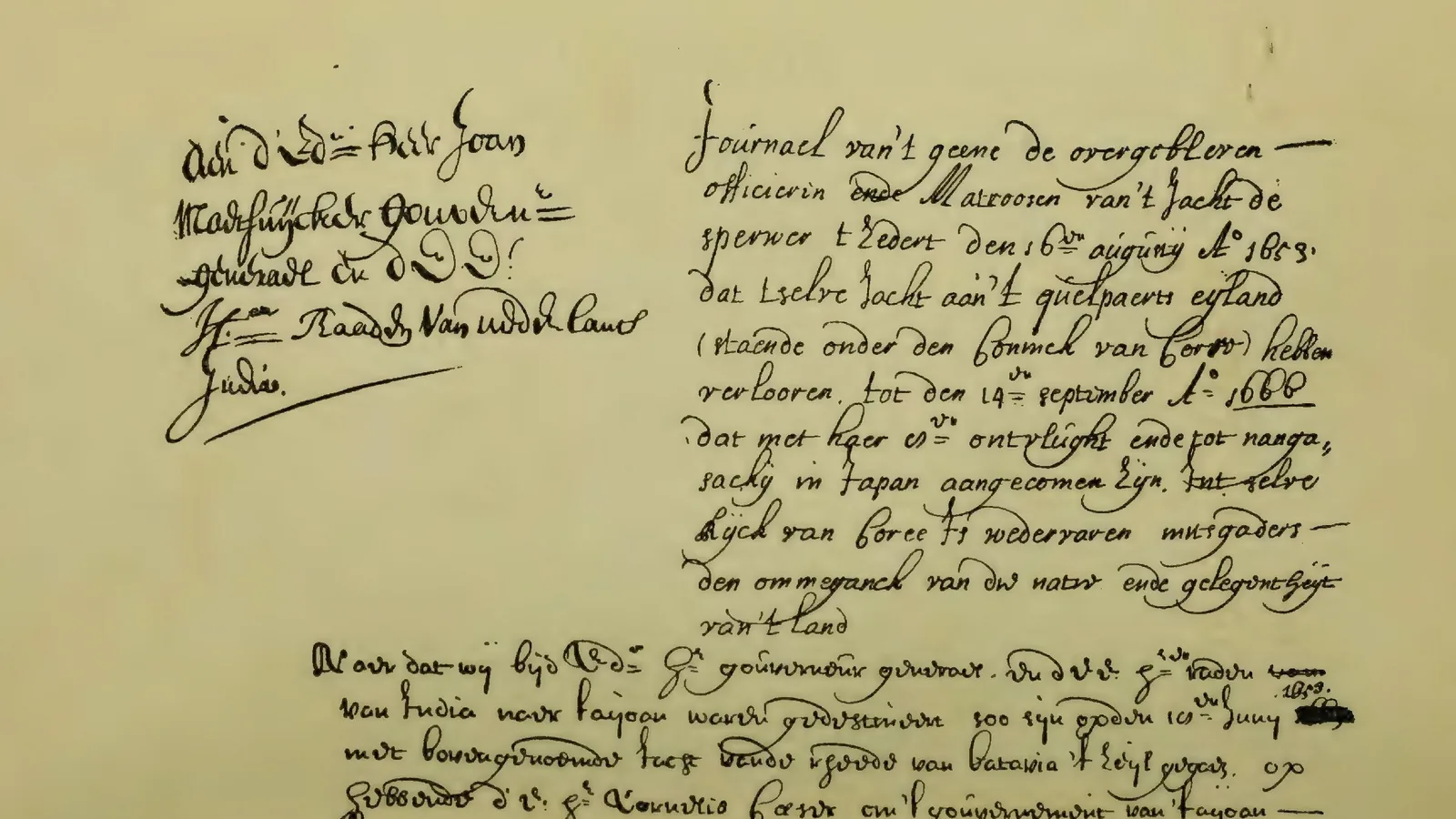
“Hoe ‘t selve Jacht door storm op’t Quel-paarts Eylant is ghestrant, ende van 64. personen, maar 36, behouden aan’t voornoemde Eylant by de Wilden zijn gelant.” How the yacht was wrecked by storm on Quelpaert Island, and of 64 persons only 36 came safe to land there among the savages: so runs the title page of the Journael that Hendrick Hamel, bookkeeper of the Dutch East India Company yacht Sperwer, published at Rotterdam in 1668. The same page gives the captivity that followed as “13. Jaar en 28. daghen,” 13 years and 28 days. On the 6th day of the 8th month of 1653 the Veritable Records of Hyojong entered a dispatch from Yi Won-jin, magistrate of Jeju: “有舡一隻, 敗於州南 . . . 生存者三十八人, 語音不通, 文字亦異.” A ship had broken up south of the town, 38 had survived, their speech could not be understood and their writing was different too. Hamel counted 36; the magistrate reported 38; neither text explains the other.
Quick facts
- When
- June 18, 1653 (the Sperwer sails from Batavia) · night of August 15–16, 1653 (wreck on Jeju) · 6th day of the 8th month, 1653 (the Jeju magistrate's dispatch in the Veritable Records of Hyojong) · March 1655 (two men reach the Qing envoy) · September 4, 1666 (eight men sail from Jeolla) · September 14, 1666 (landed at Nagasaki) · 10th month, 1666 and 2nd month, 1667 (Tsushima's questions in the Revised Veritable Records of Hyeonjong) · 1668 (the Journael printed at Rotterdam)
- Where
- The roads of Batavia; Tayowan on Taiwan; the south coast of Jeju (Quelpaert to the Dutch, Daejeong in the Records); Seoul; Jeolla province, including Byeongyeong in what is now Gangjin County; Hirado, Goto and Nagasaki; Rotterdam
- Who
- Hendrick Hamel of Gorcum, bookkeeper of the yacht Sperwer; skipper Reynier Egbertsz of Amsterdam; Cornelis Caesar, governor-designate of Tayowan; Jan Jansz Weltevree of De Rijp (Pak Yeon in the Records); Yi Won-jin, magistrate of Jeju; An Jin, magistrate of Dongnae; Willem Volgers and Nicolaes de Roy at Nagasaki; Johannes Stichter, printer
- Outcome
- Of 64 aboard, Hamel counted 36 survivors and the Jeju magistrate reported 38. The Dutch were enrolled in the royal guard, later banished to Jeolla, and held 13 years and 28 days by Hamel's count. Eight escaped by boat in September 1666 to Nagasaki; eight stayed. Tsushima raised the case with Joseon in 1666–1667, and Hamel's Journael was printed at Rotterdam in 1668
Batavia, June 18, 1653: three shocks and a ship in pieces
“So sijn wy op den 18 juny 1653 met het jagt de Sperwer van de Rede voor Batavia ‘t Zeyl gegaan”: on June 18, 1653, the Sperwer sailed from the roads of Batavia, carrying Cornelis Caesar to take over the government of Tayowan, the company’s post on Taiwan. She reached Tayowan on July 16 and left for Japan on July 30. On the night of August 15 the lookout called land, and then, in Hamel’s words, “stieten terstont in een oogenblick met 3 stooten ‘t Schip dattet geheel in stucken,” struck three times in an instant and lay wholly in pieces. At daylight on August 16 the men who could still walk went along the shore calling, “telden ons en bevonden ons in alles te wesen 36 persoonen,” counted, and found 36 persons in all: “van 64 Zielen op 36 in een quartier uur,” from 64 souls to 36 in a quarter of an hour. The skipper, Reynier Egbertsz of Amsterdam, lay dead on the beach.
"Waert gy een Vogel": Weltevree, seventy catties of rice and a musket
The interpreter who questioned them was Dutch: Jan Jansz Weltevree of De Rijp, who in 1627, on the yacht Ouwerkerck bound for Japan, had been driven by contrary winds onto the coast of Korea. The king had refused his requests to be sent to Japan: “waert gy een Vogel soo mooght ghy daer na toe vliegen, wy en senden geen vreemt volck uyt ons landt.” If you were a bird you might fly there; we send no foreign folk out of our land. The magistrate’s dispatch has the same man under his Korean name, “前來南蠻人朴燕,” Pak Yeon, a southern barbarian who had come earlier, and gives the reason the survivors were enrolled in the royal guard in Seoul, “蓋其人善火炮,” because these men were good with firearms.
The king had made them his “Lijf-schutten,” bodyguards, with a monthly ration of about seventy catties of rice; each man received a small board carved with his name, age and nation, and a musket with powder and shot. Weltevree was set to instruct them.
Fifty strokes, and a retrospect that says 1654
In March 1655, when the Qing envoy came to Seoul, the chief mate Heyndric Jansz of Amsterdam and the gunner Heyndric Jansz van den Bos of Haarlem broke through to the envoy’s train. The others were brought before the council of war, the Crijgsraden, and given 50 strokes each for not reporting them. The two died in prison, whether their own death or killed Hamel never learned. In 1656 the survivors were banished to the province Hamel called Thielado, Jeolla.
The Revised Veritable Records of Hyeonjong looked back on the wreck on the 26th day of the 2nd month of 1667: “曾在甲午年間, 有蠻船漂到大靜海邊, 其所乘船, 盡爲毁破, 不得還歸.” Once, in the gabo year, a barbarian ship had drifted to the shore of Daejeong and been wholly broken. The gabo year is 1654; the magistrate’s dispatch stands in the Hyojong Records under 1653. Gangjin County in Jeollanam-do lists a Hamel Memorial Hall at 180 Byeongyeongseong-ro in Byeongyeong-myeon, where it says Hamel stayed, and its fourth Gangjin Hamaek festival, August 27 to 29, 2026, is built round a beer of Dutch malt and Gangjin oats named for him.
September 4, 1666: over the city wall, past Goto, to Nagasaki
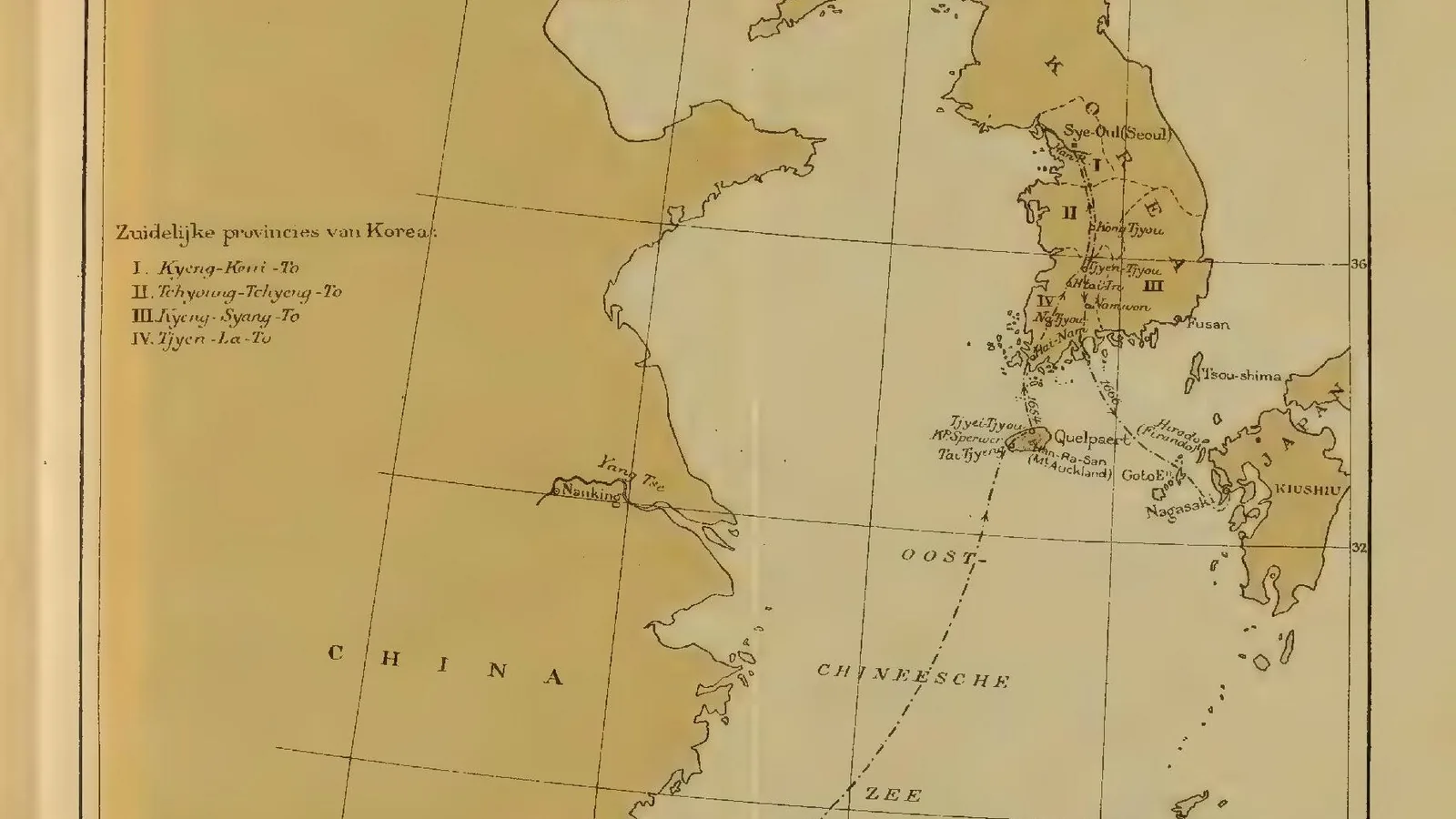
The boat was bought through a Korean neighbor. “Maeckte den 4 September 1666 alles wel klaer, om met ‘t ondergaen van de Maen, ende een voor Ebbe ‘t Ancker te lichten”: on September 4, 1666, everything was made ready to weigh anchor at moonset on the first of the ebb. The eight climbed the town wall with their goods and put rice and water pots aboard. On the morning of September 6 they were near the first Japanese islands; that evening they passed close to Farando, Hirado, and fetched up west of Goto in the night. When Japanese boats came out they hoisted a Prince’s flag they had made and shouted “hollando nangesacky.” They anchored in the Nagasaki roads at midnight, and “des Morghens den 14. dieto wierden wy aen landt gebracht,” on the morning of the 14th they were brought ashore. Hamel gave thanks for release from “13 jaren 28 dagen” of prison.
_(page_259_crop).jpg)
Envoys from Tsushima, and a book printed at Rotterdam in 1668
On the 23rd day of the 10th month of 1666 the Hyeonjong Records entered a dispatch from An Jin, magistrate of Dongnae: a Tsushima envoy had told the interpreters, “十餘年前, 阿蘭陀郡人三十六名, 載物貨漂到耽羅, 耽羅人盡奪其貨, 散置其人於全羅道內。其中八人, 今夏乘船潛逃.” More than ten years before, 36 men of the district of Oranda, Holland, had drifted to Tamna, Jeju; the Jeju people had taken their goods and scattered the men through Jeolla; eight had fled by boat that summer. The Border Defense Council replied, “服色與倭不同, 且言語不通, 故不知其某國人, 何所據而入送日本乎?” Their dress and speech were not Japanese and no one had known their country, so the council asked on what grounds they should have been sent to Japan. Here the Korean figure is 36, Hamel’s figure.
The entry of 1667 added the Japanese question. The eight had been sent from Goto to Nagasaki and Edo, and the shogun had had the lord of Tsushima ask Joseon: “耶蘇宗門餘黨之往來海邊者, 曾約貴國, 一一譏察以通矣 . . . 其餘留在貴國者, 必是耶蘇餘黨.” Joseon had once agreed to watch for remnants of the Jesus sect on the coasts and report each one; those still in Joseon must be remnants of that sect.
Hamel’s own account went to press two years later. The title page reads “Tot Rotterdam, Gedruckt by Johannes Stichter, Boeck-drucker . . . 1668,” and after the journal comes the “Beschryvinge van ‘t Koninghrijck Coeree,” which places the kingdom “tusschen de 34 en een half ende 44 Graden” of latitude, “verdeelt in 8 Provincien, ende 360 Steden,” divided into eight provinces and 360 towns. The book carries its date: Rotterdam, 1668.
Key facts
- The Sperwer sailed from the roads of Batavia on June 18, 1653, reached Tayowan on July 16 and left for Japan on July 30 with Cornelis Caesar aboard as governor-designate (Hamel, Journael).
- On the night of August 15, 1653, the ship struck three times and broke up; at daylight on August 16 the survivors counted 36 of 64 (Journael).
- The Veritable Records of Hyojong, 8th month, 6th day, 1653, print the Jeju magistrate’s dispatch: “生存者三十八人,” 38 survivors (National Institute of Korean History).
- Jan Jansz Weltevree, Pak Yeon in the Records, had reached Korea in 1627 on the yacht Ouwerkerck; the king had told him a bird might fly to Japan but no foreigner would be sent out (Journael; Hyojong Records).
- As royal bodyguards the Dutch drew about seventy catties of rice a month, a carved name board and a musket each (Journael).
- In March 1655 two men reached the Qing envoy’s train; the rest received 50 strokes, and in 1656 the survivors were banished to Jeolla on 45 catties of rice a month (Journael).
- Eight men made everything ready on September 4, 1666, passed Hirado and Goto and were landed at Nagasaki on the morning of September 14 (Journael).
- The Revised Veritable Records of Hyeonjong give the castaways as “阿蘭陀郡人三十六名” in 1666, place the wreck in the gabo year, 1654, in 1667, and record Tsushima’s charge that those left in Korea were “耶蘇餘黨” (National Institute of Korean History).
FAQ
How many men survived the wreck of the Sperwer on Jeju in 1653?
Hamel's Journael, printed in 1668, counts 36 survivors of 64 on the morning of August 16, 1653. The dispatch of the Jeju magistrate Yi Won-jin, entered in the Veritable Records of Hyojong on the 6th day of the 8th month of 1653, reports 38. The Tsushima envoy's account in the Revised Veritable Records of Hyeonjong in 1666 gives 36.
When did Hamel escape from Korea?
By his own journal, everything was made ready on September 4, 1666, to weigh anchor at moonset. Eight men climbed the town wall to the boat, were near the first Japanese islands on September 6, passed Hirado and Goto, and were brought ashore at Nagasaki on the morning of September 14, 1666.
Where is Hamel remembered in Korea?
Gangjin County in Jeollanam-do lists a Hamel Memorial Hall at 180 Byeongyeongseong-ro, Byeongyeong-myeon, and describes Hamel as having stayed in that township. The county's fourth Gangjin Hamaek festival, August 27 to 29, 2026, is named for a beer brewed after him from Dutch malt and Gangjin oats.
Sources
- Hendrick Hamel, Journael van de ongeluckige voyagie van 't jacht de Sperwer van Batavia gedestineert na Tayowan in 't jaar 1653, en van daar op Japan, gevolgd door Beschryvinge van 't Koninghrijck Coeree (Rotterdam: Johannes Stichter, 1668); full text of the first edition on DBNL, from the copy in Ghent University Library.
- National Institute of Korean History, Joseon wangjo sillok: Veritable Records of Hyojong (孝宗實錄), vol. 11, 4th year (1653), 8th month, 6th day, 2nd entry, the dispatch of Yi Won-jin, magistrate of Jeju, on the wrecked Westerners (original Chinese text with Korean translation).
- National Institute of Korean History, Revised Veritable Records of Hyeonjong (顯宗改修實錄), vol. 16, 7th year (1666), 10th month, 23rd day, 1st entry, the dispatch of An Jin, magistrate of Dongnae, on the Tsushima envoy's letter about the Oranda castaways, with the Border Defense Council's reply.
- National Institute of Korean History, Revised Veritable Records of Hyeonjong, vol. 16, 8th year (1667), 2nd month, 26th day, 4th entry, on the sending of Kim Seok-ju as reception official for the Japanese envoy, with the retrospect on the wreck and the question about the Jesus sect.
- Gangjin County (Jeollanam-do), tourism portal, Gangjin Hamaek Festival, festival introduction: the fourth festival, August 27–29, 2026, at the Gangjin sports complex, and the beer made from Dutch malt and Gangjin oats after Hamel, who stayed in Byeongyeong-myeon.
- Gangjin County (Jeollanam-do), tourism portal, exhibitions and museums list: Hamel Memorial Hall, 180 Byeongyeongseong-ro, Byeongyeong-myeon, Gangjin County, with telephone number.
Cite this article
- APA
- Our Earth's History. (2026, September 22). Thirty-six of sixty-four: Hamel's Journael and the Sillok, 1653. Our Earth's History. https://ourearthshistory.com/east-asia/early-modern/hamel-sperwer-jeju-august-16-1653-journael-1668-sillok-thirteen-years/
- Chicago
- Our Earth's History. “Thirty-six of sixty-four: Hamel's Journael and the Sillok, 1653.” Our Earth's History, September 22, 2026. https://ourearthshistory.com/east-asia/early-modern/hamel-sperwer-jeju-august-16-1653-journael-1668-sillok-thirteen-years/.
- MLA
- “Thirty-six of sixty-four: Hamel's Journael and the Sillok, 1653.” Our Earth's History, 22 Sep. 2026, https://ourearthshistory.com/east-asia/early-modern/hamel-sperwer-jeju-august-16-1653-journael-1668-sillok-thirteen-years/.
Text licensed CC BY-NC-ND 4.0. Found an error? Tell us.