December 19, 1642: four Dutch sailors die in a bay Māori already held
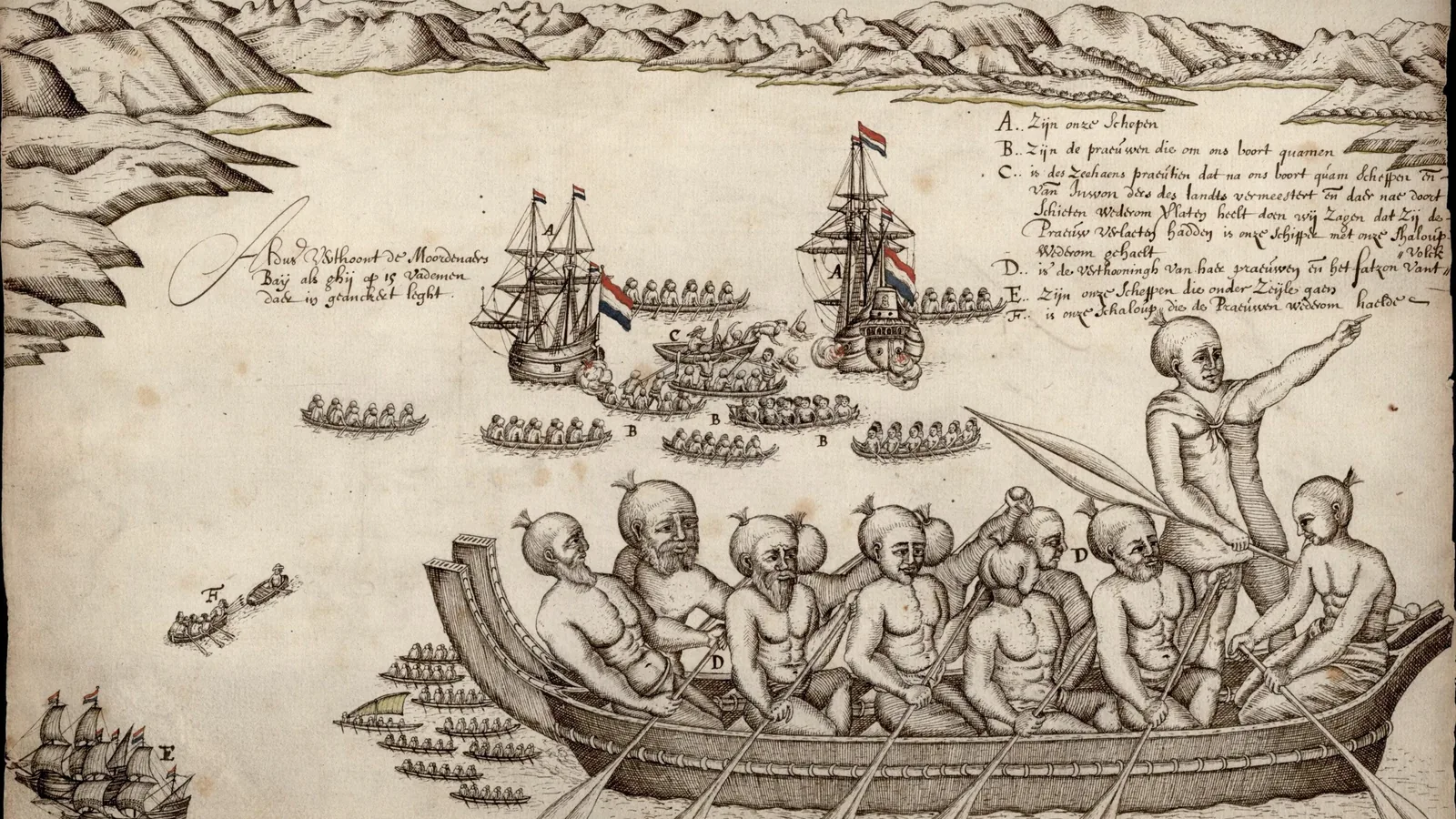

TL;DR — On December 19, 1642, a Ngāti Tūmatakōkiri canoe rammed a boat from the Dutch ship Zeehaen in Golden Bay; four sailors died, and Tasman sailed on without landing.
The yacht Heemskerck and the flute Zeehaen, two ships of the Dutch East India Company under Abel Janszoon Tasman, dropped anchor in 15 fathoms at sunset on December 18, 1642, inside a wide bay at the north end of what is now New Zealand’s South Island. The next morning a canoe struck the Zeehaen’s cock-boat, and Tasman’s journal recorded the result: “three of our men were killed and a fourth got mortally wounded through the heavy blows.” The canoes belonged to Ngāti Tūmatakōkiri, the iwi living at the bay, according to New Zealand’s Department of Conservation. No Māori account of the day was written down. Tasman named the water Moordenaers Bay, never set foot in New Zealand, and reached Batavia on June 15, 1643, where the Company’s council recorded that no profit had been found.
Quick facts
- When
- August 14, 1642 (ships leave Batavia) · December 13, 1642 (South Island sighted) · December 18, 1642 (anchor in the bay) · December 19, 1642 (the killing) · June 15, 1643 (return to Batavia)
- Where
- Golden Bay, or Mohua, at the north end of New Zealand's South Island, in what Tasman named Staten Landt; Batavia, in what is now Jakarta
- Who
- Abel Janszoon Tasman; the pilot-major Frans Jacobsz Visscher; the quartermaster Cornelis Joppen; the skipper Ide Tiercxz; Ngāti Tūmatakōkiri, the iwi living at the bay; Governor-General Antonio van Diemen and the council at Batavia
- Outcome
- Three Dutch sailors were killed in the Zeehaen's cock-boat and a fourth died of his wounds; Tasman named the place Moordenaers Bay, never landed in New Zealand, and the Company judged that no profit had been found
Lights on shore and a trumpet answered, December 18
Tasman had left Batavia on August 14, 1642, to look for the unknown South land. On December 13 the journal recorded “a large, high-lying land” to the southeast: the South Island. The ships followed its coast north, and on the morning of December 18 Tasman and the officers of the Zeehaen resolved to look for a harbor and a watering place.
About an hour after the ships anchored, the watch saw lights on shore and four boats, two of which came out. The men in them called out, in the journal’s words, “in the rough, hollow voice,” and the Dutch could not understand a word. The Māori blew an instrument whose sound the journal likened to a Moorish trumpet, and a sailor on the Heemskerck who knew the trumpet played tunes in answer; the Zeehaen’s second mate, once a trumpeter, did the same. The exchange went on until dark, when the canoes paddled off. The Dutch set double watches and cleaned the guns. What the calls and the trumpet meant on the shore side is not recorded.
Thirteen men in a canoe, then the cock-boat of the Zeehaen
Early on December 19 a canoe with 13 men came within a stone’s cast of the ships and called out again. The journal described rough voices, skin between brown and yellow, and black hair tied up on the crown of the head under a large white feather. The Dutch held up white linen and knives; the canoe went back to shore.
The Zeehaen’s officers came aboard the Heemskerck, and the council resolved to move closer in, since, the journal wrote, “these people apparently sought our friendship.” Seven more canoes then put off. The Zeehaen’s skipper sent his quartermaster, Cornelis Joppen, across in the cock-boat with six paddlers, with a warning not to let too many visitors aboard.
As the cock-boat left the Zeehaen to return, the canoe lying between the ships paddled at it and struck it with its stem. The foremost man thrust Joppen in the neck with a long blunt pike until he fell overboard. The others, with short thick clubs and their paddles, overcame the boat’s crew. Three men were killed and a fourth mortally wounded. Joppen and two sailors swam to the Heemskerck. The attackers took one body into their canoe, threw another into the sea and let the cock-boat drift. Both ships fired and hit no one; the skipper rowed out and brought the cock-boat back with one dead man and one dying man in it. The journal called the act “outrageous and detestable.”
Twenty-two canoes, a white flag, and two names
Tasman weighed anchor at once. As the ships got under way, 22 canoes appeared and 11, “swarming with people,” made for the ships. The Zeehaen’s shot hit a man in the largest canoe who was holding a small white flag, and the canoes turned back. About noon the council resolved that “the detestable deed of these natives against four men of the Zeehaen’s crew” obliged the Dutch to treat the inhabitants as enemies and to sail east along the coast for water. The anchorage was entered as Moordenaersbay, Murderers’ Bay.
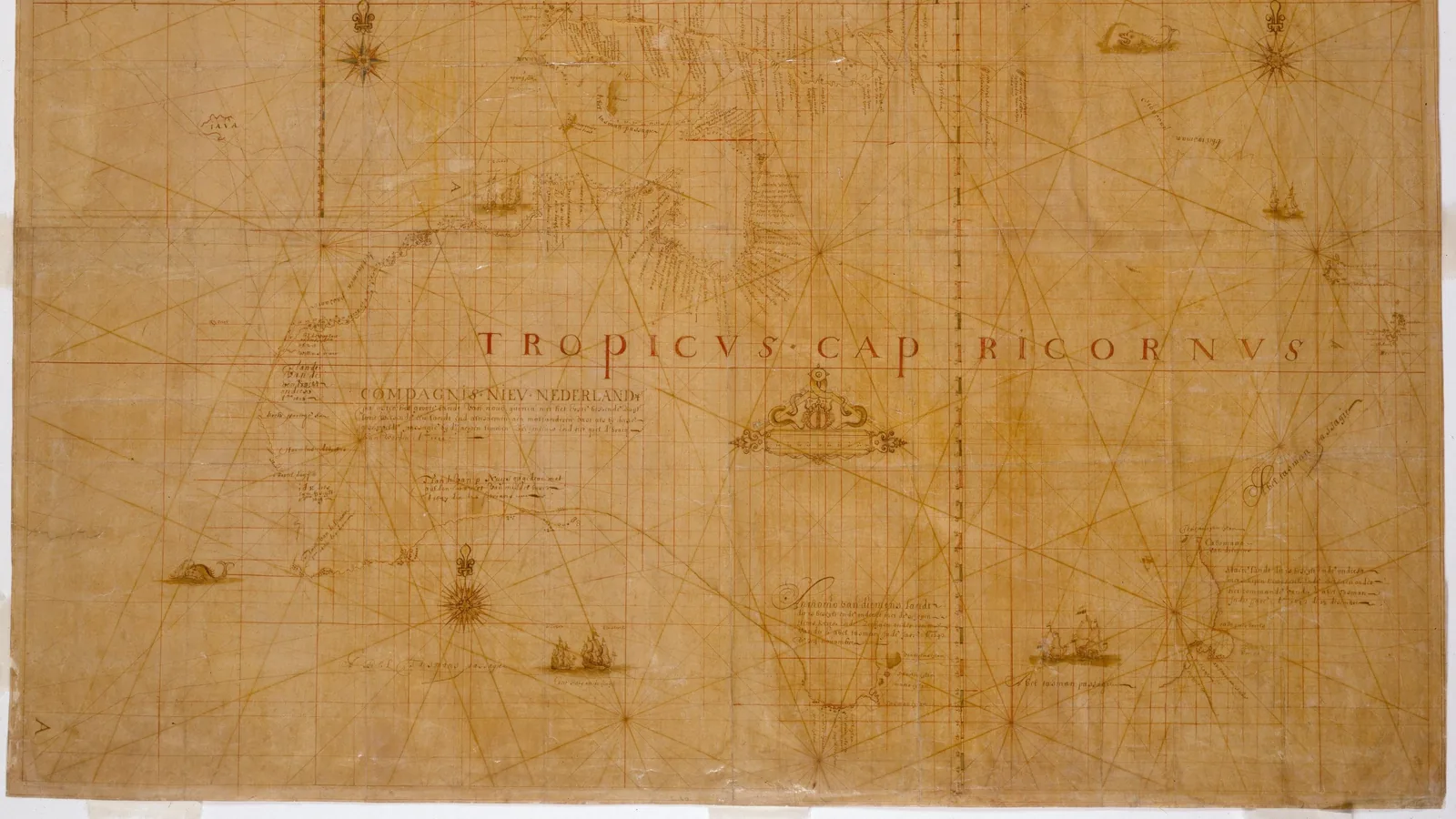
The entry also named the coast. In honor of the States-General the Dutch called it Staten Landt, guessing that it might join the Staten Land near Cape Horn, “though this is not certain.” Heeres’s edition adds that the land was afterwards named New Zealand. The ships never landed there: on January 5, 1643, they anchored off the Three Kings Islands, saw men with clubs on the hilltops and could not water; on January 21 they reached Tonga and went ashore at last.
Batavia, June 15, 1643, and the Company's verdict
The last entry ends: “God be praised and thanked for this happy voyage. Amen.” Four days later Governor-General Antonio van Diemen and his council recorded their view. The natives of Staten Landt were “of a malignant and murderous nature,” having “killed four of our men in her with wooden clubs, and wounded another who returned on board swimming.” On the voyage as a whole, “no treasures or matters of great profit have as yet been found,” only new lands and a promising passage toward Chile. The general missive to the directors of December 22, 1643, counted ten dead of illness and “four others besides that were slain by the savages on the coast of Staten land,” and added that Tasman had been “somewhat remiss in investigating the situation, conformation and nature of the lands.” James Backhouse Walker in 1896 and W. Eaton in 1905 both called the voyage a disappointment to the Company.
Walker, writing in 1896, called the bay by its present name, Golden Bay, and placed the killing near Parapara on the authority of T. M. Hocken of Dunedin. The Department of Conservation calls the same water Mohua, puts Tasman’s anchorage near Wainui, and names him the first European to visit Aotearoa New Zealand. The manuscript journal is held in the Nationaal Archief in The Hague. A trumpet duet on the evening of December 18, four dead men on the morning of December 19, and two names given before nightfall: that is the whole Dutch record of the day, and the only written one.

Key facts
- Heemskerck and Zeehaen left Batavia on August 14, 1642, sighted Van Diemen’s Land on November 24 and the South Island of New Zealand on December 13 (Tasman’s journal, Heeres edition).
- The ships anchored in the bay at sunset on December 18, 1642, and exchanged calls and trumpet notes with two canoes after dark (journal).
- On the morning of December 19 a canoe struck the Zeehaen’s cock-boat; three men were killed and a fourth mortally wounded, and the quartermaster Cornelis Joppen swam back with two sailors (journal).
- The iwi living at the bay were Ngāti Tūmatakōkiri; the anchorage was near Wainui in Mohua, Golden Bay (Department of Conservation).
- Tasman named the anchorage Moordenaersbay and the coast Staten Landt the same day, and sailed without landing (journal).
- The Batavia council resolved on June 19, 1643, that “no treasures or matters of great profit” had been found, and still paid the crews a reward of one to two months’ pay (Heeres, Appendix J).
FAQ
How many of Tasman's men died in Golden Bay?
Four. The journal for December 19, 1642, says three were killed in the cock-boat and a fourth was mortally wounded; the Batavia resolution of June 19, 1643, counts four killed and one wounded man who swam back.
Who were the Māori who attacked Tasman's boat?
Ngāti Tūmatakōkiri, the iwi living in Mohua, Golden Bay, when the ships arrived, according to the New Zealand Department of Conservation. No account from their side was written down.
Did Tasman ever land in New Zealand?
No. After the killing he sailed the same day, could not water at the Three Kings Islands on January 5 and 6, 1643, and next went ashore in Tonga later that month.
Sources
- J. E. Heeres (ed.), Abel Janszoon Tasman's Journal (Amsterdam: Frederik Muller, 1898), English translation: journal entries for August 14, December 13 and 17 to 19, 1642, January 5 and 21, 1643, and June 15, 1643; Heeres's Life of Tasman; Appendix J (Batavia resolution, June 19, 1643) and Appendix K (General Missive, December 22, 1643). Project Gutenberg Australia eBook 0600571.
- New Zealand Department of Conservation, Abel Tasman National Park: History (Ngāti Tūmatakōkiri, December 18, 1642, Wainui, Mohua / Golden Bay, four crew lost).
- James Backhouse Walker, Abel Janszoon Tasman: His Life and Voyages (Hobart: Government Printer, 1896), Royal Society of Tasmania paper; Internet Archive full text.
- W. Eaton, Tasman: A Forgotten Navigator, Proceedings and Transactions of the Royal Geographical Society of Australasia, Queensland, vol. 20 (1905); Wikisource transcription.
- Nationaal Archief, The Hague, collection 1.11.01.01 (Aanwinsten Eerste Afdeling), inventory no. 121: Journaal van Abel Jansz. Tasman betreffende diens eerste expeditie naar het Zuidland (digitized manuscript, catalog record).
- Wikisource, Author page for Jan Ernst Heeres (1858 to 1932), bibliographic record of the 1898 edition of Tasman's journal.
Cite this article
- APA
- Our Earth's History. (2026, September 22). December 19, 1642: four Dutch sailors die in a bay Māori already held. Our Earth's History. https://ourearthshistory.com/oceania/early-modern/tasman-golden-bay-1642-four-dutch-sailors/
- Chicago
- Our Earth's History. “December 19, 1642: four Dutch sailors die in a bay Māori already held.” Our Earth's History, September 22, 2026. https://ourearthshistory.com/oceania/early-modern/tasman-golden-bay-1642-four-dutch-sailors/.
- MLA
- “December 19, 1642: four Dutch sailors die in a bay Māori already held.” Our Earth's History, 22 Sep. 2026, https://ourearthshistory.com/oceania/early-modern/tasman-golden-bay-1642-four-dutch-sailors/.
Text licensed CC BY-NC-ND 4.0. Found an error? Tell us.