"Come, captain Bligh": the Bounty mutiny of April 28, 1789, on record

TL;DR — Bligh’s 1790 narrative, the 1792 court-martial minutes and the Pitcairn record carry the mutiny of April 28, 1789 — six men sentenced, three hanged, Christian never tried.
“Just before sun-rising, Mr. Christian, with the master at arms, gunner’s mate, and Thomas Burket, seaman, came into my cabin while I was asleep, and seizing me, tied my hands with a cord behind my back, and threatened me with instant death, if I spoke or made the least noise.” So Lieutenant William Bligh opened the account he printed in London in 1790. The court that tried ten of the men in 1792 heard his orders read out: by an Admiralty order of August 16, 1787, Bligh had been appointed to the Bounty, and by instructions of November 20, 1787, he was “directed to proceed in that Vessel to the Society Islands in order to procure and transport from thence to some of the British Possessions in the West Indies Bread Fruit Trees and other useful Plants.” The narrative and the minutes tell the rest.
Quick facts
- When
- August 16, 1787 (Bligh appointed) · December 23, 1787 (Bounty sails from Spithead) · October 26, 1788 to April 4, 1789 (at Tahiti) · April 28, 1789 (the mutiny) · June 14, 1789 (the launch reaches Coupang, Timor) · October 22, 1790 (Bligh's court-martial) · September 12 to 18, 1792 (court-martial of the mutineers) · October 29, 1792 (three men hanged) · September 17, 1814 (HMS Briton and Tagus reach Pitcairn)
- Where
- Deptford and Spithead in England; Matavai Bay, Tahiti; the sea near Tofoa in the Tonga group; Coupang on Timor, a Dutch settlement; Portsmouth Harbour; Pitcairn Island
- Who
- Lieutenant William Bligh; Fletcher Christian, master's mate; Sir Joseph Banks; John Norton, quartermaster; David Nelson, botanist; Captain Edward Edwards of HMS Pandora; Lord Hood, president of the court; Peter Heywood, James Morrison, Thomas Ellison, Thomas Burkitt, John Millward and William Muspratt
- Outcome
- Bligh and 18 men reached Timor in an open launch; six of the ten men tried in 1792 were sentenced to hang, three were hanged on HMS Brunswick on October 29, 1792, and the settlement Christian founded on Pitcairn was found by an American sealing captain in 1808 and by two Royal Navy ships in 1814
Bethia, 215 tons, bought for 1,950 pounds
In 1787, Owen Rutter wrote in his 1931 edition of the trial minutes, West India planters in London asked the government to bring the breadfruit tree to the Caribbean as food for the enslaved workers on their plantations. Sir Joseph Banks backed the plan, George III approved it, and the Navy Board bought a merchant ship, the Bethia, of 215 tons, for 1,950 pounds; the refit at Deptford, with the great cabin given over to plant pots, cost 4,456 pounds. The ship, renamed Bounty, sailed from Spithead on December 23, 1787, with 46 men.
She anchored at Tahiti on October 26, 1788, and stayed until April 4, 1789. The record gives no reason for the length of that stay; Rutter wrote that Bligh “offers no explanation of this delay, nor does one ever seem to have been demanded of him.” In January 1789 three men deserted in the small cutter with eight stand of arms and were flogged when caught. On March 31 all the plants were aboard, in 774 pots, 39 tubs and 24 boxes. Bligh counted 1,015 breadfruit plants, collected over “three and twenty weeks.”
April 28, 1789: "you must go with them"
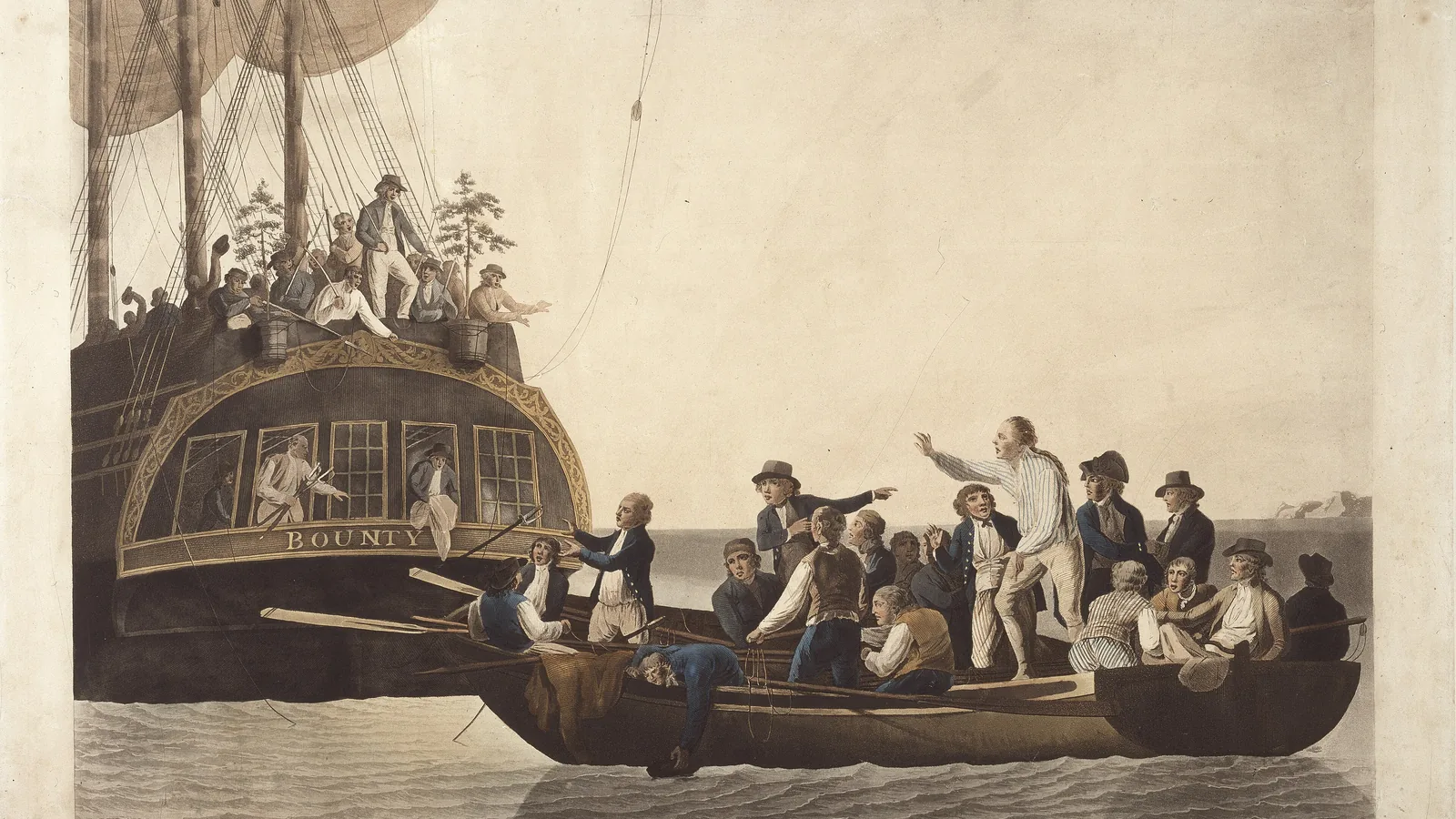
Fletcher Christian, one of the mates, had the morning watch on April 28 as the Bounty passed through the Tonga group. Bligh was seized in his cabin before sunrise and called out loud enough to wake the ship, but sentries already stood at the doors of the officers who were not of Christian’s party, and the ship’s launch was hoisted out.
When the boat was full, Christian spoke the words Bligh printed: “Come, captain Bligh, your officers and men are now in the boat, and you must go with them; if you attempt to make the least resistance you will instantly be put to death.” Bligh was forced over the side and the launch was cast off. With him went 18 men, among them the master John Fryer, the botanist David Nelson and the carpenter William Purcell. On the ship, by Bligh’s count, 25 men remained, and he listed all 25 “as pirates,” a list the court of 1792 went through name by name.
Twenty-three feet of boat and 3618 miles by the log
At Tofoa the islanders attacked on May 3 as the men pushed off; the quartermaster John Norton, who had run up the beach to cast off the stern line, “was knocked down, and the stones flew like a shower of shot.” He was the only man lost.
Every man agreed to live on an ounce of bread and a quarter of a pint of water a day. The boat, Bligh recorded, was “twenty-three feet long from stern to stern, deep laden with eighteen men,” and carried about 150 pounds of bread, 28 gallons of water, 20 pounds of pork, three bottles of wine and five quarts of rum. Timor was sighted on June 12, “in forty-one days after leaving Tofoa,” a run Bligh’s log put at 3618 miles, or, as Royal Museums Greenwich gives it, 3618 nautical miles. The launch reached Coupang on June 14. Nelson died there on July 20 “of an inflammatory fever.”
"Honorably acquitted": Bligh at Spithead, and the Pandora on the reef
Bligh landed at Portsmouth on March 14, 1790, and on October 22 he and the survivors present faced a court-martial for the loss of the ship; the court adjudged them “to be honorably acquitted.” The Admiralty sent HMS Pandora, under Captain Edward Edwards, for the men who had stayed on the Bounty. She reached Tahiti on March 23, 1791, took up the men left on the island, and on August 28 struck a reef near the entrance of Endeavour Strait. Rutter counts 89 saved out of a complement of 110; four of the prisoners drowned. Edwards’s own court-martial acquitted him.
Portsmouth, September 1792, and Pitcairn, September 1814
The minutes open with the court “assembled on board His Majesty’s Ship Duke in Portsmouth Harbour on the twelfth Day of September,” Lord Hood presiding, and run to September 18, when the court found “That the Charges had been proved against the said Peter Heywood, James Morrison, Thomas Ellison, Thomas Burkitt, John Millward and William Muspratt, and did adjudge them and each of them to suffer Death by being hanged by the Neck.” Four others were acquitted. Heywood and Morrison were pardoned, and Muspratt was discharged because the court had refused him two witnesses who were themselves on trial. On October 29, 1792, Rutter records, “the three condemned men were publicly executed on board H.M.S. ‘Brunswick,’ in the presence of a party of seamen from each ship in the harbour.”
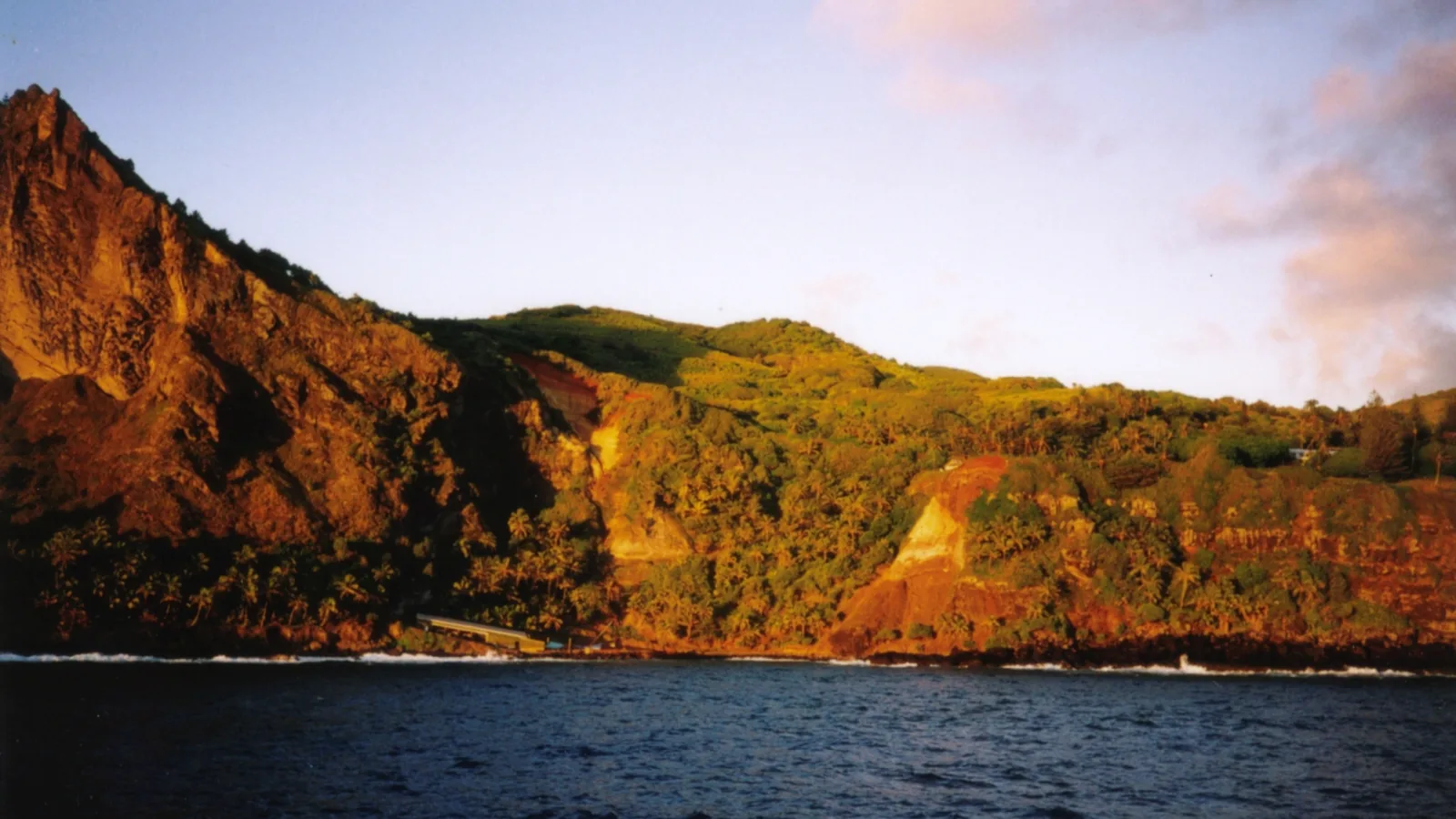
Christian never came before a court. With eight of the Bounty’s men, six Tahitian men and twelve women, he sailed the ship to Pitcairn, reached in January 1790, and burned her in the bay that now carries her name; Rutter’s chronology dates the burning January 23, 1790. In 1793 a rising of the Tahitian men killed Christian and four of the mutineers, and by 1800, the Pitcairn government’s history states, John Adams was the sole surviving man, leading ten women and 23 children. Royal Museums Greenwich holds a rudder fragment and copper sheathing catalogued as from the Bounty. In 1808 the settlement “was discovered by Captain Mayhew Folger, an American sealing captain,” and HMS Briton and Tagus found it again on September 17, 1814.

Key facts
- The Navy Board bought the merchant ship Bethia, 215 tons, for 1,950 pounds and spent 4,456 pounds refitting her at Deptford; Bligh was appointed to command on August 16, 1787, and sailed from Spithead on December 23, 1787, with 46 men (Rutter; Bligh 1792).
- The Bounty lay at Tahiti from October 26, 1788, to April 4, 1789; on March 31, 1789, 1,015 breadfruit plants were aboard in 774 pots, 39 tubs and 24 boxes (Bligh 1790 and 1792).
- Three men deserted in the cutter on January 6, 1789, with eight stand of arms and were flogged after their capture on January 23 (Rutter).
- Bligh’s narrative gives Christian’s words at the ship’s side: “Come, captain Bligh, your officers and men are now in the boat, and you must go with them” (Bligh 1790).
- Eighteen men went with Bligh in a launch 23 feet long, with about 150 pounds of bread, 28 gallons of water, 20 pounds of pork, three bottles of wine and five quarts of rum (Bligh 1790).
- John Norton was killed at Tofoa on May 3, 1789; Timor was sighted on June 12 after 41 days and 3618 miles by the log, the boat reached Coupang on June 14, and David Nelson died there of fever on July 20 (Bligh 1790; Royal Museums Greenwich).
- Bligh was “honorably acquitted” on October 22, 1790; the Pandora reached Tahiti on March 23, 1791, and was lost on a reef near Endeavour Strait on August 28, with 89 of 110 saved (Rutter).
- The court on HMS Duke, September 12 to 18, 1792, sentenced six men to hang and acquitted four; Burkitt, Millward and Ellison were hanged on HMS Brunswick on October 29, 1792 (court-martial minutes; Rutter).
FAQ
How far did Bligh sail in the Bounty's launch?
By his own log, 3618 miles in 41 days from Tofoa to Timor, sighting the island on June 12, 1789, and reaching Coupang on June 14. Royal Museums Greenwich states the distance as 3618 nautical miles. Eighteen men were in the boat with him, and only John Norton, killed at Tofoa on May 3, was lost.
Who was hanged for the Bounty mutiny?
Thomas Burkitt, John Millward and Thomas Ellison, on HMS Brunswick at Portsmouth on October 29, 1792. Six men had been sentenced on September 18; Peter Heywood and James Morrison were pardoned and William Muspratt was discharged on a procedural point. Fletcher Christian and the men who went with him to Pitcairn were never tried.
What happened to the Bounty itself?
Christian's party stripped the ship at Pitcairn and burned her in January 1790 so that no passing vessel would see her; the anchorage is called Bounty Bay. Royal Museums Greenwich catalogues a rudder fragment, sheet copper, copper sheathing and nails as from the armed vessel Bounty.
Sources
- William Bligh, A Narrative of the Mutiny, on Board His Majesty's Ship Bounty; and the Subsequent Voyage of Part of the Crew, in the Ship's Boat, from Tofoa, One of the Friendly Islands, to Timor (London: George Nicol, 1790). Project Gutenberg eBook #20337, full text.
- William Bligh, A Voyage to the South Sea, Undertaken by Command of His Majesty, for the Purpose of Conveying the Bread-fruit Tree to the West Indies, in His Majesty's Ship the Bounty (London, 1792). Project Gutenberg eBook #15411, full text: chapter 1 (the ship and her fittings), chapter 2 (departure December 23, 1787) and the entries for March 31 and April 4, 1789.
- Owen Rutter (ed.), The Court-Martial of the "Bounty" Mutineers (Edinburgh and London: William Hodge, 1931; Notable British Trials): editor's introduction and chronology, and the minutes of the court-martial held on HMS Duke, Portsmouth Harbour, September 12 to 18, 1792, with the Admiralty order of August 20, 1792. Internet Archive full text (Digital Library of India scan).
- Royal Museums Greenwich, "Mutiny on the Bounty" (story page: the breadfruit mission, the mutiny, the 3618-nautical-mile boat voyage, Pitcairn and John Adams).
- Royal Museums Greenwich, collections search results for "Bounty": rudder fragment, sheet copper, copper sheathing and nails catalogued as from the Armed Vessel Bounty.
- Government of the Pitcairn Islands, "Pitcairn's History": settlement by the mutineers in 1790, the burning of the Bounty, the killings, John Adams, the visits of 1808 and September 17, 1814.
Cite this article
- APA
- Our Earth's History. (2026, September 22). "Come, captain Bligh": the Bounty mutiny of April 28, 1789, on record. Our Earth's History. https://ourearthshistory.com/oceania/early-modern/bounty-mutiny-april-28-1789-bligh-narrative-court-martial/
- Chicago
- Our Earth's History. “"Come, captain Bligh": the Bounty mutiny of April 28, 1789, on record.” Our Earth's History, September 22, 2026. https://ourearthshistory.com/oceania/early-modern/bounty-mutiny-april-28-1789-bligh-narrative-court-martial/.
- MLA
- “"Come, captain Bligh": the Bounty mutiny of April 28, 1789, on record.” Our Earth's History, 22 Sep. 2026, https://ourearthshistory.com/oceania/early-modern/bounty-mutiny-april-28-1789-bligh-narrative-court-martial/.
Text licensed CC BY-NC-ND 4.0. Found an error? Tell us.