Why does the 1915 Gallipoli defeat define Australia and New Zealand?
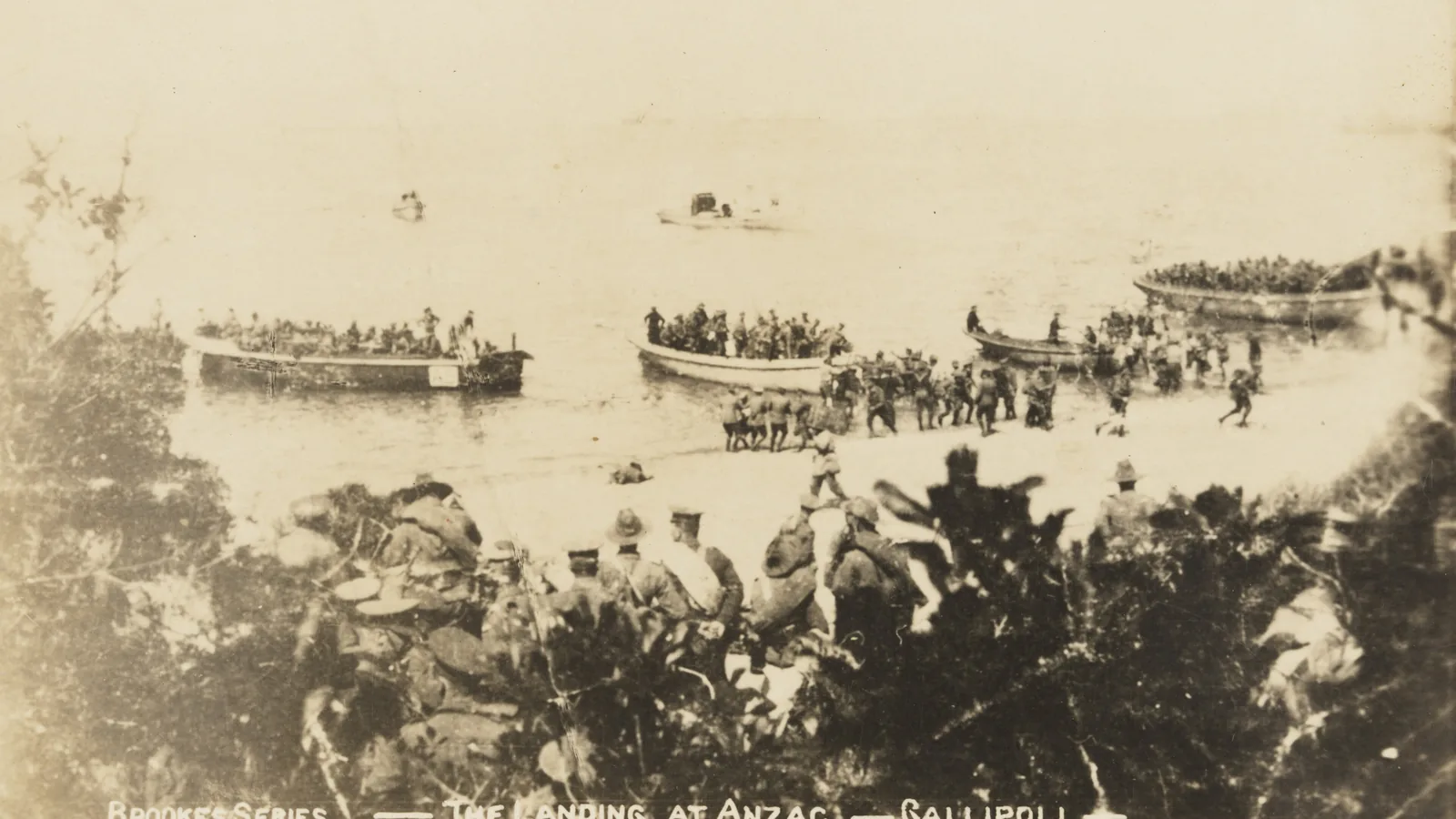

TL;DR — The landing of April 25, 1915 was the first major action of Australian and New Zealand forces. Its dead were counted at home, and the day has been kept since 1916.
Gallipoli defines Australia and New Zealand because the landing of April 25, 1915 was the first major action of their own forces, whose dead were counted at home. The Australian War Memorial gives 26,111 Australian casualties and an accepted official total of 8,709 killed; Te Papa, in Wellington, gives 2,779 New Zealanders dead. The operation failed at every stage: a naval attack on March 18 lost three battleships, the landings held a strip of cliffs, the August offensive was thrown off the ridges, and the force sailed away in December and January. The Ottoman army won. The first Anzac Day was held on April 25, 1916, in both countries.
Quick facts
- When
- March 18, 1915 (naval attack on the Dardanelles fails) · April 25, 1915 (landings at Ari Burnu, Cape Helles and Kum Kale) · August 6 to 10, 1915 (Lone Pine, Chunuk Bair, Suvla) · December 19 to 20, 1915 and January 1916 (evacuation) · April 25, 1916 (first Anzac Day) · 1921 (New Zealand public holiday) · 1927 (holiday in every Australian state) · 1928 (organized dawn service, Sydney)
- Where
- The Gallipoli peninsula on the European side of the Dardanelles, in what is now Turkey; Anzac Cove north of Gaba Tepe; Cape Helles at the tip; the Sari Bair ridge and Chunuk Bair; Suvla Bay
- Who
- Australians, New Zealanders, Britons and French troops under Sir Ian Hamilton; Ottoman troops under Liman von Sanders, with Mustafa Kemal commanding the 19th Division; Winston Churchill at the Admiralty; Charles Bean, Australia's official historian
- Outcome
- The naval attack failed, the landings gained a strip of cliffs, the August offensive failed on the ridges, and the force left in December and January; Australia counted 8,709 dead and 26,111 casualties, New Zealand 2,779 dead, by the museum figures; Anzac Day was first kept on April 25, 1916
The plan: ships alone
By the account of Charles Bean, Australia’s official historian, the idea began with Winston Churchill, First Lord of the Admiralty, who had no army for the stroke he wanted. “If Churchill was to have the serious attack upon Gallipoli which so attracted him,” Bean wrote, “it must be made by ships alone.” The attempt came on March 18, 1915. In Bean’s account the French battleship Bouvet sank in two minutes, the Irresistible and the Ocean struck mines and foundered after dark, and the attack was called off at about 5 p.m. and never renewed. The Australian Imperial Force, then training in Egypt, sailed for the peninsula with New Zealanders, Britons and French troops, the Memorial records, to help the navy force the Dardanelles and take Constantinople.
April 25: the cove and the 57th Regiment
Vice-Admiral John de Robeck’s despatch states that “the landing commenced at 4.20 a.m. on 25th,” north of Gaba Tepe and at Cape Helles. The Australians came ashore at the beach that became Anzac Cove and held, in the Memorial’s words, “a tenuous foothold on the steep slopes above the beach.”
Bean recorded the other side of the ridge. The 57th Regiment of the Ottoman 19th Division had paraded at 5:30 a.m. for a field day. Its commander, Mustafa Kemal Bey, was asked by the 9th Division for one battalion, because his superiors took the landing for a feint. “Without hesitation,” Bean wrote, “he took it upon himself to throw in immediately the whole of the 57th Turkish Regiment,” and he marched at its head. The Memorial writes that Kemal’s conduct “proved decisive in thwarting allied plans.”
August: Lone Pine and Chunuk Bair
The final despatch of Sir Ian Hamilton, the army commander, sets out the August plan: break out of Anzac at night, seize the Sari Bair ridge and cut the Turkish army off from Constantinople, while a new corps landed at Suvla Bay. Lone Pine, attacked on the afternoon of August 6, was in his words “in its essence, a diversion.” The Memorial records that Lone Pine and the Nek failed and that stalemate followed for the rest of 1915.
New Zealand’s part was the ridge itself. At first light on August 8, Hamilton wrote, “the topmost summit was ours”: the Wellington Battalion had climbed Chunuk Bair under Lieutenant-Colonel W. G. Malone, who “fell mortally wounded as he was marking out the line to be held.” That evening some 800 men held about 200 yards of crest in trenches “not more than a few inches deep.” At daybreak on August 10, after the New Zealanders had been relieved, a Turkish force Hamilton put at a division and a regiment swept over the crest and retook it. Kemal was made Pasha after these battles.
The evacuation
The Memorial calls the withdrawal of December 19 to 20 “the most successful operation of the campaign,” made under a deception plan; the Turks inflicted very few casualties. The Imperial War Museums’ oral-history podcast states that half the men left in December and the rest in January, with two men wounded. In London, Churchill spoke in the House of Commons on November 15, 1915; the next day Lord Fisher, the former First Sea Lord, told the Lords that “certain references were made to me” in that speech.
Why it stayed: the day and the count
The Memorial’s Gallipoli entry gives 8,141 Australian deaths; its table from the British statistical return of 1922 totals 8,159, and a revised estimate dated January 26, 1919, gives 8,709, the accepted official figure. Te Papa states that 2,779 New Zealanders died on the peninsula, and the New Zealand Defence Force calls the campaign “New Zealand’s first major engagement of the First World War.”
The day was fixed while the war went on. On April 25, 1916, the Memorial records, ceremonies were held all over Australia and Australian and New Zealand troops marched through London. The Defence Force records New Zealand’s first service that year at Tinui in the Wairarapa and a public holiday from 1921. Every Australian state kept some form of holiday in 1927, and about 150 people at the unfinished Sydney Cenotaph in 1928 began what the Memorial calls organized dawn services. The campaign also gave the day its figures: John Simpson Kirkpatrick, in the Memorial’s account, carried wounded men down Monash Valley on a water donkey until he was killed on May 19, and a tribute to the Anzac dead “often attributed to” Atatürk in 1934 is inscribed on his memorial in Canberra.
What remains open
The Memorial states that “it has been said that Gallipoli had no influence on the course of the war.” Bean recorded the opinion of Kiazim Bey, chief of staff to Liman von Sanders, that one more day of naval attack would have succeeded. The pages read here give no Ottoman casualty figure. What is not open is the count and the calendar: 8,709 Australians and 2,779 New Zealanders by the two museums, and a day kept every April since 1916.
Key facts
- The naval attack of March 18, 1915 lost the Bouvet, Irresistible and Ocean and was never renewed (Bean).
- The landing began at 4:20 a.m. on April 25, 1915, north of Gaba Tepe and at Cape Helles (de Robeck’s despatch).
- Mustafa Kemal committed the whole 57th Regiment on his own authority when asked for one battalion (Bean).
- The Wellington Battalion took the crest of Chunuk Bair at dawn on August 8; the Turks retook it on August 10 (Hamilton).
- The evacuation of December 19 to 20, 1915 and January 1916 cost two men wounded (Australian War Memorial, Imperial War Museums).
- Australian losses: 26,111 casualties, 8,709 dead by the revised 1919 estimate (Australian War Memorial, from HMSO 1922).
- New Zealand dead: 2,779 (Te Papa); first Anzac Day services on April 25, 1916 (Australian War Memorial, New Zealand Defence Force).
FAQ
Why is Anzac Day on April 25?
Because the Australian and New Zealand Army Corps landed at Ari Burnu, later Anzac Cove, on April 25, 1915. The first commemorations were held on the anniversary in 1916; organized dawn services date from 1928.
How many Australians and New Zealanders died at Gallipoli?
The Australian War Memorial gives 8,709 Australians killed by the revised estimate of 1919, out of 26,111 casualties. Te Papa gives 2,779 New Zealanders dead. The pages read for this article give no Ottoman total.
Did the Gallipoli campaign achieve anything?
Not its aim. The fleet never passed the Dardanelles and the army never reached the Narrows.
Sources
- Australian War Memorial, Encyclopedia — "Gallipoli," the aim of the landing, the August attacks, the evacuation of December 19 to 20 and the figures of 26,111 casualties and 8,141 deaths.
- Australian War Memorial, Encyclopedia — "Australian fatalities at Gallipoli," monthly table from Statistics of the Military Effort of the British Empire (HMSO, 1922) with the revised total of 8,709.
- Australian War Memorial, Encyclopedia — "Atatürk (Mustafa Kemal)," his 19th Division at the landing, the Anafarta command, and the 1934 words "often attributed to" him.
- Australian War Memorial, Encyclopedia — "John Simpson Kirkpatrick: Simpson and his donkey."
- Australian War Memorial — "The Anzac Day Tradition," the 1916 commemorations, the 1927 holidays and the 1928 Sydney dawn service.
- C. E. W. Bean, The Story of ANZAC, vol. 1 of the Official History of Australia in the War of 1914–1918 (1921), full text at the Internet Archive: the naval attack of March 18 and Mustafa Kemal and the 57th Regiment on April 25.
- Sir Ian Hamilton, Ian Hamilton's Despatches from the Dardanelles (London, 1917), with Vice-Admiral de Robeck's despatch on the landing, full text at the Internet Archive: Lone Pine, the Wellington Battalion on Chunuk Bair and the loss of the crest.
- Imperial War Museums — "Voices of the First World War: Gallipoli," episode 14, transcript of recorded veterans on the landings, Suvla and the evacuation.
- UK Parliament, Historic Hansard — "Lord Fisher and Mr. Churchill," House of Lords, November 16, 1915, vol. 20 cc336-7.
- Te Papa, Museum of New Zealand — "Gallipoli: The Scale of Our War," exhibition page with the figure of 2,779 New Zealand dead.
- New Zealand Defence Force — "Anzac Day," the first service at Tinui in 1916, the 1921 holiday and the Western Front comparison.
Cite this article
- APA
- Our Earth's History. (2026, September 21). Why does the 1915 Gallipoli defeat define Australia and New Zealand? Our Earth's History. https://ourearthshistory.com/oceania/contemporary/gallipoli-1915-anzac-why-it-matters/
- Chicago
- Our Earth's History. “Why does the 1915 Gallipoli defeat define Australia and New Zealand?” Our Earth's History, September 21, 2026. https://ourearthshistory.com/oceania/contemporary/gallipoli-1915-anzac-why-it-matters/.
- MLA
- “Why does the 1915 Gallipoli defeat define Australia and New Zealand?” Our Earth's History, 21 Sep. 2026, https://ourearthshistory.com/oceania/contemporary/gallipoli-1915-anzac-why-it-matters/.
Text licensed CC BY-NC-ND 4.0. Found an error? Tell us.