Tupaia, the Tahitian navigator who sailed with Cook in 1769
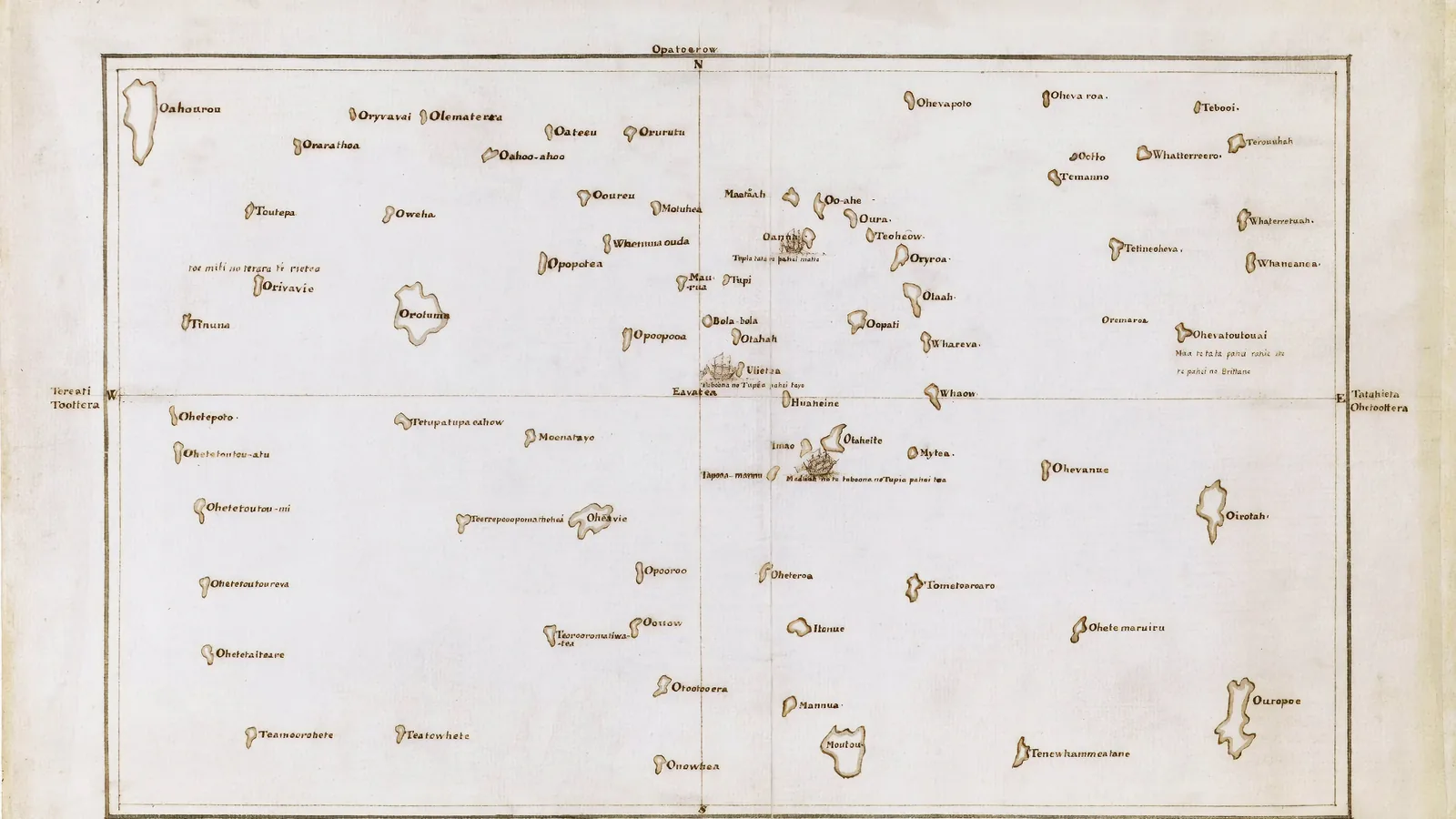

TL;DR — Tupaia, a Tahitian chief and priest, joined Endeavour on July 13, 1769, spoke for Cook in New Zealand, drew a chart of islands, and died at Batavia in December 1770.
On July 13, 1769, between 11 and 12 o’clock in the morning, Endeavour got under sail from Matavai Bay on the north coast of Tahiti, the anchorage James Cook’s journal called Royal Bay. One man on deck was leaving with her. Tupaia, whom Cook recorded as “a Cheif and a Priest,” had chosen to sail with the English after three months in their company, and Joseph Banks wrote that he “parted with a few heartfelt tears” before the two of them climbed to the topmast head and waved to the canoes. Over the next 17 months Tupaia spoke for Cook on a New Zealand beach, drew a chart of Pacific islands for him, and died at Batavia, in what is now Jakarta, before the ship reached England.
Quick facts
- When
- August 26, 1768 (Endeavour sails) · April 13, 1769 (anchors at Tahiti) · July 13, 1769 (Tupaia comes aboard) · October 7 and 9, 1769 (New Zealand sighted; Tupaia speaks with Māori) · April 19, 1770 (Point Hicks) · December 1770 (Tupaia dies at Batavia)
- Where
- Matavai Bay, Tahiti; the east coast of New Zealand's North Island; the southeast coast of Australia; Batavia, in what is now Jakarta
- Who
- Tupaia, "a Cheif and a Priest" in Cook's spelling, with a boy servant; James Cook; Joseph Banks; Daniel Solander; the surgeon William Monkhouse; Lars Eckstein and Anja Schwarz (2019)
- Outcome
- Tupaia interpreted for Cook in New Zealand and drew a chart of Pacific islands; he and his servant died of sickness at Batavia before the ship reached England
Three months at Tahiti, April to July 1769
Endeavour had left the English coast on August 26, 1768, with 94 persons on board by Cook’s count and near 18 months of provisions. At 7 in the morning on April 13, 1769, Cook anchored in 13 fathoms in the bay where the ship Dolphin had watered on an earlier voyage, and the same day issued five rules for trade with the islanders.
On the day of departure Cook wrote that several islanders had been offering daily to leave with the ship, and that he had chosen this one because he had found him “a very intelligent person” who knew more of “the Geography of the Islands situated in these seas, their produce and the religion laws and customs of the inhabitants” than anyone else they had met. Then the decisive clause: “at the request of Mr Banks I received him on board together with a you[n]g boy his servant.” The journals give the boy no name.
Banks’s own entry records that Tupaia “after all his struggles stood firm at last in his resolution” to go, and that once the canoes were gone he “shewd no farther signs of seriousness or concern.” That evening a low island Banks called Tethuroa came in sight, and Tupaia’s knowledge was already steering the ship. He said it had no fixed inhabitants, only Tahitians who went there to fish for a few days, so the ship stood on for the island he called Urietea, well peopled and as large as Tahiti.
New Zealand, October 1769: a language the Māori understood
At 2 in the afternoon on October 7, 1769, the lookout saw land from the masthead bearing west by north. On October 9 Cook anchored on the northeast side of a bay before the mouth of a small river, in 10 fathoms over sand, and went ashore with Banks and Daniel Solander. The first contact went wrong at once. Four men came out of the woods toward the yawl left at the riverbank, and after two warning shots a third musket killed one of them.
The next morning Cook landed again with marines drawn up 200 yards behind. The English called across the river “in the Georges Island Language,” meaning Tahitian, and the Māori answered by brandishing their weapons and dancing. Cook went back to the water’s edge with Tupaia, Green and the surgeon William Monkhouse. Tupaia “spoke to them in his own language and it was an [a]greeable surprise to us to find that they perfectly understood him.” One man swam over, then 20 or 30 more, carrying arms. The journal does not explain why a Tahitian and a Māori could talk.
Tupaia warned the English several times that these men were not their friends. One of them snatched Green’s hanger, a short sword, and would not give it back; Cook ordered him fired on, and he died soon after. Three more were wounded with small shot. Cook’s entry names no bay.
A chart of islands, and Tasman's journal off Point Hicks
In these months Tupaia also drew a chart of islands for Cook. Lars Eckstein and Anja Schwarz of the University of Potsdam re-read its logic in a long essay in the Journal of Pacific History in 2019, “The Making of Tupaia’s Map.” Their abstract describes Tupaia as “an arioi priest, chiefly advisor and master navigator from Ra’iātea,” dates the drawing to “between August 1769 and February 1770,” and says that the identity of many of its islands and the logic of their arrangement had posed a riddle to researchers until then.
Cook’s own method of placing land shows on April 19, 1770. At 6 in the morning the ship raised a coast 5 or 6 leagues off, and he named its southernmost point after his lieutenant: “I have named it Point Hicks, because Leuitt Hicks was the first who discover’d this land.” By his longitude compared with Abel Tasman’s, Van Diemen’s Land ought to have lain due south, and he added that “I do not take the situation of Vandiemens from the printed charts but from the extract of Tasman’s Journal published by Dirk Rembrantse.” Cook checked himself against a Dutch journal from 1642; Tupaia’s knowledge of the sea to the east came from no book at all.
Batavia, December 1770
Endeavour weighed anchor from Batavia at 6 in the morning on December 26, 1770, with 40 or more sick on board by Cook’s count. Seven had died in the port: the surgeon, three seamen, Green’s servant, “and Tupia and his servant both of which fell a sacrifice to this unwholsom climate before they had reached the Object of their wishes.” The entry gives no day for Tupaia’s death.
Cook did not blame the port alone. He wrote that “the long want of a Vegetable diat which he had all his life before been use’d to had brought upon him all the disorders attending a sea life.” Then he drew the man’s character: “He was a Shrewd Sensible, Ingenious Man, but proud and obstinate which often made his situation on board both disagreable to himself and those about him.” The priest who left Tahiti in tears on July 13, 1769, and made himself understood on a New Zealand beach three months later, died with a boy whose name Cook never wrote down.
Key facts
- Endeavour sailed on August 26, 1768, with 94 persons on board by Cook’s count, and anchored at Tahiti at 7 in the morning on April 13, 1769.
- Cook took Tupaia aboard on July 13, 1769, “at the request of Mr Banks,” describing him as “a Cheif and a Priest” who knew the geography of the islands; a boy servant came with him.
- Banks recorded Tupaia’s “few heartfelt tears” at departure and, the same evening, his report that the island he called Tethuroa had no fixed inhabitants.
- On October 9, 1769, on the east coast of New Zealand, Tupaia spoke Tahitian to Māori and, in Cook’s words, “they perfectly understood him”; one Māori had been shot dead the evening before and another died that morning.
- On April 19, 1770, Cook named Point Hicks and checked his position against an extract of Tasman’s 1642 journal published by Dirk Rembrantse.
- Tupaia and his servant died at Batavia in December 1770; Cook called him “a Shrewd Sensible, Ingenious Man, but proud and obstinate.”
- Lars Eckstein and Anja Schwarz published a new reading of the chart Tupaia drew in the Journal of Pacific History in 2019.
FAQ
Why did Cook take Tupaia aboard Endeavour?
Cook wrote on July 13, 1769, that Tupaia knew more of the geography, produce, religion, laws and customs of the islands than anyone the English had met, and that Banks had asked for him.
Could Tupaia really understand the Māori?
Cook's entry for October 9, 1769, says so in his own words: Tupaia "spoke to them in his own language" and the Māori "perfectly understood him." The journal offers no explanation, only the fact.
When and where did Tupaia die?
At Batavia, on Java, in December 1770. Cook's entry for December 26 lists him and his servant among seven dead there and gives no date of death.
Sources
- James Cook, Endeavour journal, entry for 26 August 1768 (National Library of Australia, South Seas; archived copy).
- James Cook, Endeavour journal, entry for 13 April 1769 (National Library of Australia, South Seas; archived copy).
- James Cook, Endeavour journal, entry for 13 July 1769 (National Library of Australia, South Seas; archived copy).
- Joseph Banks, Endeavour journal, entry for 13 July 1769 (National Library of Australia, South Seas, from the State Library of New South Wales transcription; archived copy).
- James Cook, Endeavour journal, entry for 7 October 1769 (National Library of Australia, South Seas; archived copy).
- James Cook, Endeavour journal, entry for 9 October 1769 (National Library of Australia, South Seas; archived copy).
- James Cook, Endeavour journal, entry for 19 April 1770 (National Library of Australia, South Seas; archived copy).
- James Cook, Endeavour journal, entry for 26 December 1770 (National Library of Australia, South Seas; archived copy).
- Lars Eckstein and Anja Schwarz, "The Making of Tupaia's Map," Journal of Pacific History (2019), bibliographic record and abstract, Semantic Scholar.
- University of Potsdam, PublishUP repository, OAI-PMH record for Eckstein and Schwarz, "The making of Tupaia's map" (DOI 10.1080/00223344.2018.1512369).
Cite this article
- APA
- Our Earth's History. (2026, September 21). Tupaia, the Tahitian navigator who sailed with Cook in 1769. Our Earth's History. https://ourearthshistory.com/oceania/early-modern/tupaia-tahitian-navigator-cook-1769/
- Chicago
- Our Earth's History. “Tupaia, the Tahitian navigator who sailed with Cook in 1769.” Our Earth's History, September 21, 2026. https://ourearthshistory.com/oceania/early-modern/tupaia-tahitian-navigator-cook-1769/.
- MLA
- “Tupaia, the Tahitian navigator who sailed with Cook in 1769.” Our Earth's History, 21 Sep. 2026, https://ourearthshistory.com/oceania/early-modern/tupaia-tahitian-navigator-cook-1769/.
Text licensed CC BY-NC-ND 4.0. Found an error? Tell us.