1918 in Samoa: one ship, two administrations, two death rates
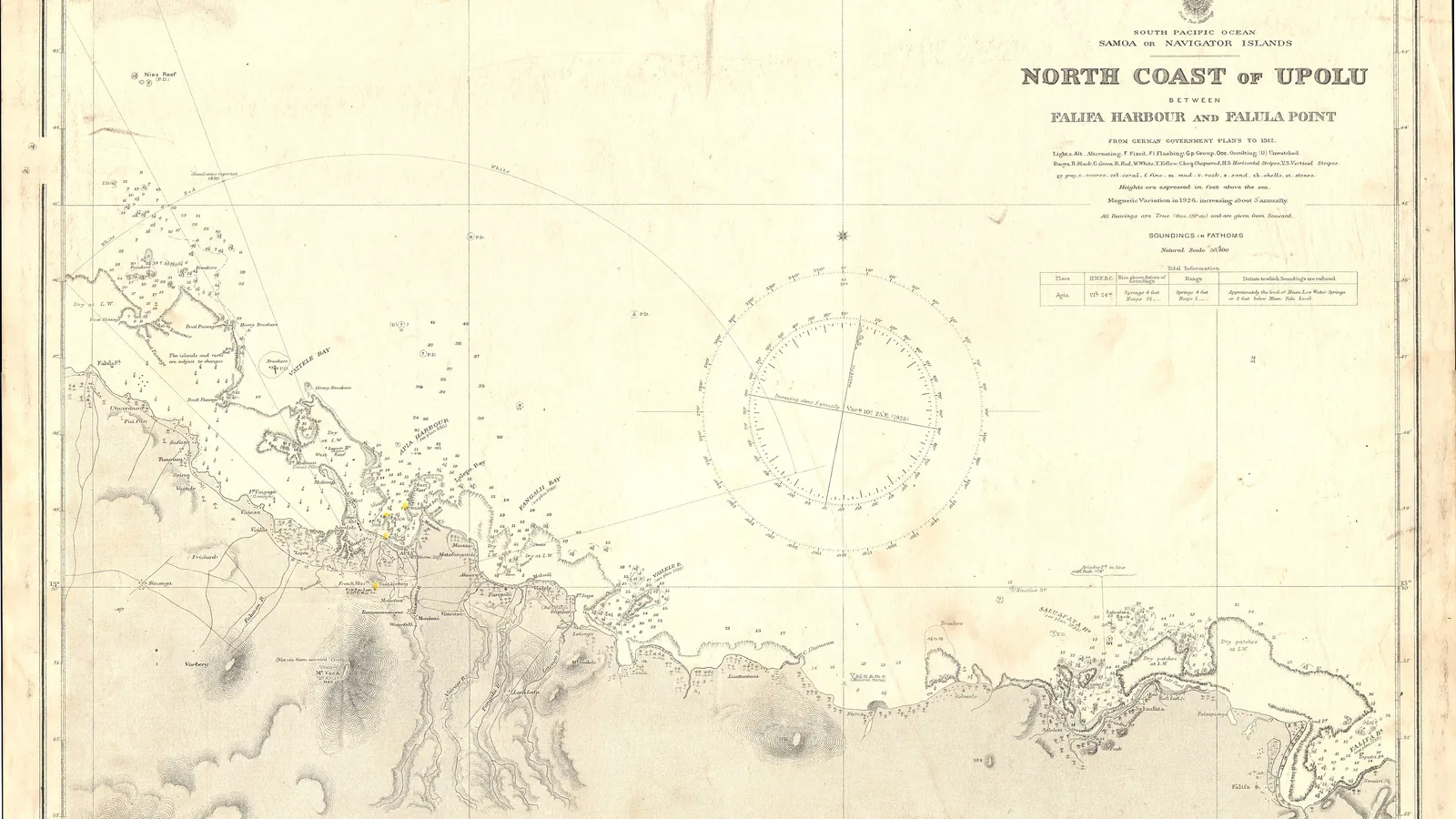

TL;DR — The Talune carried influenza from Auckland to Samoa in November 1918. Western Samoa lost a fifth to a quarter of its people, by different counts; quarantined American Samoa recorded no deaths.
“In the 19th century, the Samoan islands were partitioned into Western and American Samoa; the two geopolitical entities had ethnically identical populations.” That line comes from a 2012 paper on the two territories by G. Dennis Shanks, T. Hussell, and J. F. Brundage. Its own data set the comparison: 22 percent mortality among Samoans on Western Samoa, against 0.0 percent among Samoans on American Samoa. The territories sit about 100 kilometers apart. In November 1918 one absorbed a shipborne epidemic; the other turned it away.
Quick facts
- When
- November 1918 (influenza reaches Western Samoa); December 3, 1918 (HMAS Encounter arrives off Apia); 1919 (New Zealand epidemic commission); 1926 (a milder strain reaches American Samoa)
- Where
- Apia, Western Samoa; Pago Pago, American Samoa; Wellington, New Zealand
- Who
- the crew and captain of the SS Talune; the military governor at Pago Pago; the New Zealand garrison and the crew of HMAS Encounter; Elliot, Wilson and Moorhouse of the 1919 Samoan Epidemic Commission
- Outcome
- Western Samoa lost an estimated 8,000 to 9,000 people, about 22 percent of Samoans on the island by one count and more than a quarter by another. American Samoa, under maritime quarantine, recorded no deaths from the 1918 influenza.
Talune leaves a trail through the Pacific
Shanks, in a separate 2018 paper, describes “the tragic narrative of how the SS Talune brought influenza and thus mass mortality from Auckland, New Zealand to Fiji, Tonga, and Samoa,” and notes that the ship’s captain “denied knowing that influenza was an infectious disease.” The Talune tied three island groups to a single New Zealand departure port before reaching Apia, the administrative center of Western Samoa, which New Zealand had governed since taking it from Germany in 1914.
November 1918: an administration overwhelmed
The 2018 paper places the outbreak against the Armistice: “News of the end of the First World War arrived just as Samoans began to die of influenza.” Within two weeks the scale was clear: “By mid-November, it was clear that a disaster was underway and an urgent call for help went from Apia, Samoa to Wellington, New Zealand.” New Zealand, fighting its own epidemic, asked Australia to send a medical team on the cruiser HMAS Encounter. Locally, “the local European community mobilized to assist the Samoan population with food and water delivery to homes,” and burial fell to outsiders: “the ship’s crew, along with the local garrison of the New Zealand Army, managed the difficult task of burying thousands of bodies as nearly the entire local population was incapacitated.” HMAS Encounter reached Apia only on December 3, after “the influenza epidemic was waning.”
Three papers, three numbers for Western Samoa
No single death toll appears across the literature. The 2018 paper estimates “between 8000 and 9000” deaths, a toll “similar to that in all of New Zealand and not far short of the 11,000 dead in Australia,” countries 25 and 125 times Samoa’s population. Shanks, Hussell, and Brundage’s 2012 paper works instead from a proportion, recording “Samoans on Western Samoa 22 of 38 000” against “Samoans on American Samoa 0.0,” part of a spread that “differed more than 50-fold” across Pacific islands. Kirsty R. Short, Katherine Kedzierska, and Carolien E. van de Sandt, in a 2018 paper, put Western Samoa’s rate at “236/1000” against “0/1000” and describe a toll of “more than a quarter of the population.”
American Samoa closes its harbor
The 2012 paper traces the contrast to one act: “The survival of American Samoans reflected the effectiveness of a maritime quarantine that was instituted by the military governor in Pago Pago.” Short and her coauthors describe the same measure: “A strict maritime quarantine was imposed in American Samoa by the U.S. Governor in 1918. This quarantine prevented influenza from entering the country, and no deaths from the 1918 influenza were ever recorded in America Samoa.”
The garrison, the vaccine and the 1919 commission
Australia’s Commonwealth Serum Laboratories prepared a “mixed bacterial” vaccine, given repeatedly to the 450 crew of HMAS Encounter after most Samoans were already infected; the 2018 paper states “no actual figures are available regarding the vaccine’s effectiveness in the Samoan community.” A separate 2012 paper by Nick Wilson and coauthors, including Shanks, gave Samoa a relative mortality risk of 16.5 among indigenous Pacific populations across New Zealand’s pandemics. Inside Samoa the same gap held: New Zealand soldiers stationed there are recorded in the 2012 paper’s table as “1.8 of 600.” A milder repeat arrived eight years later: in 1926, “25% of the residents became ill but <0.1% died,”. New Zealand’s government had by then convened an inquiry, cited in the 2018 paper as Elliot, Wilson, and Moorhouse’s Report of the Samoan Epidemic Commission, published in Wellington in 1919.
Key facts
- The SS Talune carried influenza from Auckland to Fiji, Tonga, and Western Samoa; its captain denied knowing influenza was infectious (Shanks, 2018).
- HMAS Encounter reached Apia on December 3, 1918, after the epidemic had begun to wane (Shanks, 2018).
- Shanks (2018) estimates 8,000 to 9,000 deaths in Western Samoa, close to all of New Zealand’s toll and not far short of Australia’s 11,000.
- Shanks, Hussell, and Brundage’s 2012 paper records 22 percent mortality among Samoans on Western Samoa against 0.0 percent on American Samoa.
- Short and coauthors (2018) put Western Samoa’s rate at 236 per 1,000, describing the toll as “more than a quarter of the population,” against 0 per 1,000 on American Samoa.
- The military governor at Pago Pago imposed a maritime quarantine that two independent 2012 and 2018 papers credit with keeping American Samoa’s death toll at zero.
- The 2012 paper’s table records New Zealand soldiers stationed on Samoa as “1.8 of 600.”
- Wilson and coauthors, in a separate 2012 paper, give Samoa a relative mortality risk of 16.5 among indigenous Pacific populations across New Zealand’s pandemics.
- In 1926 a milder strain reached American Samoa: 25 percent of residents fell ill and fewer than 0.1 percent died (2012 paper).
FAQ
How many people died in the 1918 influenza epidemic in Western Samoa?
Estimates vary. Shanks's 2018 paper gives 8,000 to 9,000 deaths. His 2012 paper with Hussell and Brundage records 22 percent of Samoans on Western Samoa. Short's 2018 paper with Kedzierska and van de Sandt describes more than a quarter of the population, or 236 per 1,000. The figures fall in the same range without an exact match.
Why did American Samoa have no deaths from the 1918 influenza?
Two independent papers, one from 2012 and one from 2018, credit a maritime quarantine ordered by the American military governor at Pago Pago, which kept the disease from entering the territory.
What was the Samoan Epidemic Commission?
A New Zealand government inquiry into the outbreak, cited in Shanks's 2018 paper as Elliot, Wilson, and Moorhouse's Report of the Samoan Epidemic Commission, published in Wellington in 1919.
Sources
- G. Dennis Shanks, "The 'Influenza' Vaccine Used during the Samoan Pandemic of 1918," Tropical Medicine and Infectious Disease 3, no. 1 (2018): 17.
- G. Dennis Shanks, T. Hussell, and J. F. Brundage, "Epidemiological isolation causing variable mortality in Island populations during the 1918-1920 influenza pandemic," Influenza and Other Respiratory Viruses 6, no. 6 (2012): 417-423.
- Kirsty R. Short, Katherine Kedzierska, and Carolien E. van de Sandt, "Back to the Future: Lessons Learned From the 1918 Influenza Pandemic," Frontiers in Cellular and Infection Microbiology 8 (2018): 343.
- Nick Wilson, Lucy Telfar Barnard, Jennifer A. Summers, G. Dennis Shanks, and Michael G. Baker, "Differential Mortality Rates by Ethnicity in 3 Influenza Pandemics over a Century, New Zealand," Emerging Infectious Diseases 18, no. 1 (2012): 71-77.
Cite this article
- APA
- LETTER. (2026, September 28). 1918 in Samoa: one ship, two administrations, two death rates. Our Earth's History. https://ourearthshistory.com/oceania/contemporary/samoa-1918-influenza-talune-western-american-samoa-quarantine/
- Chicago
- LETTER. “1918 in Samoa: one ship, two administrations, two death rates.” Our Earth's History, September 28, 2026. https://ourearthshistory.com/oceania/contemporary/samoa-1918-influenza-talune-western-american-samoa-quarantine/.
- MLA
- LETTER. “1918 in Samoa: one ship, two administrations, two death rates.” Our Earth's History, 28 Sep. 2026, https://ourearthshistory.com/oceania/contemporary/samoa-1918-influenza-talune-western-american-samoa-quarantine/.
Text licensed CC BY-NC-ND 4.0. Found an error? Tell us.