Taputapuātea, the marae complex at Ōpoa on Ra'iatea

TL;DR — Taputapuātea on Ra’iatea is dated to the 14th to 18th centuries in its World Heritage text and after AD 1600 by one radiocarbon study. UNESCO listed it in 2017.
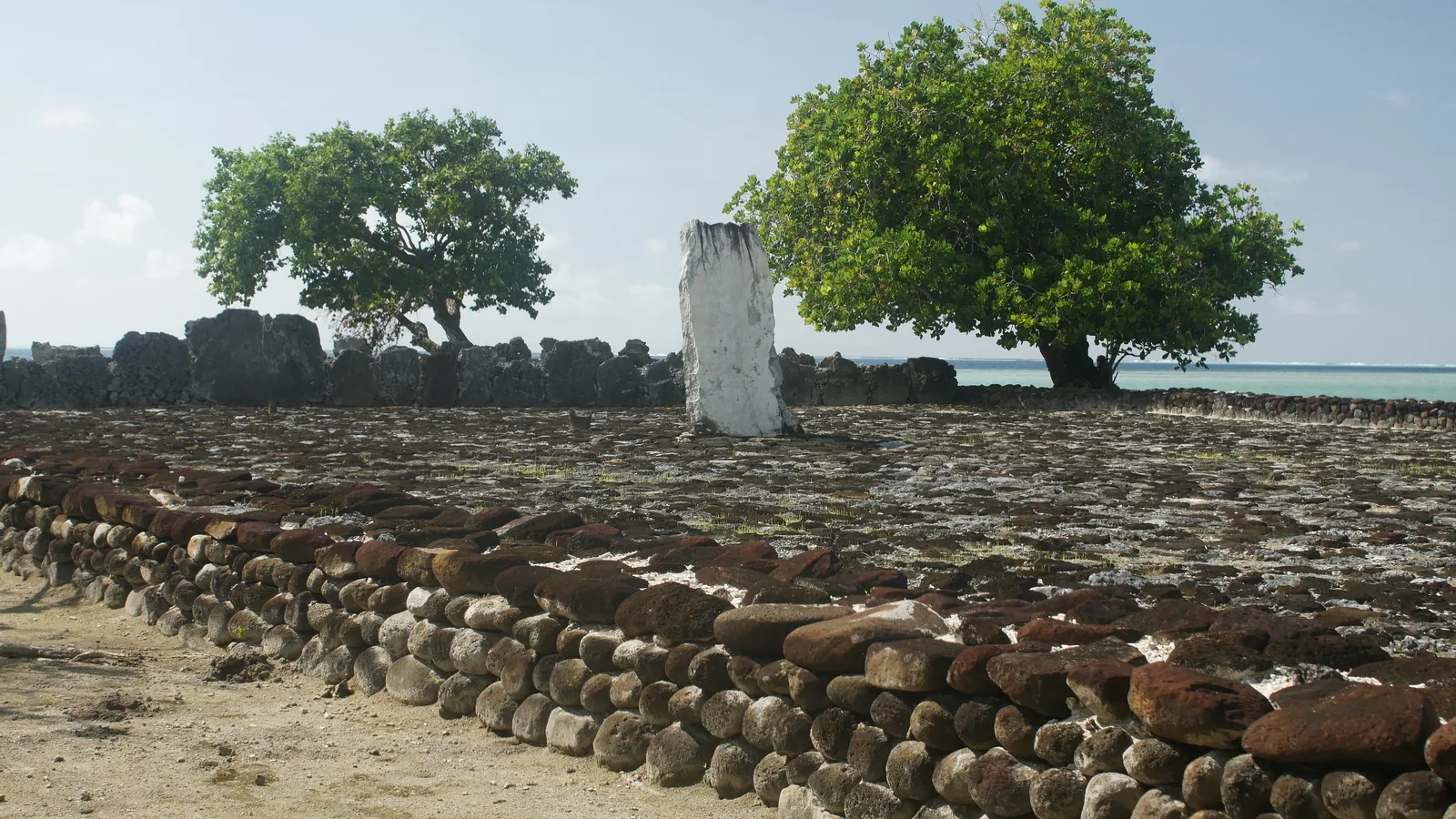
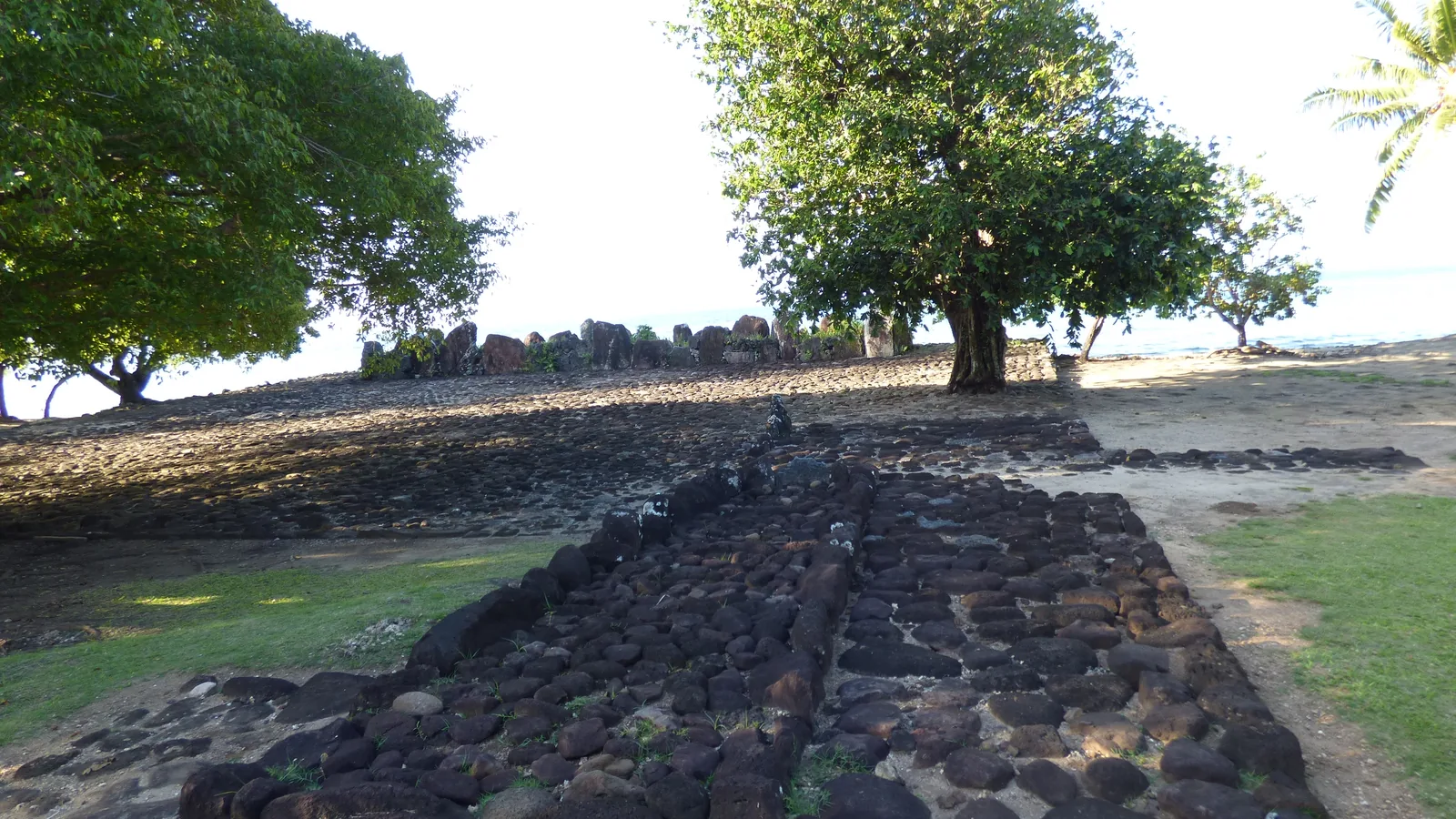
Shells from the platform of marae Taputapuātea at Ōpoa, on Ra’iatea, give a calibrated date of AD 1503 to 1722, or AD 1793 to 1799. Ra’iatea lies in the Leeward group of the Society Islands, in what is now French Polynesia, and a marae there is a paved court with a raised platform, the ahu, at one end. The World Heritage criteria for the site place the building of its marae between the 14th and 18th centuries. Reidar Solsvik and Paul Wallin, working from the shell date and one other, suggest that marae Taputapuātea was built after AD 1600. The Polynesian Voyaging Society brought a fleet of canoes to the marae in March 1995, and in July 2017 RNZ Pacific reported that UNESCO had given the complex World Heritage status.
Quick facts
- When
- Early 1960s (shells from the ahu dated during restoration) · March 18, 1995 (canoe ceremonies at the marae) · July 2017 (World Heritage status reported by RNZ Pacific)
- Where
- Marae Taputapuātea at Ōpoa, on Ra'iatea in the Leeward group of the Society Islands, in what is now French Polynesia
- Who
- Yosihiko H. Sinoto and Kenneth P. Emory; Reidar Solsvik and Paul Wallin; Nainoa Thompson and the Polynesian Voyaging Society; Paul Tapsell
- Outcome
- The World Heritage text places the building of its marae in the 14th to 18th centuries, while Solsvik and Wallin suggest the complex was built after AD 1600; UNESCO accepted France's bid at its 41st meeting, in Poland, in July 2017
Two datings for one platform
During restoration work in the early 1960s, Yosihiko H. Sinoto and Kenneth P. Emory found the shells lodged in depressions on one of the coral slabs that make up the face of the ahu, and published the result in 1965. The sample, GaK-299, returned a date of 700 ± 100 before calibration. Solsvik, of the Kon-Tiki Museum in Norway, and Wallin, of Gotland University in Sweden, recalibrated it with a marine curve to the two spans in the first paragraph.
A second sample came from about 80 meters west of the ahu, where an archery platform points toward the marae. Sinoto dug a test trench between that platform and a house foundation beside it, and a sample that predates the platform, GaK-403, calibrated to AD 1417 to 1697. From the two dates Solsvik and Wallin wrote: “It is possible, then, to suggest that marae Taputapuatea and the other marae at the area called te po were constructed after AD 1600.” They set it beside four dates from three large coastal marae on Huahine and concluded that marae of the type tied to the god ‘Oro were being built between AD 1650 and AD 1750, “or even later.” Their table of 42 radiocarbon dates from Society Islands marae holds a single date from Taputapuātea, and the same paper records that some writers treat early dates from the Gakushuin laboratory in Tokyo, the source of both GaK samples, as suspect.
The World Heritage criteria appear in French on the page of the Association des Biens Français du Patrimoine Mondial, which groups France’s listed properties. Criterion (iii) calls the landscape a witness to 1,000 years of Mā’ohi civilization, and criterion (iv) describes its marae as temples built by the Mā’ohi people “du XIVe au XVIIIe siècle,” from the 14th to the 18th century. RNZ Pacific gave the complex’s age in 2017 as about 1,000 years.
Canoes at the sacred pass
The association’s page describes marae Taputapuātea as dedicated to ‘Oro and as the place where the world of the living, Te Ao, meets the world of the ancestors and gods, Te Pō. The complex sits at the tip of a peninsula reaching into the lagoon and faces Te Ava Mo’a, a sacred pass through the reef. Canoes arriving from the open sea waited at motu Atāra, a reef islet that shelters seabirds, before they were led through the pass and formally welcomed at the marae. Inland, the wooded ‘Ōpoa and Hotopu’u valleys, ringed by ridges and the sacred mountain Tea’etapu, hold older marae such as Vaeāra’i and Taumariari.
The same page ties the marae’s rise to the Tamatoa line of ari’i, or chiefs. Taputapuātea, it states, was the center of a political alliance joining two wide regions that covered most of Polynesia, held together by regular gatherings of chiefs, warriors and priests from other islands. Building outrigger canoes and navigating the open ocean were the skills that kept the network running. Criterion (iv) adds that stones from this marae were carried to other islands to found other marae of the same name. Solsvik and Wallin write that the large coastal marae of the Leeward Islands, with ahu of huge limestone or coral slabs, frequently go with the spread of the ‘Oro cult from Ra’iatea, where Taputapuātea was the cult center.

Nainoa Thompson's account, 1976 and 1995
Nainoa Thompson of the Polynesian Voyaging Society wrote a summary of Hōkūle’a’s first 25 years. His paragraph on 1976 has the canoe leaving Hawai’i on May 1 for Tahiti and entering Pape’ete Harbor 33 days after leaving Maui. The society’s page for that voyage, built around an account by Ben Finney, describes a landfall at Matahiva in the Tuamotus and the short run on to Tahiti. Neither text names Ra’iatea or Taputapuātea for 1976.
Thompson first names the marae for 1995. “We all went to a place called Taputapuatea in Ra’iatea, formerly the cultural center of Polynesia, where navigation and genealogy were taught,” he wrote. He listed the fleet as Hōkūle’a with the new Hawaiian canoes Hawai’iloa and Makali’i, Te ‘Au O Tonga and Takitumu from Rarotonga, and Te ‘Aurere from Aotearoa, and called the marae perhaps the most appropriate place to begin a voyage to the Marquesas and on to Hawai’i.
The society’s voyage reports from that spring give a narrower count. An earlier entry calls the event the rededication of the marae. The entry for March 18, 1995, records ceremonies at the marae attended by Te ‘Aurere, Takitumu, Hōkūle’a, Hawai’iloa and Tahiti Nui, with a reed canoe built in Tahiti by people of Rapa Nui; Te Au o Tonga and Makali’i were still on their way. Te ‘Aurere entered Te Ava Mo’a first, the report states, to lift an old kapu, or prohibition, “placed on the pass after a Maori chieftain was slain on the marae over 600 years ago.”
July 2017, a listing reported from Poland
The association lists Taputapuātea as a cultural landscape inscribed in 2017 under criteria (iii), (iv) and (vi), covering 2,124 hectares with a buffer zone of 3,363 hectares. Criterion (vi) names it the ancestral home of Polynesian culture, of exceptional importance to people across Polynesia for the way it symbolizes their origins and links them to their ancestors.
RNZ Pacific reported that “UNESCO’s 41st meeting in Poland accepted the bid by France to give Taputapuatea marae World Heritage status,” after a campaign by the territory of more than 20 years. On July 12 RNZ quoted Paul Tapsell, a professor of Māori, Pacific and indigenous studies at the University of Otago, who said the Pacific peoples shared one Austronesian family and had lived in the region for about 3,000 years. “Taputapuatea is right at the heart of our very soul of being a Pacific people,” he said. RNZ Pacific’s first report of the listing, dated July 10, 2017, recorded that the French Polynesian delegation had traveled to Kraków for the weekend announcement.
Key facts
- Marine shells from a coral slab of the ahu at marae Taputapuātea, sample GaK-299, were dated by Sinoto and Emory in the early 1960s and recalibrate to AD 1503 to 1722 or AD 1793 to 1799 (Solsvik and Wallin).
- A sample predating an archery platform about 80 meters west of the ahu, GaK-403, calibrates to AD 1417 to 1697; from the two dates Solsvik and Wallin suggest the complex was built after AD 1600.
- The World Heritage criteria describe the site’s marae as built from the 14th to the 18th century and the landscape as a witness to 1,000 years of Mā’ohi civilization.
- The marae is dedicated to ‘Oro and faces Te Ava Mo’a, a sacred pass in the reef; canoes from the open sea waited at motu Atāra before being welcomed at the marae.
- Nainoa Thompson’s account ends the 1976 voyage in Pape’ete Harbor and first names Taputapuātea for 1995; the society’s reports record ceremonies there on March 18, 1995.
- RNZ Pacific reported on July 10, 2017, that UNESCO’s 41st meeting, in Poland, accepted France’s bid; the listing covers 2,124 hectares with a 3,363-hectare buffer zone.
FAQ
How old is Taputapuātea marae?
The World Heritage criteria place the building of the site's marae between the 14th and 18th centuries. Solsvik and Wallin, working from two radiocarbon samples taken in the early 1960s, suggest that marae Taputapuātea itself was built after AD 1600, and their table holds a single date from the marae.
Did Hōkūle'a sail to Taputapuātea in 1976?
Nainoa Thompson's account of 1976 ends with Hōkūle'a entering Pape'ete Harbor in Tahiti, and the society's page for that voyage does not name Ra'iatea. Thompson first names Taputapuātea for the 1995 voyage to the Marquesas.
When did Taputapuātea become a World Heritage site?
In 2017. RNZ Pacific reported on July 10, 2017, that UNESCO's 41st meeting, held in Poland, had accepted France's bid, and the Association des Biens Français du Patrimoine Mondial gives 2017 as the year of inscription.
Sources
- Reidar Solsvik (The Kon-Tiki Museum) and Paul Wallin (Gotland University), "Time and Temples: Chronology of Marae Structures in the Society Islands," Gotland University Press 11, pp. 269-284, full text in the Uppsala University DiVA repository.
- Association des Biens Français du Patrimoine Mondial, "Taputapuātea" (property page with the inscription criteria, area and year of listing, in French).
- Polynesian Voyaging Society archive, Nainoa Thompson, "Twenty-Five Years of Voyaging (1975-2000)."
- Polynesian Voyaging Society archive, "1995: Nukuhiva, Nā 'Ohana Holo Moana" voyage reports (entries for March 7 to 29, 1995).
- Polynesian Voyaging Society archive, "1976 Hawai'i to Tahiti and Back," with Ben Finney's account of the voyage.
- RNZ Pacific, "French Polynesian marae gets World Heritage status," July 10, 2017.
- RNZ Pacific, "New World Heritage site 'links all of Polynesia'," July 12, 2017.
Cite this article
- APA
- LETTER. (2026, September 29). Taputapuātea, the marae complex at Ōpoa on Ra'iatea. Our Earth's History. https://ourearthshistory.com/oceania/early-modern/taputapuatea-marae-opoa-raiatea-dating-2017/
- Chicago
- LETTER. “Taputapuātea, the marae complex at Ōpoa on Ra'iatea.” Our Earth's History, September 29, 2026. https://ourearthshistory.com/oceania/early-modern/taputapuatea-marae-opoa-raiatea-dating-2017/.
- MLA
- LETTER. “Taputapuātea, the marae complex at Ōpoa on Ra'iatea.” Our Earth's History, 29 Sep. 2026, https://ourearthshistory.com/oceania/early-modern/taputapuatea-marae-opoa-raiatea-dating-2017/.
Text licensed CC BY-NC-ND 4.0. Found an error? Tell us.