Three stones at Heketa, the Haʻamonga ʻa Maui trilithon of Tongatapu
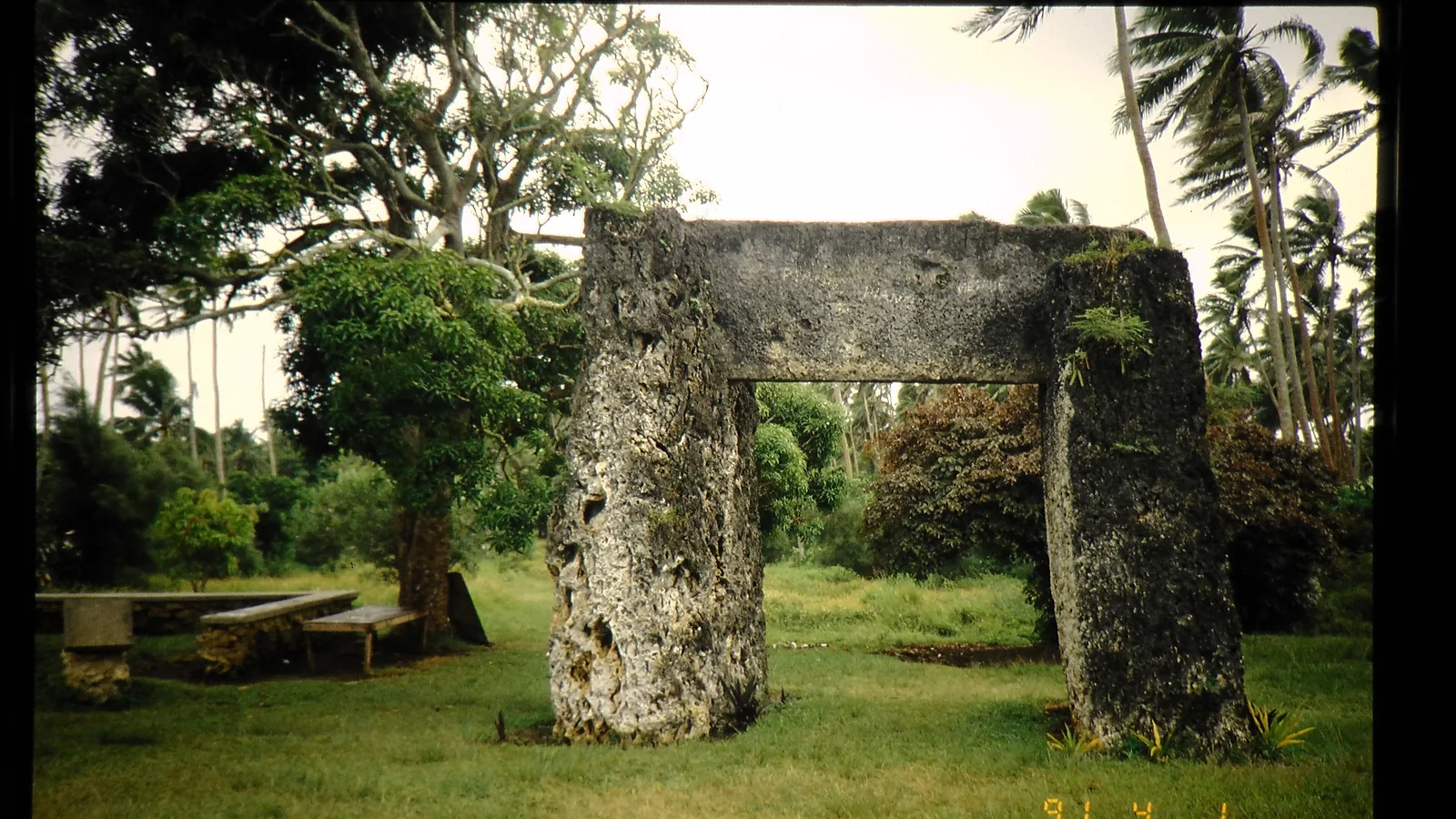

TL;DR — The Haʻamonga ʻa Maui trilithon at Heketa, Tongatapu, is tied by tradition to the eleventh Tuʻi Tonga’s sons; its weight and date are disputed.
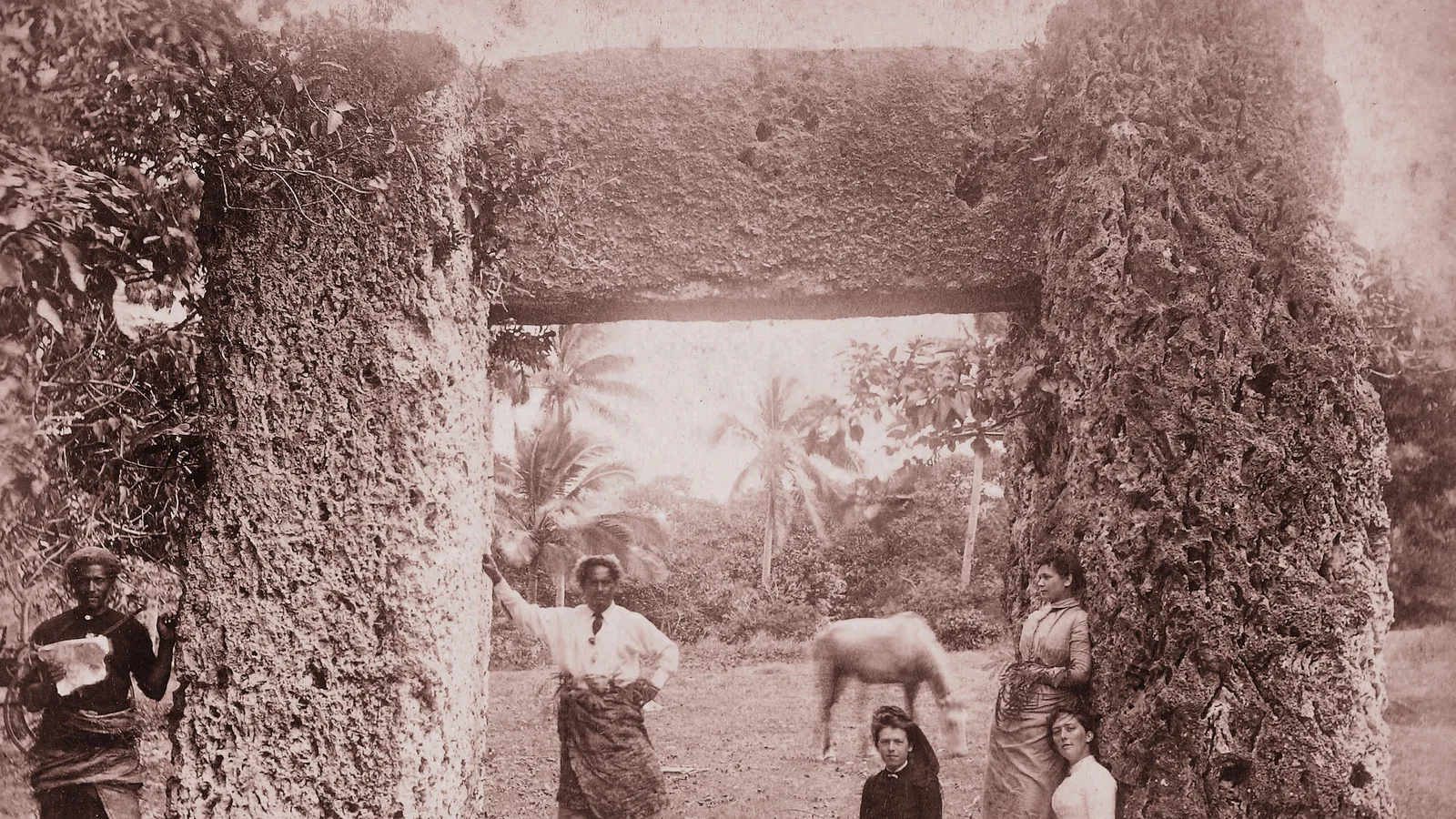
David Burley, writing in the Journal of World Prehistory in 1998, calls it “the most impressive commemorative site” on Tongatapu. It is “the Ha’amonga-‘a-Maui trilithon at Heketa, its uprights claimed as symbols of the elder and younger sons of the 11th Tu’i Tonga, and the lintel stone representing their bond of brotherhood,” Burley writes. That eleventh Tuʻi Tonga was Tuʻitātui, whom E. E. V. Collocott’s 1924 genealogy in the Journal of the Polynesian Society lists at number eleven, “c. 1200,” son of the tenth Tuʻi Tonga, Momo. The identification comes from two independent lines of work, Collocott’s genealogical research and W. C. McKern’s 1929 archaeological survey, both cited by Burley.
Quick facts
- When
- c. 1200 by the traditional Tuʻi Tonga genealogy (Collocott, 1924); the fourteenth century AD by Clark and Reepmeyer's 2014 fieldwork
- Where
- Heketa, on the northeast coast of Tongatapu, Kingdom of Tonga
- Who
- Tuʻitātui, eleventh Tuʻi Tonga; David Burley; E. E. V. Collocott; W. C. McKern; Dirk H. R. Spennemann; Geoffrey Clark and Christian Reepmeyer
- Outcome
- The trilithon's weight is given as 30 to 40 tons by McKern and over 40 tons by Spennemann, and its date is disputed between the traditional c. 1200 genealogy and the fourteenth-century date Clark and Reepmeyer report from fieldwork at Heketa
Tuʻitātui and a monument that would not perish
Collocott gives a reason for the trilithon. “Towards the close of Tui-ta-tui’s reign the determination was taken to build an imperishable monument,” he writes. “The famous trilithon in eastern Tongatabu was the fruit of this ambitious decision. The completion of this structure is by some accounts assigned to Tui-ta-tui’s sons.” He records the name as a contraction: “this monument, commonly known as the Haamonga or, more fully, Haamo-nga-a-Maui (Burden carried on the shoulder of Maui), dates from the thirteenth century,” a claim he ties to a condition, “if our assumptions as to chronology, and the general reliability of tradition be correct.” Collocott treats the whole genealogy the same way, noting that “there are different lists with varying numbers of generations” and that his reconstruction claims no more than “substantial correctness.”
A Tongan manuscript from 1870, quoted by Collocott, gives the building method: “Three stones were cut, two placed upright, earth heaped up between them till it was level with their tops, and the third pushed up, and put in place. Then the earth was removed and used for little platforms (sia) where Tui-ta-tui was buried; but the Haamonga stood for a sight.” The same manuscript credits neighboring islands with the labor: “In the beginning of the work it was portioned out, foreign groups sharing it, Rotuma, Futuna, Uvea, Niua Fo’ou and Niua Toputapu and Samoa.”
Two weights, one stone
Burley’s survey sets the trilithon apart from other Tongan stonework by its scale. “The Ha’amonga-‘a-Maui is decidedly anomalous,” he writes, “being built of massive, well-dressed limestone blocks with upright stones individually weighing in excess of 40 tons.” That figure is Spennemann’s, from his 1989 study; Burley notes in the same sentence that “McKern (1929, pp. 63-66) provides an estimate of 30-40 tons.”
A date in dispute
Burley links Heketa’s founding to an earlier ruler. “Gifford’s (1929, pp. 52-53) and Bott’s (1982, p. 92) accounts of oral traditions for Heketa associate its development with the tenth Tu’i Tonga,” he writes, giving “the genealogical date of 750 B.P.” for that founding. He does not extend that date to the trilithon itself. “In that the Ha’amonga-‘a-Maui is comparable in scale, technology, and material to only one other site in Tonga, a much later tomb at Lapaha,” he writes, “its construction may not be contemporaneous with the origins of Heketa as is usually assumed.” Geoffrey Clark and Christian Reepmeyer’s 2014 fieldwork at the site, reported in Antiquity, states that “Tongan tradition and archaeology combine to show” that the platforms, tomb and trilithon at Heketa “were the setting for new ceremonies instituted by the emergent Tu’i Tonga lineage in the fourteenth century AD as they laid the foundations of the early Tongan chiefdom,” ceremonies that included “the drinking of kava and the presentation of first fruits to the chiefs.”
What stands at Heketa
Burley cites Spennemann’s 1987 mapping of Heketa, which “records a series of chiefly sitting platforms, stone faced tombs, an upright stone, and the Ha’amonga-‘a-Maui trilithon.” The same 1870 manuscript records that Tuʻitātui wanted his burial vault built while he still lived, “meaning to build his burial vault, for he was old,” but that the men would not agree, “and so Tui-ta-tui was buried in the earth, thrown out in digging the Haamonga.”

Protection under Tongan law
Tonga’s Preservation of Objects of Archaeological Interest Act, passed as Act No. 15 of 1969 and in force from March 31, 1970, defines an “object of archaeological interest” to include a “monolith” and a “rock drawing.” The Act assigns enforcement to the Committee on Tongan Traditions, “appointed by His Majesty the King in Council by notice published in Gazette No. 14 of 1954.” Excavation or search requires the Committee’s permission, a find must be reported to it, and removal from the kingdom needs separate authorization; the Act sets a 200 dollar fine or up to three years’ imprisonment, or both, for those offenses. A Tonga National University library record, held through Digital Pasifik, lists a 1987 government-commissioned study titled “The development of the Ha’amonga Trilithon Historic Park: the Ha’amonga historical trail,” prepared by D. H. R. Spennemann for Tonga’s Ministry of Lands, Survey and Natural Resources, the Central Planning Department and the Tonga Visitors Bureau. The library record marks the study “Not online.”
Key facts
- Burley (1998) calls the Haʻamonga ʻa Maui trilithon at Heketa the “most impressive commemorative site” on Tongatapu.
- Collocott’s 1924 Tuʻi Tonga genealogy places Tuʻitātui eleventh, “c. 1200,” son of the tenth Tuʻi Tonga, Momo.
- The name is a contraction of Haamo-nga-a-Maui, “Burden carried on the shoulder of Maui” (Collocott, 1924).
- A Tongan manuscript from 1870, quoted by Collocott, describes cutting three stones, raising two uprights on heaped earth and pushing the third into place as the lintel.
- The same manuscript credits Rotuma, Futuna, Uvea, Niua Foʻou, Niua Toputapu and Samoa with sharing the labor.
- McKern (1929) estimates each upright at 30 to 40 tons; Spennemann (1989) puts them at over 40 tons.
- Burley (1998) doubts the trilithon dates to Heketa’s founding under the tenth Tuʻi Tonga; Clark and Reepmeyer (Antiquity, 2014) report fieldwork placing its monuments in the fourteenth century AD.
- Tonga’s Preservation of Objects of Archaeological Interest Act, No. 15 of 1969, covers monoliths and rock drawings and answers to the Committee on Tongan Traditions, established in 1954.
FAQ
Who built the Haʻamonga ʻa Maui trilithon?
Tradition assigns it to Tuʻitātui, the eleventh Tuʻi Tonga, or to his sons after his reign, according to Collocott's 1924 account of Tongan oral history. Burley (1998) reports that McKern's independent 1929 archaeological survey reaches the same identification.
How much does each upright stone weigh?
Sources disagree. McKern's 1929 survey estimates 30 to 40 tons per upright; Spennemann's 1989 study puts the figure at over 40 tons. Burley (1998) cites both without choosing between them.
When was the trilithon built?
Collocott's genealogy dates Tuʻitātui's reign to around 1200. Clark and Reepmeyer's 2014 fieldwork at Heketa, published in Antiquity, instead places the site's platforms, tomb and trilithon in the fourteenth century AD as part of new ceremonies established by the Tuʻi Tonga lineage.
Sources
- David V. Burley, "Tongan Archaeology and the Tongan Past, 2850-150 B.P.," Journal of World Prehistory 12(3) (1998), pp. 337-392
- E. E. V. Collocott, "An Experiment in Tongan History," The Journal of the Polynesian Society 33, No. 131 (1924), pp. 166-184 (Wayback Machine copy of jps.auckland.ac.nz, 2022-10-06 capture)
- Geoffrey Clark and Christian Reepmeyer, "Stone architecture, monumentality and the rise of the early Tongan chiefdom," Antiquity 88, Issue 342 (December 2014), pp. 1244-1260
- Kingdom of Tonga, Attorney General's Office, Preservation of Objects of Archaeological Interest Act (Act No. 15 of 1969, Cap. 90, 1988 Revised Edition)
- Kingdom of Tonga, Attorney General's Office, Tongan Legislation - Alphabetical index
- Tonga National University library record via Digital Pasifik, "The development of the Ha'amonga Trilithon Historic Park: the Ha'amonga historical trail," D. H. R. Spennemann, 1987
Cite this article
- APA
- Our Earth's History. (2026, September 27). Three stones at Heketa, the Haʻamonga ʻa Maui trilithon of Tongatapu. Our Earth's History. https://ourearthshistory.com/oceania/medieval/haamonga-a-maui-tongatapu-trilithon-tuitatui-heketa-burley-1998/
- Chicago
- Our Earth's History. “Three stones at Heketa, the Haʻamonga ʻa Maui trilithon of Tongatapu.” Our Earth's History, September 27, 2026. https://ourearthshistory.com/oceania/medieval/haamonga-a-maui-tongatapu-trilithon-tuitatui-heketa-burley-1998/.
- MLA
- “Three stones at Heketa, the Haʻamonga ʻa Maui trilithon of Tongatapu.” Our Earth's History, 27 Sep. 2026, https://ourearthshistory.com/oceania/medieval/haamonga-a-maui-tongatapu-trilithon-tuitatui-heketa-burley-1998/.
Text licensed CC BY-NC-ND 4.0. Found an error? Tell us.