An iron pillar older than its mosque: the Qutb Minar complex, Delhi
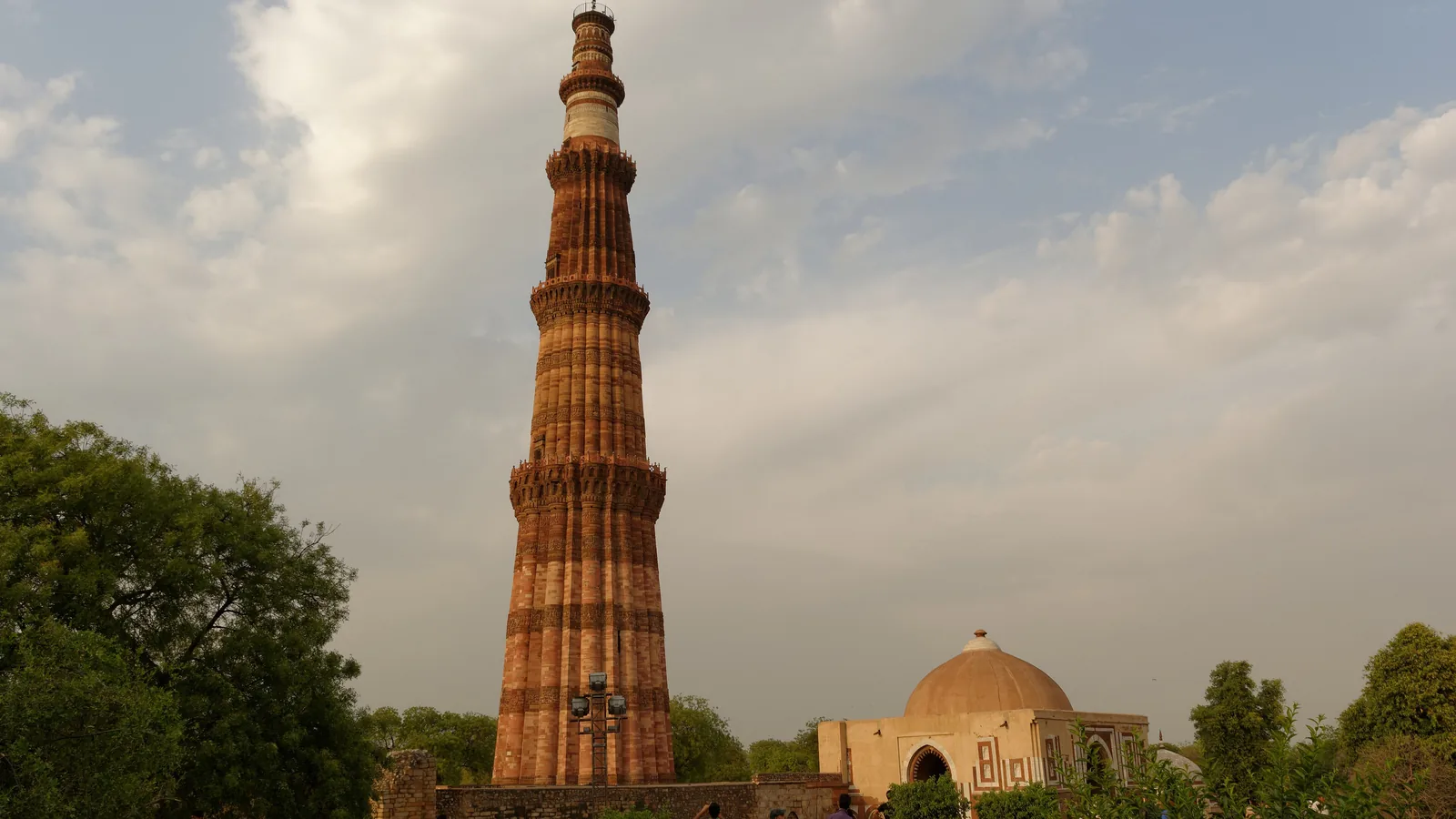

TL;DR — The Archaeological Survey of India dates the Qutb Minar’s foundation to 1199; the iron pillar standing in its courtyard, a metallurgist finds, came from Udayagiri centuries earlier.
The Archaeological Survey of India’s page on the monument states that “Qutbu’d-Din Aibak laid the foundation of Qutb Minar in AD 1199 for the use of the mu’azzin (crier) to give calls for prayer and raised the first storey, to which were added three more storeys by his successor and son-in-law, Shamsu’d-Din Iltutmish (AD 1211-36).” The Encyclopaedia Iranica entry on Qutb-al-Din Aybak, written by Nasr Hasan Zaidi, records that the tower this Ghurid general began “was extended by Iltutmiš to the total height of 69.7 m.” The survey gives a different figure, 72.5 meters, and a separate Iranica entry, by Catherine B. Asher, puts the height Iltutmish reached at an estimated 79 meters.
Quick facts
- When
- AD 1198-99 (mosque and minaret founded) · 1211-36 (Iltutmish's reign; storeys completed about 1229) · 1351-88 and 1489-1517 (repairs recorded in inscriptions, under Firuz Shah Tughlaq and Sikandar Lodi) · 1829 (repair by Major R. Smith) · 1961 (excavation of the iron pillar's buried base) · 2016 (government survey answer on the tilt)
- Where
- the Qutb complex, Delhi; the iron pillar's original site at Udayagiri, in present-day Madhya Pradesh
- Who
- Qutb-ud-din Aibak; Shamsu'd-Din Iltutmish; Firuz Shah Tughlaq; Sikandar Lodi; metallurgist R. Balasubramaniam; the Archaeological Survey of India; the Press Information Bureau, Ministry of Culture
- Outcome
- Aibak founded a mosque and a minaret in 1198-99 from stone taken from demolished temples; Iltutmish added three storeys, completing the tower around 1229; the iron pillar standing in the mosque courtyard was cast centuries earlier at Udayagiri and moved to Delhi in the eleventh century, and a 2000 metallurgical study explains why it has not rusted
Qutb-ud-din Aibak lays a foundation, 1199
Aibak was a general of the Ghurid dynasty. The tower he founded in 1199 rises in red and buff sandstone from a base 14.32 meters across to a top 2.75 meters wide, in four storeys, the survey’s page records, with balconies carried on stone brackets “decorated with honey-comb design, more conspicuously in the first storey.” Aibak raised the first storey; Iltutmish added the other three, and Asher’s Iranica entry on the Delhi Sultanate places the completion “about 626/1229.” Inscriptions on the tower’s surface record later repairs, the survey’s page states, by Firuz Shah Tughlaq in 1351-88 and by Sikandar Lodi in 1489-1517; Major R. Smith carried out a further repair in 1829. Zaidi’s Iranica entry adds that a 1794 record put the tower at 242 feet before its sixth and seventh storeys, damaged by an earthquake, were taken down, while Asher’s entry cites the surveyor Alexander Cunningham for the 79-meter figure.
1198: the earliest mosque built by the Delhi sultans
Aibak built the Quwwat-ul-Islam mosque beside the tower in AD 1198, the survey’s page states, calling it “the earliest extant mosque built by the Delhi Sultans,” with columns taken from twenty-seven demolished Hindu and Jain temples. Asher’s Iranica entry describes the same first phase as a prayer chamber, an open courtyard and galleries on the south, north and east sides, and cites a Persian inscription dated 587/1191 for the claim that the galleries’ supports came from those temples, while noting that “it is possible that this inscription was added later,” a caution she draws from the scholar Josef Horovitz. A second inscription, in the same account, suggests the phase was largely finished by 592/1196. Aibak also set a screen of five corbelled arches, the center arch tallest, in front of the prayer chamber; an inscription on it is dated, Asher’s entry states, to “20 Ḏu’l-qaʿda 594/23 September 1198,” the same year the survey gives for the mosque’s founding. Iltutmish, and later Alau’d-Din Khalji, enlarged the mosque further.
A pillar predating the mosque by eight centuries
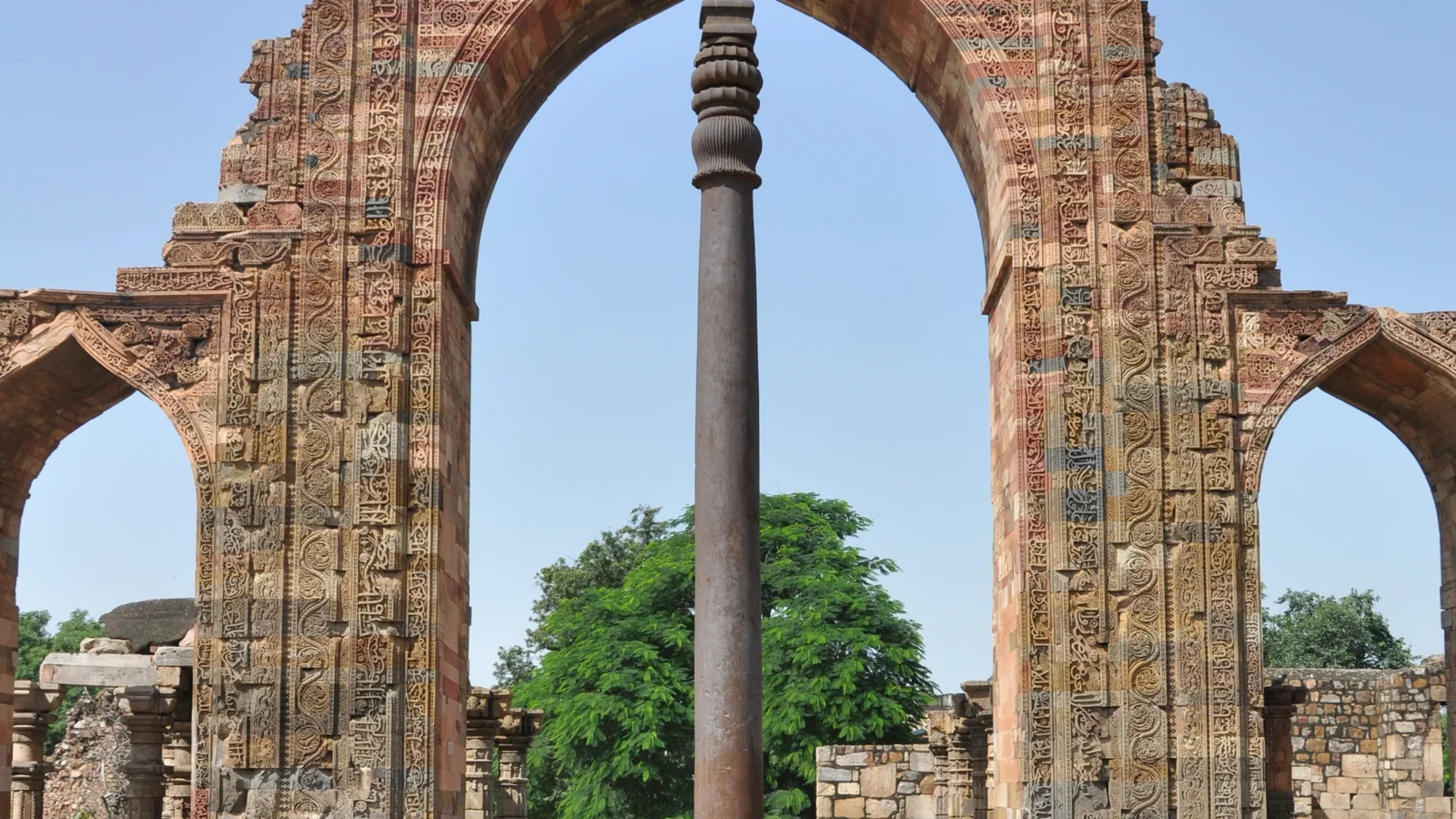
Inside that courtyard stands an iron pillar. R. Balasubramaniam’s 2000 study in Corrosion Science reports its weight at approximately six tons and its Sanskrit inscription naming a king called Chandra, whom the paper identifies as “Chandragupta II Vikramaditya (AD376-AD414).” On that dating, Balasubramaniam writes, the pillar was “at least 1600 years old” when the paper appeared. The same study places its original site far from Delhi, citing “the climatic conditions of Udayagiri, where the pillar was originally located,” and records that “it was brought to Delhi in the 11th century.” A compilation of its composition that the paper cites, credited to the metallurgist Gunnar Wranglen, gives 0.15 percent carbon, 0.25 percent phosphorus and small fractions of silicon, nitrogen, manganese, copper and nickel, with the remainder iron.

"Iron hydrogen phosphate hydrate": the corrosion question
That phosphorus content, Balasubramaniam’s abstract states, is the key to why the pillar has not rusted through: “the critical factor contributing to the superior corrosion resistance of the DIP . . . is the formation of iron hydrogen phosphate hydrate, as a thin layer next to the metal-metaloxide interface,” a layer that forms from repeated wetting and drying. The pillar’s stone platform, the same paper notes, was not there until the excavator Beglar built it in the mid-nineteenth century, when he also coated the pillar’s buried portion with lead. When archaeologists reopened that buried section in 1961, on the centenary of the Archaeological Survey of India, they found the lead coating in “excellent state of preservation,” though the surrounding surface carried rust “ranging from a few mm to 15 mm.”
Negligible tilt: the government's answer, 2016
The tower above that pillar leans, and in March 2016 the Ministry of Culture answered a written question on the subject in the Rajya Sabha. “The mean rate of annual change in tilt is 3.5 seconds per year w.r.t its base centre,” the Press Information Bureau’s release states, adding that “the entire base of Qutub Minar was water tightened to ensure that water does not percolate into the foundation of the monument.” The same answer addresses the temple stone visible around the complex: “Some architectural members of Hindu and Jain Temple were found during the course of conservation & scientific clearance,” it states, some displayed within the complex and the rest kept in storage, while “no excavation has been carried out in Qutub Complex,” only scientific clearance and conservation.
Key facts
- Aibak founded the tower in 1199 and raised its first storey; Iltutmish added three more, reigning 1211-36 (Archaeological Survey of India).
- The survey gives the tower’s present height as 72.5 meters, from a 14.32-meter base to a 2.75-meter top, in four storeys.
- Iranica’s Aybak entry (Zaidi) gives the completed height as 69.7 meters; its Delhi Sultanate entry (Asher) gives an estimated 79 meters, citing Cunningham.
- The survey dates the Quwwat-ul-Islam mosque to 1198, built with columns from twenty-seven demolished Hindu and Jain temples.
- Asher’s Iranica entry notes that the 1191 inscription citing those temples “may have been added later,” per Horovitz.
- Balasubramaniam’s 2000 study reports the iron pillar’s weight at about six tons and dates it to the reign of Chandragupta II, roughly AD 376-414.
- The same study places the pillar’s original site at Udayagiri, moved to Delhi in the eleventh century, before the mosque was built.
- The Press Information Bureau’s 2016 answer gives the tower’s tilt as 3.5 seconds of arc per year and reports no excavation, only conservation, at the site.
FAQ
How tall is the Qutb Minar?
The Archaeological Survey of India gives 72.5 meters. Encyclopaedia Iranica's Aybak entry gives 69.7 meters, citing a 1794 record and a later earthquake; its Delhi Sultanate entry gives an estimated 79 meters, citing surveyor Alexander Cunningham.
Why has the Delhi iron pillar not rusted?
Balasubramaniam's 2000 study attributes it to the pillar's high phosphorus content, about 0.25 percent, which forms a protective layer of iron hydrogen phosphate hydrate under Delhi's alternating wet and dry conditions.
Is the Qutb Minar tower leaning?
The Press Information Bureau reported in 2016 that the tower's mean rate of tilt is 3.5 seconds per year and that the base has been water-tightened against seepage.
Sources
- Archaeological Survey of India, "Qutb Minar and its Monuments, Delhi" (World Heritage page).
- Nasr Hasan Zaidi, "Aybak, Qotb-al-Din," Encyclopaedia Iranica, Vol. III, Fasc. 2, pp. 135-136 (December 15, 1987; updated January 13, 2017).
- Catherine B. Asher, "Delhi Sultanate ii. Architecture," Encyclopaedia Iranica, Vol. VII, Fasc. 3, pp. 242-250 (December 15, 1994; updated June 30, 2016).
- R. Balasubramaniam, "On the Corrosion Resistance of the Delhi Iron Pillar," Corrosion Science 42 (2000): 2103-2129, Indian Institute of Technology Kanpur repository.
- Press Information Bureau, Ministry of Culture, Government of India, "Tilting of Qutub Minar," Rajya Sabha written answer, March 2, 2016.
Cite this article
- APA
- LETTER. (2026, September 28). An iron pillar older than its mosque: the Qutb Minar complex, Delhi. Our Earth's History. https://ourearthshistory.com/south-asia/medieval/qutb-minar-delhi-aybak-iltutmish-iron-pillar-corrosion/
- Chicago
- LETTER. “An iron pillar older than its mosque: the Qutb Minar complex, Delhi.” Our Earth's History, September 28, 2026. https://ourearthshistory.com/south-asia/medieval/qutb-minar-delhi-aybak-iltutmish-iron-pillar-corrosion/.
- MLA
- LETTER. “An iron pillar older than its mosque: the Qutb Minar complex, Delhi.” Our Earth's History, 28 Sep. 2026, https://ourearthshistory.com/south-asia/medieval/qutb-minar-delhi-aybak-iltutmish-iron-pillar-corrosion/.
Text licensed CC BY-NC-ND 4.0. Found an error? Tell us.