Churches cut from rock: Francisco Álvares at Lalibela in the 1520s

TL;DR — Francisco Álvares visited Lalibela’s rock-hewn churches twice in the 1520s and recorded their names, steps and spans, and a tradition of who built them.
“I did not go inside, as it was locked,” Francisco Álvares wrote of the church of St. George at Lalibela, reached by eight steps cut into the rock. Álvares, a Portuguese priest, visited the site twice during an embassy to Ethiopia that ran from 1520 to 1527, and his account was printed in English by the Hakluyt Society in 1881. He named nine churches (Emanuel, St. Saviour, St. Mary, Holy Cross, St. George, Golgotha, Bethlehem, Marcoreos and the Martyrs) and added that “the principal one is Lalibela,” the name later tradition gives to the Zagwe-dynasty king credited with the work.
Quick facts
- When
- The 1520s, when Francisco Álvares visited Lalibela twice during the Portuguese embassy to Ethiopia of 1520 to 1527
- Where
- Lalibela, on a mountain slope in the Lasta highlands of Ethiopia
- Who
- Francisco Álvares, a Portuguese priest; King Lalibela of the Zagwe dynasty, as the tradition Álvares recorded names the builder
- Outcome
- Álvares left a description of the churches, with measurements in spans and a tradition that construction took twenty-four years; a later art-historical typology and a study of the king's hagiography give different chronologies that Álvares's account cannot settle
Francisco Álvares measured the churches twice
Álvares traveled with a Portuguese embassy to the Ethiopian ruler the Portuguese called Prester John of the Indies, and the chapters on Lalibela describe a second visit made while the embassy accompanied a new governor to a nearby lordship. He noted that no other Portuguese had gone to the churches besides himself, and wrote about his own credibility: “I swear by God, in whose power I am, that all that is written is the truth . . . and I have left it that they may not tax me with its being falsehood.” He located the site precisely: “This place is on a slope of the mountain, and from the peak of the mountain to this is a day and a half’s journey of descent.” He also corrected a story he had been told before arriving. Of the stone used in the buildings he wrote that it “had been brought from here, and had not come from Jerusalem as they had told me.”
Bete Giyorgis, locked below the others
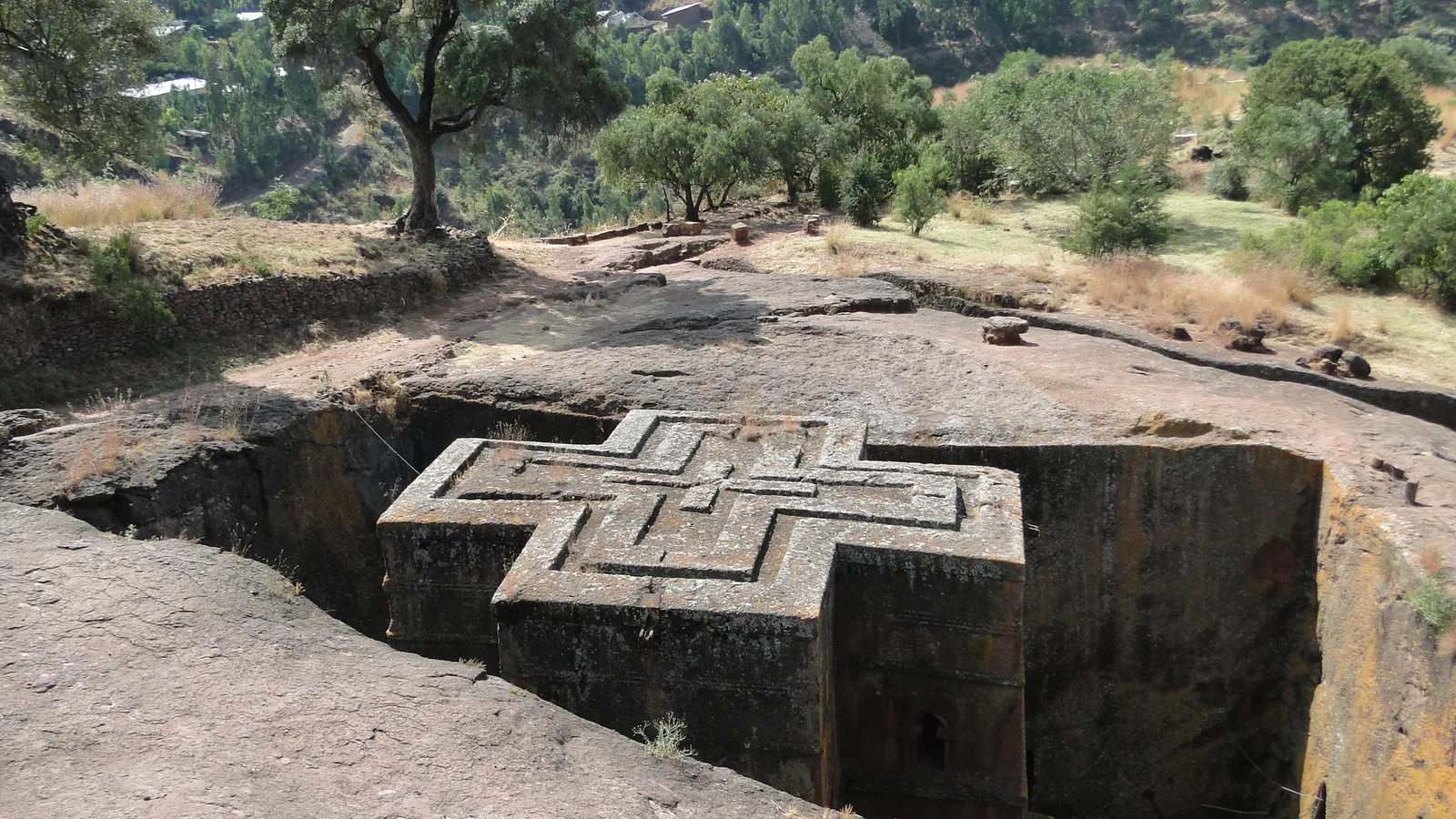
Álvares described the church of St. George, known today as Bete Giyorgis, as set apart from the rest. “The church of St. George is a good bit lower down than the others, almost separated from the place; it is in the rock, like the others. The entrance to it is under the rock or cliff: there are eight steps to ascend.” Once inside the surrounding trench, he wrote, “one comes at once to the church circuit, which is made in the form of a cross. The church also is in the form of a cross, and the distance from the principal door to the chancel is the same as that from one side door to the other, all of one compass.” He went no further, since the door was locked. The king credited with the site was not buried in the church named for him. “He does not lie in the church which bears his name, he lies in the church of Golgotha, which is the church of the fewest buildings here,” Álvares wrote, and he went on to describe galleries, three windows and a sealed stone entrance inside that church.
Spans and a stair for ten men
Álvares gave his measurements in spans. St. Saviour’s church, he wrote, has an “interior two hundred spans in length, and a hundred and twenty in width. It has five naves, in each one seven square columns,” reached “by a descent through the rock itself, eighty steps cut artificially in the stone, of a width that ten men can go side by side.” Of the church of Our Lady he wrote, “This church of Our Lady is the head of all the other churches of this place,” giving it as “eighty spans in length and sixty-four in width,” with the Martyrs church at the same dimensions and Holy Cross at sixty-eight spans in length. He set the church of Emanuel apart for its outer walls, which “have what others have not, that is to say, like tiers of walls, one bends outwards and another turns inwards two inches,” rising to “52 spans high,” with a choir reached by a stair he saw paralleled nowhere else on the site.
"It is written," he was told
Álvares recorded, and marked as something told to him rather than something he had confirmed, how the work was supposed to have been done. “They told me that the works of these churches were done in twenty-four years, and that this is written, and that they were done by Gibetas, that is, white men.” He also passed on a reign length for the king credited with the project: “This Lalibela, they say, was a King in this same country for eighty years, and he was King before the one before mentioned who was named Abraham. This King ordered these edifices to be made.” Claude Lepage and Jacques Mercier’s 2006 survey of church buildings and fixed liturgical fittings in Annales d’Éthiopie gives a different frame, identifying three architectural types across the Lasta and Wag districts, arranged, the authors write, “avec précaution, dans une chronologie relative” from the twelfth century to the middle of the fifteenth, with the third type spreading across Ethiopia only after the Solomonic dynasty took power in 1270. Richard and Rita Pankhurst, in the same 2006 volume, examined the Ge’ez hagiography known as the Gadla Lalibela and argued it served the Zagwe dynasty the way the Kebra Negast served the Solomonic dynasty that followed it, a text meant to establish the legitimacy of a ruling house. By 2009, Thomas Osmond described the monolithic churches as Ethiopia’s leading tourist destination and reported a dispute, tied to the country’s ethnic federalism, over whether Agaw or Amhara builders should be credited with the work.
The Authority for Research and Conservation of Cultural Heritage
Ethiopia’s heritage administration works through a body called the Authority for Research and Conservation of Cultural Heritage, according to the Ethiopian Heritage Fund, a United Kingdom charity that lists the authority, known as ARCCH, alongside the Ethiopian Orthodox Tewahedo Church, the Ministry of Culture and Tourism and regional culture bureaus among the partners it works with on the preservation of crosses, manuscripts and other portable church property. The charity traces its own origin to an earlier body, the Committee for the Preservation and Promotion of Ethiopian Heritage, and was registered in the United Kingdom as a charity, number 1110969, in 2005.
Key facts
- Francisco Álvares, a Portuguese priest attached to the 1520-1527 embassy to Ethiopia, visited Lalibela twice and named nine churches plus “the principal one,” Lalibela (Hakluyt Society, 1881 translation).
- Álvares measured St. Saviour’s interior at 200 spans by 120, with five naves of seven square columns each and an entrance stair of 80 steps wide enough for ten men abreast.
- He recorded the church of Our Lady as “the head of all the other churches,” 80 spans long and 64 wide, next to the Martyrs and Holy Cross churches.
- Emanuel’s outer walls step in and out by two inches per course and rise 52 spans, with a choir reached by a stair, a feature Álvares found nowhere else on the site.
- The church of St. George stood lower than the rest, cut in the shape of a cross and entered by eight steps; Álvares wrote that its door was locked and that he did not go inside.
- The king’s tomb was not in the church that bears his name but in the church of Golgotha, by Álvares’s account of its galleries and sealed stone entrance.
- Álvares reported hearing that the churches were built in twenty-four years by foreign masons called Gibetas, a claim he said was “written” but had not verified himself.
- Claude Lepage and Jacques Mercier’s 2006 typology in Annales d’Éthiopie places Lasta-region church architecture across three types spanning the twelfth to the mid-fifteenth centuries, a chronology that does not match the eighty-year reign Álvares recorded.
FAQ
Who described Lalibela's churches in the 1520s?
Francisco Álvares, a Portuguese priest who visited twice during the 1520-1527 Portuguese embassy to Ethiopia. His account was translated into English and published by the Hakluyt Society in 1881.
How many churches did Álvares describe at Lalibela?
He named nine churches, Emanuel, St. Saviour, St. Mary, Holy Cross, St. George, Golgotha, Bethlehem, Marcoreos and the Martyrs, and added that "the principal one is Lalibela."
When were the Lalibela churches built?
Álvares recorded a tradition that construction took twenty-four years, under a king reported to have reigned eighty years. Claude Lepage and Jacques Mercier's 2006 art-historical typology instead places Lasta-region church types across the twelfth to mid-fifteenth centuries. The two accounts do not agree, and neither has been confirmed by the other.
Sources
- Francisco Álvares (trans. Lord Stanley of Alderley), Narrative of the Portuguese Embassy to Abyssinia during the Years 1520-1527, Hakluyt Society, vol. 64 (London, 1881), chapters lii-liv.
- Claude Lepage and Jacques Mercier, "L'architecture des églises éthiopiennes du XIIe au milieu du XVe siècle," Annales d'Éthiopie, vol. 22 (2006), pp. 9-43.
- Richard Pankhurst and Rita Pankhurst, "King Lalibela: His Supposed Travels, Tribulations and Achievements," Annales d'Éthiopie, vol. 22 (2006), pp. 45-71.
- Thomas Osmond, "Revendications patrimoniales et imaginaires post-nationaux: reconstructions identitaires autour des églises de Lalibela dans le contexte du fédéralisme ethnique éthiopien," Annales d'Éthiopie, vol. 24 (2009), pp. 149-170.
- The Ethiopian Heritage Fund, "About" page.
Cite this article
- APA
- LETTER. (2026, September 28). Churches cut from rock: Francisco Álvares at Lalibela in the 1520s. Our Earth's History. https://ourearthshistory.com/africa/medieval/lalibela-rock-hewn-churches-alvares-1520s-bete-giyorgis/
- Chicago
- LETTER. “Churches cut from rock: Francisco Álvares at Lalibela in the 1520s.” Our Earth's History, September 28, 2026. https://ourearthshistory.com/africa/medieval/lalibela-rock-hewn-churches-alvares-1520s-bete-giyorgis/.
- MLA
- LETTER. “Churches cut from rock: Francisco Álvares at Lalibela in the 1520s.” Our Earth's History, 28 Sep. 2026, https://ourearthshistory.com/africa/medieval/lalibela-rock-hewn-churches-alvares-1520s-bete-giyorgis/.
Text licensed CC BY-NC-ND 4.0. Found an error? Tell us.