A gold rhinoceros from Mapungubwe Hill, found in the 1930s


TL;DR — University of Pretoria Museums calls it the world’s only gold rhino, found in a royal grave on Mapungubwe Hill after farmers searched the site in December 1932 and 1933.
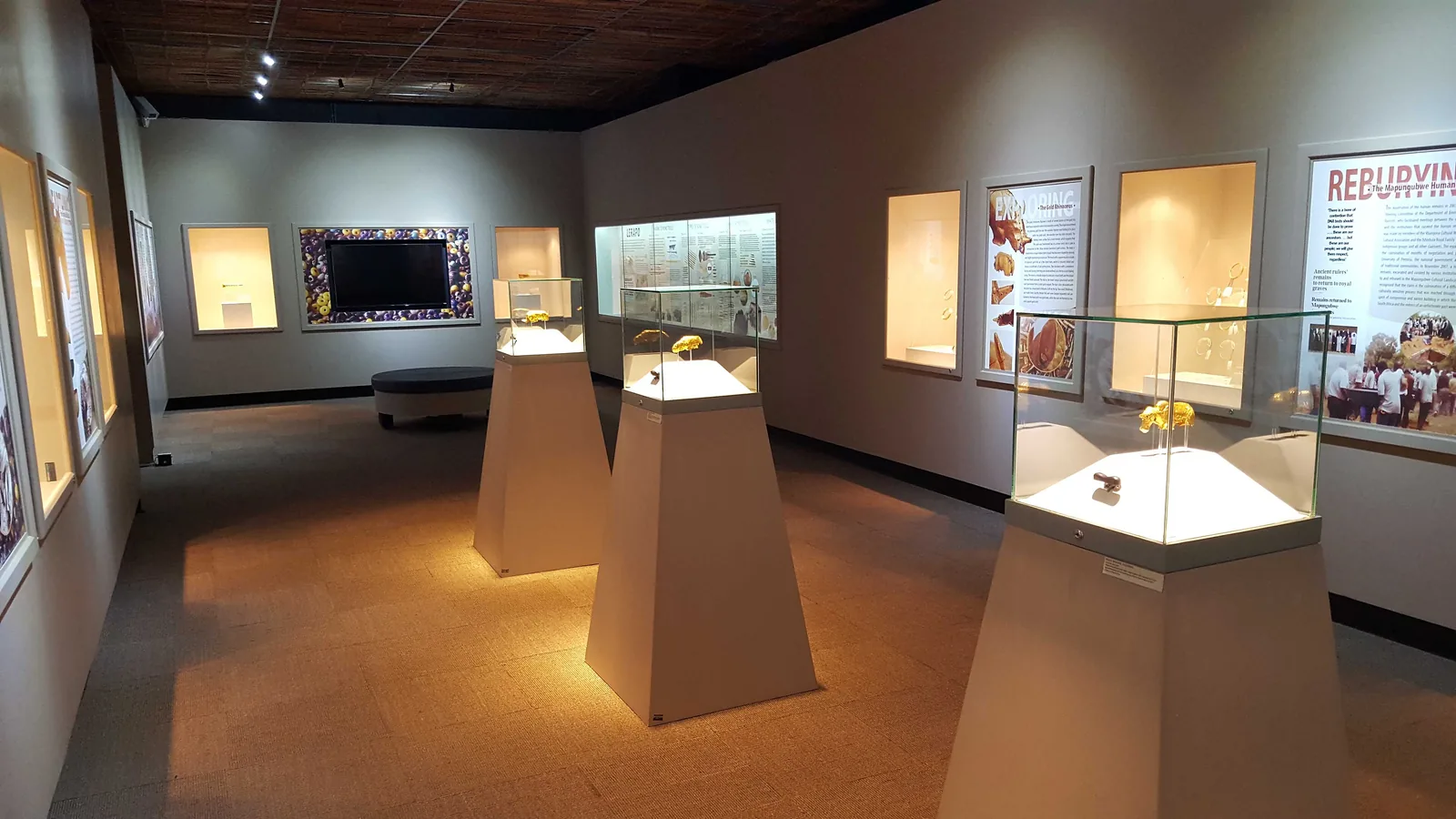
The University of Pretoria Museums describes its gold rhinoceros as “a hollow gold foil figurine of a rhino.” The museum recovered it from Mapungubwe Hill, in South Africa’s Limpopo province, from a burial it calls the “original gold grave,” or M1 A620, and dates the object to CE 1250 to CE 1290.
Quick facts
- When
- December 1932 (first search of the farm Greefswald, per SANParks) and 1933 (opening of the royal grave, reported by the Illustrated London News on April 8, 1933)
- Where
- Mapungubwe Hill, on the farm Greefswald above the Limpopo River, in what is now Limpopo province, South Africa
- Who
- Ernst van Graan and his son Jerry van Graan, named by SANParks as the men who searched the hill; the University of Pretoria's archaeological expeditions from 1933 onward; Linda C. Prinsloo, Nigel Wood, Maggi Loubser, Sabine M. C. Verryn and Sian Tiley, authors of the 2005 re-dating study; M. Steyn, author of the 2007 grave study
- Outcome
- A gold rhinoceros, bowl and scepter, glass beads and Chinese porcelain fragments entered the University of Pretoria's Mapungubwe Collection; the rhinoceros became the central motif of South Africa's Order of Mapungubwe, instituted by Government Gazette on December 6, 2002
Ernst van Graan's search on Greefswald farm
In December 1932, SANParks records, the farmer Ernst van Graan, his son Jerry and three other men searched the farm Greefswald, where Mapungubwe Hill and the nearby site of K2 are located, for a sacred hill rumored to hold “the treasure of kings.” Reaching the top, SANParks states, the men found remnants of stone walls, quantities of potsherds, iron tools and scattered copper and glass beads. They returned the next day with spades and unearthed ancient graves, three of which were different and, SANParks says, probably belonged to royalty. One royal grave held “gold bangles,” a “necklace of gold beads and cowrie shells,” and a “golden bowl, scepter and a golden rhino.”
1933: a royal grave opened above the Limpopo
A different date appears in the 2005 study by Linda C. Prinsloo, Nigel Wood, Maggi Loubser, Sabine M. C. Verryn and Sian Tiley, published in the Journal of Raman Spectroscopy: “The discovery in 1933 of intact gold-bearing graves by prospectors was…a remarkable find of great archaeological and historical significance and marked the beginning of a 70-year archaeological project.” The same paper quotes the Illustrated London News of April 8, 1933, describing “a remarkable discovery in the Transvaal: a grave of unknown origin, containing much gold-work, found on the summit of a natural rock stronghold in a wild region.” A color slide held by the University of Pretoria’s UPSpace repository, credited to Heleen Visser in 1998, also dates the find to 1933, captioning it “the complete gold rhinoceros discovered on Mapungubwe Hill 1933, before its final restoration by the British Museum Senior Metals Conservator in 1999.” The University of Pretoria Museums states that the rhinoceros is a hollow figurine built from a single folded sheet of gold “shaped by creasing and slight hammering or repoussé,” with a separate gold-foil head and horn, eyes made from “two solid capped gold nails” and a tail “hammered from a solid gold nugget.” It weighs 37.4 grams and measures 145.26 by 55.06 millimeters, and the museum calls it “the only artwork of its kind in the world.”

A kingdom counted three different ways
SANParks dates the Mapungubwe kingdom to between AD 1220 and AD 1300, calling the site the center of “southern Africa’s first indigenous kingdom.” Prinsloo and her co-authors instead describe “a prehistoric African trade kingdom (ca 1000-1290 AD),” a span that begins more than two centuries earlier. The University of Pretoria Museums dates the rhinoceros itself, as an object, to CE 1250 to CE 1290, narrower than either of the other two ranges. SANParks records a population of “at least 9,000 people,” divided between “an elite class with a sacred leader who lived on top of the hill, and commoners who lived on the plains below,” and attributes the kingdom’s wealth to trade with “the Indian Ocean network” through “the East African ports.” The 2019 study in Heritage, co-authored by researchers working on Sub-Saharan African trade beads, states that Mapungubwe Hill has produced “more than 100,000” glass beads, with a group the paper calls the “Mapungubwe Oblates” dated to roughly the eleventh through thirteenth centuries, and records that the capital moved “from K2 to Mapungubwe Hill in 1220.” Two fragments of Chinese porcelain, Prinsloo and her co-authors write, “were excavated in 1934, during the first archaeological expedition to Mapungubwe,” and were classified that year by the British Museum’s R. L. Hobson as celadon from the “late Southern Song dynasty, 13th to 14th century.” Raman spectroscopy, XRF and XRD analysis carried out for the 2005 paper instead “date the shards to possibly the Yuan (1279-1368 AD) or even early Ming (1368-1644 AD) dynasties.” Prinsloo worked in the University of Pretoria’s physics department; her co-authors included Nigel Wood of Oxford University’s Institute of Archaeology and Art History and Sian Tiley of the university’s Mapungubwe Museum.
"Very little information on these graves is available today"
M. Steyn’s 2007 paper in the South African Archaeological Bulletin, titled “The Mapungubwe gold graves revisited,” opens by noting that “very little information on these graves is available today.” Its findings hold that at least one of the burials, the “Gold Grave,” was a secondary burial, similar to a burial found at Thulamela, and state that “the skeletons are destined for reburial.” A University of Pretoria poster by A. Nienaber, presented at the university’s Health Sciences Faculty Day in August 2008, describes the legal and practical steps that followed: the National Heritage Resources Act of 1999 provided the basis for returning the remains, though implementing regulations were only drafted in 2004. The poster states that “no samples for destructive analyses (DNA, chemical) prior to re-burial were…allowed.”
The Order of Mapungubwe, December 6, 2002
On December 6, 2002, the Government Gazette of South Africa published a warrant “by the President whereby…the ORDER OF MAPUNGUBWE is instituted,” citing “section 84 (2) (k) of the Constitution of the Republic of South Africa, 1996 (Act 108 of 1996).” The gazette set out three classes, platinum, gold and bronze, and specified a badge with “a representation of Mapungubwe Hill bearing a gold Rhinoceros and there above on a black field a rising sun,” adding that regardless of class, “the representation of the Mapungubwe Rhinoceros shall be in gold.” The Presidency’s current page on the order lists four classes instead, platinum, gold, silver and bronze, and calls “the iconic Mapungubwe rhino” the order’s central motif, alongside a smelting furnace and a scepter representing “abundance of wealth, excellence.”
Key facts
- In December 1932, SANParks records, Ernst van Graan, his son Jerry and three other men searched the farm Greefswald and found a hilltop grave holding “gold bangles,” a “necklace of gold beads and cowrie shells,” and a “golden bowl, scepter and a golden rhino” (SANParks).
- Prinsloo, Wood, Loubser, Verryn and Tiley (2005) date “the discovery” of the gold-bearing graves to 1933, and quote the Illustrated London News report of April 8, 1933 (Journal of Raman Spectroscopy, 2005).
- The University of Pretoria Museums dates the rhinoceros itself to CE 1250 to CE 1290; it weighs 37.4 grams and measures 145.26 by 55.06 millimeters (University of Pretoria Museums).
- SANParks dates the Mapungubwe kingdom to AD 1220-1300; Prinsloo and her co-authors give “ca 1000-1290 AD” instead (SANParks; Journal of Raman Spectroscopy, 2005).
- Two Chinese porcelain fragments excavated in 1934 were classified by the British Museum’s R. L. Hobson as Southern Song celadon; a 2005 re-analysis suggested they could be Yuan or early Ming instead (Journal of Raman Spectroscopy, 2005).
- A 2019 study in Heritage counts “more than 100,000” glass beads from Mapungubwe Hill and dates the move of the capital “from K2 to Mapungubwe Hill” to 1220 (Heritage, 2019).
- M. Steyn’s 2007 paper concludes the “Gold Grave” was a secondary burial and that “the skeletons are destined for reburial”; a 2008 University of Pretoria poster records their return under the National Heritage Resources Act of 1999 (Steyn, UPSpace; Nienaber, UPSpace).
- The Government Gazette of December 6, 2002, instituted the Order of Mapungubwe with three classes and a gold rhinoceros on its badge; the Presidency’s current page lists four classes instead (Government Gazette No. 24155, 2002; The Presidency).
FAQ
When was the Mapungubwe gold rhinoceros found?
SANParks dates the first search of Mapungubwe Hill to December 1932. The University of Pretoria's UPSpace repository and the 2005 Prinsloo study instead date the opening of the gold-bearing royal grave to 1933, the year the Illustrated London News reported the find.
How old is the Mapungubwe kingdom?
Sources disagree. SANParks gives AD 1220 to 1300, Prinsloo and her co-authors give roughly 1000 to 1290, and the University of Pretoria Museums dates the gold rhinoceros itself to CE 1250 to 1290.
What classes does the Order of Mapungubwe have?
The Government Gazette of December 6, 2002, instituted three classes, with platinum ranked above gold and gold above bronze. The Presidency's current page instead lists four classes: platinum, then gold, then silver, then bronze.
Sources
- SANParks, "Natural & Cultural History – Mapungubwe National Park."
- University of Pretoria Museums, "International World Rhino Day: The one and only gold rhino in the world @ the University of Pretoria."
- Visser, Heleen (1998), color slide caption, University of Pretoria, UPSpace Repository.
- Prinsloo, L. C., Wood, N., Loubser, M., Verryn, S. M. C. and Tiley, S., "Re-dating of Chinese celadon shards excavated on Mapungubwe Hill, a 13th century Iron Age site in South Africa, using Raman spectroscopy, XRF and XRD," Journal of Raman Spectroscopy 36 (2005), pp. 806-816.
- Steyn, M., "The Mapungubwe gold graves revisited," South African Archaeological Bulletin 62(186) (2007), pp. 140-146.
- Nienaber, A., University of Pretoria Health Sciences Faculty Day poster (August 2008).
- Republic of South Africa, Government Gazette No. 24155 (December 6, 2002), warrant instituting the Order of Mapungubwe.
- The Presidency, Republic of South Africa, "The Order of Mapungubwe."
- "Glass Beads, Markers of Ancient Trade in Sub-Saharan Africa: Methodology, State of the Art and Perspectives," Heritage 2(3) (2019), MDPI.
Cite this article
- APA
- Our Earth's History. (2026, September 27). A gold rhinoceros from Mapungubwe Hill, found in the 1930s. Our Earth's History. https://ourearthshistory.com/africa/medieval/mapungubwe-1933-gold-rhinoceros-hilltop-graves-university-of-pretoria/
- Chicago
- Our Earth's History. “A gold rhinoceros from Mapungubwe Hill, found in the 1930s.” Our Earth's History, September 27, 2026. https://ourearthshistory.com/africa/medieval/mapungubwe-1933-gold-rhinoceros-hilltop-graves-university-of-pretoria/.
- MLA
- “A gold rhinoceros from Mapungubwe Hill, found in the 1930s.” Our Earth's History, 27 Sep. 2026, https://ourearthshistory.com/africa/medieval/mapungubwe-1933-gold-rhinoceros-hilltop-graves-university-of-pretoria/.
Text licensed CC BY-NC-ND 4.0. Found an error? Tell us.