Which African kingdom minted gold coins and raised 23-meter stelae?
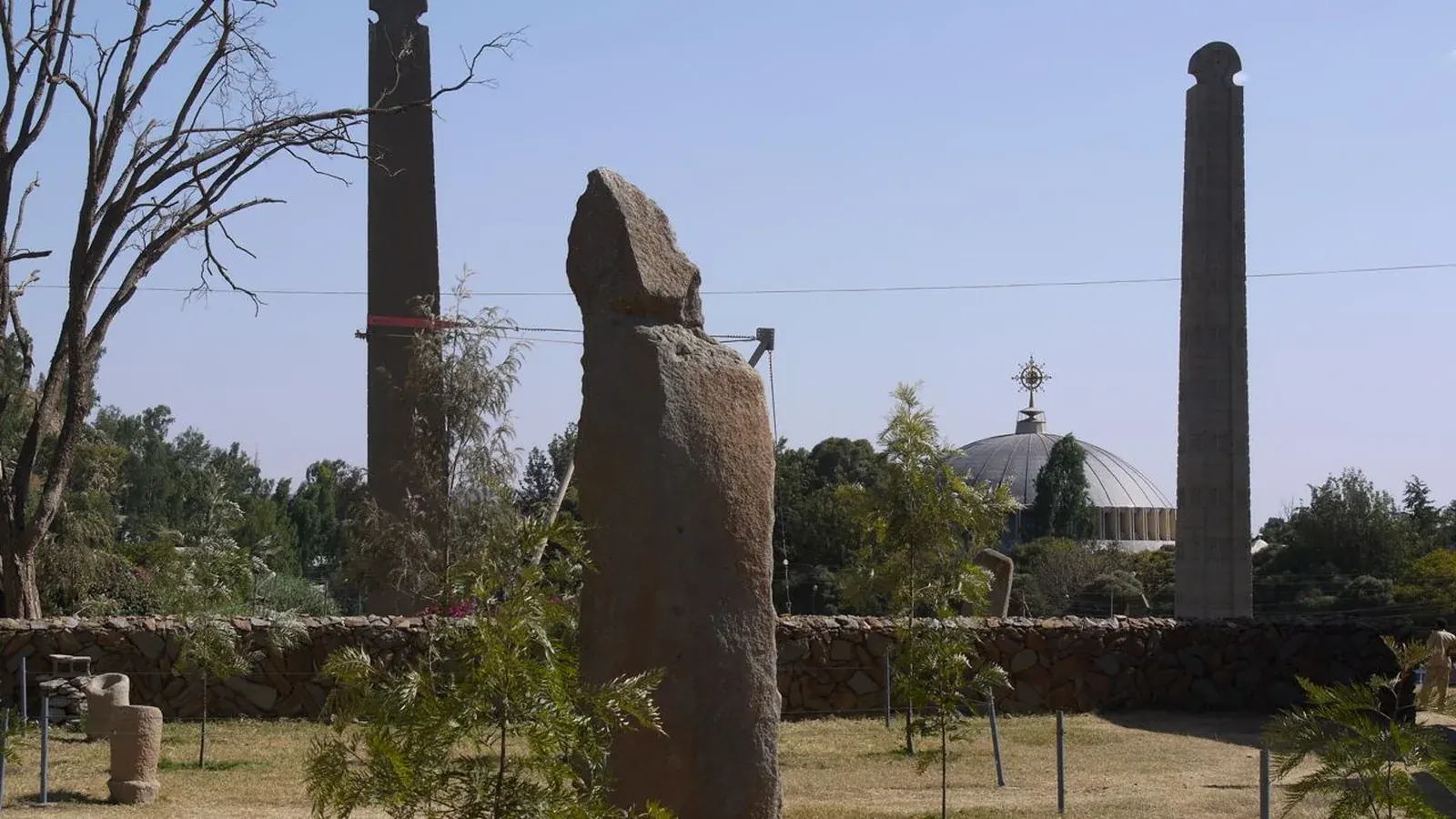
_in_Aksum,_een_symbool_van_beschaving_(6821531699).jpg)
TL;DR — Aksum, in northern Ethiopia, traded through the Red Sea port of Adulis, struck gold, silver and bronze coins from the third century AD, and raised granite stelae over 23 meters.
The kingdom of Aksum, in what is now the Tigray region of northern Ethiopia, minted its own gold coins and raised granite stelae more than 23 meters tall. Both came out of one source of money: control of the Red Sea trade through Adulis, which carried African gold and ivory to Rome and on to Arabia and India. The stelae went up in the third and fourth centuries AD over the graves of the Aksumite elite. The coins began in the same century, and under King Ezana in the fourth the disc and crescent on them gave way to the cross. UNESCO, which listed the ruins in 1980, dates the kingdom from the first to the eighth centuries AD.
Quick facts
- When
- About AD 100 to 700, with coinage from the third century AD and the stelae from the third and fourth centuries AD
- Where
- Aksum, on the Tigray plateau of northern Ethiopia, with its Red Sea port at Adulis
- Who
- Endybis (first coins, about AD 270-290), Ezana (trilingual inscriptions and the cross on the coins), Kaleb (Himyar campaign, AD 525)
- Outcome
- Gold, silver and bronze coinage on Roman weight standards; a standing stele over 23 meters and a fallen one about 33 meters; UNESCO World Heritage listing in 1980
Where Aksum sat and what moved through Adulis
The city of Aksum sat on the Tigray plateau of northern Ethiopia, above 2,000 meters, where the summer rains were dependable and the soil was good. It was not a port. Its outlet was Adulis, on the Red Sea coast at modern Zula, about four kilometers inland, reached by camel caravan.
One of the earliest outside records of Aksumite trade is the Periplus of the Erythraean Sea, a trader’s handbook written in Greek in the first century AD, which the Metropolitan Museum of Art’s essay on Aksumite civilization describes as the work of an Alexandria-based merchant. Mark Cartwright’s 2019 survey for World History Encyclopedia lists gold and ivory as the main exports, with salt, tortoiseshell, frankincense and myrrh behind them; back through Adulis came textiles, iron, weapons and wine.
How the stelae were cut and moved
Several stelae survive in the town; UNESCO dates them between the third and fourth centuries AD. The largest standing one rises over 23 meters and is carved to look like a nine-story Aksumite building, with false doors and rows of beam ends in the granite. The Met’s essay describes them as funerary markers for dead members of the elite, and Cartwright notes that many have an inscribed stone throne beside them.
A larger stele, about 33 meters long, lies broken where it fell. UNESCO’s description hedges on how that happened: it fell “perhaps during the process of erection,” and the body calls it possibly the largest monolithic stele ancient people ever attempted to raise. Tekle Hagos of Addis Ababa University, writing in Annales d’Ethiopie in 2018, gives it a height of 33 meters and a weight of 520 tons, and puts the quarry about five kilometers northwest of the town, in the hills of Gobo Dura and Addi Tsehafi. Cartwright describes the stelae as hauled on log rollers from there.
What the coins were made of and what they said
Aksum was the first African state to strike its own coinage, and it did so in gold, silver and bronze, on the standard Roman weights, according to National Geographic Education. The earliest carried the name of King Endybis, about AD 270 to 290; the Smarthistory account written by the British Museum reads them as money made for international trade.
The metal decided the language. Gold coins were inscribed in Greek and largely meant for export, while silver and copper carried Ge’ez, the Aksumite script, which the British Museum text reads as evidence that Aksumites wrote in both. A ruler’s head appeared on obverse and reverse, framed by stalks of teff, the local grain. Cartwright counts about 20 kings known mainly from their coins, which have turned up as far away as India and Sri Lanka.
Ezana and the change on the coinage
In the fourth century AD the symbols on the coins changed. The Met’s essay records that after his conversion King Ezana had the crescent and disc of South Arabian polytheism removed from his coins and replaced with the Christian cross; the British Museum text dates the conversion to about AD 340 to 356. Copper issues then carried open Christian legends, among them “Joy and Peace to the People” and “He conquers through Christ.”
The inscriptions show the same change. UNESCO describes stone tablets inscribed by Ezana in the fourth century AD in three scripts, Greek, Sabaean and Ge’ez. Cartwright reads the wording of Aksumite royal inscriptions as framed so as not to alienate Aksumites who had not accepted Christianity. The dates disagree: Cartwright gives Ezana’s reign as about AD 303 to 350, the Met’s essay as AD 320 to 350, and ancient accounts of the conversion itself range from AD 315 to 360.
Kaleb across the Red Sea, and the decline
Ian Janssen’s 2022 account for EBSCO Research Starters records that King Kaleb defeated the Himyarite kingdom of Yemen in AD 525, after its Jewish ruler Dhu Nuwas massacred Christians at Najran in 523, and that Kaleb abdicated before his death and became a monk. Cartwright adds that the Aksumites installed a viceroy who held Yemen until Sasanian Persian forces arrived, in 570 by his dating and about 578 by National Geographic’s.
The end came through the same sea lanes that had made the kingdom rich. The Met’s essay ties Aksum’s seventh-century decline to growing Muslim control of the region, which cut its access to international trade. National Geographic adds the movement of Beja herders into Aksumite territory, soil exhaustion and a fall in rainfall, and places the collapse by the end of the eighth century, when authority passed to the Agau rulers of the Zagwe dynasty at Lalibela. Cartwright dates the decline from the late sixth century and has the state’s center shift 300 kilometers south.
The stele that went to Rome and came back
One of the stelae left Ethiopia. UNESCO records that it was removed from the site and taken to Rome as a war trophy during the Italian occupation, returned to Aksum in 2005 and re-erected in 2008. The site entered the World Heritage List in 1980 under criteria (i) and (iv), for the carving of the monolithic stelae and for the urban group of obelisks, royal tombs and churches. Among those churches is Saint Mary of Zion, rebuilt in the seventeenth century AD, where Ethiopian tradition places the Ark of the Covenant; UNESCO records that as tradition, not as a finding.
What survives at Aksum is a record in two materials: the granite gives the scale of the wealth, and the coins give the dates, the names of the kings and the reign in which the crescent came off the die.
Key facts
- Aksum lay on the Tigray plateau of northern Ethiopia and reached the Red Sea through the port of Adulis, at modern Zula.
- UNESCO dates the Aksumite kingdom from the first to the eighth centuries AD and the surviving stelae to the third and fourth centuries AD.
- The largest standing stele rises over 23 meters and is carved as a nine-story building; the largest of all, about 33 meters long, lies where it fell, perhaps while being raised (UNESCO).
- Tekle Hagos gives the fallen stele a height of 33 meters and a weight of 520 tons, quarried about five kilometers northwest of the town, in the hills of Gobo Dura and Addi Tsehafi.
- Aksum was the first African state to mint its own coins, in gold, silver and bronze, on Roman weight standards; the earliest carry the name of Endybis, about AD 270 to 290.
- Gold coins were inscribed in Greek, silver and copper in Ge’ez; after Ezana’s conversion the disc and crescent gave way to the cross.
- Kaleb defeated the Himyarite kingdom of Yemen in AD 525; the stele taken to Rome returned in 2005 and was re-erected in 2008.
FAQ
How tall are the Aksum stelae?
UNESCO records that the largest standing obelisk rises to over 23 meters and that a larger one, about 33 meters long, lies broken where it fell, perhaps during the attempt to raise it. The stelae date to the third and fourth centuries AD and marked elite graves.
Why did Aksumite coins change from the crescent to the cross?
The coins of the early kings carried the disc and crescent used in the religions of southern Arabia. After King Ezana's conversion in the fourth century AD, the Met's essay records, those symbols were replaced with the Christian cross, and copper coins began to carry legends such as "He conquers through Christ."
What language is written on Aksumite coins?
Both Greek and Ge'ez. Gold coins, largely made for export, were inscribed in Greek, while silver and copper coins carried Ge'ez, the Aksumite script that grew out of the Sabaean writing of southern Arabia and is still used by the Ethiopian Orthodox Church.
Sources
- UNESCO World Heritage Centre, "Aksum" (World Heritage List No. 15).
- The Metropolitan Museum of Art, Department of the Arts of Africa, Oceania, and the Americas, "Foundations of Aksumite Civilization and Its Christian Legacy (1st-8th Century)," Heilbrunn Timeline of Art History (October 2000).
- Smarthistory, "Aksumite Coins," text contributed by the British Museum, reprinted in LibreTexts Humanities.
- World History Encyclopedia, Mark Cartwright, "Kingdom of Axum" (March 21, 2019).
- National Geographic Education, "The Kingdom of Aksum."
- EBSCO Research Starters, Ian Janssen, "Kaleb" (2022).
- Tekle Hagos, "Current Management Challenges at the World Heritage site of Aksum, Ethiopia," Annales d'Ethiopie 32 (2018-2019), 293-315, on Persee.
Cite this article
- APA
- Our Earth's History. (2026, September 19). Which African kingdom minted gold coins and raised 23-meter stelae? Our Earth's History. https://ourearthshistory.com/africa/medieval/aksum-gold-coins-and-stelae/
- Chicago
- Our Earth's History. “Which African kingdom minted gold coins and raised 23-meter stelae?” Our Earth's History, September 19, 2026. https://ourearthshistory.com/africa/medieval/aksum-gold-coins-and-stelae/.
- MLA
- “Which African kingdom minted gold coins and raised 23-meter stelae?” Our Earth's History, 19 Sep. 2026, https://ourearthshistory.com/africa/medieval/aksum-gold-coins-and-stelae/.
Text licensed CC BY-NC-ND 4.0. Found an error? Tell us.