How did a desert oasis get rich enough to challenge Rome?

TL;DR — Palmyra held the one watered stop between the Euphrates and Damascus and taxed the caravans that passed through. That income built a city that ruled Rome’s East for five years.
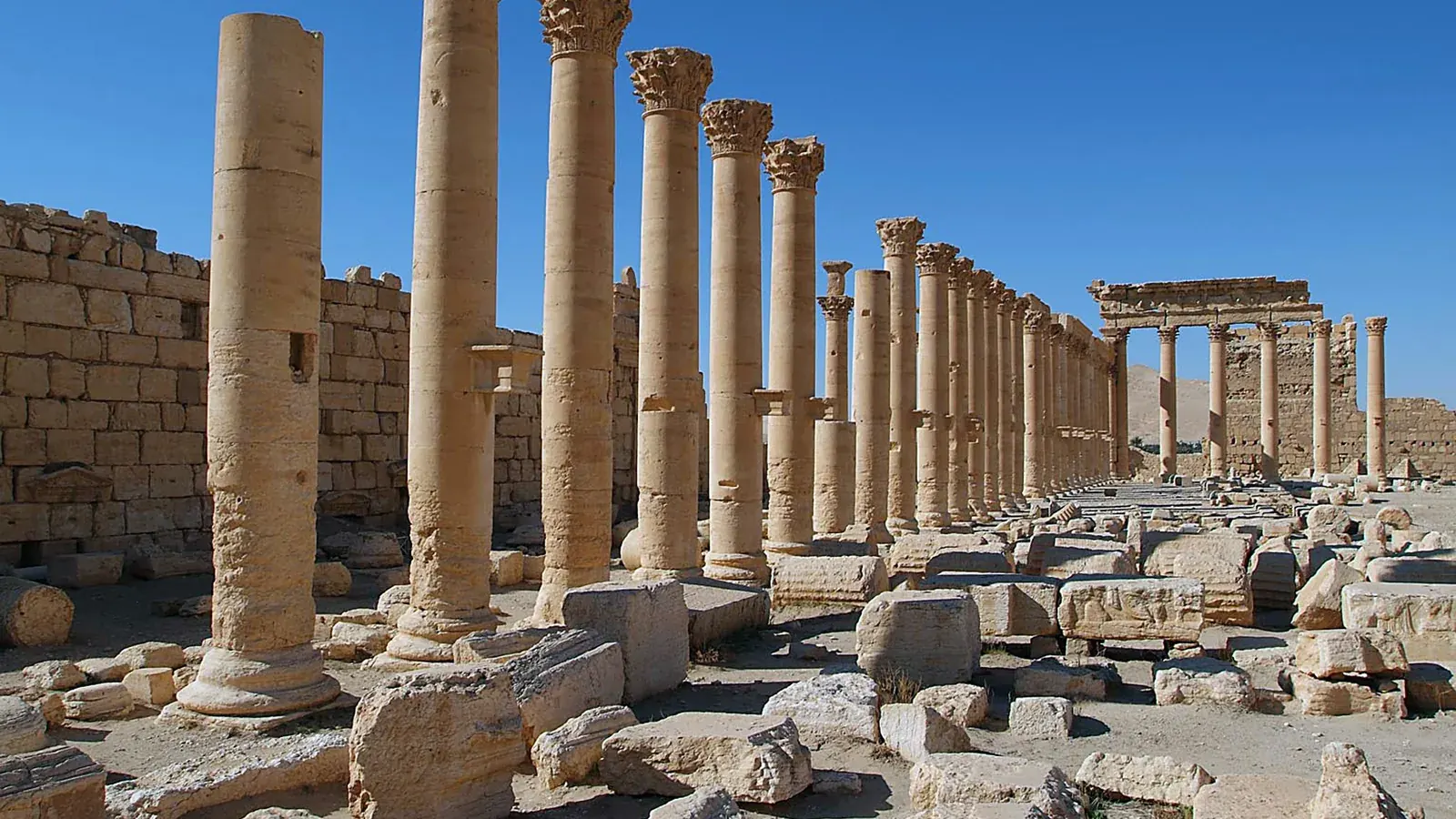
Palmyra grew rich because it held the largest oasis on the desert shortcut between the Euphrates and Damascus, and it charged the caravans that used it. Merchants coming up from the Persian Gulf with Indian and Arabian goods entered Roman territory there, and the city took its share. The money went into a temple, a colonnaded street more than a kilometer long and hundreds of carved tombs. After Persia captured a Roman emperor in AD 260, that wealth let one family, Odaenathus and then his widow Zenobia, govern the Roman East until Aurelian defeated them in 272.
Quick facts
- When
- Temple of Bel consecrated AD 32 · tariff inscribed 137 · Hadrian's visit 129 · colonia 212 · Odaenathus killed 267 · Zenobia defeated 272 · revolt and sack 273 · UNESCO 1980 · danger list 2013 · destruction 2015
- Where
- The Tadmor oasis in the Syrian desert, about 240 kilometers from Damascus and 250 from the Euphrates, in what is now Syria
- Who
- Septimius Odaenathus; his widow Zenobia and son Vaballathus; the general Zabdas; the emperors Hadrian, Caracalla, Gallienus and Aurelian; Khaled al-Asaad, the site's former director
- Outcome
- Aurelian sacked the city in 273 and the trade moved to Nisibis; the ruins were inscribed by UNESCO in 1980, placed on the danger list in 2013 and partly destroyed in 2015 and 2017
Where the water and the money came from
The oasis lay about 240 kilometers from Damascus and 250 from the Euphrates, in what is now Syria. Jona Lendering, writing for Livius.org, described it as the largest oasis on the direct route across the desert, fed by a wadi and by the Efqa spring. Joan Aruz, curator emerita at the Metropolitan Museum of Art, wrote in an essay for the Getty Research Institute that the geothermal spring supplied drinking water from Neolithic times and dried up “only decades ago.”
The trade came later. Lendering recorded that the route grew busy after the Parthians took Iraq in 141 BC. The Greek historian Appian described the Palmyrenes of 41 BC as merchants who brought “the products of India and Arabia from Persia” and sold them in Roman territory. Aruz described the mechanics: caravans crossed to the Euphrates near Hit, then rafted downstream to ports that served Indian shipping. Palmyrene tombs have yielded Gulf pearls and Chinese silk.
Rome took its cut, and so did the city. A stele inscribed in 137, in Greek and the local Aramaic dialect, set out the city’s taxes. John Healey of the University of Manchester described it as the longest Palmyrene inscription, concerned with local taxes rather than the caravan trade itself. The six-meter stone is in the State Hermitage Museum in St. Petersburg, according to The Art Newspaper.
What the city looked like
The Temple of Bel was consecrated in AD 32 on the sixth of Nisan, a date Lendering read as proof that the city kept the Babylonian New Year festival. West of it ran the colonnaded street, 1,100 meters long by UNESCO’s measure, ending at a tetrapylon of pink Egyptian granite.
The dead were housed as well. Carole Raddato, in a survey republished by the World History Foundation, counted about 300 funerary monuments outside the walls: tower tombs rising more than 20 meters, house tombs and underground hypogea. Each burial niche was sealed with a limestone slab carved with the dead person’s face and a short inscription. More than 1,500 of these portraits, Raddato wrote, are now spread across the world’s museums; one at the Penn Museum reads “Malku, son of Moqimu. Alas!”
Rome's oasis: 129 to 212
Palmyra came under Roman control in the first century; the Metropolitan Museum’s timeline records that after Rome annexed Nabataea in 106, it replaced Petra as the region’s leading trading city. The emperor Hadrian visited in 129, or early 130 by Lendering’s dating. Aruz wrote that the city took the name Hadriana Tadmor, and the Met describes it as a free city from about then. In 212 Caracalla made Palmyra a Roman colonia; Raddato added that he exempted it from taxes on luxury items.
Odaenathus and the Persian war
The Sasanian dynasty replaced the Parthians in 224, and the Met’s timeline states that Palmyra lost control of the trade routes. In 260 Shapur I captured the emperor Valerian near Edessa. Palmyra by then had a single leader, Septimius Odaenathus, who had been consul in 258. Lendering wrote that his first act was to attack Shapur’s army as it withdrew south along the Euphrates. Valerian’s son Gallienus gave him the titles dux Romanorum and corrector totius Orientis, and Odaenathus also used rex regum, king of kings. With Roman troops he besieged Ctesiphon, the Sasanian capital, in 262, according to Aruz. In 267 he was murdered with his son Herodian; Lendering wrote that the killer is believed to have acted on Gallienus’s orders.
Zenobia's four years
Odaenathus’s son Vaballathus was a minor, so his mother Zenobia ruled as regent. In 269 her general Zabdas occupied Roman Egypt; Roman forces drove him out, and in 270 the Palmyrenes took it again. Lendering wrote that Egypt gave Palmyra the Red Sea route to India while the Sasanians blocked the Persian Gulf. Zenobia’s coins showed Vaballathus with the new emperor Aurelian, but she also took the title Augusta for herself and Augustus for her son.
Aurelian marched east in 272. Joshua J. Mark, writing for World History Encyclopedia, described two battles, at Immae near Daphne and outside Emesa, both won by a feigned Roman retreat that turned on the pursuing Palmyrene cavalry. Zenobia withdrew to Palmyra, waited for Persian help that never came, and was caught at the Euphrates.
What happened next depends on which ancient writer one trusts. The Historia Augusta, a fourth-century collection of imperial lives, says she walked in Aurelian’s triumph in gold chains and then lived out her days in a villa at Tibur near Rome. Zosimus, writing about 490, says she died on the way to Rome, and elsewhere that she reached Rome, was acquitted at trial and married a Roman. Mark wrote that the Historia Augusta has long been recognized as unreliable; Lendering wrote that no one knows what became of her.
After 273, and after 2015
The Palmyrenes revolted again in 273, and Aurelian returned and sacked the city. Lendering wrote that the sack ended its prosperity and that the Rome-Persia trade moved to Nisibis, though the ruins show few traces of the sack.
UNESCO inscribed the site in 1980 and placed it on its danger list in 2013, where it remains. Daesh took the town in May 2015. On August 21, 2015, UNESCO’s director-general Irina Bokova condemned the killing of Khaled al-Asaad, the 82-year-old archaeologist who had overseen the site’s antiquities for more than 50 years. UNESCO then reported the destruction of the Temple of Baalshamin on August 23, the Temple of Bel on August 30 and the Arch of Triumph in early October. The town was retaken in March 2016 and lost again; UNESCO confirmed from satellite images on January 20, 2017, that the tetrapylon had been destroyed, and noted a second recapture on March 3, 2017.
The spring that made the city is dry, and the temple it paid for is rubble. What remains is the record of how the money moved: a six-meter tax law in two languages, tombs full of merchants’ faces, and a colonnade more than a kilometer long.
Key facts
- Palmyra, ancient Tadmor, lay about 240 kilometers from Damascus and 250 from the Euphrates, watered by the Efqa spring.
- The Temple of Bel was consecrated in AD 32; the colonnaded street measures 1,100 meters (UNESCO).
- A bilingual Greek and Aramaic tax law was inscribed in 137 and is now in the State Hermitage Museum, St. Petersburg.
- Hadrian visited in 129 or 130, and Caracalla made the city a Roman colonia in 212.
- Septimius Odaenathus attacked Shapur’s army after 260, was named dux Romanorum and corrector totius Orientis, and was murdered in 267.
- Zenobia’s forces took Egypt in 269 and 270; Aurelian defeated her at Immae and Emesa in 272 and sacked Palmyra after the revolt of 273.
- UNESCO inscribed the site in 1980 and listed it as in danger in 2013; the Temples of Baalshamin and Bel and the Arch of Triumph were destroyed in 2015 and the tetrapylon in 2017.
FAQ
Why was Palmyra so wealthy?
It was the one large watered stop on the desert road between the Euphrates and Damascus. Caravans carrying Indian, Arabian and Persian goods entered Roman territory there, and the city taxed them, as its tax law of AD 137 shows.
Did Zenobia really rebel against Rome?
Her general took Egypt in 269 and 270, and she gave herself and her son imperial titles, but her coins also showed Aurelian. Joshua J. Mark wrote that no ancient source calls her actions an outright rebellion. Aurelian treated it as one and defeated her in 272.
What happened to Palmyra in 2015?
Daesh took the town in May 2015. The site's former director Khaled al-Asaad was killed in August, and the Temples of Baalshamin and Bel and the Arch of Triumph were blown up between August and October, according to UNESCO statements. The tetrapylon was destroyed in January 2017.
Sources
- Livius.org — Jona Lendering, "Palmyra," parts 1 to 5.
- Livius.org — Jona Lendering, "Odaenathus."
- The Metropolitan Museum of Art, Heilbrunn Timeline of Art History — Department of Ancient Near Eastern Art, "Palmyra" (October 2000).
- Getty Research Institute — Joan Aruz, "Palmyra: Caravan City and Cultural Crossroads," in Return to Palmyra.
- World History Encyclopedia — Joshua J. Mark, "Zenobia" (September 14, 2014).
- World History Foundation — Carole Raddato, "The Ancient People of Palmyra, Syria."
- Penn Museum, Expedition Magazine 43-3 — Michael Danti, "Palmyrene Funerary Sculptures at Penn" (2001).
- University of Manchester Research Explorer — John Healey, "The Palmyrene Tax Tariff," abstract, in The Oxford Handbook of Palmyra (2024).
- The Art Newspaper — Sophia Kishkovsky, "'This is living antiquity': the director of the Hermitage wants to rebuild Palmyra" (March 7, 2016).
- UNESCO World Heritage Centre — "Site of Palmyra," inscribed 1980.
- UNESCO World Heritage Centre — "Director-General Irina Bokova deplores the loss of two leading scholars of Syrian antiquity" (August 21, 2015).
- UNESCO World Heritage Centre — "Director-General of UNESCO Irina Bokova firmly condemns the destruction of Palmyra's ancient temple of Baalshamin, Syria" (August 24, 2015).
- UNESCO World Heritage Centre — "Director-General Irina Bokova expresses consternation at the destruction of the Temple of Bel in Palmyra" (September 1, 2015).
- UNESCO World Heritage Centre — "UNESCO Director-General condemns the destruction of the Arch of Triumph in Palmyra" (October 5, 2015).
- UNESCO World Heritage Centre — "UNESCO Director-General welcomes the liberation of Palmyra" (March 25, 2016).
- UNESCO World Heritage Centre — "UNESCO Director-General condemns destruction of the Tetrapylon and severe damage to the Theatre in Palmyra" (January 20, 2017).
- UNESCO World Heritage Centre — "After the recapture of Palmyra, Director-General calls for renewed efforts to protect Syrian heritage" (March 3, 2017).
Cite this article
- APA
- Our Earth's History. (2026, September 20). How did a desert oasis get rich enough to challenge Rome? Our Earth's History. https://ourearthshistory.com/west-asia/classical/palmyra-oasis-that-challenged-rome/
- Chicago
- Our Earth's History. “How did a desert oasis get rich enough to challenge Rome?” Our Earth's History, September 20, 2026. https://ourearthshistory.com/west-asia/classical/palmyra-oasis-that-challenged-rome/.
- MLA
- “How did a desert oasis get rich enough to challenge Rome?” Our Earth's History, 20 Sep. 2026, https://ourearthshistory.com/west-asia/classical/palmyra-oasis-that-challenged-rome/.
Text licensed CC BY-NC-ND 4.0. Found an error? Tell us.