Did Persia really capture a Roman emperor alive in AD 260?
.jpg)
TL;DR — Shapur I took the emperor Valerian prisoner near Edessa in AD 260 and recorded it himself, in a three-language inscription and in rock reliefs cut in Fars.
The Persian king Shapur I captured the Roman emperor Valerian alive near Edessa in AD 260, and had the capture carved into rock in his home province of Fars. The capture ended the third of three wars between Shapur and Rome. Shapur set his own account of all three on the walls of a stone tower at Naqsh-e Rostam, in Middle Persian, Parthian and Greek, and had the scene cut into cliffs there and at Bishapur. Roman writers told the same events with the defeat explained away, and the two traditions disagree about how Valerian’s predecessor died and about what happened to Valerian afterward.
Quick facts
- When
- Sasanian dynasty from AD 224 · Shapur I sole rule from about 240 · wars with Rome 242–244, 252–256 and 260 · Valerian captured in 260 · inscription and reliefs cut after 260
- Where
- Carrhae and Edessa in northern Mesopotamia; the inscription and reliefs in Fars, in what is now southern Iran, at Naqsh-e Rostam and the Tang-e Chogan gorge at Bishapur
- Who
- Shapur I; the Roman emperors Gordian III, Philip the Arab and Valerian; the Christian writer Lactantius; the scholars A. Sh. Shahbazi, Bruno Overlaet and Erich Kettenhofen
- Outcome
- Valerian died in Persian captivity; Roman prisoners were settled in Persis and Khuzestan and worked on Bishapur, inscribed by UNESCO in 2018
How a house from Fars took the Persian throne
Around AD 224 Ardashir I defeated the Parthians and gave his name to the Sasanian dynasty, as the Metropolitan Museum of Art’s timeline records. His son Shapur shared rule with him before ruling alone: the Cologne Mani Codex records that in the prophet Mani’s twenty-fourth year, that is 240, Ardashir took Hatra and set the royal diadem on Shapur’s head. The regnal dates are not settled: the Encyclopaedia Iranica entry by A. Sh. Shahbazi gives 239 to 270, the Metropolitan Museum 241 to 272. The new dynasty inherited a border with Rome in northern Mesopotamia, and the wars that ran along it.
The three wars, and the battle at Edessa in 260
Shahbazi wrote that the inscription and the reliefs agree with the Roman sources on three campaigns. The first, in 242 to 244, opened when the emperor Gordian III marched east and wintered at Antioch. The second ran through 252 to 256 and drove into Syria; Shapur’s text records the destruction of a Roman force of 60,000 at Barbalissus on the Euphrates.
The third came in 260. Shapur recorded that he was besieging Carrhae and Edessa when Valerian came against him with a force from the Roman provinces, later given as 70,000 men, and that “we with our own hands took Valerian Caesar prisoner.” The inscription adds the army’s commanders, the Praetorian Prefect and the senators, all led away into Persis. That is a royal inscription written for the winner, and every number in it is his.
What Shapur had carved, and where
The text sits on the walls of the Ka’ba-ye Zartosht, a stone tower at Naqsh-e Rostam, and runs in Middle Persian, Parthian and Greek on separate faces of the building. Parthian Sources Online, which publishes the Parthian version after Philip Huyse’s edition of 1999, records that much of the Middle Persian text is damaged, and that the whole is also known as the Res Gestae Divi Saporis.
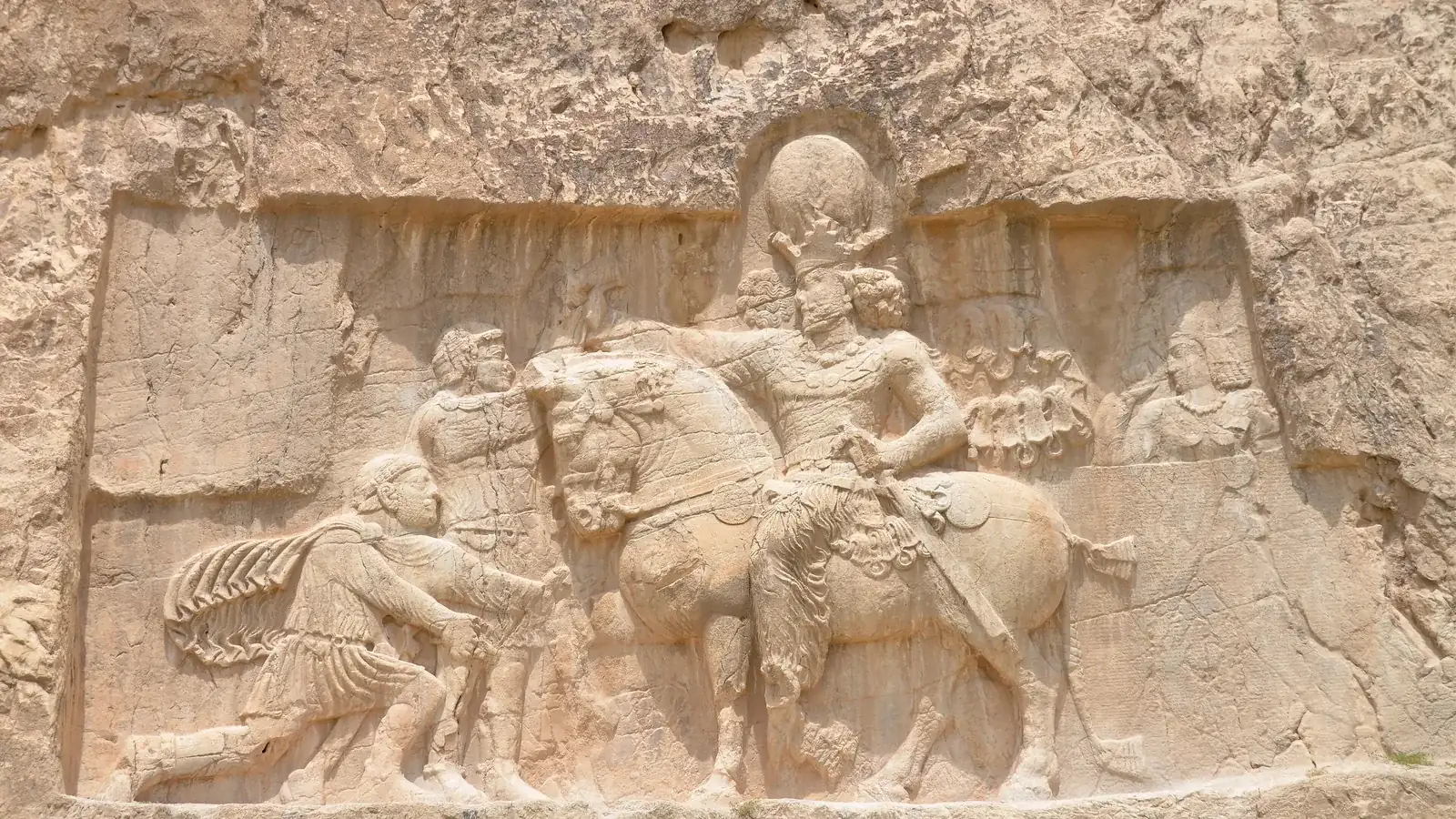
Opposite the tower, the relief called Naqsh-e Rostam VI shows Shapur on horseback with Philip the Arab kneeling before him and Valerian standing at his side, held by the wrist. Bruno Overlaet, writing for the Encyclopaedia Iranica in 2017, recorded that the carving follows the inscription so closely that the relief had to be cut after 260. What the larger reliefs in the Tang-e Chogan gorge at Bishapur show is disputed. Shahbazi read Bishapur II as Shapur with Gordian prostrate and Valerian at his wrist; Overlaet read Bishapur II and III as the surrender of Emesa by the usurper Uranius Antoninus in about November 253.
What Roman writers put in place of it
The traditions disagree first about Gordian III. The official Roman biography in the Historia Augusta recorded that Gordian won battles, drove Shapur from Carrhae and Nisibis, then died during a retreat engineered by Philip the Arab, prefect of the guard. John Zonaras recorded instead that he fell from his horse, broke his thigh and died of the wound. Shapur’s inscription records a frontal battle at Misikhe on the Euphrates in which “Gordianus Caesar perished,” after which Philip paid 500,000 dinars for his life.
The captivity got the same treatment. Lactantius, a Christian writer of the early fourth century, described in “Of the Manner in Which the Persecutors Died” how Shapur made Valerian stoop as a step when mounting his horse, and how the emperor’s skin was flayed after death and set up in a Persian temple. The book was written to show that rulers who persecuted Christians met fitting ends, and Valerian had ordered such a persecution. Neither inscription nor relief carries anything of the kind, and Shahbazi recorded that every Persian image of the captive emperor shows him unfettered and in his regalia.
The prisoners and the cities they built
The inscription treats the prisoners as the point of the war. Shapur recorded that the captives were led away with the booty and settled “in Persis, Parthia and in Khuzestan and in Asoristan,” on royal estates. Shahbazi wrote that many were artisans, that many were Christians who founded churches and bishoprics without being persecuted, and that Gondeshapur was founded for the deportees from Antioch.
Bishapur was Shapur’s own foundation. Jona Lendering, writing for Livius.org, recorded that the city and its palace were built by Roman soldiers taken after Valerian’s defeat, and that much of the plan looks Roman: a grid, where Iranian cities of the period were laid out in circles. Which unit they came from is not established; Lendering offered the Sixth Legion Ferrata as a guess, since it drops out of the record after 260. In 2018 UNESCO inscribed eight archaeological sites at Firuzabad, Bishapur and Sarvestan as the Sassanid Archaeological Landscape of Fars Region, and its statement of value singles out Bishapur for the influence of Roman art and architecture.
How the two versions are weighed
Neither account is neutral, and historians have not treated them as equal. Erich Kettenhofen, whose study Shahbazi follows, wrote that Roman pride moved the blame for the first defeat onto Philip, and that the Roman version cannot explain why an army said to have reached Ctesiphon then bought a shameful peace. On the fate of Valerian the weight runs the other way from Lactantius: the Persian monuments, which had every reason to show a humiliated Roman, show a clothed and unbound one.
What survives is a defeat recorded by the side that won it, in stone, in three languages, in cliff carvings cut through Fars. The Roman books that answer it were written by men who had not been there, and they disagree with one another about Gordian III before they disagree with Shapur. The capture at Edessa is the point on which both traditions agree.
Key facts
- Ardashir I defeated the Parthians about AD 224 and founded the Sasanian dynasty; his son Shapur I ruled from about 240 to 270.
- Shapur fought three wars with Rome: 242 to 244 against Gordian III, 252 to 256 in Syria, and the campaign of 260.
- Valerian was captured near Edessa in 260 and died in Persian captivity; the inscription gives his force as 70,000 men.
- Shapur’s trilingual inscription, in Middle Persian, Parthian and Greek, is cut on the Ka’ba-ye Zartosht at Naqsh-e Rostam and is also called Res Gestae Divi Saporis.
- The Naqsh-e Rostam VI relief shows Philip the Arab kneeling and Valerian held by the wrist, so it was cut after 260.
- Roman prisoners were settled in Persis, Khuzestan and Asoristan and worked on Bishapur, whose grid plan differs from the circular Iranian cities of the period.
- UNESCO inscribed eight Sasanian sites in Fars, among them Bishapur, in 2018.
FAQ
Which Roman emperor was captured by the Persians?
Valerian, taken near Edessa in AD 260 by the Sasanian king Shapur. The Persian inscription records that the emperor was seized in person, along with the Praetorian Prefect and senators, and led into Persis. Valerian died in captivity.
Was Valerian really flayed and stuffed?
Lactantius wrote in the early fourth century that Shapur used Valerian as a mounting step and had his skin flayed and displayed in a temple. The book set out to show that persecutors of Christians died badly. Shapur's inscription and the Persian reliefs record nothing of it, and show Valerian unbound and in regalia.
Where are the Sasanian victory reliefs?
At Naqsh-e Rostam, near Persepolis in Fars, and in the Tang-e Chogan gorge at Bishapur. Both lie inside the Sassanid Archaeological Landscape of Fars Region, inscribed by UNESCO in 2018.
Sources
- Encyclopaedia Iranica — A. Sh. Shahbazi, "ŠĀPUR I: History" (published 2002, updated 2018).
- Encyclopaedia Iranica — Bruno Overlaet, "ŠĀPUR I: Rock Reliefs" (2017).
- The Metropolitan Museum of Art, Heilbrunn Timeline of Art History — Blair Fowlkes-Childs and the Department of Ancient Near Eastern Art, "The Sasanian Empire (224–651 A.D.)" (2003, revised 2016).
- UNESCO World Heritage Centre — "Sassanid Archaeological Landscape of Fars Region," inscribed 2018.
- Parthian Sources Online — "The Inscription of Shapur I | SKZ," Parthian text after the edition of Philip Huyse (1999).
- Livius.org — Jona Lendering, "Bishapur" (2004, last modified September 24, 2020).
- New Advent — Lactantius, "Of the Manner in Which the Persecutors Died," chapter 5, translated by William Fletcher.
Cite this article
- APA
- Our Earth's History. (2026, September 19). Did Persia really capture a Roman emperor alive in AD 260? Our Earth's History. https://ourearthshistory.com/west-asia/classical/shapur-captured-a-roman-emperor/
- Chicago
- Our Earth's History. “Did Persia really capture a Roman emperor alive in AD 260?” Our Earth's History, September 19, 2026. https://ourearthshistory.com/west-asia/classical/shapur-captured-a-roman-emperor/.
- MLA
- “Did Persia really capture a Roman emperor alive in AD 260?” Our Earth's History, 19 Sep. 2026, https://ourearthshistory.com/west-asia/classical/shapur-captured-a-roman-emperor/.
Text licensed CC BY-NC-ND 4.0. Found an error? Tell us.