One fifth of Babeldaob: the terraced hills of Palau, 500 BC to AD 650
_-_panoramio.jpg)
TL;DR — Earthwork terraces cover an estimated 20 percent of Babeldaob, Palau’s largest island, built about 500 BC to AD 650 and left for coastal stone villages by about AD 1000.
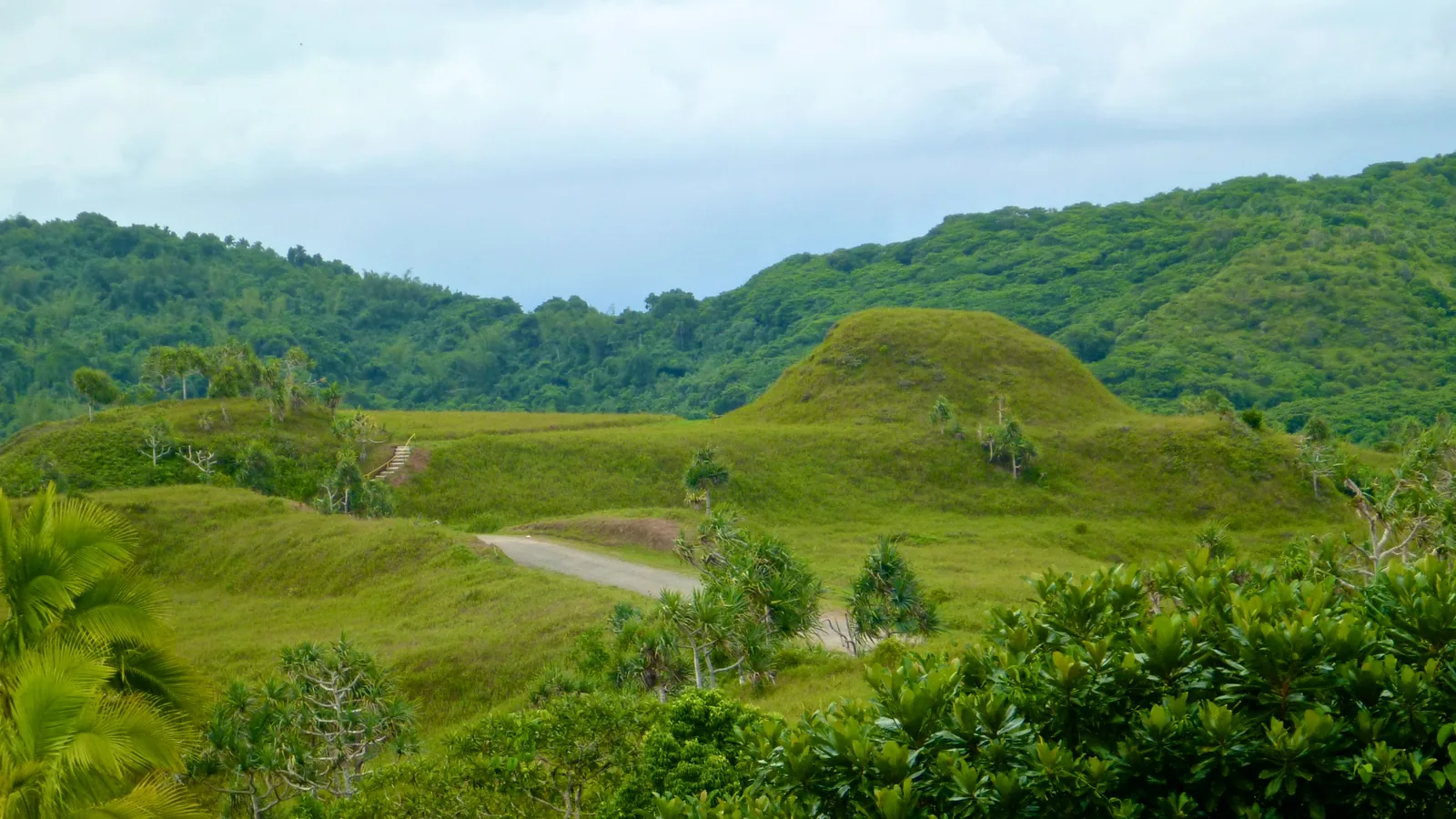
Terraced hills, shaped as earthworks, cover an estimated 20 percent of the land on Babeldaob, the largest island of Palau in western Micronesia. The complexes number in the dozens, according to J. Liston’s 2009 chronology as cited by the archaeologist Scott Fitzpatrick in 2011. W. B. Masse and colleagues placed their construction in an earthwork era of about 500 BC to AD 650, a span Fitzpatrick cited in 2010. Terrace sites in the interior were established between about 200 BC and AD 1000 and were deserted by about AD 1000, when villages built of stone spread along the coasts. The builders were descendants of people who had reached Palau about 3,000 to 3,300 years before the present.
Quick facts
- When
- Earthwork era about 500 BC to AD 650; interior terraces in use about 200 BC to AD 1000; stone villages from about AD 1000 to 1200
- Where
- Babeldaob, the largest island of Palau in western Micronesia; the limestone Rock Islands to its south
- Who
- Palauans descended from settlers who arrived about 3,000 to 3,300 years before the present; archaeologists Scott Fitzpatrick, Greg Nelson, Geoffrey Clark, Patrick Nunn, Rosalind Hunter-Anderson and Lee Berger
- Outcome
- Dozens of terrace complexes covering an estimated 20 percent of Babeldaob; abandonment of the interior by about AD 1000; about 1,752 stonework villages on Babeldaob alone
Landfall about 3,000 years before the present
Palau’s chain of islands runs more than 150 kilometers. Babeldaob and Koror are volcanic; to their south lie the Rock Islands, small limestone islands with caves. Fitzpatrick, Greg Nelson and Geoffrey Clark wrote in PLOS ONE in 2008 that “current archaeological evidence from Palau in western Micronesia indicates that the archipelago was settled around 3000–3300 BP by normal sized populations.” BP means before the present, counted from 1950 by radiocarbon convention.
The site that anchors the early dates is Chelechol ra Orrak, a cemetery in the Rock Islands with layered deposits about 3,000 years old. Nelson and Fitzpatrick published the first report on its skeletons in 2006 in Anthropological Science, the journal of the Anthropological Society of Nippon, and by 2008 the site had produced the remains of at least 25 people. Palauans used caves as burial places from at least about 800 BC, Fitzpatrick wrote in 2010, and as fishing camps from at least AD 300 into the historic period.
Embankments, ring ditches and eroded hillsides
Fitzpatrick’s 2010 paper set the interior terrace sites between about 200 BC and AD 1000, citing S. Wickler’s 2002 study of terraces and villages, and quoted Masse and colleagues on “some of the most spectacular defensive features” of Palau, which belonged to the earthwork era of about 500 BC to AD 650. In 2011 Fitzpatrick added that Liston had described embankments and ring-ditch palisades attached to the terraces, features he read as support for a defensive purpose. Building the terraces stripped soil from the hills, and Masse and colleagues wrote that the eroded material formed wet lowland soils that became important for taro farming, as Fitzpatrick cited in 2010.
Whether the hills were fortresses is argued. Patrick Nunn of the University of New England in Armidale, Australia, and Rosalind Hunter-Anderson of the University of New Mexico wrote in the Journal of Pacific Archaeology in 2011 that “there is no archaeological evidence of violence, no weapons and no traumatic injuries among the few known burials excavated from earthwork-era sites.” Their simpler explanation was territory: “Constructing monumental features is a way of deterring land-taking.” Fitzpatrick answered that the same absence of wounds applied to every burial found in Palau over three millennia, so the reading of the earthworks depended on how far one projected later Palauan warfare into the past.
Stone villages on the coast, AD 1000 to 1200
Liston’s chronology, as cited by Fitzpatrick in 2010, put the abandonment of the artificially constructed terrace sites of inland Babeldaob at about AD 1000, and Wickler’s study, cited in the same paper, had villages common along the coasts by about AD 1100 to 1200. Construction of stonework villages began about AD 1000 to 1200, Fitzpatrick wrote in 2011, and the terraces may have kept some uses after that.
Fitzpatrick’s 2011 paper gave the number of stonework villages on Babeldaob alone as about 1,752, or one village for every 2 square kilometers, from the geographic information system (GIS) database of the Palau Bureau of Arts and Culture, with others on Koror, Peleliu, Angaur and the Rock Islands. He read the total as a sign that population grew after AD 1200 and that provincial boundaries hardened. Masse and colleagues, as he quoted them, had found that the scarcity of remains on Babeldaob at the turn of the second millennium was “countered by only a slight rise in the frequency of Rock Island cultural deposits, but not enough to account for a wholesale migration of the Babeldaob population to the smaller islands.”
A climate event, or none
Nunn and Hunter-Anderson held that cooling and a fall in sea level, between the Medieval Warm Period and the Little Ice Age, cut food resources across the Pacific and drove conflict, an outbreak they placed in Palau at about AD 1250 on Masse’s evidence, with people leaving open sites for defensible ground. Fitzpatrick’s 2010 critique answered that Palau’s movement ran from inland to coast beginning about AD 1200 and that “there is nothing in the Palauan data to support the operation of a supposed ‘AD 1300 event.’” The 2011 rebuttal replied that a move to better coastal access “in no way does this refute the suggestion that this change was ultimately a response to the independently-verifiable climate change that took place at this time.” Fitzpatrick’s response in the same volume held that Masse’s fish and shellfish data came from one locale, sieved through a 6.35-millimeter mesh that undercounted small fish.
Small bones in two Rock Island caves
The Rock Island caves produced a second dispute in 2008. Lee Berger of the University of the Witwatersrand in Johannesburg, with Steven Churchill, Bonita De Klerk and Rhonda Quinn, reported in PLOS ONE on bones collected from the surface and a test pit in Ucheliungs and Omedokel caves, explored in 2006 and dated by radiocarbon to between about 2,900 and 1,400 years ago. The older individuals, they wrote, “are small in body size even relative to ‘pygmoid’ populations from Southeast Asia and Indonesia, and thus may represent a marked case of human insular dwarfism,” an interpretation they called preliminary. Fitzpatrick, Nelson and Clark replied in the same journal that year under the title “Small Scattered Fragments Do Not a Dwarf Make”: the sample was “too small and fragmentary to adequately address the variation inherent in modern humans,” and every other prehistoric skeletal assemblage from Palau, older and contemporary, fell within the normal range for the region. Palau also exported stone: the disks of Yapese stone money were quarried there, and the quarrying was still under way in the mid-1800s when Europeans saw it and later joined in, according to Fitzpatrick’s 2008 study as cited in his 2011 paper.


Key facts
- Palau was settled about 3,000 to 3,300 years before the present by populations of normal body size, according to Fitzpatrick, Nelson and Clark (PLOS ONE, 2008).
- Chelechol ra Orrak, a layered cemetery in the Rock Islands about 3,000 years old, was first reported by Nelson and Fitzpatrick in Anthropological Science in 2006 and had yielded at least 25 individuals by 2008.
- The earthwork era of Palau ran about 500 BC to AD 650 (Masse and colleagues, 2006, as cited by Fitzpatrick, 2010); interior terrace sites were established between about 200 BC and AD 1000 (Wickler, 2002, as cited in the same paper).
- Terrace complexes number in the dozens and cover an estimated 20 percent of Babeldaob’s land area (Liston, 2009, as cited by Fitzpatrick, 2011).
- The interior terraces were abandoned by about AD 1000 (Liston, 2009, as cited by Fitzpatrick, 2010), and stonework villages were built from about AD 1000 to 1200.
- Babeldaob alone holds about 1,752 stonework villages, one per 2 square kilometers, by the GIS database of the Palau Bureau of Arts and Culture as cited by Fitzpatrick (2011).
- Berger and colleagues (PLOS ONE, March 2008) proposed insular dwarfism for bones from Ucheliungs and Omedokel caves; Fitzpatrick, Nelson and Clark (PLOS ONE, August 2008) answered that the sample was too small and fragmentary.
FAQ
When were the Babeldaob terraces built?
Masse and colleagues, as cited by Fitzpatrick in 2010, set an earthwork era of about 500 BC to AD 650. Wickler's 2002 study, cited in the same paper, put the interior terrace sites between about 200 BC and AD 1000, with abandonment by about AD 1000.
How much of Babeldaob do the earthworks cover?
An estimated 20 percent of the island's land area, in complexes numbering in the dozens, according to Liston's 2009 chronology as cited by Fitzpatrick in 2011.
Were the earthworks fortifications?
Fitzpatrick cited embankments and ring-ditch palisades attached to the terraces as support for a defensive purpose. Nunn and Hunter-Anderson wrote that no weapons or wounds had been found in earthwork-era burials and read the monuments as a way of deterring land-taking.
Sources
- PLOS ONE — Fitzpatrick, Nelson and Clark, "Small Scattered Fragments Do Not a Dwarf Make: Biological and Archaeological Data Indicate that Prehistoric Inhabitants of Palau Were Normal Sized," 3(8): e3015, 2008.
- PLOS ONE — Berger, Churchill, De Klerk and Quinn, "Small-Bodied Humans from Palau, Micronesia," 3(3): e1780, March 12, 2008.
- Journal of Pacific Archaeology — Fitzpatrick, "A Critique of the 'AD 1300 Event', with Particular Reference to Palau," 1(2): 168–173, 2010.
- Journal of Pacific Archaeology — Nunn and Hunter-Anderson, "Defending the Defensible: A Rebuttal of Scott Fitzpatrick's (2010) Critique of the AD 1300 Event Model with Particular Reference to Palau," 2(1): 92–99, 2011.
- Journal of Pacific Archaeology — Fitzpatrick, "Defending the Defensible or Offending the Sensible? A Response to Nunn & Hunter-Anderson," 2(1): 100–105, 2011.
- Anthropological Science (J-STAGE) — Nelson and Fitzpatrick, "Preliminary investigations of the Chelechol ra Orrak Cemetery, Republic of Palau: I, skeletal biology and paleopathology," 114(1): 1–12, 2006.
- University of Oregon, Department of Anthropology — faculty profile of Scott Fitzpatrick.
Cite this article
- APA
- Our Earth's History. (2026, September 22). One fifth of Babeldaob: the terraced hills of Palau, 500 BC to AD 650. Our Earth's History. https://ourearthshistory.com/oceania/classical/palau-babeldaob-earthworks-terraces/
- Chicago
- Our Earth's History. “One fifth of Babeldaob: the terraced hills of Palau, 500 BC to AD 650.” Our Earth's History, September 22, 2026. https://ourearthshistory.com/oceania/classical/palau-babeldaob-earthworks-terraces/.
- MLA
- “One fifth of Babeldaob: the terraced hills of Palau, 500 BC to AD 650.” Our Earth's History, 22 Sep. 2026, https://ourearthshistory.com/oceania/classical/palau-babeldaob-earthworks-terraces/.
Text licensed CC BY-NC-ND 4.0. Found an error? Tell us.