A synagogue to Damascus, a church to Yale: Dura-Europos, 1920–1937
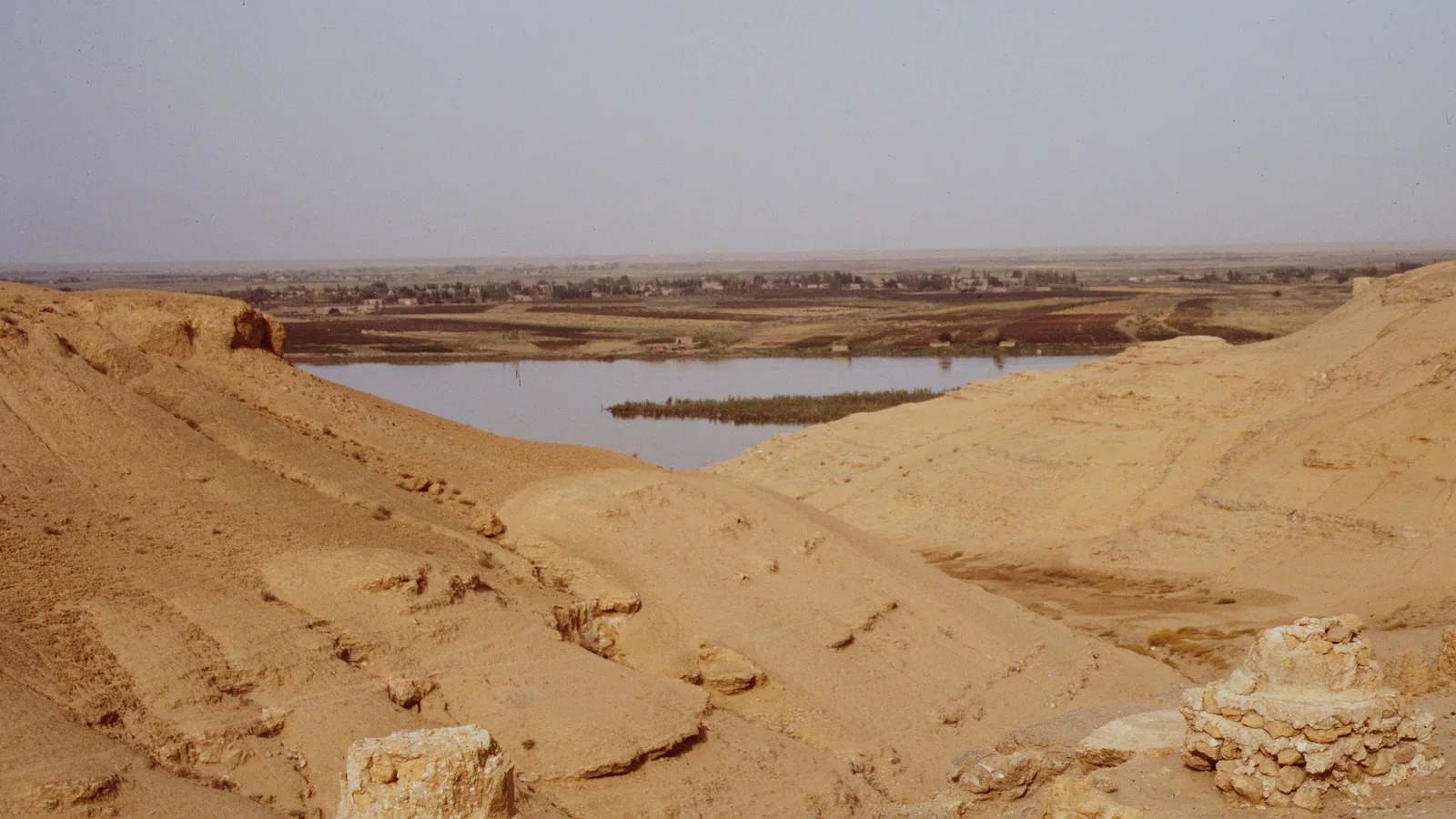

TL;DR — Dura-Europos was dug from 1920 to 1937; the synagogue paintings of 244/245 went to Damascus, the Christian baptistery to Yale, and satellite images of 2015 show fresh looting.
“It was more than 100 years ago, in March 1920, that British troops camping in the ruins of some unknown ancient fort on the Euphrates, named Al-Salihiyah in Arabic, during the skirmishing that followed the collapse of the Ottoman Empire in the aftermath of the First World War, dug a trench and excavated some astonishing wall paintings.” So Jaś Elsner opened his account in the Journal of Roman Archaeology in 2021. In 1937 Michel Rostovtzeff of Yale reported to the Académie des Inscriptions et Belles-Lettres in Paris: “Je dois vous informer à mon grand regret que cette campagne de fouilles sera la dernière” (I must inform you, to my great regret, that this campaign of excavations will be the last). Between the two sentences lie the seasons that turned the fort into Dura-Europos, a town on the Euphrates in what is now Syria, and brought out two painted rooms: a synagogue dated to 244/245, which went to Damascus, and a Christian house with a baptistery, which went to Yale.
Quick facts
- When
- March 1920 (British troops find wall paintings in a trench) · May 1920 (Breasted's one-day visit) · autumn 1922 and 1923 (Armée du Levant digs under Cumont) · 1928 or 1929 to 1937 (Yale and the Académie des Inscriptions) · 1931–32 season (Christian chapel) · 1933 (synagogue reported to the Académie) · 1937 (last season; synagogue paintings rebuilt in Damascus) · April 2015 (satellite imagery of new looting)
- Where
- Dura-Europos, the ruin called Al-Salihiyah on the right bank of the Euphrates, in what is now Syria; Damascus; New Haven
- Who
- James Henry Breasted; Franz Cumont; Michel Rostovtzeff; Clark Hopkins; Robert du Mesnil du Buisson; Frank Brown; Henry Pearson; Shapur I
- Outcome
- About one third of the town was dug by 1937, when the money ran out. The synagogue paintings of 244/245 were taken down and rebuilt in the Musée des Antiquités in Damascus; the baptistery of the Christian house was rebuilt at Yale; the other finds were divided among the Louvre, Damascus, Deir ez-Zor and Yale
March 1920: a trench, a one-day visit and the Armée du Levant
The officers called in an American archaeologist who happened to be in Syria at the end of April 1920: James Henry Breasted, first director of the Oriental Institute in Chicago. Elsner writes that Breasted “visited in May, in dangerous conditions and with the British about to withdraw,” stayed only a day, and photographed murals of the sacrifices of Conon and Julius Terentius in what later became known as the Temple of the Palmyrene Gods.
The French army took over. Franz Cumont reported in 1924 on “les fouilles entreprises à l’automne de 1922 et poursuivies l’année suivante par l’armée du Levant” (the excavations undertaken in the autumn of 1922 and continued the following year by the Army of the Levant). The least hoped-for find, he wrote, was parchments.
Encyclopaedia Iranica, in Pierre Leriche’s entry, gives the sequence: exploration in 1920–22 under Cumont, then “From 1929 to 1937 Yale University and the Académie sponsored excavations under the initiative of M. I. Rostovtzeff.” J. W. Crowfoot, writing in Antiquity in 1945, put the start “in 1928” and the end: “By 1937 about one third of the site had been excavated and work was suspended through lack of funds.” Frank Brown directed that last season.
Nicanor's town, and the siege of 256
Iranica dates the foundation to 303 BC, by Nicanor, for Seleucus I. The town passed to the Parthians in about 113 BC, was held by Trajan from AD 113 to 117, and became Roman in 165 under Avidius Cassius. The only Iranian cult known there was that of Mithra, introduced by Roman troops in 168; the mithraeum was a single room with a bench along each long side.
In 256, in the offensive of Shapur I, Iranica records, “it was taken after a bitter siege, and the population was deported.” The defenders had thickened the western and northern walls with earth under a mud-brick glacis. The Persians tunneled under towers 19 and 14 of the west wall without bringing them down, and at the southeast corner they built a ramp 40 meters long and 10 meters high. The body of a Sasanian soldier was found in one of the trenches, with his coat of mail, his sword and an iron helmet. A 2011 review in the Journal of Toxicology lists the siege of Dura-Europos in 256 among historical uses of a sulfurous gas as a chemical warfare agent, and cites for it Simon James’s article of the same year in the American Journal of Archaeology on the siege mines. Iranica adds that the chronology of the siege “is still far from having been resolved,” and that the Pahlavi inscriptions on the synagogue frescoes, of which David Neil MacKenzie counts 12 in ink, do not prove an earlier Sasanian occupation in 253.
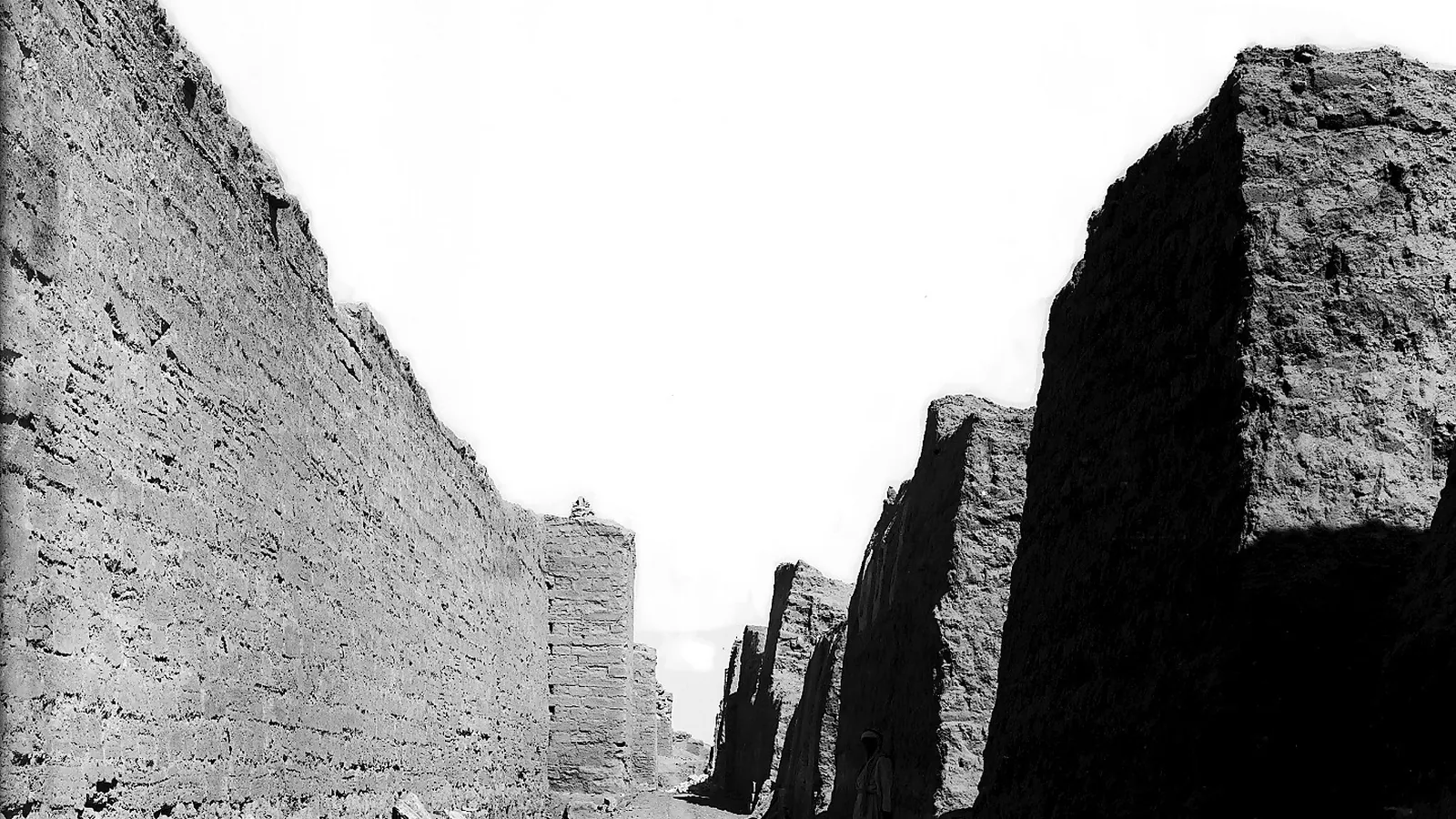
_toward_tower_18_Main_Gate_(Palmyrene_Gate).jpg)
Five months, two temples and a Christian chapel
The season of 1931–32 was reported to the Académie by Rostovtzeff and Clark Hopkins in 1932: “Durant la saison de cinq mois nous avons déblayé quelques tours du mur d’enceinte, un ensemble de maisons privées, le marché central, deux temples, un prétoire romain, et une chapelle chrétienne” (during the five-month season we cleared several towers of the circuit wall, a group of private houses, the central market, two temples, a Roman praetorium, and a Christian chapel). Marcel Aubert, in the Bulletin Monumental of 1934, identified the room as the chapel of a Christian house and listed its paintings under their titles, among them “LE BON PASTEUR”, “ADAM ET EVE” and “LES SAINTES FEMMES AU TOMBEAU”. William Seston, lecturing at Ghent in 1937, said the historian of early Christian art “ne peut que se passionner pour l’étude d’une église qui est la plus ancienne du monde” (cannot but be gripped by the study of a church which is the oldest in the world).
"La chapelle chrétienne, découverte l'an dernier"
Hopkins and Robert du Mesnil du Buisson reported the synagogue to the Académie in 1933, and their first sentence placed it against the chapel: “La chapelle chrétienne, découverte l’an dernier” (the Christian chapel, discovered last year) stood beside the circuit wall. Iranica dates the synagogue frescoes to 245; Aline Rousselle, in Pallas in 1997, gives 244/5.
C. B. Welles published the parchments and papyri as Final Report 5/1 in 1959. The best known piece is the Feriale Duranum, which Duncan Fishwick described in Syria in 1988 as “the solitary, surviving example of a calendar of festivals valid for all military units throughout the Roman empire.” It belonged to the cohors XX Palmyrenorum, was written possibly between AD 225 and 227, and came from room W13 of the Temple of Artemis Azzanathkona.
The paintings to Damascus, the baptistery to New Haven
Rostovtzeff’s 1937 report told the Académie where the synagogue had gone: its paintings “ont été détachées des murs et transportées à Damas” (were detached from the walls and transported to Damascus), where the courtyard and the synagogue itself were rebuilt in the new Musée des Antiquités, at the Syrian government’s expense, by the mission’s architect, Henry Pearson. Aubert, reviewing Rostovtzeff’s Dura-Europos and its art in 1939, recorded the other room’s journey: “la salle principale, baptistère ou chapelle, a été reconstituée au Musée de l’Université Yale aux Etats-Unis” (the main room, baptistery or chapel, was reconstructed at the Museum of Yale University in the United States). Leriche, in Syria in 1988, described the division of the finds among the Louvre, Damascus, Deir ez-Zor and Yale.
Jesse Casana and Elise Jakoby Laugier wrote in PLOS ONE that satellite imagery from April 2015 showed hundreds of new looting holes at Dura-Europos, some inside older trenches. Their paper of 2017 found that “the most severe looting has generally been focused on sites of the Roman and late Roman period (such as Apamea, Palmyra, and Dura Europos).”
Key facts
- British troops dug a trench in the ruin called Al-Salihiyah on the Euphrates in March 1920 and exposed wall paintings (Elsner, Journal of Roman Archaeology, 2021).
- James Henry Breasted visited in May 1920, stayed one day, and photographed the murals of Conon and Julius Terentius in the Temple of the Palmyrene Gods (Elsner 2021).
- The Armée du Levant dug in the autumn of 1922 and in 1923 and found parchments, including an Aramaic letter about grain (Cumont, 1924).
- Yale and the Académie des Inscriptions excavated under Rostovtzeff until 1937; Encyclopaedia Iranica gives 1929 as the first year, Crowfoot in Antiquity gives 1928. About one third of the site was dug when funds ran out (Crowfoot 1945; Rostovtzeff 1937).
- The Christian chapel was cleared in the five-month season of 1931–32 (Rostovtzeff and Hopkins, CRAI 1932); the synagogue was reported in 1933 with the chapel described as “découverte l’an dernier” (Hopkins and du Mesnil du Buisson, CRAI 1933).
- The synagogue frescoes are dated to 245 by Iranica and to 244/5 by Rousselle (1997).
- Shapur I took the town in 256 after mining under towers 19 and 14 and building a ramp 40 meters long and 10 meters high at the southeast corner (Iranica).
- The synagogue paintings were rebuilt in the Musée des Antiquités in Damascus by Henry Pearson at the Syrian government’s expense (Rostovtzeff 1937); the baptistery was rebuilt at Yale (Aubert 1939).
FAQ
Where are the Dura-Europos synagogue paintings now?
In Damascus. Rostovtzeff's 1937 report to the Académie states that the paintings were detached from the walls and transported to Damascus, where the courtyard and the synagogue were rebuilt in the Musée des Antiquités at the expense of the Syrian government.
Which was found first at Dura-Europos, the synagogue or the house church?
The house church. Rostovtzeff and Hopkins reported a Christian chapel among the finds of the five-month 1931–32 season, and the 1933 report on the synagogue opens by calling the chapel "découverte l'an dernier," discovered last year.
What is the Feriale Duranum?
A papyrus calendar of Roman military festivals kept by the cohors XX Palmyrenorum at Dura, found in room W13 of the Temple of Artemis Azzanathkona. Fishwick dates the copy to the reign of Severus Alexander, possibly between AD 225 and 227.
Sources
- Pierre Leriche, "DURA EUROPOS i. Archaeology and History," Encyclopaedia Iranica, vol. VII, fasc. 6 (1996; updated 2013).
- David Neil MacKenzie, "DURA EUROPOS ii. The Inscriptions," Encyclopaedia Iranica, vol. VII, fasc. 6 (1996; updated 2013).
- Jaś Elsner, "100 years of Dura Europos," Journal of Roman Archaeology 34.2 (2021), pp. 764–784 (Cambridge Core extract).
- J. W. Crowfoot, "Dura-Europos," Antiquity 19.75 (1945), pp. 113–121 (Cambridge Core extract).
- Franz Cumont, "Les parchemins de Doura-Europos," Bulletin de l'Association Guillaume Budé 5 (1924), pp. 50–53 (Persée).
- Michel Rostovtzeff and Clark Hopkins, "La dernière campagne de fouilles de Doura-Europos," Comptes rendus des séances de l'Académie des Inscriptions et Belles-Lettres 76-3 (1932), pp. 314–328 (Persée).
- Clark Hopkins and Robert du Mesnil du Buisson, "La synagogue de Doura-Europos," Comptes rendus des séances de l'Académie des Inscriptions et Belles-Lettres 77-2 (1933), pp. 243–255 (Persée).
- Michel Rostovtzeff, "Rapport sur les fouilles de Doura-Europos, campagne de 1936-1937," Comptes rendus des séances de l'Académie des Inscriptions et Belles-Lettres 81-2 (1937), pp. 195–204 (Persée).
- Marcel Aubert, "Les fouilles de Doura-Europos, note sur les origines de l'iconographie chrétienne," Bulletin Monumental 93-4 (1934), pp. 397–407 (Persée).
- William Seston, "L'église et le baptistère de Doura-Europos" (lecture, Ghent, 1937), Scripta varia, Publications de l'École française de Rome 43 (1980), pp. 607–627 (Persée).
- Marcel Aubert, review of M. Rostovtzeff, Dura-Europos and its art (1938), Bulletin Monumental 98-1 (1939), p. 122 (Persée).
- Aline Rousselle, "L'iconographie juive au IIIe siècle," Pallas, hors-série (1997), pp. 21–29 (Persée).
- Duncan Fishwick, "Dated inscriptions and the Feriale Duranum," Syria 65 (1988), pp. 349–361 (Persée).
- Pierre Leriche, "Histoire des recherches à Doura-Europos," Syria 65 (1988), p. 363 (Persée).
- Jesse Casana and Elise Jakoby Laugier, "Satellite imagery-based monitoring of archaeological site damage in the Syrian civil war," PLOS ONE 12(11) (2017), e0188589 (PubMed Central).
- Nikhil D. Mathew, David I. Schlipalius and Paul R. Ebert, "Sulfurous Gases as Biological Messengers and Toxins," Journal of Toxicology 2011, article 394970 (PubMed Central).
Cite this article
- APA
- Our Earth's History. (2026, September 22). A synagogue to Damascus, a church to Yale: Dura-Europos, 1920–1937. Our Earth's History. https://ourearthshistory.com/west-asia/classical/dura-europos-1920-1937-synagogue-1932-house-church-yale-damascus/
- Chicago
- Our Earth's History. “A synagogue to Damascus, a church to Yale: Dura-Europos, 1920–1937.” Our Earth's History, September 22, 2026. https://ourearthshistory.com/west-asia/classical/dura-europos-1920-1937-synagogue-1932-house-church-yale-damascus/.
- MLA
- “A synagogue to Damascus, a church to Yale: Dura-Europos, 1920–1937.” Our Earth's History, 22 Sep. 2026, https://ourearthshistory.com/west-asia/classical/dura-europos-1920-1937-synagogue-1932-house-church-yale-damascus/.
Text licensed CC BY-NC-ND 4.0. Found an error? Tell us.