A goat for Aaron's tomb: Burckhardt at Petra, August 22, 1812

TL;DR — Burckhardt entered Petra on August 22, 1812, after telling his guide he had vowed a goat to Haroun, a pretext to see the valley before slaughtering the goat at dusk.
“I therefore pretended to have made a vow to slaughter a goat in honour of Haroun (Aaron), whose tomb I knew was situated at the extremity of the valley, and by this stratagem I thought that I should have the means of seeing the valley in my way to the tomb.” Johann Ludwig Burckhardt wrote that sentence about August 22, 1812, the day he passed through Wady Mousa, the valley later known as Petra, on a journey he had planned to end in Cairo.
Quick facts
- When
- August 22, 1812 (entry into the valley and the sacrifice at Aaron's terrace); August 23, 1812 (return without climbing to the tomb)
- Where
- Wady Mousa, the valley of Petra, on the road between Shobak and Akaba
- Who
- Johann Ludwig Burckhardt, traveling as "Sheikh Ibrahim Ibn Abdallah"; his unnamed local guide
- Outcome
- Burckhardt passed through Petra under the pretext of a vow, described the Siq, its rock-cut tombs, the theater and the facade he called Kaszr Faraoun, sacrificed a goat at Aaron's terrace, and did not climb to the tomb itself. His account appeared in London in 1822, five years after his death.
Johann Ludwig Burckhardt, traveling as Sheikh Ibrahim
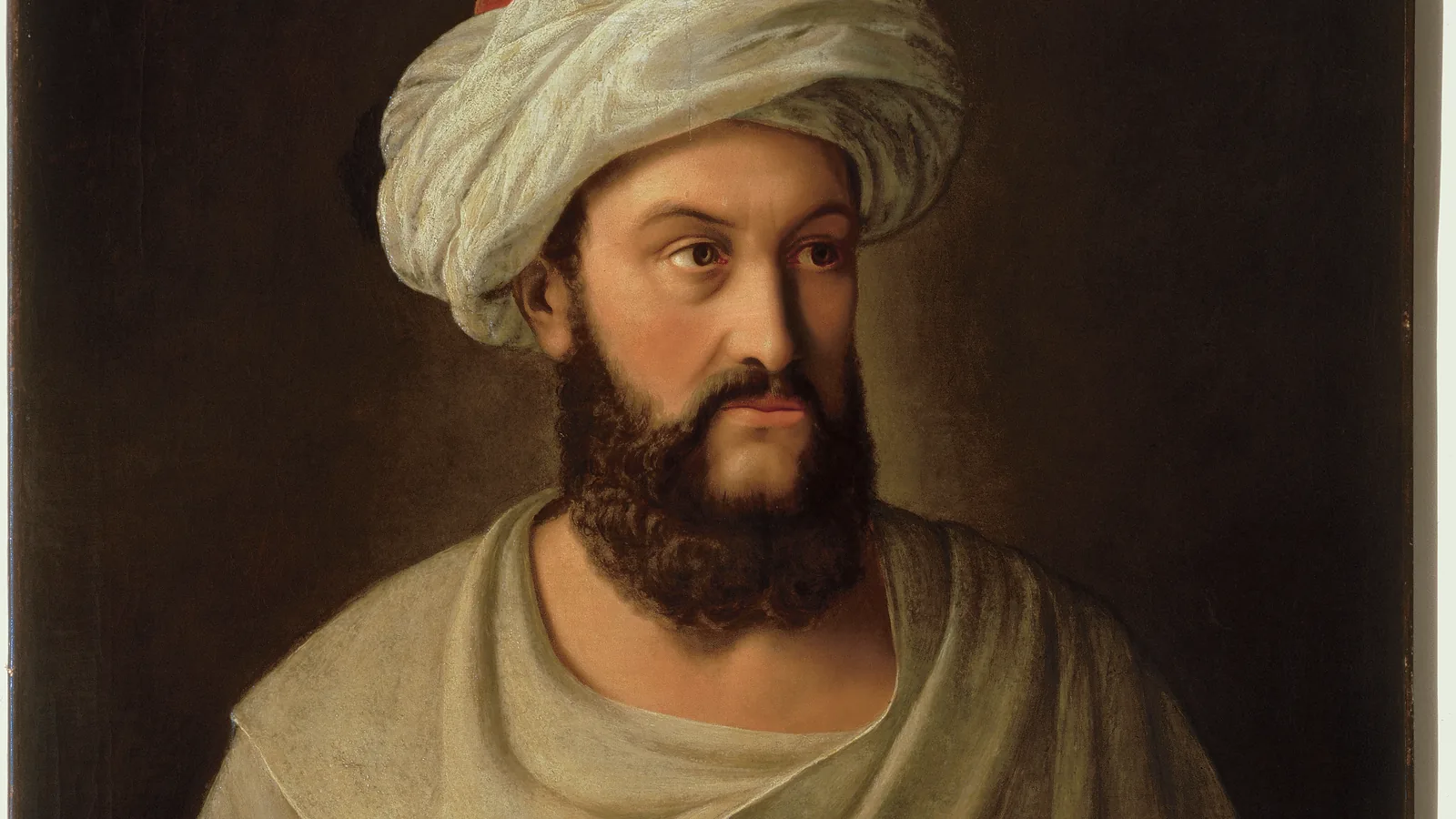
Burckhardt made the journey under an assumed identity. The Linda Hall Library, a science history library in the United States, records that he traveled as “Sheikh Ibrahim Ibn Abdallah” and that his stated purpose that year was to reach Cairo and join a caravan bound for Timbuktu. The Wellcome Collection catalogs his book as written “By the late John Lewis Burckhardt,” an anglicized form of his name used after his death. He was born in 1784 and died in Cairo on October 15, 1817, of dysentery, at age 32, according to the Linda Hall Library. The African Association, which had sent him to Africa by way of Arabic study in Syria, published his travel accounts in three volumes after his death: Travels in Nubia in 1819, Travels in Syria and the Holy Land in 1822, and a third volume in 1829.
August 22, 1812: a vow to Haroun
Burckhardt’s guide wanted to reach Cairo by way of Akaba, where the Pasha of Egypt kept a garrison. Burckhardt wrote that a stranger coming from Damascus without papers would have “roused the suspicions of the officer commanding at Akaba,” and that turning off the Akaba road out of mere curiosity “would have looked very suspicious in the eyes of the Arabs.” The vow to Haroun solved both problems. Once Burckhardt proposed it, he wrote, “the dread of drawing upon himself, by resistance, the wrath of Haroun, completely silenced” his guide. On the mountain where the road to Wady Mousa branches from the Akaba road, Burckhardt passed heaps of stones left by earlier travelers who had already killed a goat at that spot rather than go on to the tomb. His guide urged him to do the same. Burckhardt refused, saying he had sworn to make the sacrifice at the tomb itself, and continued down into the valley.
Kaszr Faraoun and a suspicious guide
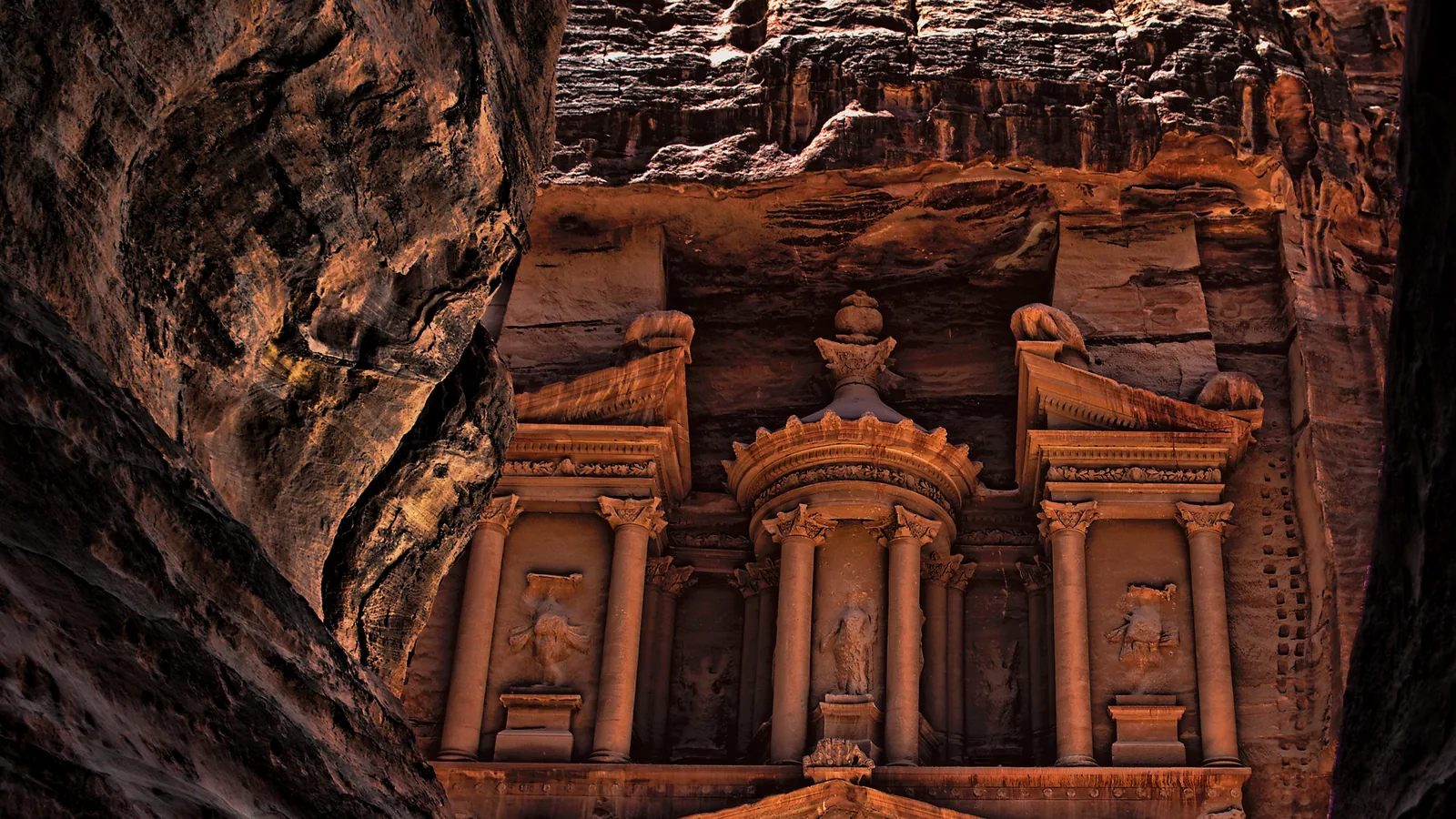
Where the Siq widens, Burckhardt reached a facade he measured in detail: a chamber “sixteen paces square, and about twenty-five feet high,” fronted by a colonnade of four columns about thirty-five feet high with Corinthian capitals, the whole front standing “sixty or sixty-five feet” from the base of the columns to the top of the ornaments. “The natives call this monument Kaszr Faraoun,” he wrote, “or Pharaoh’s castle,” adding his own judgment that it was “rather the sepulchre of a prince” than a residence. He did not linger to inspect the site as closely as he wished. A “close examination of these works of the infidels,” he wrote, “would have excited suspicions that I was a magician in search of treasures.” Farther down the Siq he found large tombs cut into the rock on both sides, in a truncated-pyramid form he compared to Palmyra’s tomb fronts, noting that the Palmyra examples were built of hewn stone rather than cut from the cliff. He also passed a theater “cut entirely out of the rock, with all its benches,” which he judged capable of holding about three thousand spectators, its floor filled with gravel carried down by winter torrents. Beyond it the ground was covered with hewn stones, building foundations, column fragments and the traces of paved streets, which he took as proof that a large city had once stood there.
"O Haroun, look upon us!"
The sun had already set when Burckhardt and his guide reached Szetouh Haroun, Aaron’s terrace, at the foot of the mountain that carries the tomb. Too tired and too late to climb further, Burckhardt killed the goat there in sight of the tomb. His guide, he wrote, “exclaimed aloud, ‘O Haroun, look upon us!’” and asked the dead prophet to accept the offering of “a lean goat” and to smooth their onward path. Even the campfire was a risk that night: the guide, Burckhardt wrote, was afraid the fire would be seen and would draw robbers to the camp. The next morning, August 23, Burckhardt did not climb to the tomb itself. He had been told it held nothing worth seeing beyond a large coffin, and his guide was pressing to leave at once with a small caravan bound for Maan. Burckhardt agreed, and the two turned back the way they had come.
Petra, before and after Burckhardt
Leake’s edition of Burckhardt’s travels went to press five years after the author’s death, published by John Murray for the Association for Promoting the Discovery of the Interior Parts of Africa. The valley Burckhardt described had a far longer history than his single day there could show. A paper published in Topoi’s 2004 supplement on the Persée platform traces the earliest surviving written notice of the Nabataeans to 312 BC, when Antigonus the One-Eyed sent an expedition against them that failed, an episode known through Diodorus Siculus. Diodorus described a people who built no permanent houses, farmed no land and drank no wine, a picture the Persée paper treats with caution as a possible literary stereotype. Strabo, writing under Augustus, described a far more settled Petra, and the Persée paper notes that material evidence for Nabataean settlement barely appears before the late second century BC, consistent with a long earlier period of nomadic life. By the reign of Aretas IV, from 9 BC to AD 40, the kingdom controlled a chain of settlements along the spice routes between southern Arabia and the Mediterranean, according to the Petra Development and Tourism Region Authority. In AD 106, the authority states, the Roman emperor Trajan incorporated the Nabataean kingdom into the Arabian Provincia. The same source records that an earthquake struck the city in AD 363, a blow that, together with shifting trade routes, contributed to its abandonment by the seventh century.

Key facts
- On August 22, 1812, Burckhardt told his guide he had vowed to sacrifice a goat to Haroun (Aaron) in order to pass through Wady Mousa (Gutenberg ebook #8884).
- He measured the facade known locally as Kaszr Faraoun at roughly sixty to sixty-five feet high, with a colonnade of four Corinthian columns (Gutenberg ebook #8884).
- He wrote that a close examination of the ruins would have raised suspicion that he was a magician hunting for treasure (Gutenberg ebook #8884).
- He recorded a rock-cut theater capable of holding about three thousand spectators (Gutenberg ebook #8884).
- At dusk on August 22, he killed the goat at Szetouh Haroun, Aaron’s terrace, and recorded his guide’s prayer (Gutenberg ebook #8884).
- On August 23 he did not climb to Haroun’s tomb and turned back with his guide toward Maan (Gutenberg ebook #8884).
- Burckhardt died in Cairo on October 15, 1817; his account was published in London in 1822 under W. M. Leake’s editorship (Linda Hall Library; Wellcome Collection).
- The Petra Development and Tourism Region Authority dates the Roman annexation of the Nabataean kingdom to AD 106 and an earthquake that damaged the city to AD 363.
FAQ
What did Burckhardt call the tomb facade at Petra?
He recorded that local people called it Kaszr Faraoun, or Pharaoh's castle, and judged from its design that it was a tomb rather than a residence, as his guides believed.
Why did Burckhardt pretend to have vowed a goat to Aaron?
He wanted to avoid the Egyptian garrison at Akaba without raising suspicion about his true route, so he told his guide he had sworn to sacrifice a goat at the tomb of Haroun, which lay at the far end of the valley.
When was Travels in Syria and the Holy Land published?
It appeared in London in 1822, edited by W. M. Leake and issued for the Association for Promoting the Discovery of the Interior Parts of Africa, five years after Burckhardt's death in 1817.
Sources
- Johann Ludwig Burckhardt (edited by W. M. Leake), "Travels in Syria and the Holy Land" (London: John Murray, 1822), Project Gutenberg ebook #8884.
- Wellcome Collection, bibliographic record for "Travels in Syria and the Holy Land / By the late John Lewis Burckhardt."
- Linda Hall Library, "Scientist of the Day: Johann Ludwig Burckhardt."
- Persée, "Les Nabatéens et leurs contacts avec la Mésopotamie et la région du golfe arabo-persique," Topoi, Supplement 6 (2004).
- Petra Development and Tourism Region Authority, "History of Petra."
- Petra Development and Tourism Region Authority, "The Nabataeans."
Cite this article
- APA
- Our Earth's History. (2026, September 27). A goat for Aaron's tomb: Burckhardt at Petra, August 22, 1812. Our Earth's History. https://ourearthshistory.com/west-asia/classical/petra-burckhardt-august-22-1812-sheikh-ibrahim-goat-for-aaron-travels-1822/
- Chicago
- Our Earth's History. “A goat for Aaron's tomb: Burckhardt at Petra, August 22, 1812.” Our Earth's History, September 27, 2026. https://ourearthshistory.com/west-asia/classical/petra-burckhardt-august-22-1812-sheikh-ibrahim-goat-for-aaron-travels-1822/.
- MLA
- “A goat for Aaron's tomb: Burckhardt at Petra, August 22, 1812.” Our Earth's History, 27 Sep. 2026, https://ourearthshistory.com/west-asia/classical/petra-burckhardt-august-22-1812-sheikh-ibrahim-goat-for-aaron-travels-1822/.
Text licensed CC BY-NC-ND 4.0. Found an error? Tell us.