A birthday invitation on a wooden leaf from Roman Vindolanda

TL;DR — Since 1973 the fort of Vindolanda has yielded Roman ink letters on thin wood, among them Claudia Severa’s birthday invitation, dated AD 97–105.
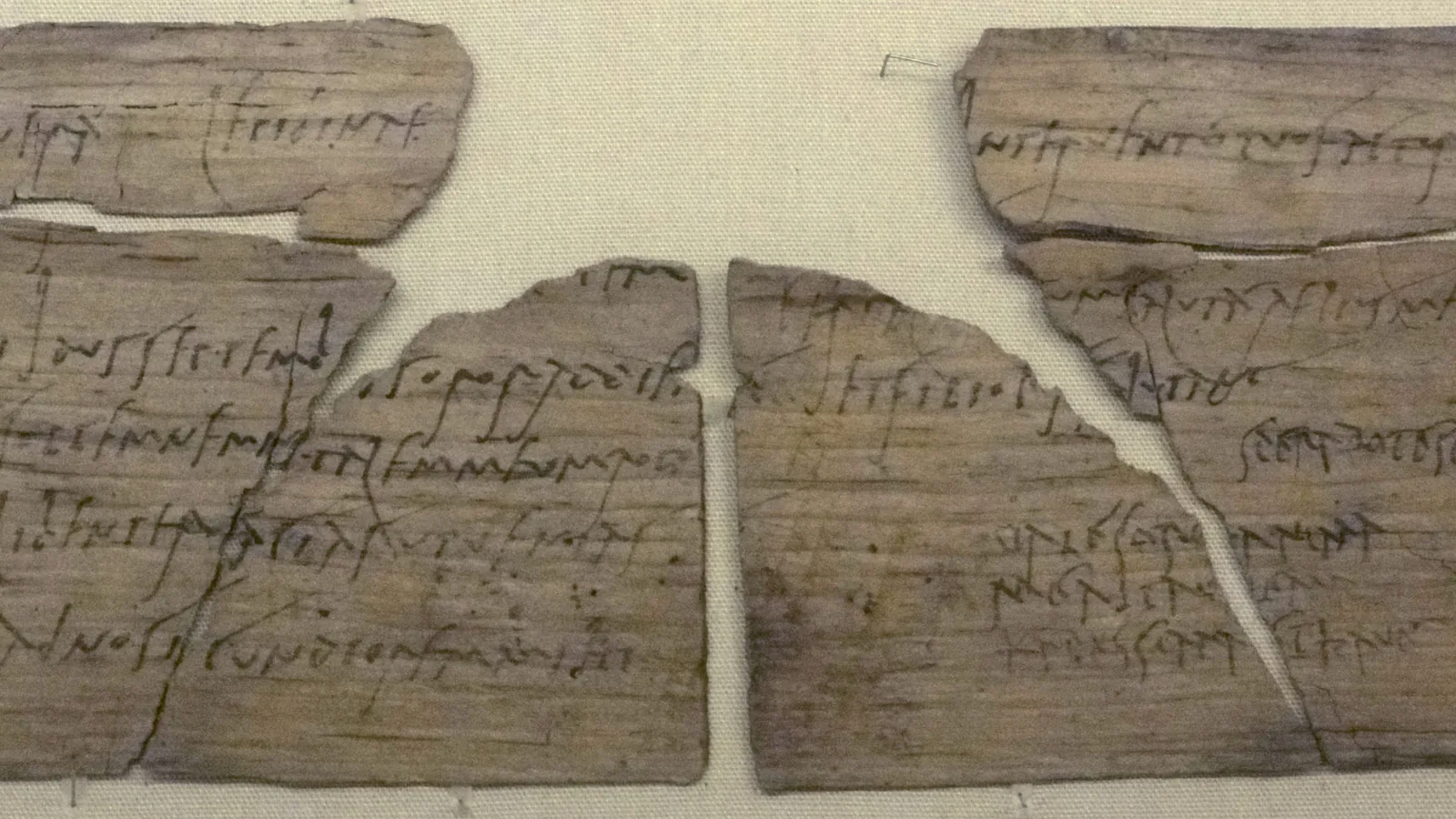
On March 23, 1973, an excavator at the Roman fort of Vindolanda in northern England passed Robin Birley a thin fragment of dark wood that seemed to carry writing. It was a leaf tablet, a sliver of wood written with ink and a split-nib pen, and the first of many. The best known is tablet 291, a birthday invitation from Claudia Severa to Sulpicia Lepidina that its Oxford editors date to AD 97–105. Tablet 164 carries Brittunculi, a belittling word for Britons that the same editors call new. The Roman Inscriptions of Britain website publishes “nearly 780 texts” from the site, while a British Museum team counted “around 1300” ink tablets in 2026.
Quick facts
- When
- March 23, 1973 (first ink tablet recognized) · 1985 (tablets 291 and 164 found) · AD 97–105 (the editors' date for tablet 291; tablet 164 carries a question mark) · fort first occupied soon after AD 80 (J. David Thomas, 1976) or around AD 85 (British Museum paper, 2026) and temporarily abandoned in the 120s (Thomas)
- Where
- The Roman fort of Vindolanda (Chesterholm) on the Stanegate in northern England, 3.2 km south of the fort at Housesteads on Hadrian's Wall; the tablets are now in the British Museum, London, with some shown at the Vindolanda Museum
- Who
- Robin and Patricia Birley; Alison Rutherford of Newcastle University School of Medicine; J. David Thomas and A. K. Bowman; Claudia Severa, wife of Aelius Brocchus; Sulpicia Lepidina, wife of Cerialis
- Outcome
- The Roman Inscriptions of Britain website publishes nearly 780 Vindolanda texts; a British Museum paper of 2026 counts around 1,300 ink tablets and at least 340 stylus tablets from the site
March 1973, a layer of bracken under the fort
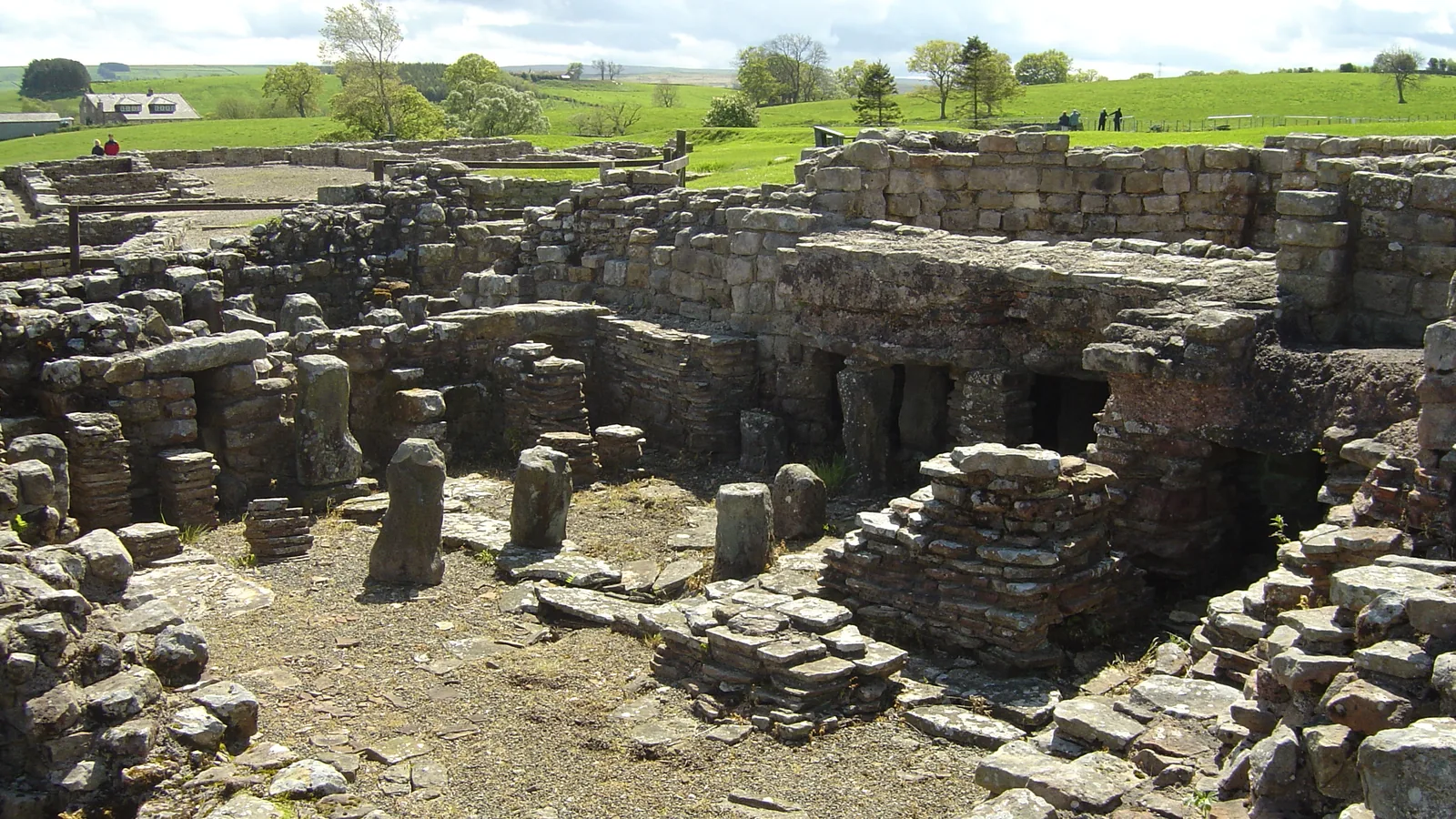
Vindolanda, also called Chesterholm, stands on the Stanegate, 3.2 km south of the fort at Housesteads on Hadrian’s Wall. J. David Thomas wrote in 1976 that “a fort was first there soon after A.D. 80, only to be temporarily abandoned in the 120s when the troops moved forward to the Wall.” The British Museum paper of 2026 puts the first occupation “around AD 85.”
Birley, the director of excavations, had cut a trench into a compacted layer less than eighteen inches thick, made mostly of bracken. Thomas described it as four successive levels, “all of pre-Hadrianic date,” with most tablets in the second. Leather goods, textiles and animal bones lay with them.
Patricia Birley, who worked beside him, recalled in 2023 that the first fragment looked almost black by the time they carried it to Richard Wright at Durham University the next day. Wright sent them to Alison Rutherford, an infrared photographer at Newcastle University School of Medicine. A few days later her photograph showed the ink of what the Vindolanda Trust calls “the now famous socks and underpants letter.” The British Museum conserved the first few tablets.
Thomas’s paper in the journal Scriptorium described the find as evidence “likely to prove of great interest and importance for the history of Latin writing in the first and second centuries A.D.” He thanked A. K. Bowman and pointed readers to the booklet the two had published in 1974.
Claudia Severa's invitation for September 11
Tablet 291 was found in 1985. It is a diptych in two halves, 223 mm wide and 96 mm high, and it belongs to site period 3; the editors date it to AD 97–105 from that context. The British Museum holds it as 1986,1001.64.
The letter came from Claudia Severa, wife of Aelius Brocchus, to Sulpicia Lepidina, wife of Cerialis. The Roman Inscriptions of Britain translation begins: “Claudia Severa to her Lepidina greetings. On 11 September, sister, for the day of the celebration of my birthday, I give you a warm invitation to make sure that you come to us, to make the day more enjoyable for me by your arrival, if you are present (?).” The letter then passes on greetings to Cerialis from Severa, her husband and her small son.
A second hand added four lines, among them “Farewell, sister, my dearest soul,” built on the Latin words anima mea and karissima. The back is addressed “To Sulpicia Lepidina, wife of Cerialis, from Severa.”
That second hand matters to the editors. “It is quite certain that the author is Severa herself, adding a brief message and the closing greeting in her own hand as she also does in 292 and 293,” they wrote, and so “almost certainly” these are “the earliest known examples of writing in Latin by a woman.” They also read the name Claudia as a sign that Severa’s family gained Roman citizenship under the emperor Claudius, a generation before Cerialis and his wife.
"Brittunculi" in a note about cavalry
Tablet 164, also found in 1985, measures 78 mm by 186 mm, with six lines written across the grain on one face. The first edition placed its context around AD 92; the editors later moved it to period 3 and now date it “a.d. 97-105?” with a question mark.
Its translation reads: “… the Britons are unprotected by armour (?). There are very many cavalry. The cavalry do not use swords nor do the wretched Britons mount in order to throw javelins.” Line 1 calls the Britons Brittones. Line 5 calls them Brittunculi, which the editors describe as “the patronising diminutive,” formed like homunculus. They add that the tablet “remains the only published text from Vindolanda which refers explicitly to the native Britons collectively or individually.”
No heading survives to say what the document was. The editors’ “best guess” is a military memorandum on the fighting habits of the native Britons, perhaps a report from scouts (exploratores) to the commanding officer. They find “more attractive” the idea of a note left by a departing commander for his successor.
Two counts, from Oxford and the British Museum
The Oxford editions come from the Centre for the Study of Ancient Documents, founded in 1995 in the Faculty of Classics. With the university’s Academic Computing Development Team and support from the Andrew W. Mellon Foundation, it built Vindolanda Tablets Online, which carried the first two volumes of the edition. That site’s home page now states that it “has been superseded” by the Roman Inscriptions of Britain website, where tablets are cited by number, as in Tab. Vindol. II 291.
That website describes “nearly 780 texts written on thin sheets of wood” from “the late 1st and early 2nd centuries.” Its figure counts texts that have been edited and published. The centre’s current British Academy project, Romano-British Writing Tablets 2023-2028, sets out to interpret “many hundreds of written documents” found in the province since the 1970s.
The British Museum paper counts objects. Giovanna Vasco, Joanne Dyer, Richard Hobbs, Caroline R. Cartwright and Alessandro Buccolieri list among the site’s organic finds “at least 340 stylus tablets and around 1300 postcard‐sized ink‐written tablets,” adding that “[t]hese numbers are increasing.” Stylus tablets were wax-coated boards scratched with a pen of metal or bone; the ink tablets are the leaves. The paper, published in the Journal of Analytical Methods in Chemistry in February 2026, identified charcoal as the most abundant source of black ink in the tablets it tested.

Key facts
- The first Vindolanda ink tablet was recognized on March 23, 1973, in a trench dug by Robin Birley; Alison Rutherford’s infrared photograph revealed its script a few days later (Vindolanda Trust).
- J. David Thomas reported the find in Scriptorium in 1976 and dated the first fort to soon after AD 80, abandoned for a time in the 120s.
- Tablet 291, found in 1985 and dated AD 97–105, is Claudia Severa’s invitation to Sulpicia Lepidina for her birthday on September 11 (Roman Inscriptions of Britain).
- The editors judge the closing lines of tablet 291 to be in Severa’s own hand and “almost certainly” the earliest known Latin writing by a woman.
- Tablet 164, dated “a.d. 97-105?”, contains the word Brittunculi; its editors call it the only published Vindolanda text that refers explicitly to the native Britons.
- Roman Inscriptions of Britain publishes “nearly 780 texts”; a British Museum paper of 2026 counts “around 1300” ink tablets and at least 340 stylus tablets from the site.
FAQ
What is written on the Vindolanda birthday invitation?
Claudia Severa invited Sulpicia Lepidina to her birthday on September 11 and sent greetings to Lepidina's husband Cerialis from her own husband Aelius and her son. In a second hand, which the editors identify as Severa's own, she added a farewell to her "dearest soul."
Where are the Vindolanda tablets now?
Tablets 291 and 164 are in the British Museum, under the numbers 1986,1001.64 and 1986,1001.34. The Vindolanda Trust shows some later finds at the Vindolanda Museum, and the edited texts are online at the Roman Inscriptions of Britain website.
How many Vindolanda tablets are there?
The Roman Inscriptions of Britain website publishes nearly 780 edited texts. The British Museum paper of 2026 counts around 1,300 ink tablets and at least 340 stylus tablets recovered from the site, a total its authors say is still rising.
Sources
- Patricia Birley, "Finding the first Vindolanda Writing Tablet: A personal recollection," The Vindolanda Trust blog, March 10, 2023.
- J. David Thomas, "New light on early Latin writing: the Vindolanda tablets," Scriptorium 30-1 (1976), pp. 38-43 (Persée).
- Roman Inscriptions of Britain (Centre for the Study of Ancient Documents, University of Oxford), "Tab.Vindol. 291. Birthday Invitation of Sulpicia Lepidina": edition, translation, commentary and object record.
- Roman Inscriptions of Britain, "Tab.Vindol. 164. Ink writing tablet": edition, translation, commentary and object record.
- Roman Inscriptions of Britain, home page: the Vindolanda Tablets collection, "nearly 780 texts."
- Giovanna Vasco, Joanne Dyer, Richard Hobbs, Caroline R. Cartwright and Alessandro Buccolieri, "The Making of the Vindolanda Wooden Writing Tablets: A Noninvasive Multianalytical Protocol for the Characterisation of Black Roman Inks," Journal of Analytical Methods in Chemistry (2026), British Museum Department of Scientific Research (PMC12884006).
- Centre for the Study of Ancient Documents, Faculty of Classics, University of Oxford, home page and project list.
- The Vindolanda Trust, "Top Treasures" listing: four writing tablets found in the summer of 2017, to be shown in the Vindolanda Museum from spring 2020.
- Vindolanda Tablets Online, home page (Centre for the Study of Ancient Documents, Oxford), Internet Archive capture of September 19, 2026.
Cite this article
- APA
- LETTER. (2026, September 29). A birthday invitation on a wooden leaf from Roman Vindolanda. Our Earth's History. https://ourearthshistory.com/europe/classical/vindolanda-tablets-birthday-invitation-wooden-leaf/
- Chicago
- LETTER. “A birthday invitation on a wooden leaf from Roman Vindolanda.” Our Earth's History, September 29, 2026. https://ourearthshistory.com/europe/classical/vindolanda-tablets-birthday-invitation-wooden-leaf/.
- MLA
- LETTER. “A birthday invitation on a wooden leaf from Roman Vindolanda.” Our Earth's History, 29 Sep. 2026, https://ourearthshistory.com/europe/classical/vindolanda-tablets-birthday-invitation-wooden-leaf/.
Text licensed CC BY-NC-ND 4.0. Found an error? Tell us.