Bronze gears from a wreck off Antikythera modeled the Greek sky
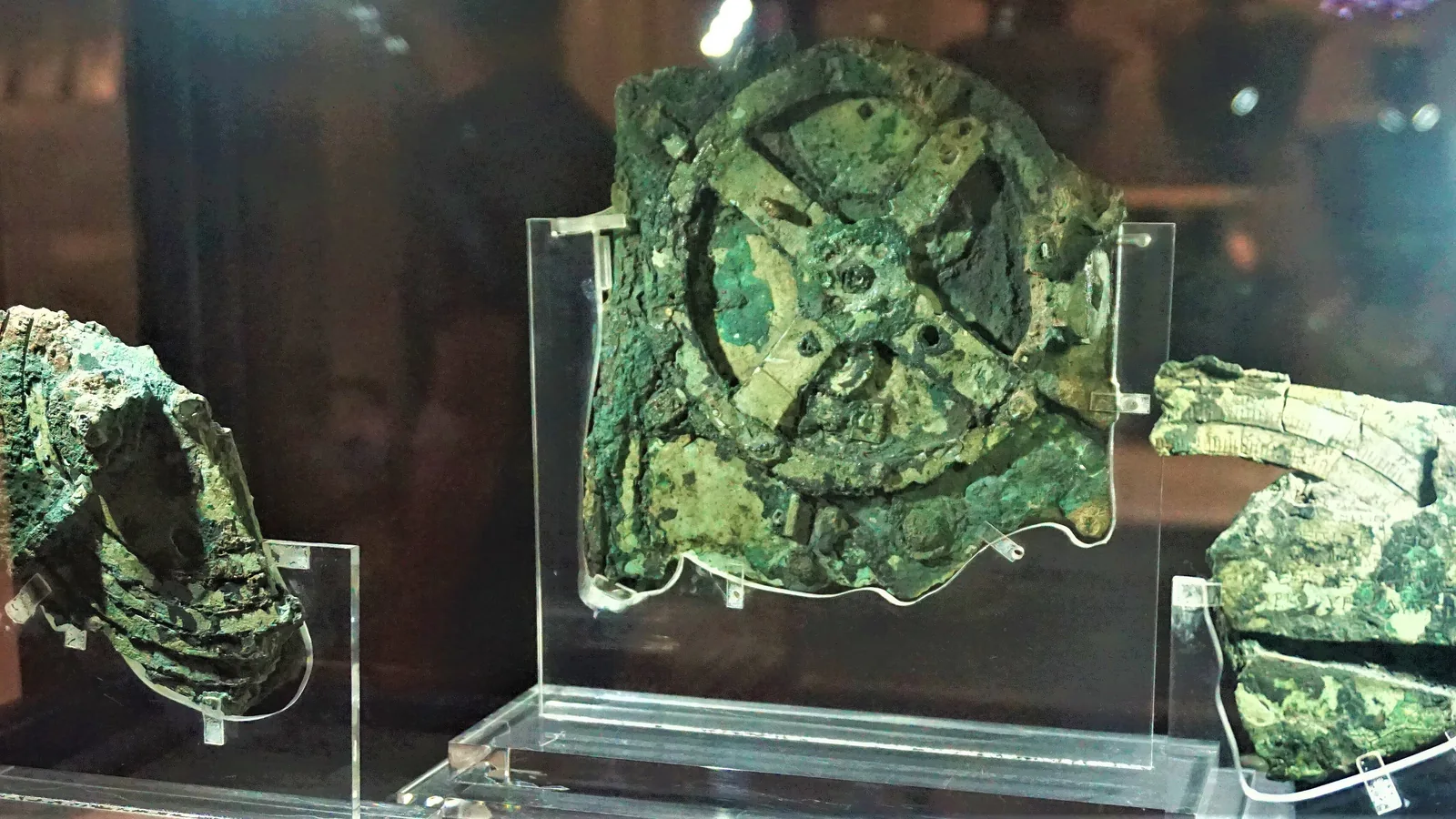

TL;DR — Eighty-two corroded fragments from a wreck off Antikythera hold 30 bronze gears; X-ray studies from 2005 to 2021 read them as a Greek calculator of eclipses and planets.
A corroded lump raised from a shipwreck off the Greek island of Antikythera showed part of a gear wheel to the archaeologist Valerios Stais on May 17, 1902. The Linda Hall Library calls this “the first recognition that the object was some kind of mechanism.” Eighty-two fragments survive in the National Archaeological Museum in Athens. An Anglo-Greek team scanned them in 2005, and papers in Nature in 2006 and 2008 and in Scientific Reports in 2021 read the gearing as a machine for eclipses, calendar cycles, the Olympic games and the five planets known in antiquity.
Quick facts
- When
- 1900 (wreck found) · 1901 (objects recovered) · May 17, 1902 (gear wheel noticed) · 1951 (Price begins his study) · autumn 2005 (surface imaging and X-ray CT) · 2006 and 2008 (Nature papers) · March 12, 2021 (Scientific Reports model of the front display)
- Where
- A Roman-era wreck off the islet of Antikythera, between Crete and the Greek mainland; the National Archaeological Museum in Athens
- Who
- Valerios Stais; Derek de Solla Price; the Antikythera Mechanism Research Project, including Tony Freeth and Mike Edmunds; X-Tek Systems and Hewlett-Packard
- Outcome
- The 82 surviving fragments, with 30 gears, were read as a geared calculator of eclipses, calendar cycles, the four-year Olympiad and the motions of the Sun, Moon and five planets; its date of construction is still given differently by different studies
Sponge divers, 1900–1901: the wreck and its date
Sponge divers found the wreck in 1900, and artifacts came up in 1901, according to the Antikythera Mechanism Research Project (AMRP), which calls the recovery the first underwater archaeology ever undertaken. The National Archaeological Museum adds that the divers worked with the assistance of the Greek Royal Navy. The islet lies south of the Peloponnese, between Crete and the Greek mainland. The project describes the vessel as a Roman merchant ship of some 300 tons, sunk on a trade route from the eastern to the western Mediterranean.
The two institutions date the sinking differently. The museum places the wreck at about 60–50 BC, with cargo ranging from the 4th to the 1st century BC. The AMRP starts from coins: coins from Pergamon of about 86–67 BC, raised by Jacques Cousteau’s team, and Ephesian coins of 70–60 BC. It concludes that “A reasonable date for the wreck is thus 85–60 BC,” and adds that part of the hull timber dates to 200 BC, plus or minus 43 years.
The lump Stais examined was, in the library’s words, a “cook-book-sized rocky slab” brought up the previous summer. At some point before or after May 17 it broke into three large fragments and scores of smaller ones. The largest, now called Fragment A, carries a four-spoked gear wheel.
Derek de Solla Price and a "calendar computer"
For half a century the object was generally assumed to be much later than the wreck, a product of the second millennium AD, when mechanical clocks appeared. In 1951 Derek de Solla Price, later a professor at Yale, took a closer look and concluded that it was an astronomical computer or planetarium, and that it was ancient. He wrote an article for Scientific American in 1959 and built a replica. His monograph of 1974, Gears from the Greeks, carried the subtitle “A calendar computer from ca. 80 BC.”
Price’s account of the recovery has since been corrected. He wrote that six divers worked without air tanks or tubes, about nine minutes under water at a time. The AMRP answers that by the late 1870s Greek sponge divers had fully adopted the diving suit, and that the Antikythera divers almost certainly used “closed, flexible diving suits, with copper diving helmets and surface supplied air.” On the front of the machine, where planets would have been shown, Price proposed lost gearing but “made no attempt at a reconstruction,” according to the 2021 study.
October 2005: an eight-tonne scanner in the museum
The AMRP was formed under the aegis of the Hellenic Ministry of Culture, with an initial grant from the Leverhulme Trust in Britain. Its core group in 2005 included the astronomer Mike Edmunds and the mathematician and filmmaker Tony Freeth of Cardiff University, with colleagues from the universities of Thessaloniki and Athens. In September 2005 three Hewlett-Packard scientists brought a dome imaging system to Athens to record the surface inscriptions. In October a team from X-Tek Systems arrived with the prototype of an eight-tonne X-ray machine called the Bladerunner, built to find minute cracks in turbine blades. A later study in PLoS ONE (2018) gives its source as an experimental 450 kV microfocus unit and the imaging time as two weeks.
The first results appeared in Nature in 2006. The paper’s abstract describes a device “constructed around the end of the second century bc” and “technically more complex than any known device for at least a millennium afterwards.” The team doubled the number of deciphered inscriptions and reported that the mechanism “predicted lunar and solar eclipses on the basis of Babylonian arithmetic-progression cycles.” It also found in the gearing a mechanical form of a theory by Hipparchos, a 2nd-century BC astronomer, of the irregular motion of the Moon.
"Corinthian origin": the calendar, the games and the date
A second Nature paper, in 2008, turned to the back of the machine. Its abstract describes the upper back dial as a 19-year calendar based on the Metonic cycle, laid out as a spiral of five turns, and the lower back dial as a Saros eclipse dial, a spiral of four turns covering 223 lunar months. The team identified all 12 month names on the calendar, “unexpectedly of Corinthian origin,” and named the Corinthian colonies of northwestern Greece or Syracuse in Sicily as leading contenders for its home, the latter “suggesting a heritage going back to Archimedes.” A small subsidiary dial, earlier read as a 76-year cycle, “follows the four-year cycle of the Olympiad and its associated Panhellenic Games.”
The date of the device depends on which question is asked. The 2006 abstract and the AMRP overview place its construction around the end of the 2nd century BC, and the project’s FAQ gives 150 to 100 BC. In PLoS ONE in 2014, Freeth modeled the eclipse glyphs on the Saros dial and found one matching starting date, a full moon written in astronomers’ notation as -204 May 12, consistent with 205 BC. The abstract calls this “a surprisingly early epoch.” The same paper warns that “it should not necessarily be inferred that the date of the Antikythera Mechanism is the same as the date for which the Saros Dial was designed,” and that the machine could have been made later.
The AMRP writes that there is “no hard evidence identifying a particular maker,” and calls it “very tempting” to name Hipparchos, active as an astronomer from at least 147 to 127 BC, as the maker.
In Athens: 82 fragments and a model of the Cosmos
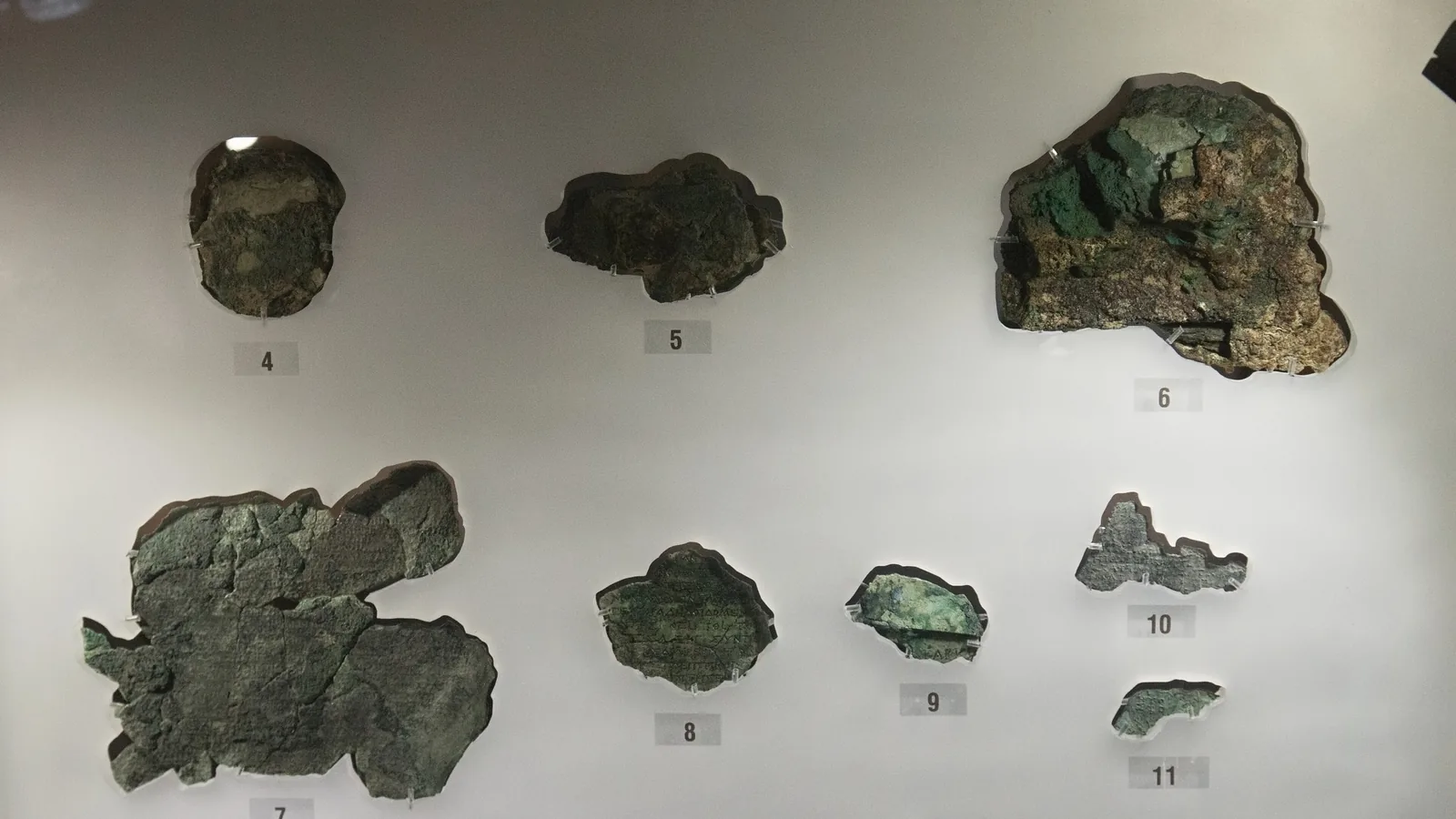
The fragments are conserved in the National Archaeological Museum under accession number X 15087. The AMRP counts 30 surviving gears, 27 of them in Fragment A and one each in Fragments B, C and D, and states that a further five are required for its known functions. Objects from the 1900–1901 recovery and from a second underwater survey in 1976 by the Greek Archaeological Service and Cousteau’s ship Calypso were shown together in a museum exhibition from April 2012 to June 2014.
The front display resisted every model. Research notes by A. Rehm in 1905–06 described a ring display for the planets, “mechanically completely wrong due to his lack of data,” in the words of the 2021 paper. M. T. Wright built the first workable front system, with pointers on a common axis. Later models by Freeth and Alexander Jones, and by C. Carman, A. Thorndike and J. Evans, kept to basic planetary periods. None fitted all the data.
The 2021 study, by Freeth and five colleagues at University College London, started from inscriptions the scans had revealed. The abstract states that only a third of the original survives, and that the inscriptions describe the motions of the Sun, Moon and all five planets known in antiquity and how they were displayed on the front “as an ancient Greek Cosmos.” A cover inscription on the planets gives the numbers 462 in its Venus section and 442 in its Saturn section. The authors built a new gear model to fit these inscribed periods, combining cycles from Babylonian astronomy with mathematics from Plato’s Academy, and published it in Scientific Reports on March 12, 2021.

Key facts
- Sponge divers found the Antikythera wreck in 1900, and objects were recovered in 1901 with help from the Greek Royal Navy (AMRP; National Archaeological Museum).
- The museum dates the wreck to about 60–50 BC; the AMRP gives 85–60 BC from coins of Pergamon and Ephesus.
- Valerios Stais noticed a gear wheel in one of the corroded lumps on May 17, 1902 (Linda Hall Library).
- Derek de Solla Price began studying the mechanism in 1951; his 1974 monograph Gears from the Greeks dated it to “ca. 80 BC.”
- In autumn 2005 the AMRP imaged all 82 fragments with Hewlett-Packard surface imaging and an X-Tek microfocus X-ray CT scanner.
- The 2006 Nature abstract dates construction to around the end of the 2nd century BC; a 2014 PLoS ONE model of the Saros dial points to 205 BC for that dial’s design, which the paper says need not be the date the machine was made.
- The 2008 Nature abstract identified Corinthian month names and an Olympiad dial; the 2021 Scientific Reports paper, published March 12, 2021, proposed a model of the front display of the Sun, Moon and five planets.
FAQ
Where is the Antikythera Mechanism today?
All 82 known fragments are in the National Archaeological Museum in Athens, which holds the mechanism under accession number X 15087.
How old is the Antikythera Mechanism?
The 2006 Nature paper and the AMRP place its construction around the end of the 2nd century BC, and the AMRP FAQ gives 150 to 100 BC. A 2014 PLoS ONE study dated the design of its eclipse dial to 205 BC and stated that the machine itself may have been made later.
Who found the Antikythera Mechanism?
Sponge divers found the wreck in 1900 and brought up its contents in 1901. The archaeologist Valerios Stais first noticed a gear wheel in one of the lumps on May 17, 1902.
Sources
- Linda Hall Library, "Scientist of the Day: The Antikythera Mechanism" (May 17, 2024).
- National Archaeological Museum, Athens, temporary exhibition "The Antikythera Shipwreck: The ship, the treasures, the Mechanism" (April 6, 2012 to June 29, 2014).
- Antikythera Mechanism Research Project, FAQ: "How was it found?", "How was it recovered?", "When was the ship wrecked?", "Who made it?" and "How many gears does it have?"
- Antikythera Mechanism Research Project, "Project Overview."
- Freeth, T. et al., "Decoding the ancient Greek astronomical calculator known as the Antikythera Mechanism," Nature 444, 587–591 (2006), abstract.
- Freeth, T. et al., "Calendars with Olympiad display and eclipse prediction on the Antikythera Mechanism," Nature 454, 614–617 (2008), abstract.
- Freeth, T., "Eclipse Prediction on the Ancient Greek Astronomical Calculating Machine Known as the Antikythera Mechanism," PLoS ONE 9(7): e103275 (2014).
- Pakzad, A. et al., "Improved X-ray computed tomography reconstruction of the largest fragment of the Antikythera Mechanism," PLoS ONE 13(11): e0207430 (2018).
- Freeth, T., Higgon, D., Dacanalis, A., MacDonald, L., Georgakopoulou, M. and Wojcik, A., "A Model of the Cosmos in the ancient Greek Antikythera Mechanism," Scientific Reports 11, 5821 (2021).
Cite this article
- APA
- LETTER. (2026, September 29). Bronze gears from a wreck off Antikythera modeled the Greek sky. Our Earth's History. https://ourearthshistory.com/europe/classical/antikythera-mechanism-bronze-gears-shipwreck/
- Chicago
- LETTER. “Bronze gears from a wreck off Antikythera modeled the Greek sky.” Our Earth's History, September 29, 2026. https://ourearthshistory.com/europe/classical/antikythera-mechanism-bronze-gears-shipwreck/.
- MLA
- LETTER. “Bronze gears from a wreck off Antikythera modeled the Greek sky.” Our Earth's History, 29 Sep. 2026, https://ourearthshistory.com/europe/classical/antikythera-mechanism-bronze-gears-shipwreck/.
Text licensed CC BY-NC-ND 4.0. Found an error? Tell us.