Two walled-up rooms at Begram, 1937 and 1939: glass, ivory and lacquer

TL;DR — Two walled-up rooms at Begram, opened in 1937 and 1939, held Roman glass, Indian ivory and Han lacquer; 20 ivories stolen from Kabul returned there in 2012.
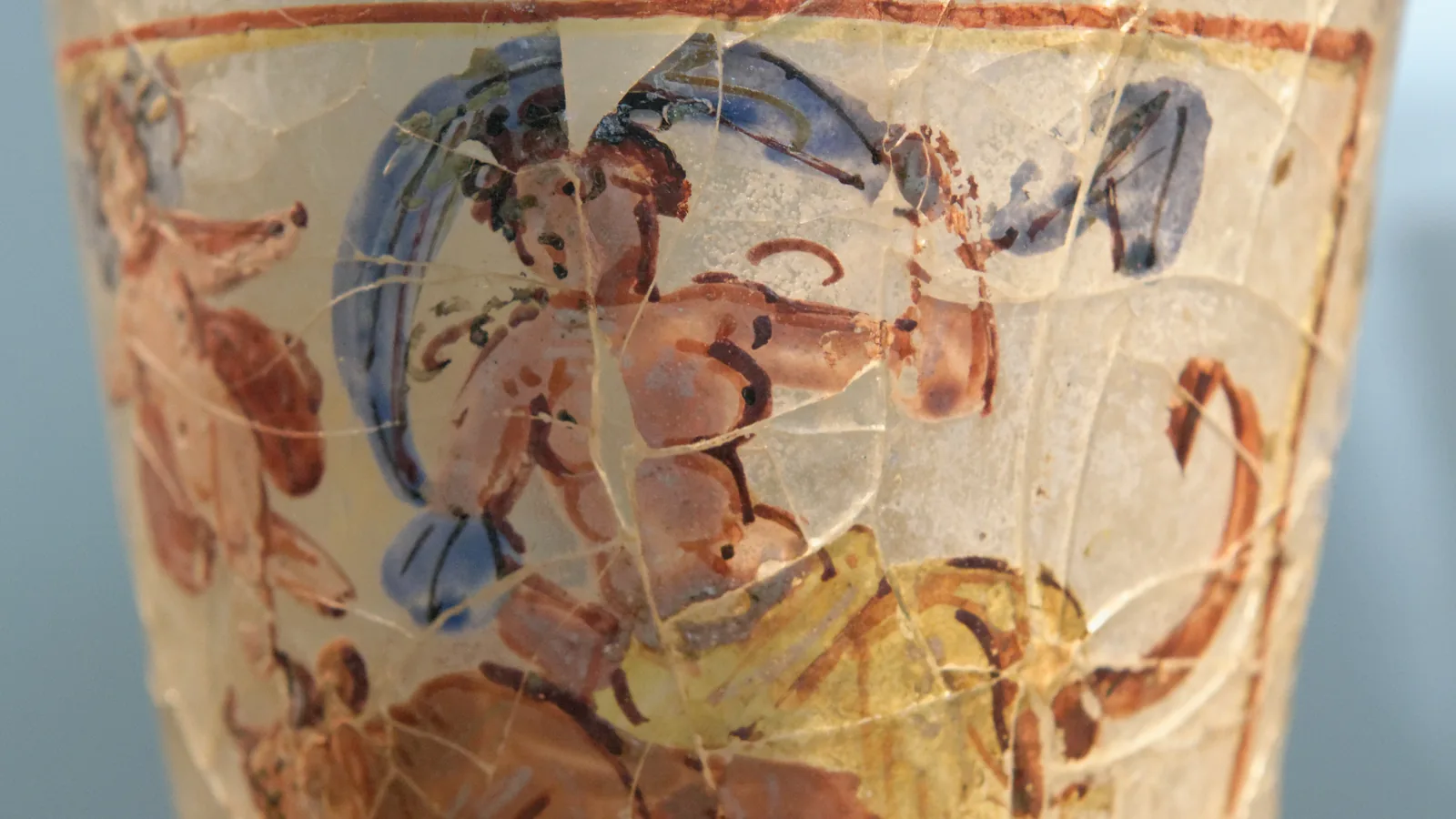
“BEGRĀM, the site of ancient Kāpiśī, is located 80.5 km north of Kabul overlooking the Panjšīr valley at the confluence of the Panjšīr and Ḡorband rivers.” So Martha L. Carter began her Encyclopaedia Iranica entry in 1989. The Musée Guimet in Paris tells what happened there in one sentence: “En 1937, puis en 1939, Ria Hackin tomba sur deux ‘caches’, dont la finalité reste discutée,” that is, in 1937 and again in 1939 Ria Hackin came upon two “caches” whose purpose is still argued over. She was working on the dig that her husband Joseph Hackin directed for the Délégation archéologique française en Afghanistan (DAFA). The rooms held Roman glass, Indian ivory, Han lacquer and plaster casts, later divided between the Guimet and the museum in Kabul. Twenty of the Kabul ivories, stolen after 1989, came back in 2012.
Quick facts
- When
- 1922 (Franco-Afghan accord) · 1936–1940 (Joseph Hackin's excavation) · 1937 and 1939 (the two walled-up rooms) · 1941–1942 (Roman Ghirshman's seasons) · 1989 (Kabul Museum closed) · 1993 (looting begins) · February 26, 2001 (Taliban decree) · 2011 (British Museum exhibition) · 2012 (20 ivories returned to Kabul)
- Where
- Begram, the site of ancient Kāpiśī, 80.5 km north of Kabul at the meeting of the Panjšīr and Ḡorband rivers; the Musée Guimet in Paris; the National Museum of Afghanistan in Kabul
- Who
- Joseph Hackin and Ria Hackin of the Délégation archéologique française en Afghanistan (DAFA); Paul Pelliot; Victor Goloubew; Marcel Aubert; Roman Ghirshman; Benjamin Rowland; David Whitehouse; Osmund Bopearachchi; Liangren Zhang; John Simpson
- Outcome
- About 180 glass vessels, Indian ivory furniture plaques, Han lacquer, nearly 50 plaster emblemata, bronzes and stone vessels were divided equally between the Guimet and Kabul. The Kabul share was packed away in 1989 and looted from 1993; 20 ivories were recovered, shown in London in 2011 and returned to Kabul in 2012. The purpose of the rooms is still argued over
Joseph Hackin's dig and the summer capital of Kanishka
“The official beginning of archaeology in Afghanistan dates from 1922, when the French government in Kabul signed an accord for cultural cooperation with King Amān-Allāh giving them exclusive rights to survey and excavate in Afghanistan for a period of 30 years.” So wrote Carla Grissmann in the Iranica entry on the Kabul Museum. In the same year Alfred Foucher identified the mounds at Begram with Kāpiśī, which the Chinese pilgrim Xuanzang, in Samuel Beal’s 1884 translation, called the summer capital of the Kushan king Kanishka.
“The site was first excavated by J. Hackin between 1936 and 1940,” Carter wrote. The work fell into two areas, the “new royal city,” the main mound where the treasure lay, and the “old royal city.” In the new city the team found the objects, in Carter’s words, “walled in chambers of a large edifice of the Kushan period, possibly a palace or bāzār.”
Glass, ivory, lacquer and plaster
David Whitehouse of the Corning Museum of Glass summed up the glass in the journal Topoi in 2001: “The Begram ‘treasure’ included some 180 glass vessels (many are represented by fragments and the exact number may never be known).” He sorted them into 13 groups.
The ivories came from India. Carter described “a large and equally extraordinary group of Indian carved ivory plaques and ornaments made for articles of furniture,” “bearing a strong similarity to the sculptural styles of Kushan Mathurā and Amarāvatī under the Āndhras of the Deccan.” Sandrine Gill wrote in Topoi that beyond two jātaka scenes identified by Foucher, their religious meaning was unsettled.
The lacquer came from China. Liangren Zhang, in the International Journal of Asian Studies in 2011, wrote that his article “offers a new chronology of the period from 74 BC to AD 23” for their manufacture. There was also, in Carter’s list, “a group of nearly 50 plaster casts of emblemata with reliefs, perhaps originally intended as designs for silversmiths, also of probable Alexandrian origin,” with bronzes and vessels of porphyry and alabaster. Osmund Bopearachchi catalogued 121 coins from the 1936 and 1937 seasons in 1987.
"Des laques Han du début de notre ère": the news reaches Paris
Paul Pelliot reported the 1939 season to the Académie des Inscriptions et Belles-Lettres, whose Comptes rendus printed his account. The Hackins had found “des ivoires hindous et des verreries syriennes, mais aussi des laques Han du début de notre ère, les premiers exhumés en Afghanistan, qui malheureusement se désagrègent au contact de l’air,” Indian ivories and Syrian glass as in earlier seasons, and Han lacquers from the beginning of the Christian era, the first dug up in Afghanistan, which fell apart on contact with the air.
Victor Goloubew, reviewing the 1937 report in the Bulletin de l’École française d’Extrême-Orient in 1940, credited the finder by name: the objects “ont été trouvés par Mme J. R. Hackin dans le site de l’ancienne Kapisï (Begram),” found by Mme J. R. Hackin at ancient Kapisi. A year later Marcel Aubert reviewed the same report in the Bulletin Monumental and named the directors as “M. et Mme Hackin, dont nous déplorons la fin prématurée,” whose early end we mourn. By 1941 both were dead. When Roman Ghirshman reported his 1942 season to the Académie in 1945, the site was “déjà exploré par le regretté Joseph Hackin,” already explored by the late Joseph Hackin.
AD 241, or objects already a century old
Ghirshman, who dug in 1941 and 1942, argued in his 1946 volume Bégram that the city was laid waste by the Sasanian king Shapur I in AD 241. Carter reports the argument and adds “although this is by no means certain.” Benjamin Rowland, in Ancient Art from Afghanistan in 1966, dated the hoard to the first and second centuries AD and doubted the Sasanian date, since, in Carter’s summary, “all the objects in the hoard would have been almost a century old by that date, with no more recent additions”; he proposed instead the unrest after the death of Kanishka I.
One outside date does exist. An Indian ivory mirror handle from Pompeii, reported by A. Maiuri in 1946, lay under the ash of AD 79, and the Guimet’s collection entry calls it “certainement des mêmes ateliers que les ivoires découverts en Afghanistan,” surely from the same workshops. The ivory, then, was carved before AD 79 and the lacquer, on Zhang’s chronology, before AD 23. Whether the rooms held a king’s treasure or a trader’s stock is the question the Guimet leaves open with the words “dont la finalité reste discutée.”
Half to Paris, half to Kabul, and the road back in 2012
Under the 1922 accord, the Guimet states, the treasure was “partagé à part égale entre le musée Guimet et le musée national d’Afghanistan à Kaboul,” shared equally, with Kabul keeping the unique works, such as the large ivories of river deities carved in the round.
In the autumn of 1989, Grissmann recorded, President Najibullah’s government “closed the Museum and ordered all objects from the exhibition rooms to be packed and taken for safekeeping to two locations in Kabul City.” “Looting began in 1993,” she wrote, and “The world-famous collection of 35,000 coins had vanished.” On February 26, 2001, “Mullah ʿOmar reversed his earlier decree, and the world watched in impotent shock as the Taleban dynamited the Bāmīān Buddhas, destroyed major pieces in the Kabul Museum, and vandalized the ministry and museum storerooms.” DAFA reopened its Kabul offices in 2002.
John Simpson of the British Museum told the end of the story in the International Journal of Cultural Property in 2016. In Kabul, he wrote, “most of the Begram ivories were stolen and entered different collections.” His article “discusses how a group of 20 of these exquisite carvings were acquired, conserved, exhibited, and returned to Kabul as a direct result of the negotiations for the British Museum exhibition” of 2011. Its abstract ends: “The objects were returned safely to Kabul in 2012.”
Key facts
- Begram, ancient Kāpiśī, lies 80.5 km north of Kabul where the Panjšīr and Ḡorband rivers meet; Alfred Foucher made the identification in 1922 (Encyclopaedia Iranica, Carter).
- A Franco-Afghan accord signed in Kabul on September 9, 1922, gave France exclusive rights to survey and excavate for 30 years and provided for a division of finds (Iranica, Grissmann; Bopearachchi, Topoi 2001).
- Joseph Hackin excavated the site between 1936 and 1940; Ria Hackin came upon the two “caches” in 1937 and 1939 (Iranica; Musée Guimet).
- The glass amounted to “some 180 glass vessels,” many of them fragments, sorted into 13 groups (Whitehouse, Topoi 2001).
- Liangren Zhang dated the making of the Han lacquer to the period from 74 BC to AD 23 (International Journal of Asian Studies, 2011).
- Nearly 50 plaster emblemata, “perhaps originally intended as designs for silversmiths,” came from the same rooms; 121 coins from the 1936 and 1937 seasons were catalogued in 1987 (Iranica; Bopearachchi).
- Ghirshman dated the destruction to Shapur I’s invasion of AD 241; Rowland objected in 1966 that the objects would already have been “almost a century old” (Iranica).
- The Kabul Museum was closed and packed in the autumn of 1989, looted from 1993, and its storerooms were vandalized after the decree of February 26, 2001; 20 Begram ivories were returned to Kabul in 2012 (Iranica, Grissmann; Simpson, 2016).
FAQ
Who found the Begram treasure?
The Musée Guimet states that Ria Hackin came upon the two "caches" in 1937 and 1939, during the excavation that her husband Joseph Hackin directed for the French archaeological mission in Afghanistan (DAFA). Victor Goloubew's 1940 review of the excavation report also names Mme J. R. Hackin as the finder.
Where are the Begram ivories now?
Under the 1922 Franco-Afghan accord the finds were divided equally between the Musée Guimet in Paris and the National Museum of Afghanistan in Kabul, with Kabul keeping the unique large ivories. Most of the Kabul ivories were stolen after the museum closed in 1989; a group of 20 was recovered, shown at the British Museum in 2011 and returned to Kabul in 2012.
When were the Begram rooms sealed?
No agreed date exists. Roman Ghirshman argued for the Sasanian invasion of AD 241, which Encyclopaedia Iranica calls "by no means certain"; Benjamin Rowland dated the hoard to the first and second centuries AD and proposed the unrest after the death of Kanishka I. The ivories match a Pompeii mirror handle buried in AD 79, and the lacquer was made before AD 23.
Sources
- Encyclopaedia Iranica, Martha L. Carter, "BEGRĀM," vol. IV, fasc. 1, pp. 84–86 (published December 15, 1989; updated November 10, 2016).
- Encyclopaedia Iranica, "KAPISA" (cross-reference to the BEGRĀM entry, published June 27, 2016).
- Encyclopaedia Iranica, Carla Grissmann, "KABUL MUSEUM," vol. XV, fasc. 3, pp. 318–323 (published September 15, 2009; updated October 16, 2012).
- Musée Guimet, Paris, collection entry "Deux figures féminines sous un portique (trésor de Begram)," ivory, first century.
- Musée Guimet, Paris, "Les collections: Afghanistan et Gandhara."
- Paul Pelliot, "Nouvelles des fouilles de M. et Mme Hackin à Begram (Afghanistan)," Comptes rendus des séances de l'Académie des Inscriptions et Belles-Lettres 83, no. 4 (1939), pp. 386–387, via Persée.
- Roman Ghirshman, "Compte rendu des fouilles de Begram en 1942 (Afghanistan), mise au jour d'une seconde Begram," Comptes rendus des séances de l'Académie des Inscriptions et Belles-Lettres 89, no. 1 (1945), p. 10, via Persée.
- Victor Goloubew, review of J. Hackin and J. R. Hackin, Recherches archéologiques à Begram, chantier no. 2 (1937), Bulletin de l'École française d'Extrême-Orient 40, no. 2 (1940), pp. 453–454, via Persée.
- Marcel Aubert, review of J. Hackin and J. R. Hackin, Recherches archéologiques à Begram, chantier no. 2, 1937, Bulletin Monumental 100, no. 1–2 (1941), pp. 167–168, via Persée.
- Osmund Bopearachchi, "Les données numismatiques et la datation du bazar de Begram," Topoi. Orient-Occident 11, no. 1 (2001), pp. 411–435, via Persée.
- David Whitehouse, "Begram: The Glass," Topoi. Orient-Occident 11, no. 1 (2001), pp. 437–449, via Persée.
- Sandrine Gill, "Procédés narratifs dans les ivoires de Begram," Topoi. Orient-Occident 11, no. 1 (2001), pp. 515–535, via Persée.
- John Simpson, "The 'Begram Ivories': A Successful Case of Restitution of Some Antiquities Stolen from the National Museum of Afghanistan in Kabul," International Journal of Cultural Property 23, no. 4 (2016), abstract, Cambridge Core.
- Liangren Zhang, "Chinese Lacquerwares from Begram: Date and Provenance," International Journal of Asian Studies 8, no. 1 (2011), abstract, Cambridge Core.
Cite this article
- APA
- Our Earth's History. (2026, September 22). Two walled-up rooms at Begram, 1937 and 1939: glass, ivory and lacquer. Our Earth's History. https://ourearthshistory.com/central-asia/classical/begram-hoard-1937-1939-hackin-two-sealed-rooms-guimet-kabul-ivories-2012/
- Chicago
- Our Earth's History. “Two walled-up rooms at Begram, 1937 and 1939: glass, ivory and lacquer.” Our Earth's History, September 22, 2026. https://ourearthshistory.com/central-asia/classical/begram-hoard-1937-1939-hackin-two-sealed-rooms-guimet-kabul-ivories-2012/.
- MLA
- “Two walled-up rooms at Begram, 1937 and 1939: glass, ivory and lacquer.” Our Earth's History, 22 Sep. 2026, https://ourearthshistory.com/central-asia/classical/begram-hoard-1937-1939-hackin-two-sealed-rooms-guimet-kabul-ivories-2012/.
Text licensed CC BY-NC-ND 4.0. Found an error? Tell us.