He put it into Aryan: the Rabatak inscription of Kanishka, found 1993
.jpg)
TL;DR — A Bactrian stone from Rabatak, 1993, records Kanishka’s year one, three ancestors, a shift from Greek to “Aryan” and four captured cities; Falk dates it to AD 127.
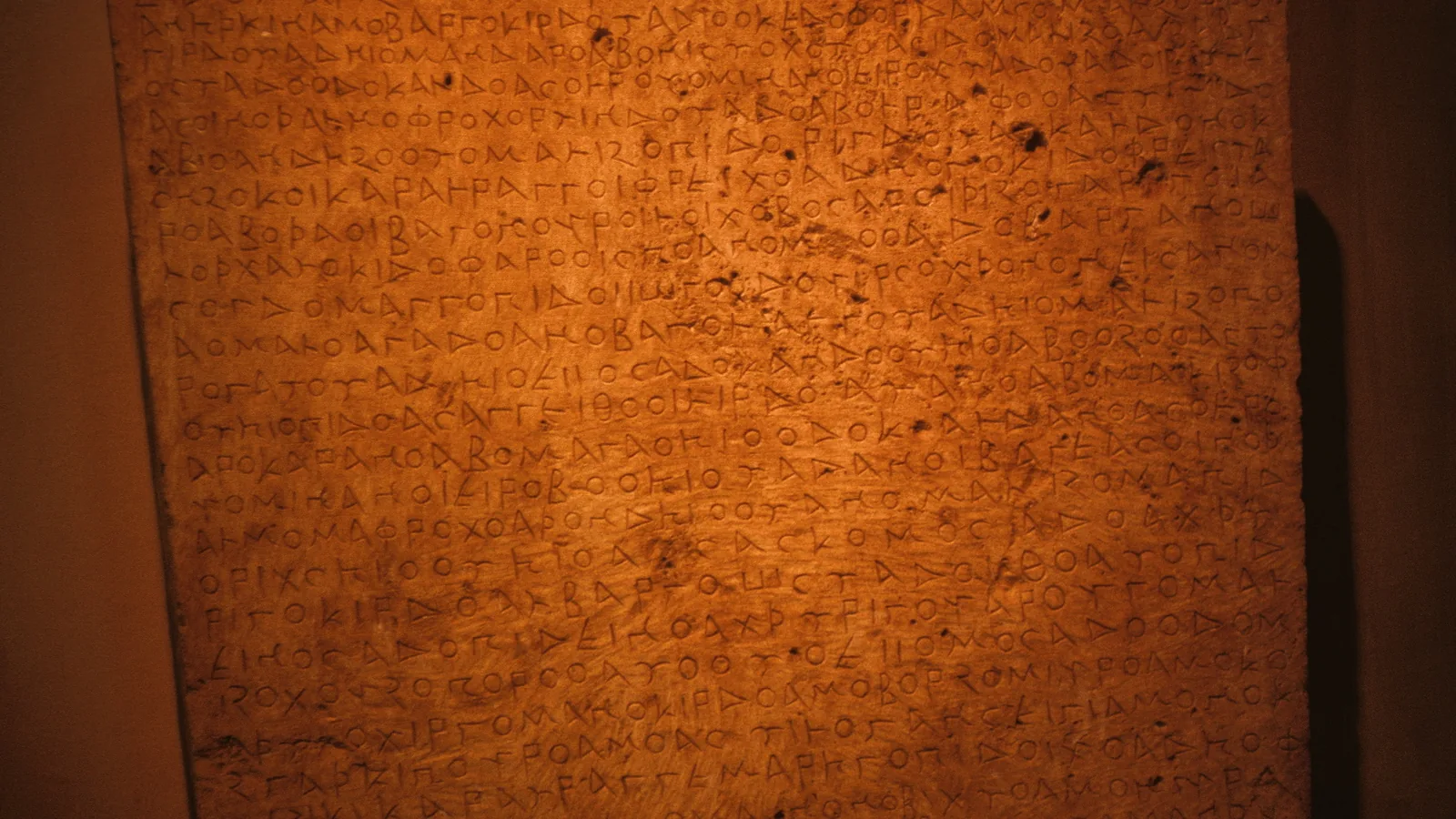
“Kanishka … who has inaugurated the year one as the gods pleased and he issued a Greek edict (and) then he put it into Aryan.” So run the opening lines of a stone unearthed in 1993 at Rabatak, in Baghlan province of what is now northern Afghanistan, in the reading that Nicholas Sims-Williams published in 2004 and that Joe Cribb and Robert Bracey reprint in the British Museum’s 2025 catalogue of Kushan coins. The text is Bactrian, an Iranian language written in Greek letters. Encyclopaedia Iranica calls it the most important Bactrian inscription of the Kushan period: a record of the founding of a temple that housed statues of Kanishka I, his ancestors and a list of gods. Harry Falk placed that year one at AD 127 or 128 in 2001. The stone itself was cut no earlier than AD 132, and the Kabul Museum first put it on show in August 2000.
Quick facts
- When
- Year one of Kanishka, placed at AD 127 or 128 by Harry Falk in 2001 · the inscription cut no earlier than AD 132 · unearthed 1993 · first published 1995–96 · revised reading 2004 · first exhibited August 2000
- Where
- Rabatak, Baghlan province, in what is now northern Afghanistan; the Kabul Museum
- Who
- Kanishka I; his ancestors Kujula Kadphises, Vima Taktu and Vima Kadphises; the goddess Nana; Nicholas Sims-Williams and Joe Cribb, who published the text; Harry Falk, who dated the era
- Outcome
- The stone fixed the order of four Kushan kings, recorded Kanishka's move from Greek to Bactrian, named Saketa, Kausambi, Pataliputra and Sri-Campa as captured, and, with Falk's dating, anchored the Kushan era at AD 127 or 128
Bactrian in Greek letters
Kushan royal inscriptions come in two kinds, according to Sims-Williams and Falk in Encyclopaedia Iranica: Bactrian written in Greek script, found mostly in Bactria, and Prakrit written in Brahmi or Kharoshthi. Bactrian was the only Middle Iranian language written in an alphabet derived from Greek, Sims-Williams wrote in his 1988 entry on the language, a result of Alexander’s conquest of Bactria and of the roughly 200 years of Greek rule that followed. The script used the 24 standard letters plus one sign for the sound sh, 25 in all, the same count that the Chinese monk Xuanzang (Hsüan-tsang) reported for the alphabet of Tokharistan in the seventh century. No document in an Indian language survives from Kanishka’s own administration; the Bactrian royal texts, Rabatak and the inscriptions of Surkh Kotal, are his chancery’s voice.
"Then he put it into Aryan": the edict and the coins
Cribb and Bracey print line 3 as “And he issued a Greek edict and then put it into Aryan,” and add that Aryan, meaning Iranian, was the contemporary name for the Bactrian language. Sims-Williams and Falk are more cautious. The clause, they write, is one “the exact translation of which is not quite clear,” though it may imply a policy of replacing Greek with Bactrian as the language of state.
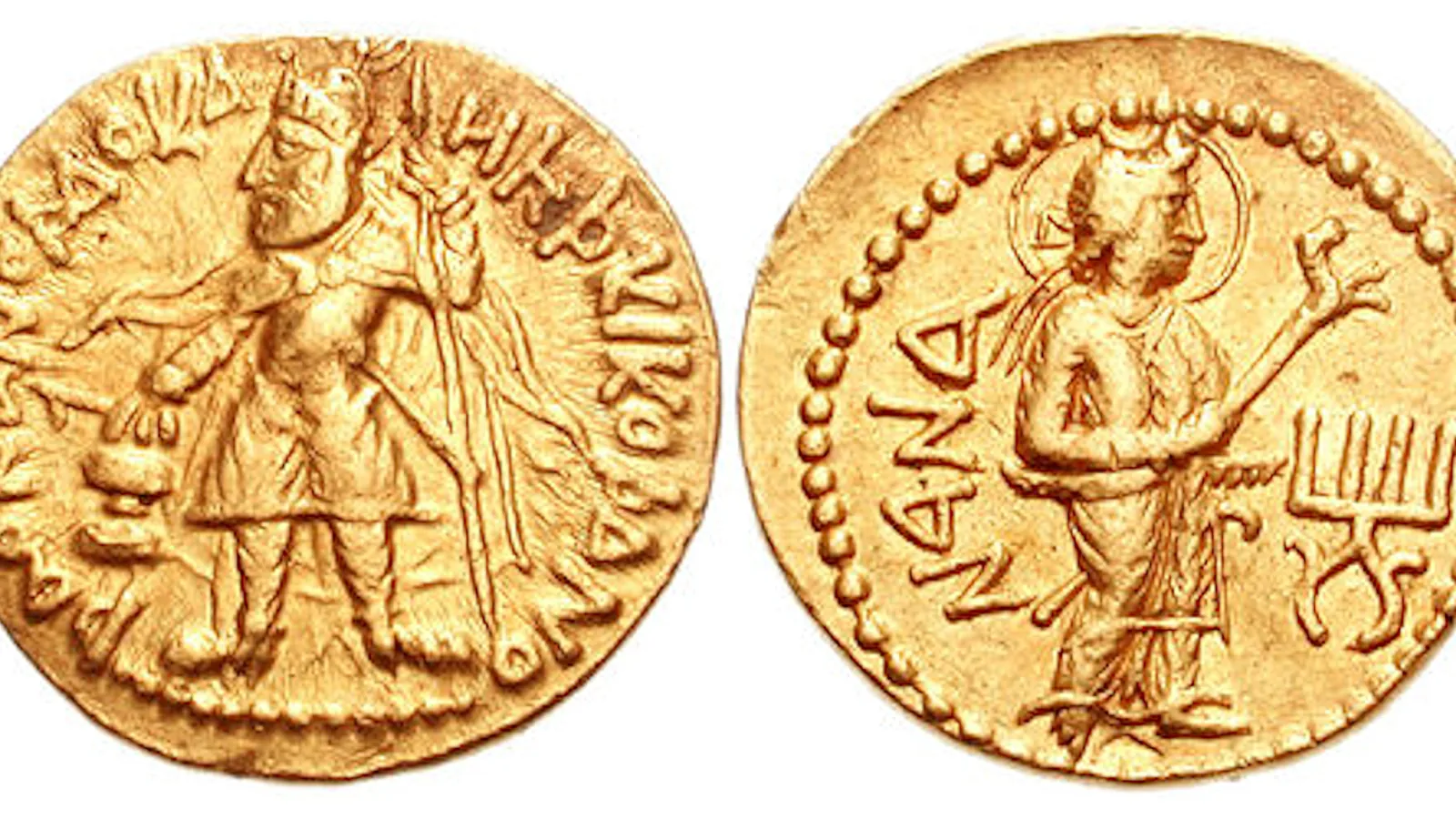
On his earliest issues Kanishka used the Greek legend basileus basileōn kanēškou, “of Kanishka, king of kings,” and after a very short time, according to the same entry, he replaced it with the Bactrian šaonano šao kanēški. In the collection of the American Numismatic Society (ANS), a bronze didrachm from Gandhara, 1921.54.194, carries the Greek BACIΛEYC BACIΛεωN KANHÞKOY, while a gold dinar from Bactria, 1944.100.15491, reads ÞAONANOÞAO KANHÞKI KOÞANO. For the first issue, Cribb and Bracey found, the mint recut the dies themselves, cutting the Bactrian legend over the Greek.
Four generations, and a grandfather some doubt
The stone traces Kanishka’s line back through his father Vima Kadphises, his grandfather Vima Taktu and his great-grandfather Kujula Kadphises, which Osmund Bopearachchi’s Iranica entry on Kujula calls the most informative source on that ancestry. Before 1993 a run of coins carried only the Greek title Basileùs Basiléōn Sōtēr Mégas, and their issuer was known as the Nameless King. A. D. H. Bivar wrote in the same encyclopedia that Rabatak, by naming Vima Taktu as a king, made it possible to identify him with the Nameless King, and a coin reading OOHMO TAKT[.] that Cribb published in 1995–96 supports the link. Gérard Fussman in 1998 and D. W. MacDowall in 2002 objected that the identification rests on restored readings of a damaged stone and damaged coins.
Lines 4 to 7 turn from ancestors to conquests. In year one, the text says, the capture of cities was proclaimed, “and Saketa, and Kausambi, and Pataliputra, as far as Sri-Campa,” and the king “submitted all India to (his) will.” Cribb and Bracey place Saketa at Ayodhya, Kausambi near Allahabad, Pataliputra at Patna and Sri Campa near Bhagalpur. B. N. Mukherjee read the name Ujjain and a king called Saddashkana there; Sims-Williams and Falk reject both as “incompatible with what can be seen on the stone.”
Nana gives the kingship
Line 2 says that Kanishka received his kingship from the goddess Nana. Lines 9 to 11 list the gods whose images were to stand in the temple, the bagolango or “house of the gods”: “the above-mentioned Nana and the above-mentioned Umma,” then Aurmuzd, Muzhduwan, Sroshard, whom an interlinear note says “in Indian is called Mahasena,” then Narasa “and Mihir.” Two of them, Nana and Mozdooano, are the reverse types of the ANS gold dinars 1944.100.30743 and 1944.100.15491.
The list contains no Buddha. Buddhist literary sources portray Kanishka as a major patron of Buddhism on the model of Ashoka, as Jason Neelis wrote in the Silk Road Seattle essay for the University of Washington. Cribb and Bracey answer that those texts were written much later and are mixed with legends of other patrons, so that the date, extent and reality of his conversion stay unclear. On the coins, the Buddha types appear only in the last phase of the main bronze and gold mints, late in the reign, an exceptional event in Cribb and Bracey’s account; the ANS Gandhara tetradrachm 2012.31.1 is catalogued with the Sakayamuni Buddha reverse type. Bivar wrote that the Kushans should not be assumed to have been Buddhists; the coinage points to an eclectic Zoroastrianism.

AD 127, AD 132, August 2000
For a century the date of year one moved between proposals, from about AD 125 (Vincent A. Smith, 1903) to about AD 100 (Neelis, before Falk). Falk’s argument of 2001 used the Yavanajataka of Sphujiddhvaja, a fourth-century astronomical text whose rule adds 149 to a Kushan year to reach the Shaka era, which began in AD 78, so that AD 227 opened a Kushan century and, with the dropped hundreds of Indian dating, AD 127 opened the one before. Bivar called Falk’s solution “in fact the definitive one,” and on that basis the years 2 to 23 of Kanishka’s inscriptions fall between AD 128 and 150. The American Numismatic Society gives his reign as 127 to 151.
Most of the Rabatak text concerns year one, but it also mentions years 3 and 6, which is why Sims-Williams and Falk hold that the stone cannot be earlier than AD 132; Cribb and Bracey write that it was cut after his sixth year.
The stone was brought to the Kabul Museum, which Carla Grissmann’s Iranica entry records as looted and shelled from 1993. Its entrance hall had once held the Bactrian inscriptions from Surkh Kotal, which Rabatak supplements. In August 2000, on Afghan independence day, the museum opened for four days and exhibited for the first time the Rabatak inscription, unearthed in 1993 and only lately received.
Key facts
- The Rabatak inscription was unearthed in 1993 in Baghlan province and brought to the Kabul Museum (Encyclopaedia Iranica, “Kabul Museum”; Cribb and Bracey, 2025).
- Sims-Williams and Cribb first published it in Silk Road Art and Archaeology 4 (1995–96); Sims-Williams issued a revised reading in Bulletin of the Asia Institute 18 (2004).
- The text is Bactrian in Greek script, the only Middle Iranian language written in a Greek-derived alphabet of 25 letters (Sims-Williams, Iranica).
- Lines 1 to 4 state that Kanishka “inaugurated the year one” and “issued a Greek edict (and) then he put it into Aryan” (Sims-Williams 2004, quoted by Cribb and Bracey).
- Kanishka’s coins moved from the Greek legend basileus basileōn kanēškou to the Bactrian šaonano šao kanēški; ANS 1921.54.194 and 1944.100.15491 carry the two legends.
- The genealogy runs Kujula Kadphises, Vima Taktu, Vima Kadphises, Kanishka; Cribb identifies Vima Taktu with the Nameless King, Fussman and MacDowall doubt it.
- Lines 4 to 7 name Saketa, Kausambi, Pataliputra and Sri-Campa; Sims-Williams and Falk reject Mukherjee’s reading of Ujjain.
- Falk placed year one at AD 127 or 128 in 2001; the stone, which mentions years 3 and 6, is not earlier than AD 132; the museum first exhibited it in August 2000.
FAQ
What language is the Rabatak inscription written in?
Bactrian, a Middle Iranian language written in the Greek alphabet with one added letter for the sound sh, 25 letters in all. The text itself calls the language "Aryan." Sims-Williams and Falk note that the clause about the Greek edict is not fully clear in translation, but Kanishka's coins show the same change from Greek to Bactrian legends.
When was year one of Kanishka?
Harry Falk argued in 2001, from the Yavanajataka's rule that a Kushan year plus 149 equals a year of the Shaka era, that the Kushan era began in AD 127 or 128. Encyclopaedia Iranica adopts that date in all three of its Kushan dynasty entries, and the American Numismatic Society gives Kanishka's reign as 127 to 151.
Which kings does the Rabatak inscription name before Kanishka?
Three: his great-grandfather Kujula Kadphises, his grandfather Vima Taktu and his father Vima Kadphises. Before 1993 the issuer of the Soter Megas coins was known only as the Nameless King; Joe Cribb identified Vima Taktu with the Nameless King of the Soter Megas coins, an identification that Gérard Fussman and D. W. MacDowall questioned.
Sources
- Encyclopaedia Iranica, Nicholas Sims-Williams and Harry Falk, "KUSHAN DYNASTY ii. Inscriptions of the Kushans" (published December 8, 2014).
- Encyclopaedia Iranica, A. D. H. Bivar, "KUSHAN DYNASTY i. Dynastic History" (published July 15, 2009; updated December 15, 2014).
- Encyclopaedia Iranica, Harry Falk, "KUSHAN DYNASTY iii. Chronology of the Kushans" (published December 8, 2014).
- Encyclopaedia Iranica, Carla Grissmann, "KABUL MUSEUM" (Vol. XV, Fasc. 3, pp. 318–323; published September 15, 2009).
- Encyclopaedia Iranica, Nicholas Sims-Williams, "BACTRIAN LANGUAGE" (published December 15, 1988).
- Encyclopaedia Iranica, Osmund Bopearachchi, "KADPHISES, KUJULA" (published September 15, 2009).
- Joe Cribb and Robert Bracey, Kushan Coins and History: A Type Catalogue of Kushan, Kushano-Sasanian and Kidarite Hun Coins Based on the Collection of the British Museum (British Museum Research Publication, 2025, open access), full text via Internet Archive; quoting Nicholas Sims-Williams, "The Bactrian inscription of Rabatak: a new reading," Bulletin of the Asia Institute 18 (2004), pp. 53–68.
- American Numismatic Society, MANTIS collection database, Kanishka coins 1921.54.194 (Gandhara bronze didrachm, Greek legend, Göbl 766), 1944.100.15491 (Bactria gold dinar, Bactrian legend, Göbl 61.3) and 2012.31.1 (Gandhara bronze tetradrachm, Sakayamuni Buddha reverse type).
- Silk Road Seattle, University of Washington, Jason Neelis, "The Kushan Empire" (Virtual Art Exhibit essay).
Cite this article
- APA
- Our Earth's History. (2026, September 22). He put it into Aryan: the Rabatak inscription of Kanishka, found 1993. Our Earth's History. https://ourearthshistory.com/central-asia/classical/rabatak-inscription-1993-kanishka-year-one-bactrian/
- Chicago
- Our Earth's History. “He put it into Aryan: the Rabatak inscription of Kanishka, found 1993.” Our Earth's History, September 22, 2026. https://ourearthshistory.com/central-asia/classical/rabatak-inscription-1993-kanishka-year-one-bactrian/.
- MLA
- “He put it into Aryan: the Rabatak inscription of Kanishka, found 1993.” Our Earth's History, 22 Sep. 2026, https://ourearthshistory.com/central-asia/classical/rabatak-inscription-1993-kanishka-year-one-bactrian/.
Text licensed CC BY-NC-ND 4.0. Found an error? Tell us.