Mound City, twenty-four mounds in 1848 and an army camp in 1917

TL;DR — Squier and Davis mapped 24 mounds at Mound City in 1848; Camp Sherman covered them in 1917; the Newark Octagon, a golf course from 1910, opened on January 1, 2025.
“The enclosure, designated, from the great number of mounds within its walls, ‘Mound City,’ is in many respects the most remarkable in the Scioto valley.” Ephraim G. Squier and Edwin H. Davis printed that sentence in 1848 in Ancient Monuments of the Mississippi Valley, the first volume of the Smithsonian Institution’s Contributions to Knowledge, and counted “no less than twenty-four” mounds inside the wall, four miles north of Chillicothe, Ohio. The National Park Service, which manages the site, counts 25 and dates their construction to between AD 1 and 400. In 1917 the Army built Camp Sherman on top of them, and the Ohio Historical Society rebuilt the mounds in the early 1920s from the 1848 maps. At Newark, the Octagon that the same survey measured at “something over fifty acres” stayed under a golf club’s lease from 1910 until January 1, 2025.
Quick facts
- When
- AD 1 to 400 (construction, National Park Service dating) · 1848 (Squier and Davis publish Ancient Monuments of the Mississippi Valley) · 1917 (Camp Sherman built on Mound City) · 1923 (Harding proclaims Mound City Group National Monument) · 1992 (Hopewell Culture National Historical Park) · December 7, 2022 (Ohio Supreme Court ruling on the Octagon lease) · September 19, 2023 (World Heritage inscription) · January 1, 2025 (Octagon opens to full public access)
- Where
- The Scioto River and Paint Creek valleys around Chillicothe, Ross County, Ohio (Mound City, Hopeton, Hopewell Mound Group, Seip); Newark and Heath, Licking County, Ohio (Great Circle, Octagon, Wright Square)
- Who
- The Hopewell culture; Ephraim G. Squier and Edwin H. Davis; Henry Shriver; M. Cloud Hopewell; the Ohio Historical Society, later the Ohio History Connection; President Warren G. Harding; the National Park Service; Moundbuilders Country Club; Judge David Branstool; Megan Wood
- Outcome
- Mound City was excavated in 1848, built over by Camp Sherman in 1917 and rebuilt in the 1920s from the 1848 maps. The Newark Octagon, leased to a golf club since 1910, passed to the Ohio History Connection's control on January 1, 2025, after a 2022 court ruling and a 2024 settlement
Squier and Davis, 1848
Plate XIX of the 1848 volume placed the group on the left bank of the Scioto River, “nearly square, with rounded angles,” and “still covered with the primitive forest.” Henry Shriver, who owned the land, let the two surveyors open every mound, and the principal ones held altars of burned clay. One altar had been rebuilt three times, each layer on the last, and was baked to a depth of 22 inches. On it lay pottery, spear-heads chipped from quartz and garnet, two copper gravers six and eight inches long, 20 or more tubes of thin copper and “a single arrow-point of obsidian.” The word Hopewell appears nowhere in the volume; its authors wrote of “mound-builders.”
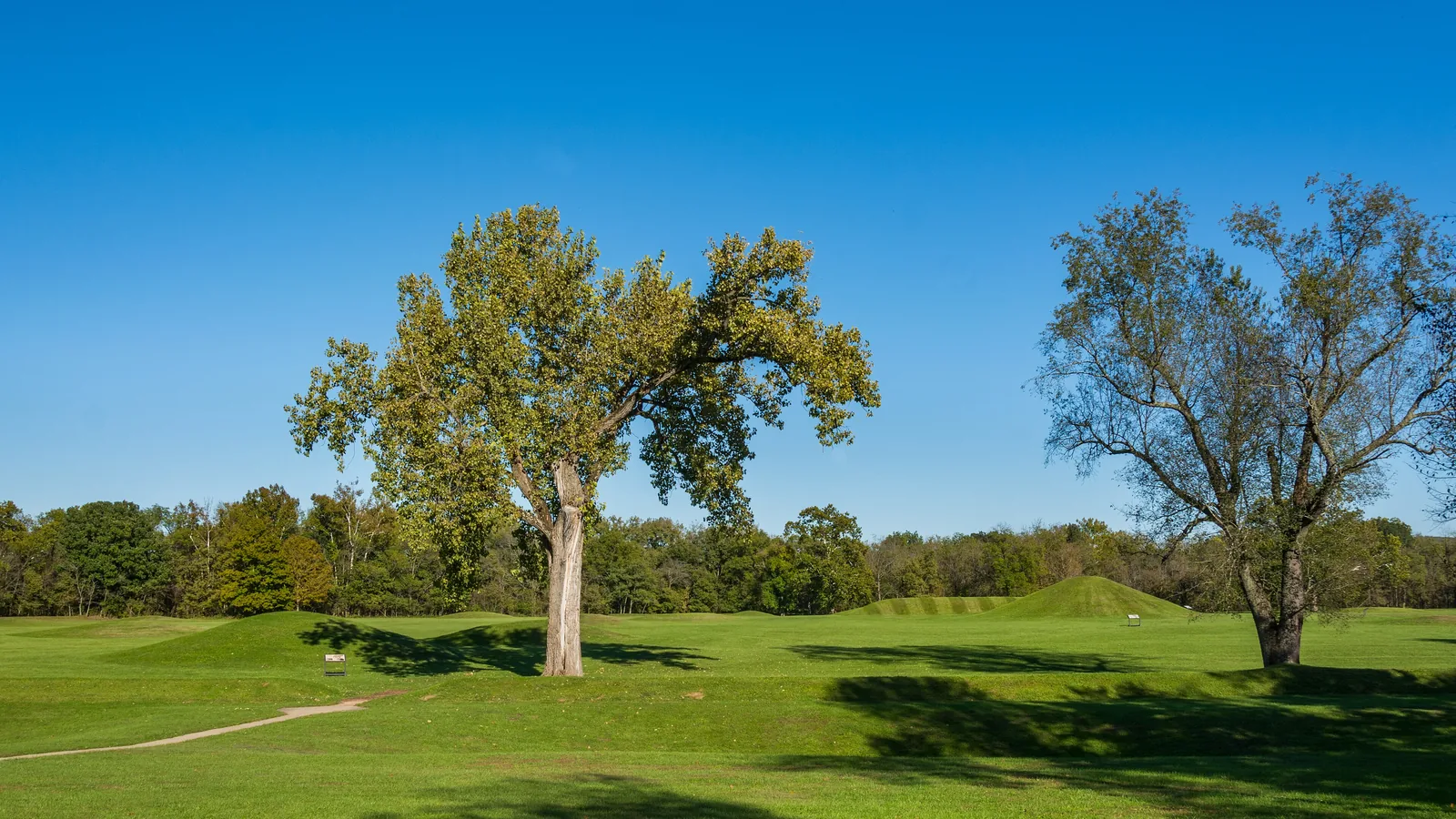
The Park Service’s plan of the restored site has 25 mounds inside a wall about 260 meters across, enclosing 6.81 hectares (16.8 acres), with gateways in the east and west sides. The 1848 text gives 24 mounds and the Park Service gives 25, and neither explains the difference.
An army camp on the mounds, 1917
The Park Service records that “During World War I the Mound City Group site was occupied by a military training center known as Camp Sherman.” The camp was one of 32 cantonments planned after the United States entered the war in early 1917. “In the early 1920s after Camp Sherman was razed, the Ohio Historical Society excavated the site and began reconstruction of the Hopewell earthworks and mounds,” and that reconstruction “was based on the maps of Squier and Davis in order to be as accurate as possible.” Under the mounds the diggers found floors of buildings of poles and bark and about one hundred cremated remains.
President Warren G. Harding’s proclamation of 1923 preserved mounds of “great historic and scientific interest.” In 1980 Congress added part of the Hopeton Earthworks, and a 1992 law renamed the monument Hopewell Culture National Historical Park and took in High Bank Works, Hopewell Mound Group and Seip.
Obsidian from Yellowstone, mica from North Carolina
The culture took its name from a farm. “Early archeologists named the site for its owner, M. Cloud Hopewell,” the Park Service writes of the Hopewell Mound Group on the North Fork of Paint Creek. Its wall ran more than two miles around 29 burial mounds. Mound 25, the largest the culture built, was 500 feet long and, by the Park Service’s two figures on the same page, 30 or 33 feet high. Here were found “Huge ceremonial blades made of obsidian from Yellowstone National Park,” and the Park Service states that “the total amount of obsidian here was the largest ever found east of the Mississippi River.”
The Ohio History Connection lists the sources of the materials: mica, copper, obsidian and seashells “brought from what is now North Carolina, Michigan, Wyoming, and the coast of Florida, respectively.” They accumulated in Ohio, it writes, “apparently without corresponding trade goods returning to their places of origin.”
"A gigantic 'Woodhenge'" at Hopeton
Hopeton has a 7.3 hectare circle and a 7.86 hectare square, together 15.16 hectares (37.5 acres). The circle was 320 meters across, a diameter the Park Service says was repeated at Circleville, High Bank, Newark and Seal. Parallel walls ran at least 730 meters toward the river, built “to align with the sunset on the winter solstice.” In 2012 a LiDAR survey mapped the surface to within three inches, and a magnetic survey found that “a row of monumental wooden posts spaced at 6 meter intervals once marked the outline of the Great Circle, forming a gigantic ‘Woodhenge.’”
Seip, in the Paint Creek valley, has over two miles of wall around more than 36 hectares (89 acres), with a circle 494 meters (1620 feet) across. Its central mound, 240 by 160 by 30 feet, was opened by the Ohio Historical Society in 1925 and held the clay Seip Head, now in the Ohio History Center in Columbus. The deed to Seip passed from the Ohio History Connection to the Park Service on September 3, 2014.
December 7, 2022: the Octagon under a golf course since 1910
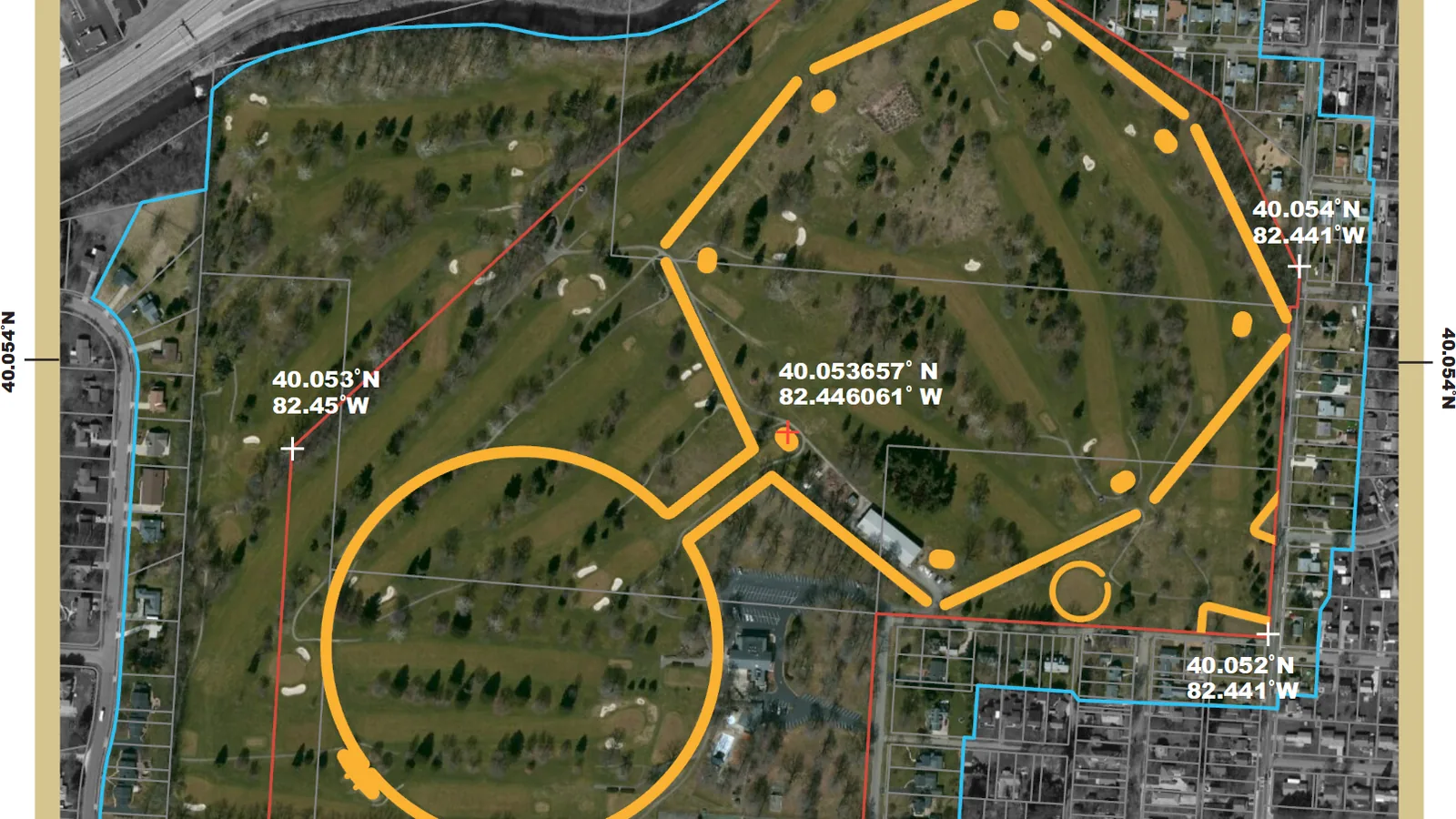
At Newark in 1848, Squier and Davis found an octagon with a gateway at each angle, each covered inside by “a small, truncated pyramidal elevation” five feet high, and an area of “something over fifty acres.” On the wall of the smaller circle joined to it stood a mound “one hundred and seventy feet long, eight feet higher than the general line of the embankment,” which “has been called the ‘Observatory,’” and digging in it “disclosed nothing, except an abundance of rough stones.” The Ohio History Connection gives the Octagon as a 20-acre circle and a 50-acre octagon “connected by a small passageway.” Its earthworks site states that a line between the centers of the Great Circle and the Observatory Circle points “to where the moon rises at its northernmost point on the eastern horizon,” within a cycle of 18.6 years.
Moundbuilders Country Club held a lease on the Octagon from 1910; the Ohio History Connection was deeded the land in 1933 and filed an eminent domain case in 2018. Judge David Branstool of the Licking County Common Pleas Court ruled in May 2019 that the acquisition was “both necessary and for a public use,” and on December 7, 2022, the Ohio Supreme Court upheld that ruling and the appeals court’s. The History Connection announced that “A jury trial will be scheduled to determine the value of the lease.” On August 1, 2024, the two sides settled “for a confidential sum.” In between, on September 19, 2023, the Hopewell Ceremonial Earthworks were inscribed on the World Heritage List; the settlement release calls the Octagon “one of the eight locations” in that listing, while the History Connection’s Newark page counts Newark with “6 other” earthworks. The Ohio History Connection took the leasehold on January 1, 2025, and opened the Octagon to full public access that day.

Key facts
- Squier and Davis’s Ancient Monuments of the Mississippi Valley (1848) named “Mound City,” four miles north of Chillicothe, and counted “no less than twenty-four” mounds inside its wall (Plate XIX).
- The National Park Service counts 25 mounds inside a wall about 260 meters across, enclosing 6.81 hectares, and dates construction to between AD 1 and 400.
- One altar at Mound City, rebuilt three times and burned 22 inches deep, held “a single arrow-point of obsidian” with quartz and garnet spear-heads and copper tubes (1848).
- Camp Sherman, a World War I training cantonment, occupied the site from 1917; after it was razed, the Ohio Historical Society rebuilt the mounds in the early 1920s “based on the maps of Squier and Davis.”
- Harding proclaimed Mound City Group National Monument in 1923; a 1992 law renamed it Hopewell Culture National Historical Park and added Hopeton, High Bank, Hopewell Mound Group and Seip.
- At the Hopewell Mound Group, named for landowner M. Cloud Hopewell, the obsidian from Yellowstone was “the largest ever found east of the Mississippi River” (National Park Service).
- A magnetic survey at Hopeton found wooden posts at six-meter intervals around the 320-meter Great Circle, whose parallel walls align with the winter solstice sunset.
- The Ohio Supreme Court upheld the Octagon lease acquisition on December 7, 2022; a settlement followed on August 1, 2024, and full public access began on January 1, 2025.
FAQ
How many mounds are at Mound City?
Squier and Davis counted "no less than twenty-four" in 1848. The National Park Service's plan of the restored site has 25 inside the wall and two more outside it.
What happened to Mound City during World War I?
Camp Sherman, one of 32 Army cantonments built in 1917, was laid out over the site. After the camp was razed in the early 1920s, the Ohio Historical Society excavated the mounds and rebuilt them from the 1848 maps.
Why was the Newark Octagon a golf course?
Moundbuilders Country Club held a lease on the Octagon from 1910. The Ohio History Connection, deeded the land in 1933, went to court in 2018 to buy out the lease, won at the Ohio Supreme Court on December 7, 2022, settled on August 1, 2024, and opened the site fully on January 1, 2025.
Sources
- E. G. Squier and E. H. Davis, Ancient Monuments of the Mississippi Valley (Smithsonian Contributions to Knowledge, vol. I, Washington, 1848), Plate XIX "Mound City, Ross County, Ohio," the altar of the same group and Plate XXV (Newark), read in the Project Gutenberg edition, eBook 49668.
- National Park Service, Hopewell Culture National Historical Park, "Mound City Group" (page updated May 14, 2025).
- National Park Service, Hopewell Culture National Historical Park, "Camp Sherman" (page updated April 19, 2020).
- National Park Service, Hopewell Culture National Historical Park, "History & Culture" (page updated September 26, 2025).
- National Park Service, Hopewell Culture National Historical Park, "Hopewell Mound Group" (page updated July 10, 2024).
- National Park Service, Hopewell Culture National Historical Park, "Hopeton Earthworks" (page updated July 10, 2024).
- National Park Service, Hopewell Culture National Historical Park, "Seip Earthworks" (page updated July 10, 2024).
- Ohio History Connection, Hopewell Ceremonial Earthworks site, "Culture" (hopewellearthworks.org).
- Ohio History Connection, Hopewell Ceremonial Earthworks site, "Octagon Earthworks" (hopewellearthworks.org).
- Ohio History Connection, "Newark Earthworks" (visitor page: Great Circle, Octagon, Wright Square, World Heritage).
- Ohio History Connection, "Ohio Supreme Court upholds lower court decisions for Ohio History Connection to acquire Octagon Earthworks lease" (posted December 7, 2022).
- Ohio History Connection, "Octagon Earthworks will open to public Jan. 1, 2025" (posted August 1, 2024).
- Ohio History Connection, "Support the Hopewell Ceremonial Earthworks" (inscription date September 19, 2023).
Cite this article
- APA
- Our Earth's History. (2026, September 22). Mound City, twenty-four mounds in 1848 and an army camp in 1917. Our Earth's History. https://ourearthshistory.com/americas/classical/hopewell-mound-city-squier-davis-1848-camp-sherman-1917-octagon-2025/
- Chicago
- Our Earth's History. “Mound City, twenty-four mounds in 1848 and an army camp in 1917.” Our Earth's History, September 22, 2026. https://ourearthshistory.com/americas/classical/hopewell-mound-city-squier-davis-1848-camp-sherman-1917-octagon-2025/.
- MLA
- “Mound City, twenty-four mounds in 1848 and an army camp in 1917.” Our Earth's History, 22 Sep. 2026, https://ourearthshistory.com/americas/classical/hopewell-mound-city-squier-davis-1848-camp-sherman-1917-octagon-2025/.
Text licensed CC BY-NC-ND 4.0. Found an error? Tell us.