How big was Teotihuacan, and who ran it?
.jpg)
TL;DR — Teotihuacan covered about eight square miles and held 100,000 to 200,000 people by AD 400. No royal portrait or tomb has been found; who governed it is debated.
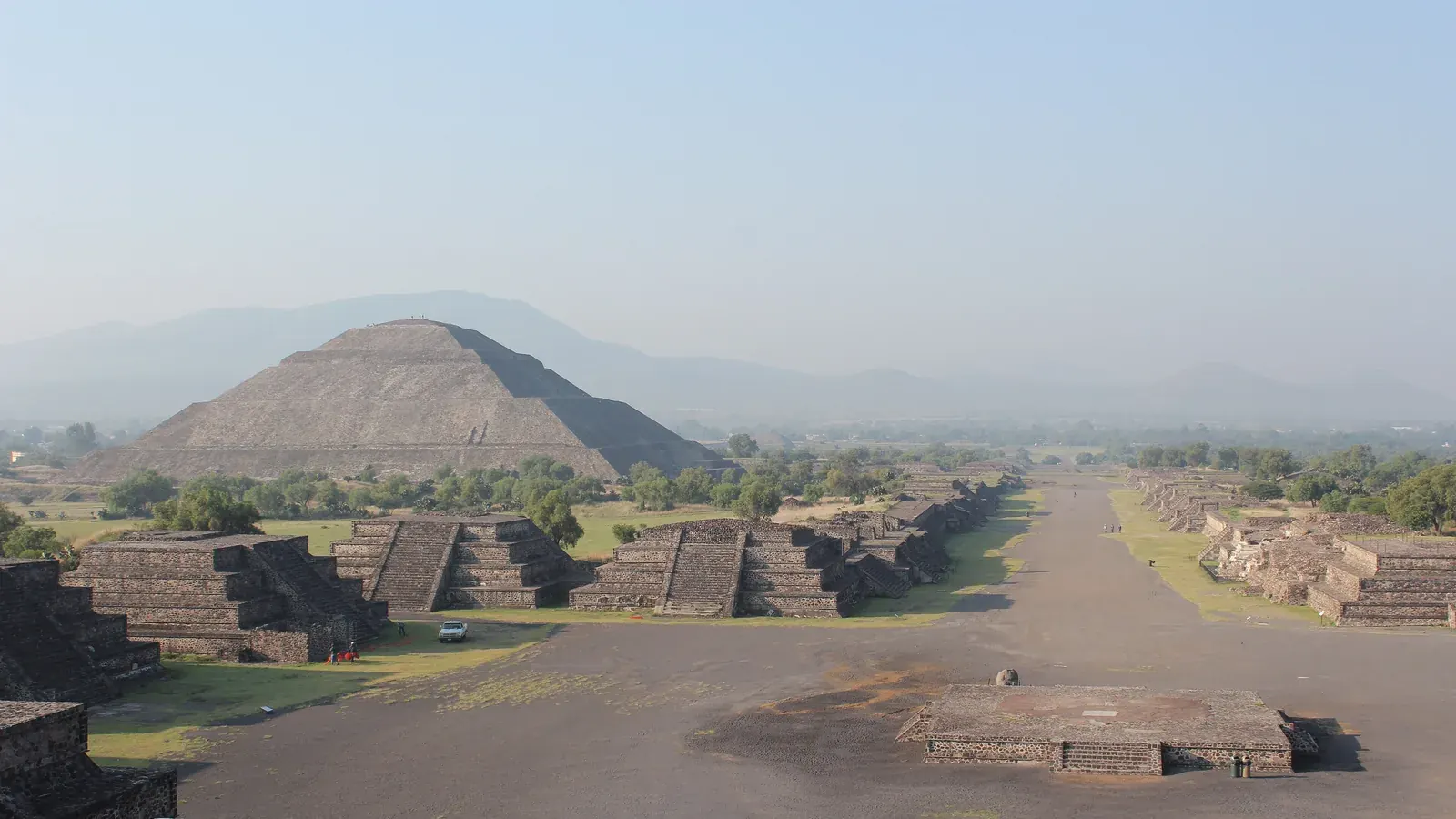
Teotihuacan, in the Basin of Mexico, covered about eight square miles and held 100,000 people or more around AD 400, and no one knows who ruled it. The city lay some 30 miles (50 kilometers) northeast of what is now Mexico City. Its two great pyramids and central avenue were finished by about AD 200, and its population peaked between about 375 and 500. Excavators have found thousands of apartment compounds, foreign neighborhoods and mass burials of sacrifice victims, but no statue, tomb or inscription that names a king. Around AD 550 the temples and palaces along the main avenue burned, and the center was never rebuilt.
Quick facts
- When
- Built c. 150 BC–AD 250 · peak c. AD 375–500 · central fire c. AD 550–570 · abandoned by c. AD 750
- Where
- Basin of Mexico, about 30 miles (50 km) northeast of what is now Mexico City
- Who
- The Teotihuacanos (original name unknown); archaeologists George Cowgill, Linda Manzanilla, Sergio Gómez (INAH)
- Outcome
- Largest city in the Western Hemisphere before the 1400s; its core burned and no royal portrait or tomb has been found
A planned city on a grid
The city took shape between about 150 BC and AD 200, according to the World History Encyclopedia entry by Mark Cartwright (2015). Its builders laid the streets on a grid turned 15.5 degrees east of true north. The main axis, which the Aztecs later called the Avenue of the Dead, ran 3.2 kilometers (2 miles) and was 40 meters wide. Along it stood the Pyramid of the Sun, built around AD 100, the Pyramid of the Moon, around AD 150, and the walled Ciudadela with the Temple of the Feathered Serpent, around AD 200.
The Pyramid of the Sun measured about 215 meters on a side and 60 meters high by Cartwright’s figures; the UNESCO World Heritage listing gives 225 by 222 meters and 75 meters. George Cowgill, an archaeologist at Arizona State University, told National Geographic that the city covered eight square miles and supported about 100,000 people. “It was the largest city anywhere in the Western Hemisphere before the 1400s,” he said. Cartwright gives a fourth-century peak as high as 200,000, and Smithsonian magazine reported in 2016 that the residential zones “may have housed 200,000 people.”
Who lived in the apartment compounds
Most people lived in one-story walled compounds of rooms set around courtyards. Cartwright counts more than 2,000 of them; an Arizona State University report in 2011 gave about 2,300, each with three to five apartments.
The residents came from far beyond the valley. Linda Manzanilla of the National Autonomous University of Mexico, writing in the Proceedings of the National Academy of Sciences in 2015, described a multiethnic settlement whose foreign groups settled mostly on the edges: the Oaxaca Barrio, or Tlailotlacan, in the southwest; the Merchants’ Barrio of Gulf Coast people in the east; and a small group from Michoacán in the west. Obsidian paid for much of it. The city controlled the deposits at nearby Pachuca and turned the volcanic glass into spear and dart points, and its pottery turns up in elite burials as far south as the Maya city of Tikal.
The ruler who left no face
Maya kings carved their portraits on stone and were buried under their temples. Teotihuacan has yielded neither. Cartwright wrote that its sculpture “never captures individual likenesses.” Smithsonian magazine described a split among specialists in 2016. One camp, which included Saburo Sugiyama of Arizona State University, held that a powerful king ruled the city. The other held that a council of elite families governed it. Cowgill, in the 2011 Arizona State report, described the city as most likely governed by a collective rulership. In a 2026 paper in Latin American Antiquity, Manzanilla described a state built on a pact among roughly 22 neighborhoods, with possible co-rulers living in the palace of Xalla north of the Pyramid of the Sun.
The clearest sign of central power is the Temple of the Feathered Serpent. When it was completed around AD 200, more than 200 men and women from outside the city were sacrificed and buried in and around it, according to Cartwright. Two groups of 18 young warriors, hands tied behind their backs, lay in pits on the north and south sides.
The tunnel under the temple
In the fall of 2003 a rainstorm opened a sinkhole about three feet wide at the foot of the Temple of the Feathered Serpent. Sergio Gómez, an archaeologist at Mexico’s National Institute of Anthropology and History (INAH), climbed down into a man-made tunnel blocked in both directions by large stones. Radar surveys in 2004 and 2005 traced it about 330 feet (100 meters) to a point under the temple’s center; its entrance had been sealed with boulders nearly 2,000 years earlier. Digging began in 2009. Two robots, Tlaloque and Tláloc II, scouted the final stretch and found a cross-shaped chamber. By 2016 the team had recovered about 75,000 objects, among them obsidian knives and two black stone statues. The royal tomb that the press expected has not appeared, and Gómez came to read the chamber as a symbolic resting place for the city’s founders.
Fire around AD 550
Manzanilla dated the burning of the major buildings along the Avenue of the Dead to AD 550 in 2015; in 2026 she placed the “Great Fire” at about AD 550 to 570. Cartwright gives around 600, and UNESCO’s listing puts the destruction toward 650. Temples and palaces on the central axis burned, sculptures inside Xalla were smashed, and the neighborhoods on the edges were mostly spared. Manzanilla found no trace of a foreign army and read the event as a revolt against the ruling elite; INAH’s site description says the center was damaged “apparently by sectors of the population itself.” Lake sediments show a long drought beginning about the same time. The periphery stayed occupied for a century more; Smithsonian magazine puts the final abandonment at about AD 750.
What the Aztecs found
When Nahuatl-speaking groups reached the valley, in the 1200s or 1300s depending on the account, the pyramids had stood in ruins for about 700 years. They called the place Teotihuacan, which INAH translates as “place of the gods” or “place of deification.” The Aztec ruler Montezuma made pilgrimages there, according to Cartwright, a thousand years after the city’s peak. No glyph has given up what the residents called their home.
The scale is well measured; the government is not. A city that outgrew every other in its hemisphere for four centuries has left more than 2,000 apartment compounds, at least 200 sacrifice victims and 75,000 objects in one sealed tunnel, and not a single face of a ruler.
Key facts
- Teotihuacan lay about 30 miles (50 kilometers) northeast of what is now Mexico City and covered about eight square miles (21 square kilometers).
- Population estimates run from about 100,000 (George Cowgill) to as many as 200,000 (World History Encyclopedia; Smithsonian magazine) at the peak, c. AD 375–500.
- The Pyramid of the Sun (c. AD 100) measured about 215 meters on a side; its height is given as 60 to 75 meters depending on the source.
- More than 2,000 walled apartment compounds housed the population; foreign quarters included the Oaxaca Barrio and the Merchants’ Barrio.
- No portrait, tomb or inscription of a king has been found; Cowgill and Linda Manzanilla favored collective rule, Saburo Sugiyama a single king.
- More than 200 sacrificed people were buried in the Temple of the Feathered Serpent around AD 200; a tunnel found beneath it in 2003 by Sergio Gómez (INAH) yielded about 75,000 objects by 2016.
- The core of the city burned around AD 550–570; the site was largely abandoned by about AD 750.
FAQ
How big was Teotihuacan?
About eight square miles (21 square kilometers), with 100,000 people or more at its peak around AD 400; some estimates reach 200,000. Cowgill called it the largest city in the Western Hemisphere before the 1400s.
Who ruled Teotihuacan?
Unknown. No royal portrait, tomb or name has been found. Cowgill and Manzanilla argued for collective rule by elite families or neighborhoods; Sugiyama argued for a powerful king.
Why was Teotihuacan abandoned?
Its central temples and palaces burned around AD 550–570. Manzanilla read the fire as an internal revolt, with no sign of foreign invasion, and a long drought began about the same time. The periphery stayed occupied for a century or more; the site was largely empty by about AD 750.
Sources
- National Geographic — "Teotihuacan" (Kelly Hearn; George Cowgill on size and population; updated 2025)
- World History Encyclopedia — "Teotihuacan" (Mark Cartwright, 2015)
- Arizona State University News — "Teotihuacan finds shed light on an ancient civilization" (2011)
- Smithsonian Magazine — "A Secret Tunnel Found in Mexico May Finally Solve the Mysteries of Teotihuacán" (2016)
- Manzanilla, L. R., "Cooperation and tensions in multiethnic corporate societies using Teotihuacan, Central Mexico, as a case study," PNAS 112 (2015), via PubMed Central
- Manzanilla, L. R., "Introduction: What Happened after the Fall of Teotihuacan?" Latin American Antiquity 37 (2026)
- UNESCO World Heritage Centre — "Pre-Hispanic City of Teotihuacan"
- INAH (Mexico's National Institute of Anthropology and History) — "Teotihuacán" archaeological zone page
Cite this article
- APA
- Our Earth's History. (2026, September 19). How big was Teotihuacan, and who ran it? Our Earth's History. https://ourearthshistory.com/americas/classical/teotihuacan-largest-city-americas-no-king/
- Chicago
- Our Earth's History. “How big was Teotihuacan, and who ran it?” Our Earth's History, September 19, 2026. https://ourearthshistory.com/americas/classical/teotihuacan-largest-city-americas-no-king/.
- MLA
- “How big was Teotihuacan, and who ran it?” Our Earth's History, 19 Sep. 2026, https://ourearthshistory.com/americas/classical/teotihuacan-largest-city-americas-no-king/.
Text licensed CC BY-NC-ND 4.0. Found an error? Tell us.