Three painted rooms at Bonampak, c. 790, entered by outsiders in 1946
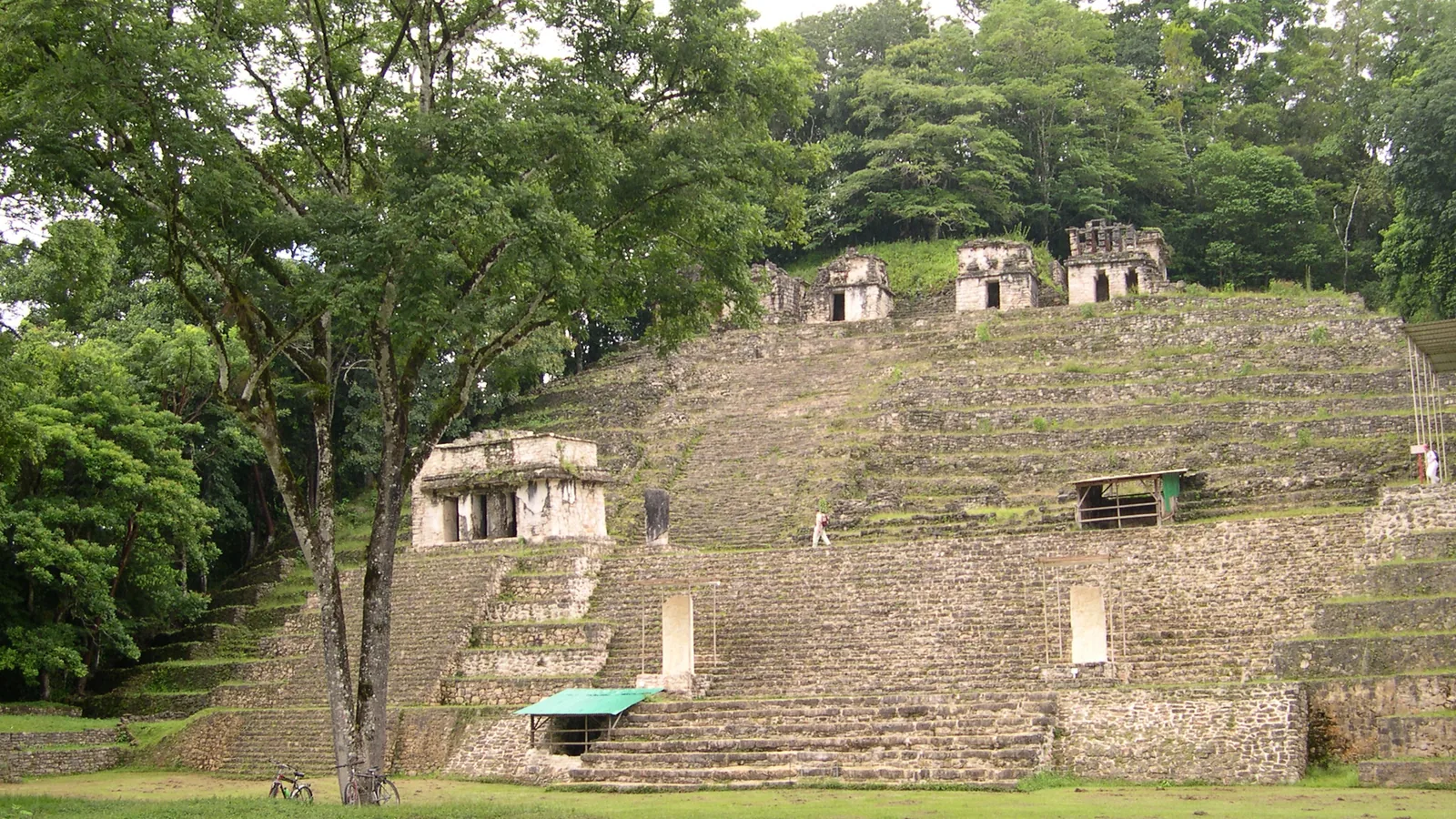

TL;DR — Bonampak’s Structure 1 holds three rooms painted c. 790-792 with an heir, a battle and its captives, and a ceremony; unseen by outsiders until 1946, when Giles Healey was shown the building.
The three rooms of Structure 1 at Bonampak “were, and still are, profusely decorated with mural paintings,” Mexico’s Instituto Nacional de Antropología e Historia (INAH) states. Calendar inscriptions inside date the murals to between AD 790 and 792, the Smithsonian’s National Museum of the American Indian (NMAI) reports.
Quick facts
- When
- c. AD 790-792 (murals, by calendar inscriptions); February 6, 1946 (Frey and Bourne reach Structure 1); May 1946 (Healey shown the murals); c. 1947 (kerosene cleaning, INAH photo record); c. 1950 (the photograph of that cleaning); 1984 and since 2011 (INAH restorations); 1995 (Yale project formed); May 15, 2002 (records delivered to INAH)
- Where
- Structure 1 ("Temple of the Paintings"), Bonampak, Chiapas, Mexico, in the Lacandon jungle near the Lacanhá river
- Who
- Chan Muwan II; Giles Healey; Carl(os) Frey; John Bourne; the Lacandon guide ChanBor (José Pépe); painters Agustín Villagra Caleti, Antonio Tejeda and Rina Lazo; Mary Miller, Heather Hurst and Leonard Ashby of Yale; INAH director general Sergio Raúl Arroyo
- Outcome
- INAH restored the murals in 1984 and again from 2011; Yale's Bonampak Documentation Project recorded them with infrared photography and delivered reconstruction paintings and records to INAH on May 15, 2002
Structure 1, built in the site's last phase
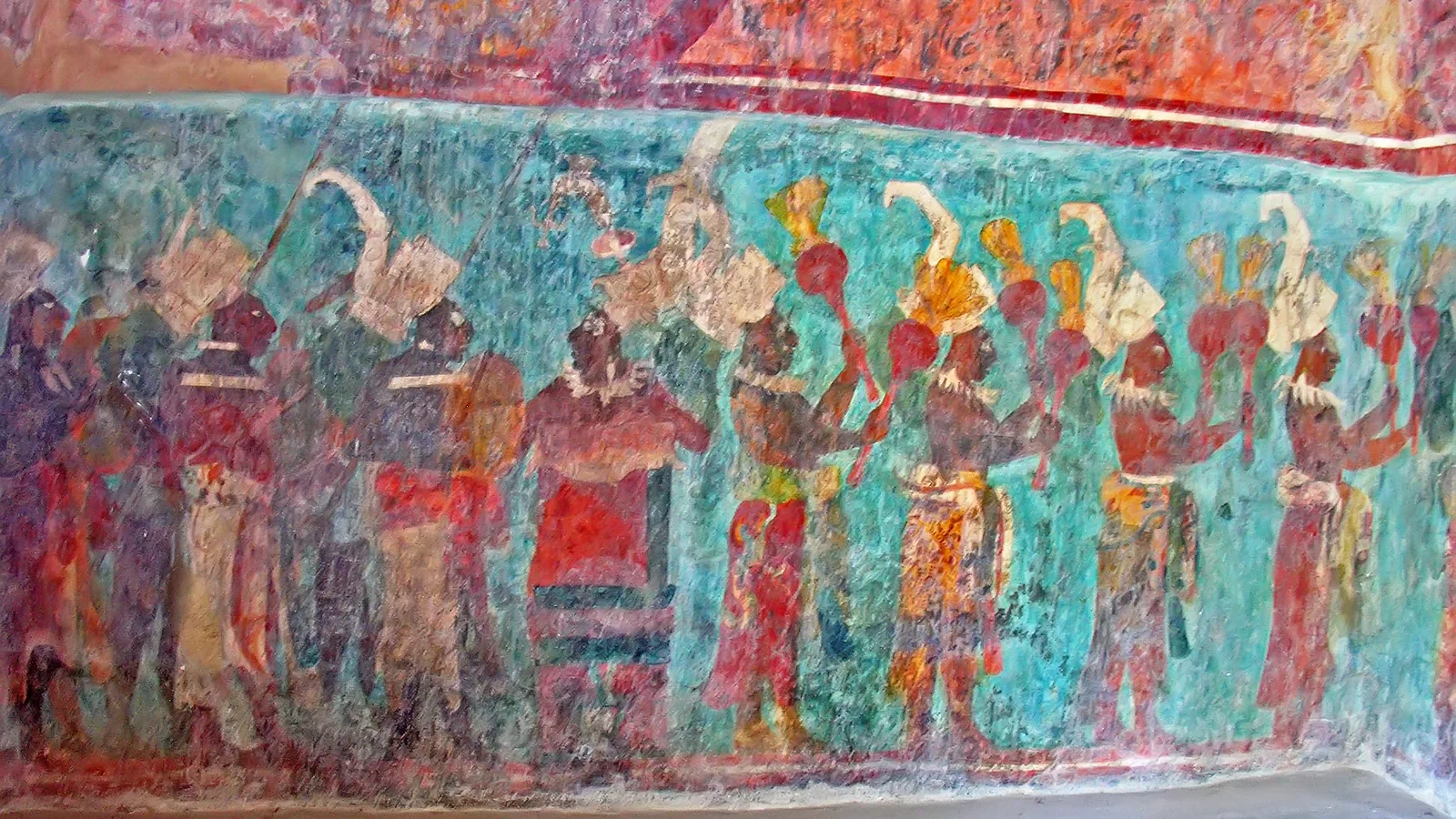
INAH calls Structure 1 “Building 1 or Temple of the Paintings” and places it in “the last construction phase” at Bonampak, a site that “reached its apogee between 600 and 800 AD,” first under the rule of Piedras Negras and later under Yaxchilán. An earlier ruler is carved on a different building: INAH records that “Building six is the oldest of the whole complex; it has a lintel carved with the image of the ruler Chaan Muan I, who ruled Bonampak around 600 AD.” Room 1 of Structure 1 shows, per INAH, “the heir’s presentation, clothing of nobles, and musicians.” NMAI describes nobles in “white robes adorned with precious spondylus shells” and jade ornaments, watching “a procession of musicians” play rattles, drums, turtle-shell drums and trumpets. Room 3, INAH writes, holds “ceremonial scenes with dancers in resplendent dress and self-sacrifice rituals,” with 69 painted figures. NMAI records that royal women performed “acts of self-sacrifice through bloodletting,” drawing blood with stingray spines, cactus spines and obsidian knives.
Chan Muwan II's battle, painted in Room 2
Room 2, INAH states, “features an important battle in which Chan Muwan II, the lord or ‘ajaw’ of the city, defeated the previous governor with the support of Yaxchilán.” INAH does not name the defeated ruler. NMAI counts “at least 100 figures” in the original battle scene. A FAMSI research report by Kevin J. Johnston, drawing on a National Geographic Society computer reconstruction directed by Mary Miller, describes the aftermath in the same room: “nine prisoners are crouching at the feet of the local victorious ruler.” Johnston’s report argues, from that reconstruction, that the captives may have been scribes.
February 6, 1946: past the murals without seeing them
John Bourne wrote in his memoir that he and Carl Frey spent “36 days in the Lacanhá, from January 31, 1946 to March 7, 1946.” On February 6, he recorded that the party crossed a shallow stream and reached a large, well-preserved temple, the first ruin they had seen: “We named this Structure 1.” Frey and the chiclero Acasio Chan then worked beside the mural building without knowing it: Bourne wrote that “Carl and Acasio were hacking down jungle growth just west of Structure 1. This was in the same area where four months later Healey found the temple with the fabulous murals . . . The temple with the murals turned out to be only 115 feet west of Structure 1.” On March 14, 1946, Bourne recorded, “Carl reported the ruins to Sr. Juan Palacios of the Instituto Nacional de Antropologia e História.”
Giles Healey and a dispute recorded only in Bourne's memoir
Bourne’s guide to Bonampak itself was the Lacandon ChanBor, known by the Spanish name José Pépe. After Bourne gave him a Victrola phonograph, Bourne wrote, “he was so pleased with his new toy he agreed to take us to a very special ruin the Lacandon kept secret”: the building later known as Bonampak. Bourne credited the archaeologist Sylvanus Griswold Morley with the name itself, and glossed it as “literally translated as ‘vat-dyed’ or ‘tanned,’ as in fabric or leather.” When Healey returned to the area in May 1946, Bourne wrote, “he heard about our discoveries and was taken to the first ruin Carl and I had seen on February 6, 1946. It was then he was shown the building with the paintings.” Bourne’s memoir also records a dispute over credit: he wrote that Frey, in a letter of June 7, 1947, described how the names he and Bourne had left at Bonampak in October 1946 had since disappeared, because “a Mexican painter told Carl only Healey’s name was there.” The account of the dispute is Bourne’s own.
Kerosene, INAH's restorations and Yale's infrared record
A photograph held in the Repositorio INAH records that researchers on “a Carnegie Institution and Instituto Nacional de Antropología e Historia expedition” once “cleaned mural walls with kerosene to temporarily reveal the painted surfaces for extensive photographic documentation,” an activity the repository dates to about 1947, in a photograph it dates to about 1950. The same record shows painters Agustín Villagra Caleti and Antonio Tejeda copying the west wall of Room 1, and states that “replicas of the murals were realized by Agustín Villagra, Antonio Tejeda and Rina Lazo.” INAH writes that it later “restored the murals in 1984 after extensive and lengthy deliberation at national and international levels,” reversing a “thick layer of carbonate salt deposits,” and that “since 2011 the INAH has begun a second restoration process, this time using modern methods.” Yale formed its Bonampak Documentation Project in 1995 under Mary Miller, recording the rooms in “color transparency, photographic infrared, and video infrared,” Yale News reported. Painters Heather Hurst and Leonard Ashby spent two years producing reconstruction paintings at half the murals’ scale, 29 feet by 8 feet, Yale News reported in January 2002. On May 15, 2002, Yale News reported, the project delivered its records and prints to the Museo Nacional de Antropología, where Miller told INAH director general Sergio Raúl Arroyo that “perhaps no single artifact from the ancient New World offers as complex a view of Prehispanic society as do the Bonampak paintings.”
.jpg)
Key facts
- Structure 1’s three rooms carry calendar inscriptions dating the murals to AD 790-792 (NMAI).
- Room 1 shows an heir’s presentation, nobles in spondylus-shell robes and jade, and a procession of musicians (INAH; NMAI).
- Room 2 shows Chan Muwan II’s battle, fought “with the support of Yaxchilán,” against an unnamed previous governor (INAH).
- NMAI counts at least 100 figures in the original battle scene; a FAMSI report by Kevin J. Johnston describes nine captives crouching before the victorious ruler (NMAI; Johnston).
- Room 3 shows a ceremony with 69 figures and royal bloodletting with stingray spines, cactus spines and obsidian knives (INAH; NMAI).
- On February 6, 1946, Carl Frey and John Bourne reached Structure 1 and worked within 115 feet of the mural building without finding it, by Bourne’s own account.
- Giles Healey was shown the murals in May 1946, guided back to the site after hearing of Frey and Bourne’s earlier find (Bourne’s memoir).
- Yale’s Bonampak Documentation Project, formed in 1995 under Mary Miller, delivered its infrared record and reconstruction paintings to INAH on May 15, 2002.
FAQ
When were the Bonampak murals painted?
Calendar inscriptions in the murals date them to between AD 790 and 792, according to the Smithsonian's National Museum of the American Indian.
Who found the Bonampak murals?
Local Lacandon guides took Carl Frey and John Bourne to Structure 1 on February 6, 1946, but the pair did not find the mural building itself; Giles Healey was guided to it in May 1946. Bourne's own memoir records a later dispute over credit between Frey and Healey.
What damaged the murals after their discovery?
A photograph in the Repositorio INAH shows researchers cleaning the walls with kerosene, around 1947, to make the paintings visible for photography. INAH restored the murals in 1984 and began a second restoration, with modern methods, from 2011.
Sources
- Instituto Nacional de Antropología e Historia (INAH), "Bonampak" (lugares.inah.gob.mx, English edition) — used for Structure 1's three rooms, Room 1-3 content, the site's apogee dates, Building 6 and Chaan Muan I, the 1946 Lacandon guiding, and the 1984 and post-2011 restorations.
- Smithsonian, National Museum of the American Indian, "Bonampak" (Living Maya Time gallery) — used for Room 1-3 detail (nobles' dress, the musicians, the battle's original scale, the bloodletting instruments) and the AD 790-792 date range.
- Kevin J. Johnston, "Broken Fingers: The Capture of the Scribe in Classic Maya Culture," FAMSI research report — used for the description of the captives crouching before the victorious ruler.
- John Bourne, Recollections of My Early Travels in Chiapas: Discoveries at Oxlahuntun (el Perro), Miguel Angel Fernandez, Bonampak and Lacanhá (2001, hosted by Mesoweb) — used for the February 6, 1946 approach to Structure 1, the guide ChanBor, the March 14, 1946 report to INAH, Healey's May 1946 viewing, and the credit dispute, all as Bourne recorded them.
- Repositorio INAH, photograph record "Agustín Villagra Caleti y Antonio Tejeda, pintores, copian los murales del Cuarto 1, lado poniente de Bonampak" — used for the kerosene cleaning and its dating, and the painters' copy work including Rina Lazo's later replicas.
- Yale News, "Yale Professor Presents Mexican Government with Records of Ancient Maya Art" (May 15, 2002) — used for the Bonampak Documentation Project's formation in 1995, its recording methods, and the delivery of records to INAH director general Sergio Raúl Arroyo.
- Yale News, "Reconstruction of Historical Maya Murals Exhibited at Yale" (January 4, 2002) — used for the reconstruction paintings by Heather Hurst and Leonard Ashby, their scale and the two years the work took.
Cite this article
- APA
- Our Earth's History. (2026, September 27). Three painted rooms at Bonampak, c. 790, entered by outsiders in 1946. Our Earth's History. https://ourearthshistory.com/americas/classical/bonampak-murals-c-790-three-rooms-structure-1-healey-1946/
- Chicago
- Our Earth's History. “Three painted rooms at Bonampak, c. 790, entered by outsiders in 1946.” Our Earth's History, September 27, 2026. https://ourearthshistory.com/americas/classical/bonampak-murals-c-790-three-rooms-structure-1-healey-1946/.
- MLA
- “Three painted rooms at Bonampak, c. 790, entered by outsiders in 1946.” Our Earth's History, 27 Sep. 2026, https://ourearthshistory.com/americas/classical/bonampak-murals-c-790-three-rooms-structure-1-healey-1946/.
Text licensed CC BY-NC-ND 4.0. Found an error? Tell us.