PLOS ONE's 102 dates put Tiwanaku's collapse at AD 1010 to 1050
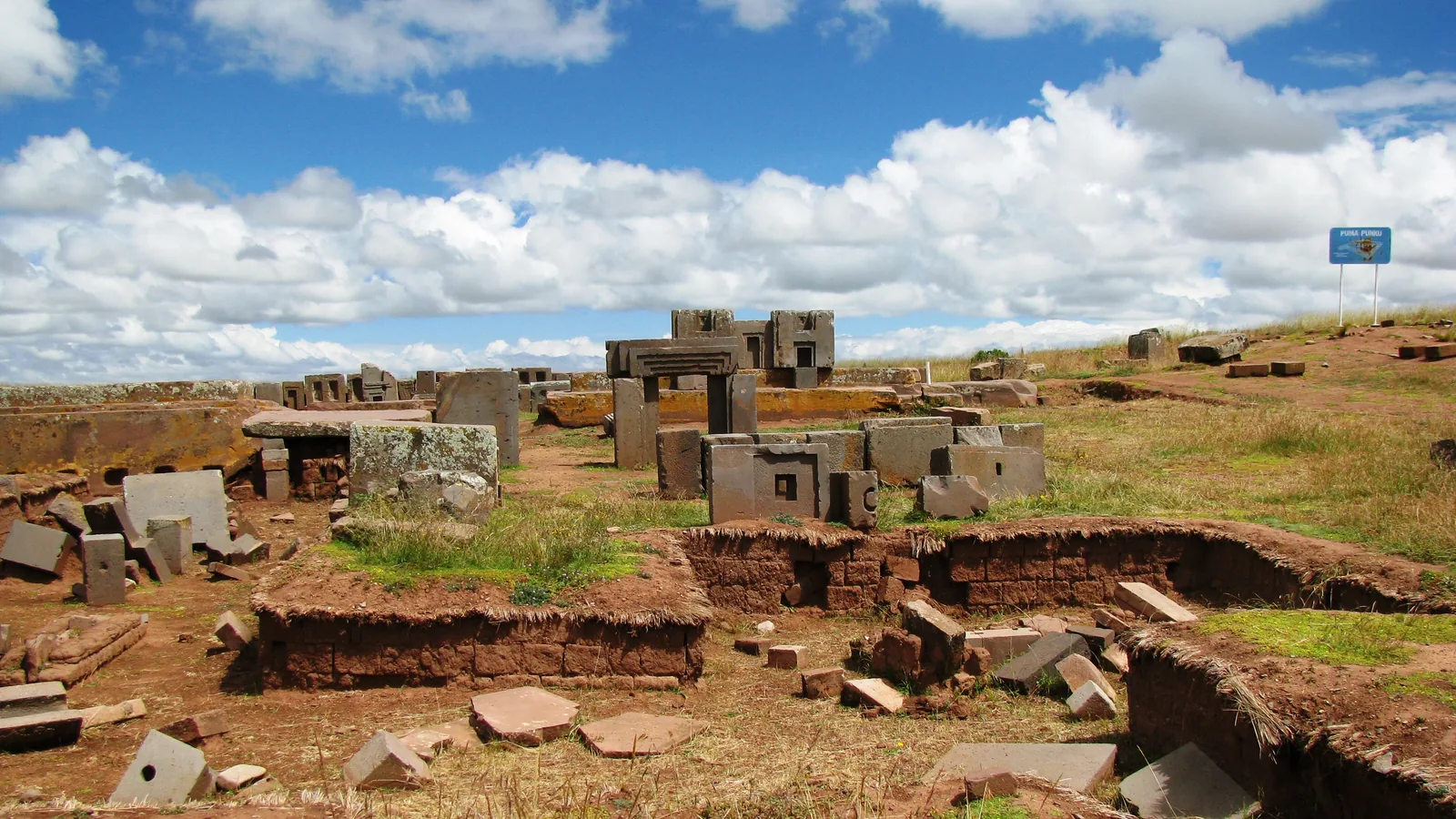

TL;DR — A 2023 model of 102 radiocarbon dates puts Tiwanaku’s monuments at about AD 590 to 720 and its collapse at 1010 to 1050, earlier than the drought.
“These four events suggest a rapid, city-wide collapse,” Erik J. Marsh, Alexei Vranich and their co-authors wrote in PLOS ONE in 2023, placing the end of Tiwanaku between AD 1010 and 1050. The city stood near the southern rim of Lake Titicaca, in what is now Bolivia. The team modeled 102 radiocarbon dates and found that its two great stepped platforms, the Akapana and the Pumapunku, went up mostly between about 590 and 720, and that the breakdown took about 20 years. The authors wrote that it came “well before reduced precipitation,” and a separate 2023 study of Lake Titicaca’s water levels, published in the Proceedings of the National Academy of Sciences (PNAS), also rejected a drought-driven collapse.
Quick facts
- When
- About AD 180 (founding, per Marsh and colleagues) · about 580 to 710 (Pumapunku construction) · about 590 to 720 (monument building site-wide) · about 910 (tomb burials end) · about 1010 (permanent residence ends) · about 1050 (temporary camps end) · 1932 (Bennett monolith exhumed) · 1957 (Ponce monolith exhumed) · 2000 (Bennett monolith returned to Tiwanaku, per Villanueva Criales)
- Where
- Tiwanaku, near the southern rim of Lake Titicaca, in what is now Bolivia; the Akapana, the Pumapunku, the Kalasasaya and the Templete Semisubterráneo; La Paz
- Who
- Erik J. Marsh, Alexei Vranich and colleagues (PLOS ONE, 2023); Stéphane Guédron and colleagues (PNAS, 2023); Alan L. Kolata; Charles R. Ortloff; Wendell Bennett; Carlos Ponce Sanginés; Juan Villanueva Criales; Bolivia's site authority, CIAAAT
- Outcome
- A Bayesian model of 102 radiocarbon dates placed Tiwanaku's collapse at about AD 1010 to 1050, over roughly 20 years, and its authors wrote that it came well before reduced precipitation; an independent 2023 lake-level study also concluded that the drier period did not imply a drought-induced collapse
Seven terraces, three platforms and a gate of andesite
Bolivia’s site authority, the Centro de Investigaciones Arqueológicas, Antropológicas y Administración de Tiwanaku (CIAAAT), describes the Akapana as a pyramid temple of seven platforms whose main western entrance was guarded by black chachapumas, carved puma-men. Marsh and his colleagues call the Akapana the site’s largest monument, a stepped platform 17 meters tall, and give its base as 197 by 203 meters.
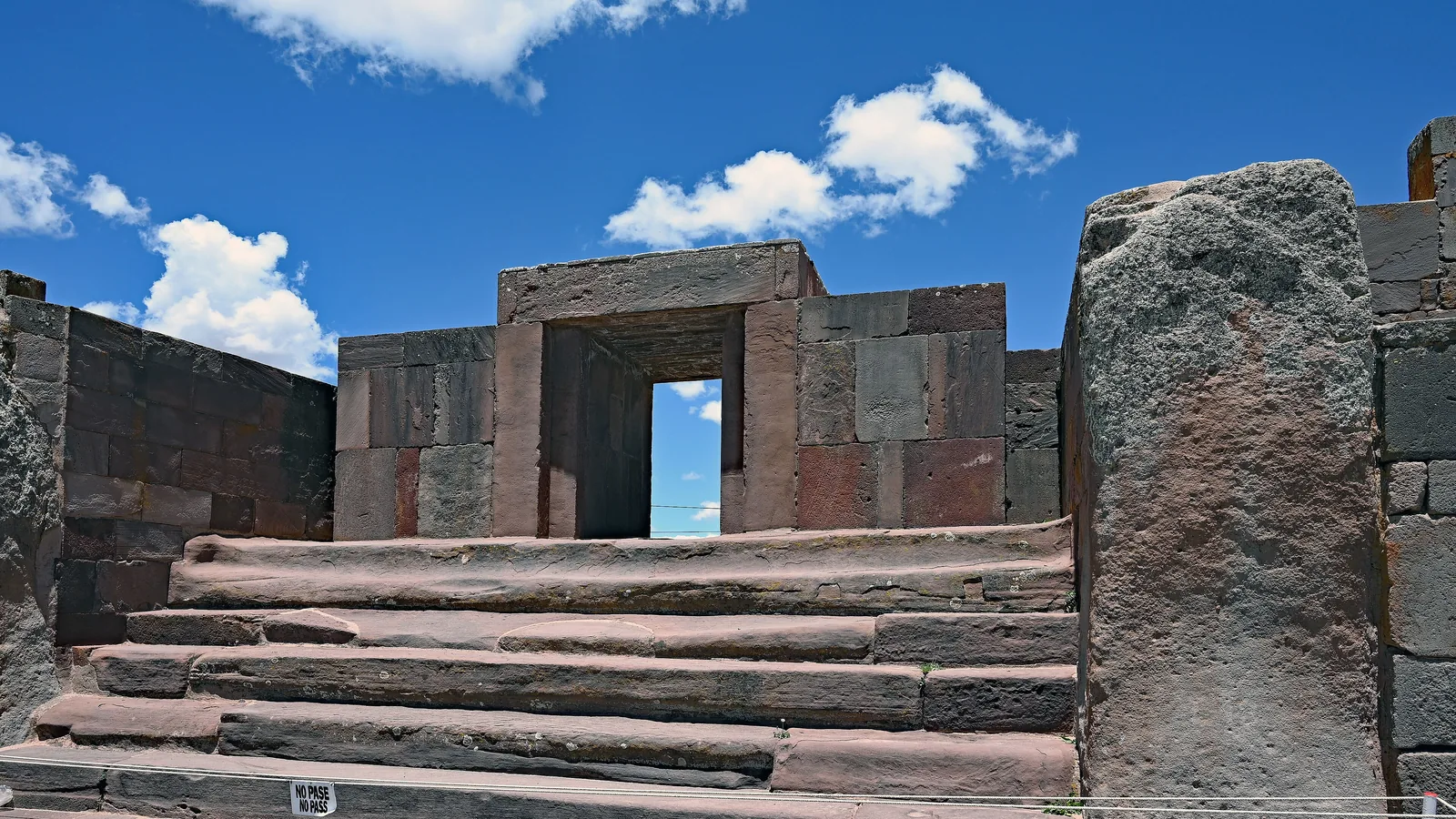
The Pumapunku, in CIAAAT’s account, is a pyramid temple of three platforms facing Lake Titicaca, fronted with large carved stones, and it shows a later Inca presence. The PLOS ONE paper describes it as a smaller platform “renowned for oversized stone blocks and precisely cut ashlars.” In the older Kalasasaya enclosure, CIAAAT places the Gateway of the Sun, which it calls the most important architectural piece at Tiwanaku: a single block of andesite weighing more than 10 tonnes, 3 meters high and 4 wide.
Radiocarbon dates for one or two generations of masons
The PLOS ONE model starts construction at the Pumapunku around AD 580. A green surface in its layers, which the model puts around 630, marks the last use of quarried, carved stone; after it, masons at both platforms worked with reused blocks. “Hence perhaps only one or two generations of masons were responsible for most of Tiwanaku’s iconic stonework,” the authors wrote. Pumapunku construction ended around 710. At the Akapana, four dated offerings cluster around 640 to 660, with wide error ranges. Combining 11 dated events from both monuments, the team set monument building at about 590 to 720.
One offering on the Akapana, sample SMU-2473, had been read as a closing ceremony during a 12th-century drought. The 2023 paper calls that reading “tenuous,” since the date carries an error range of plus or minus 243 years, and adds that a second date from the same context, INAH-972, is three centuries older.

AD 910 to 1050, from tombs to temporary camps
In the authors’ account, Tiwanaku was founded around AD 180 and by about 600 had become the region’s main destination for migrants. Around 910, burial in formal tombs ended and violent deaths began, which they call “a major watershed in the site’s history that has been unrecognized until now.” The violent deaths ended around 1020.
The model’s clearest marker of breakdown is the end of permanent residence, around 1010, with a 95 percent range of 970 to 1050. Visitors kept using the same ceramics until about 1040, and temporary camps lasted until about 1050. The authors estimate that the sequence took about 20 years, with a 95 percent range of zero to 70.
At Lukurmata and Tiraska, closer to the lake, redware pottery stayed in use for several more generations, and nearby raised fields were farmed after Tiwanaku had no permanent residents. The authors read this as a small community keeping older farming and potting traditions, and they wrote that it cannot be treated as a state still operating into the 12th century.
"Drier overall" at Lake Titicaca
The role of drought, in the paper’s words, has been “hotly contested for decades.” Alan L. Kolata’s 1993 book The Tiwanaku: Portrait of an Andean Civilization and a 1997 paper in Quaternary Research by M. W. Binford, Kolata and colleagues used lake-core data to propose drought as the cause of the fall of both the city and the state. Charles R. Ortloff and Kolata made a similar case in the Journal of Archaeological Science, and Patrick Ryan Williams questioned disaster-driven collapse in World Archaeology in 2002. The 2023 paper states that climate records, though imprecise, suggest the drought began in the 12th century, more than a century after the site’s abandonment. On that timing, the authors concluded that the collapse “took place well before reduced precipitation, hence this was not a drought-induced societal change.” Their dates put the empty city ahead of the dry spell.
Stéphane Guédron and colleagues reached a similar result from the lake itself. Their PNAS paper, issued January 10, 2023, modeled Lake Titicaca’s level from sediment cores and ancient shorelines. The second half of the Tiwanaku state period, they wrote, “was drier overall,” with the lake falling gradually from about AD 850 to 1000 and rising again around 1150. Reduced rainfall “likely affected Tiwanaku’s residents,” they concluded, but it did not imply a drought-induced collapse.
The same paper places the development of raised-field farming in the Late Formative period, 200 BC to AD 500. A University of Chicago anthropology department notice of November 14, 2023, reported that Kolata and Ortloff had published a fluid and thermal analysis of Tiwanaku raised-field systems in the journal Water.
Bennett and Ponce, the two largest monoliths
The archaeologist Juan Villanueva Criales, writing in Latin American Antiquity in 2025, calls the Bennett monolith the largest complete Tiwanaku sculpture, 730 by 180 by 127 centimeters. Wendell Bennett fully exhumed it in 1932. It lay face up inside the Templete Semisubterráneo, the sunken temple that CIAAAT describes as the oldest at the site.
The Ponce monolith, 300 by 79 by 54 centimeters, is in Villanueva Criales’s account the best preserved and second largest. A team from the Centro de Investigaciones Arqueológicas en Tiwanaku led by Carlos Ponce Sanginés exhumed it in 1957 in the central enclosure of the Kalasasaya. After the team’s restoration of the Kalasasaya, which Villanueva Criales calls controversial, the monolith was raised in the center of the enclosure, where it still stands.
The Bennett monolith traveled farther. A. Posnansky, who documented its carvings in 1945, promoted moving it to La Paz. CIAAAT’s museum page lists it, at more than 7 meters tall, among the leading sculptures of the stone museum. Villanueva Criales gives the year it came home: it “was returned to Tiwanaku in 2000 and is now the main attraction of the site’s Museo Lítico.”
Key facts
- Marsh, Vranich and colleagues modeled 102 radiocarbon dates for PLOS ONE in 2023, and called one earlier reading of an Akapana date “tenuous” because of its error range of plus or minus 243 years.
- Their model puts Tiwanaku’s founding around AD 180 and monument building at about 590 to 720.
- Pumapunku construction began around 580, the last quarried, carved stone was used around 630, and construction ended around 710.
- Burial in formal tombs ended and violent deaths began around 910; permanent residence ended around 1010 (95 percent range 970 to 1050).
- The authors estimate the collapse took about 20 years, between about 1010 and 1050, and wrote that it came “well before reduced precipitation.”
- Guédron and colleagues, in PNAS in 2023, found the lake falling gradually from about 850 to 1000 and rising around 1150, and wrote that the drier period did not imply a drought-induced collapse.
- CIAAAT describes the Akapana as a temple of seven platforms, the Pumapunku as a temple of three platforms facing Lake Titicaca, and the Gateway of the Sun as a single andesite block of more than 10 tonnes.
- Wendell Bennett exhumed the Bennett monolith in 1932 and Carlos Ponce Sanginés’s team the Ponce monolith in 1957; Villanueva Criales gives 2000 as the year the Bennett monolith returned to Tiwanaku.
FAQ
When did Tiwanaku collapse?
A 2023 model of 102 radiocarbon dates by Erik J. Marsh, Alexei Vranich and colleagues places permanent residence ending around AD 1010 and the collapse between about 1010 and 1050, over roughly 20 years.
Did drought cause the fall of Tiwanaku?
Alan L. Kolata and colleagues proposed drought in the 1990s from lake-core data. The 2023 PLOS ONE authors wrote that the collapse came well before reduced precipitation, and a 2023 PNAS study of Lake Titicaca's levels concluded that the drier period did not imply a drought-induced collapse.
Where is the Bennett monolith?
In the Museo Lítico at Tiwanaku. Wendell Bennett exhumed it in 1932, it was moved to La Paz, and Juan Villanueva Criales writes that it was returned to Tiwanaku in 2000.
Sources
- Erik J. Marsh, Alexei Vranich and colleagues, "The center cannot hold: A Bayesian chronology for the collapse of Tiwanaku," PLOS ONE 18(11) (2023), e0293641, PubMed Central open-access copy.
- Stéphane Guédron, Christine Delaere, Sherilyn C. Fritz and colleagues, "Holocene variations in Lake Titicaca water level and their implications for sociopolitical developments in the central Andes," Proceedings of the National Academy of Sciences 120(2) (2023), e2215882120, PubMed Central open-access copy.
- Juan Villanueva Criales, "Drunken Mountains: Analysis of the Bennett and Ponce Monoliths of Tiwanaku (AD 500–1100) from a Multispecies Perspective," Latin American Antiquity 36 (2025), 181–201, Cambridge University Press (open access PDF).
- University of Chicago, Department of Anthropology, "Kolata discusses the function of raised fields associated with the Tiwanaku society" (November 14, 2023).
- Centro de Investigaciones Arqueológicas, Antropológicas y Administración de Tiwanaku (CIAAAT), official site, "Sitio Arqueológico" (Kalasasaya, Puerta del Sol, Templete Semisubterráneo, Akapana, Pumapunku).
- CIAAAT, official site, "Museos" (Museo Cerámico and Museo Lítico).
Cite this article
- APA
- Song Letter. (2026, September 29). PLOS ONE's 102 dates put Tiwanaku's collapse at AD 1010 to 1050. Our Earth's History. https://ourearthshistory.com/americas/medieval/tiwanaku-akapana-pumapunku-radiocarbon-2023/
- Chicago
- Song Letter. “PLOS ONE's 102 dates put Tiwanaku's collapse at AD 1010 to 1050.” Our Earth's History, September 29, 2026. https://ourearthshistory.com/americas/medieval/tiwanaku-akapana-pumapunku-radiocarbon-2023/.
- MLA
- Song Letter. “PLOS ONE's 102 dates put Tiwanaku's collapse at AD 1010 to 1050.” Our Earth's History, 29 Sep. 2026, https://ourearthshistory.com/americas/medieval/tiwanaku-akapana-pumapunku-radiocarbon-2023/.
Get the week in history
One email a week: the new articles, and what was happening elsewhere at the same moment. Free, no ads, unsubscribe any time. How we handle your email.
Text licensed CC BY-NC-ND 4.0. Found an error? Tell us.