How Did the Maya Nail Venus's Cycle to Within 0.01 Days — Without a Telescope?
.jpg)
TL;DR — The Classic Maya (about AD 250–900) worked out the cycle of Venus at 583.92 days by naked-eye observation over generations. The modern value is 583.93. The figure survives in the Venus Table of the Dresden Codex.
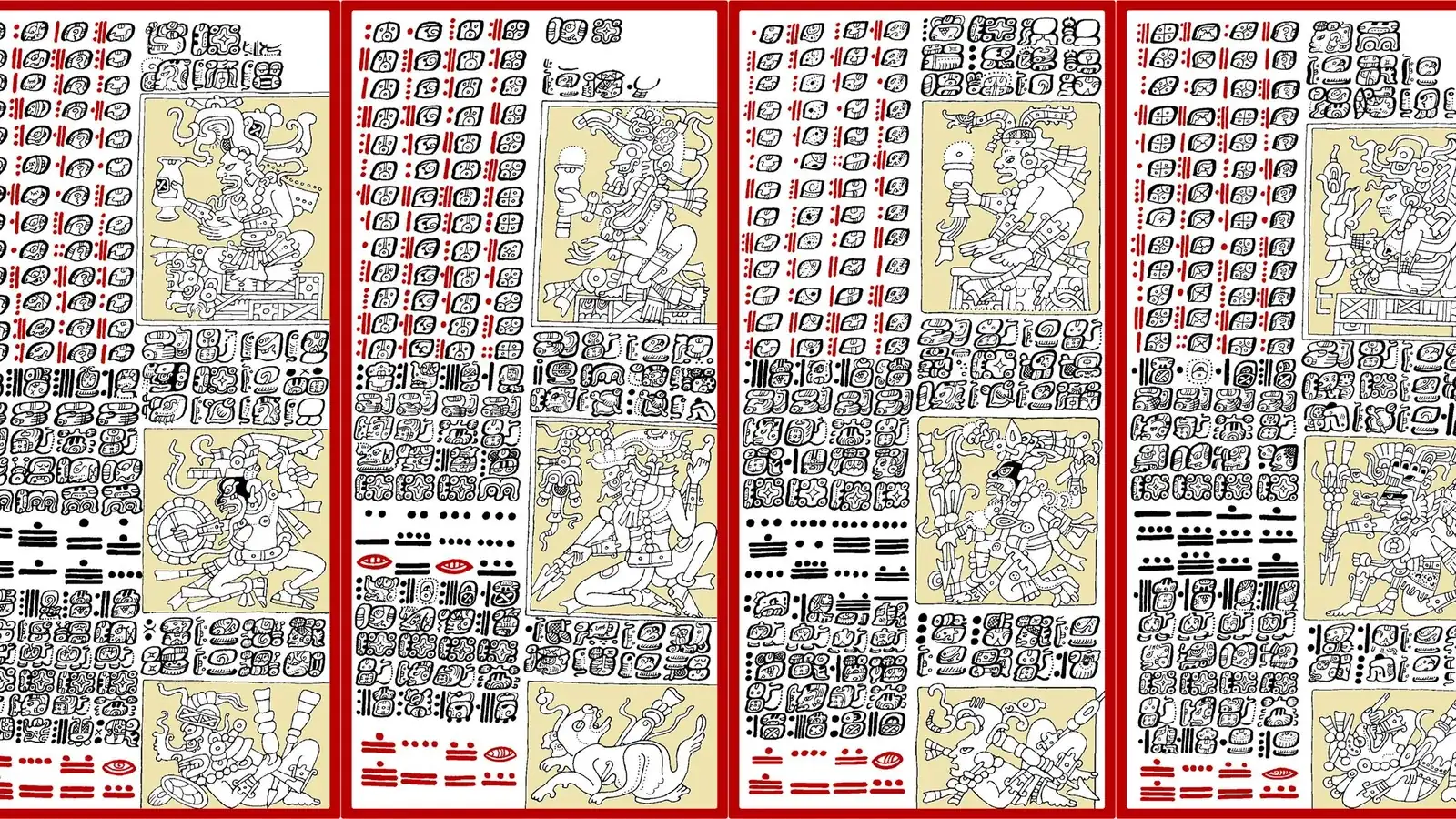
The Classic Maya calculated the cycle of Venus at 583.92 days, one-hundredth of a day from the modern value of 583.93, and recorded it in the Venus Table of the Dresden Codex, a folded bark-paper book. They did it with no telescope, lens, or metal tools. Scribes in the city-states of southern Mexico, Guatemala, Belize, and Honduras noted the dates on which Venus appeared and vanished, generation after generation, in a base-20 number system with a shell sign for zero. From that ledger of sky-dates they extracted the planet’s rhythm as seen from Earth and could predict its returns days in advance. The method was observation and arithmetic, not anything supernatural.
Which star did the Maya track so precisely?
The star was the planet Venus. To the naked eye Venus is maddening: it blazes in the eastern sky before dawn, then vanishes for a stretch, only to reappear in the west after sunset. Predicting when it would disappear and return was the puzzle.
The Maya solved it. From long observation they found that one full cycle of Venus, from morning star through evening star and back to the same position, runs about 583.92 days. This is the planet’s synodic period, its rhythm as seen from Earth, not its 225-day orbit around the Sun.
Who were the Classic Maya?
The Classic Maya civilization flourished roughly between AD 250 and 900 across what is now southern Mexico (Chiapas, Yucatán), Guatemala’s Petén, Belize, and western Honduras. It was a world of dozens of independent city-states, among them Tikal, Calakmul, Palenque, and Copán, each with its own king, raising limestone step-pyramids above the jungle. There was no single empire.
This was a civilization without metal tools, without the wheel for transport, and without draft animals. Their cutting tools were obsidian and chert. Precise long-term astronomy under those limits is what makes the feat stand out.
Why did tracking the sky matter to them?
In each city, certain people were charged with reading the heavens. The movements of the sky helped set when to plant and when to hold ceremonies, so the calendar functioned as a kind of state timetable. A scribe might look up at the same star, night after night, for a lifetime.
One lifetime was not enough to solve Venus. The answer had to be built across generations, which is why written records became essential.
How did they record the data without paper or Arabic numerals?
The Maya wrote in books of folded bark paper, called codices, using a base-20 (vigesimal) number system built from just three signs: a dot for one, a bar for five, and a shell for zero. Scribes noted each date that Venus appeared and vanished, and those observations accumulated over centuries.
The zero as a place-holder mattered: positional notation with zero appears in Mesoamerica early. From this long ledger of sky-dates, Maya reckoners extracted the underlying rhythm and set it down in the Venus Table of the Dresden Codex, one of only four Maya codices to survive the Spanish conquest.
How close were they to the modern value?
Very close. The Maya figure of 583.92 days differs from the modern astronomical value of about 583.93 days by roughly one-hundredth of a day. With the table, they could predict on which horizon Venus would next rise days in advance, by naked eye and arithmetic alone.
The popular line “Venus’s year” means its synodic cycle (morning star to evening star and back), not the planet’s orbital year of about 225 days.
Was this supernatural, or evidence of "ancient astronauts"?
Neither. The precision came from centuries of disciplined observation combined with mathematics, a human achievement. Claims that aliens or a lost super-civilization were involved are pseudo-archaeology with no evidence. The same goes for the popular idea that the carved lid of King Pakal’s sarcophagus depicts a “spaceman.” It is Maya cosmology, read in its own symbolic terms.
The Maya also did not vanish. The Classic-period collapse of the southern lowland cities was not the extinction of a people. Roughly seven million Maya live across Mexico and Central America, speaking some 30 Mayan languages.
Key facts
- The “star” the Maya tracked so precisely was the planet Venus.
- Their value for Venus’s synodic cycle was 583.92 days, within about 0.01 days of the modern 583.93.
- The calculation survives in the Venus Table of the Dresden Codex, one of only four surviving Maya codices.
- The Classic Maya (about AD 250–900) were a world of independent city-states, not a single empire.
- They had no telescope, no metal tools, and no wheel, only naked-eye observation, obsidian tools, and base-20 math.
- Their numbers used a dot (1), a bar (5), and a shell (0), with an early use of positional zero.
- The precision was a human achievement; “ancient astronaut” claims are pseudo-archaeology and are rejected.
FAQ
How did the Maya calculate Venus's cycle without a telescope?
By accumulating naked-eye observations of Venus's appearances and disappearances over generations, recording each date in bark-paper codices using base-20 numbers, and extracting the repeating rhythm, a synodic cycle of 583.92 days.
What is the Dresden Codex?
The Dresden Codex is a Maya bark-paper book, one of only four Maya codices to survive the Spanish conquest. Its Venus Table records the planet's cycle and allowed long-range predictions of its appearances.
How accurate was the Maya figure for Venus?
Their value of 583.92 days differs from the modern astronomical value of about 583.93 days by only around one-hundredth of a day.
Did the Maya really disappear?
No. The Classic-period collapse affected the southern lowland cities, not the Maya people. About seven million Maya live across Mexico and Central America, speaking around 30 Mayan languages.
Does this prove aliens visited the Maya?
No. The achievement came from centuries of patient observation and mathematics. "Ancient astronaut" and lost-civilization claims are pseudo-archaeology with no supporting evidence.
Sources
- Mayan.org — "Maya Mathematics" (base-20 system, zero, and the Dresden Codex Venus figure of 583.92 days)
- Wikipedia — "Maya numerals," "Dresden Codex," "Mesoamerican Long Count calendar," "Maya peoples," "2012 phenomenon."
- Lumen Learning, World Civilization — "The Classic Period of the Maya" (chronology, city-states, writing, calendars)
- UCSB Mesoamerican Research Center — "Classic Period" (architecture, cities)
- Britannica — "Maya" and "Long Count."
- National Geographic — "2012 Maya Calendar Explained" (why the doomsday reading is a modern misunderstanding)
Cite this article
- APA
- Our Earth's History. (2026, August 7). How Did the Maya Nail Venus's Cycle to Within 0.01 Days — Without a Telescope? Our Earth's History. https://ourearthshistory.com/americas/medieval/maya-venus-cycle-dresden-codex-naked-eye/
- Chicago
- Our Earth's History. “How Did the Maya Nail Venus's Cycle to Within 0.01 Days — Without a Telescope?” Our Earth's History, August 7, 2026. https://ourearthshistory.com/americas/medieval/maya-venus-cycle-dresden-codex-naked-eye/.
- MLA
- “How Did the Maya Nail Venus's Cycle to Within 0.01 Days — Without a Telescope?” Our Earth's History, 7 Aug. 2026, https://ourearthshistory.com/americas/medieval/maya-venus-cycle-dresden-codex-naked-eye/.
Text licensed CC BY-NC-ND 4.0. Found an error? Tell us.