A sealed room at Mogao, opened in 1900: the Dunhuang Library Cave
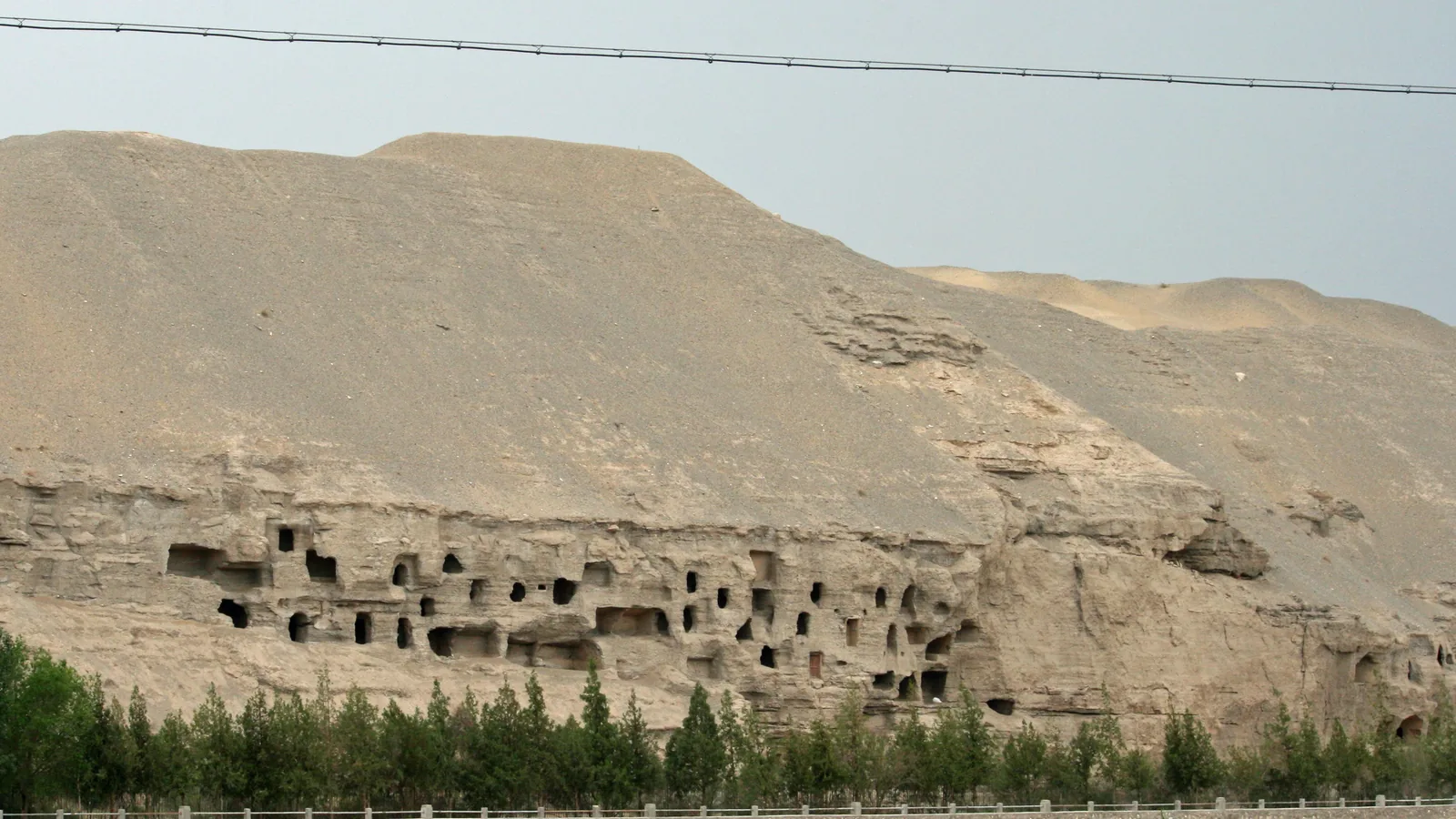

TL;DR — Cave 17 at Mogao, sealed by the early 11th century, was opened by Wang Yuanlu in 1900; Stein, Pelliot and others later carried its manuscripts abroad.
The material in Cave 17 at Mogao dates, in the Encyclopaedia Iranica’s words, “from the 4th to the early years of the 11th century, when the cave was sealed.” In June 1900, Wang Yuanlu, the Daoist caretaker of the site, found the hidden entrance to that small room while clearing sand from the corridor of a large cave-temple. Inside were tens of thousands of manuscripts, printed documents, paintings and textiles.
Quick facts
- When
- sealed by the early 11th century; opened June 1900; Stein's purchase 1907; Pelliot's visit 1908; Chinese government recovery 1909-10; Otani expedition 1911; Oldenburg expedition 1914
- Where
- Cave 17 (the Library Cave) at the Mogao Caves, near Dunhuang, in what was then Gansu province, China
- Who
- Wang Yuanlu, the Daoist caretaker who opened the cave; Aurel Stein; Paul Pelliot; Otani Kozui and Zuichi Tachibana; Sergei Oldenburg
- Outcome
- manuscripts dating from the 4th to the 11th century were dispersed to London, Paris, Beijing, St. Petersburg and Kyoto; the International Dunhuang Project, founded in 1994, now links more than 35 partner institutions
Wang Yuanlu opens a sealed room, 1900
The International Dunhuang Programme blog, published by the British Library, describes Wang Yuanlu as “Originally from Hubei,” who “moved to the Mogao Caves around 1899” and worked to raise funds for the restoration of the site. A separate account, the University of Washington Tateuchi East Asia Library’s virtual exhibition, calls him “a Daoist abbot from Shanxi Province.” The two institutions give different provinces of origin.
Wang alerted local officials about the find, but the IDP blog records that “no measures were taken until 1904, when orders came from the provincial government in Lanzhou to ensure that Cave 17’s contents were back in situ and safely guarded.” That task fell to Wang himself, who put a locked door on the cave and kept the key. From 1900 onward he had already given some well-preserved manuscripts and silk paintings to local officials who had shown interest in the find.
1907: Aurel Stein's purchase
Aurel Stein returned to Mogao in May 1907. The IDP blog describes how Wang, who separated the material into “miscellaneous” and “regular” bundles, allowed Stein only a brief look inside the cave and handed items to him one at a time rather than letting him choose freely. The Encyclopaedia Iranica entry on Stein states that once he and Wang discovered “a common admiration for Xuanzang, Wang Yuanlu eventually agreed to sell, for a small sum, many thousands of manuscripts and paintings.” Neither institutional source gives a specific figure for that sum.
Accounts of the volume removed differ between the two institutions. The IDP blog states that “Stein left Dunhuang at the beginning of June 1907, with 12 cases crammed with all his acquisitions,” and that his secretary Jiang Xiaowan later secured “another 230 of the regular bundles.” The University of Washington exhibition instead states that Stein “bought 29 cases of manuscripts and paintings with silvers.”
A letter from Pelliot, and removals to 1944
Paul Pelliot arrived the following year. The University of Washington exhibition records that he “spent three weeks in the Library Cave, selecting thousands of religious, secular, and local documents of great value,” and that on his way back through Beijing he showed some to local Chinese scholars. The Encyclopaedia Iranica cites Pelliot’s own account, written at the site: “In his famous letter to Émile Senart in Paris, dated 26 March 1908 and written at the site, Paul Pelliot reported on his most important finds in the library cave.” Among the items he singled out were Manichean texts in Chinese, including a fragment outlining Manichean doctrine and church organization.
Further removals followed. In 1909, the University of Washington exhibition states, “the Chinese Ministry of Education issued a government directive to recover and transport the remaining manuscripts to Beijing,” but during that process “some were relocated by Abbott Wang before the transport, and hundreds were stolen by government officials.” What remained, more than 8,000 manuscripts, became the core of the National Library of China’s collection. In 1911, “Japanese expedition led by Count Otani Kozui and Zuichi Tachibana arrived at Dunhuang” and purchased 369 manuscript scrolls from Wang. In 1914, “Russian Oriental scholar Sergei Fedorovich Oldenburg bought over 300 scrolls from Dunhuang,” and Stein himself returned that same year to buy more. In 1944 the Republic of China government “established the Dunhuang Art Institute, the predecessor of the current day Dunhuang Academy.” The Encyclopaedia Iranica sums up the result: “the largest collections of Dunhuang manuscripts and printed documents, well over 40,000 in total,” now belong to the National Library of China and Beijing University Library, the British Library, the Bibliothèque Nationale de France, the Institute for Oriental Studies in St. Petersburg, and Ryūkoku University Library in Kyoto.
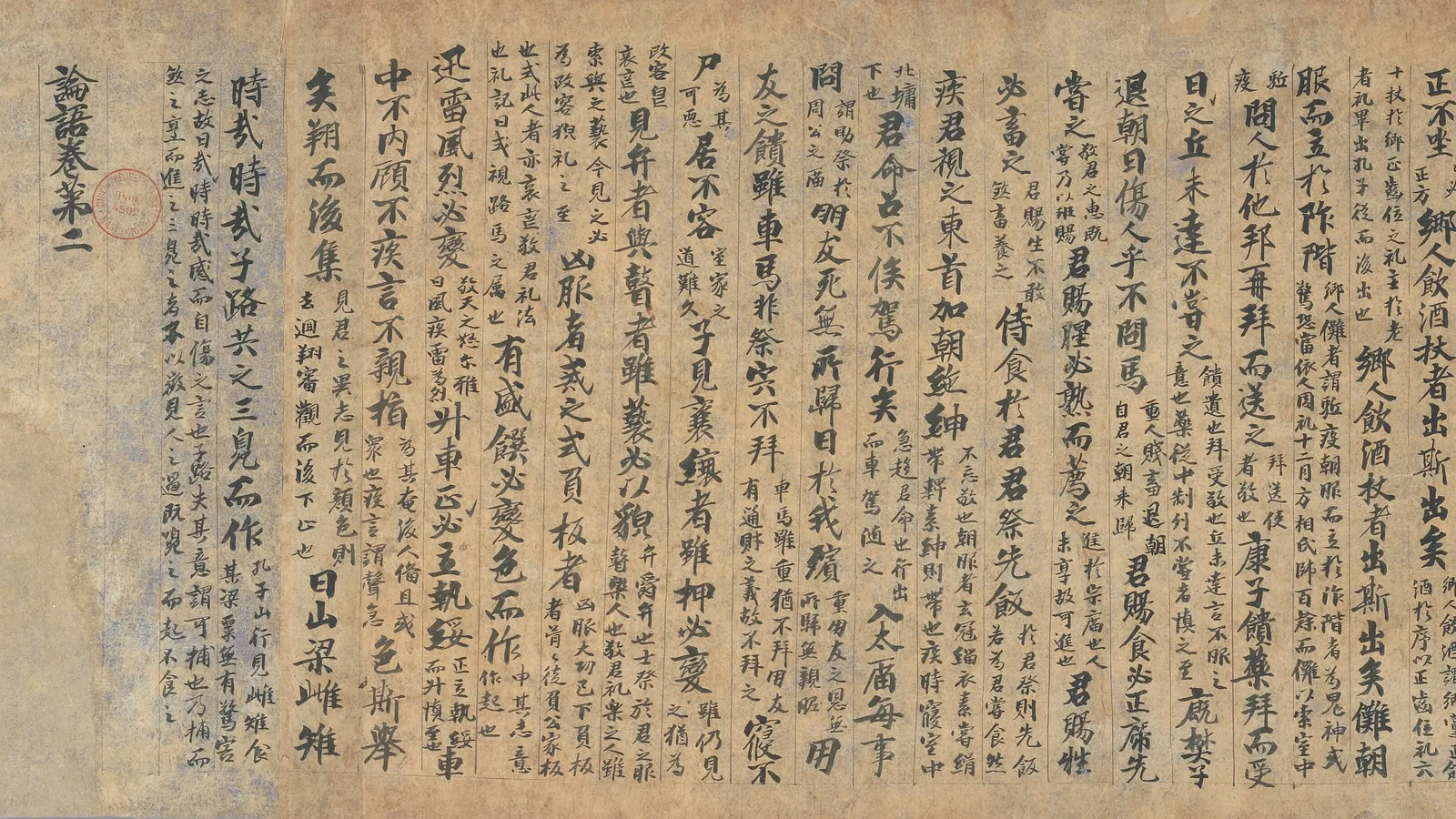

"The world's earliest dated printed book"
Among the dispersed material was a printed scroll now held by the British Library. The International Dunhuang Project describes it as “the world’s earliest dated printed book,” made in AD 868: “As noted in the colophon… the production of this copy was sponsored by Wang Jie and completed 11 May 868. The text was woodblock printed onto seven sheets of yellow-dyed paper and joined together to form a 5-metre horizontal long scroll.”
Reuniting the collection: the International Dunhuang Project
The International Dunhuang Project records its own founding: “In 1993, the British Library hosted a conference gathering conservators and curators from all the major collections with holdings from Dunhuang. All parties agreed to work together to make these more accessible and to ensure their long-term preservation. The International Dunhuang Project was founded the following year in 1994.” It states that the project now links “the collections of over 35 partner institutions worldwide, forming a growing network of libraries, museums and research institutes,” with founding partners in London, Beijing, St. Petersburg, Kyoto, Berlin, Dunhuang and Paris.
Key facts
- Cave 17 at Mogao held documents dating from the 4th to the early 11th century, “when the cave was sealed” (Encyclopaedia Iranica).
- Wang Yuanlu found the sealed room in June 1900 while clearing sand from a corridor (IDP blog).
- The Lanzhou provincial government ordered the cave’s contents secured only in 1904; Wang locked the door and kept the key (IDP blog).
- Aurel Stein negotiated with Wang in May 1907 and left with either 12 cases plus 230 later bundles (IDP blog) or 29 cases (University of Washington), for what Encyclopaedia Iranica calls “a small sum.”
- Paul Pelliot spent three weeks selecting documents in 1908 (University of Washington) and reported his finds in a letter dated March 26, 1908 (Encyclopaedia Iranica).
- After a 1909 government directive to move the remaining manuscripts to Beijing, more than 8,000 formed the main collection of the National Library of China (University of Washington).
- The Otani expedition bought 369 scrolls in 1911 and the Oldenburg expedition bought over 300 in 1914, the same year Stein returned (University of Washington).
- The Diamond Sutra scroll was completed on May 11, 868, printed on seven joined sheets of paper forming a 5-metre scroll (International Dunhuang Programme).
FAQ
Who opened the Dunhuang Library Cave and when?
Wang Yuanlu, the Daoist caretaker of the Mogao Caves, found the sealed entrance to Cave 17 in June 1900 while clearing sand from the corridor of a large cave-temple.
Why was Cave 17 sealed?
The Encyclopaedia Iranica dates the sealing to the early 11th century but gives no reason for it.
What happened to the manuscripts from the cave?
Aurel Stein purchased a large portion in 1907, Paul Pelliot selected more in 1908, and Chinese government transport, a Japanese expedition and a Russian expedition removed most of the rest by 1914. The material is now held in London, Paris, Beijing, St. Petersburg and Kyoto.
Sources
- International Dunhuang Programme, British Library, Mélodie Doumy, "Shaping the Stein collection's Dunhuang corpus (1): Wang Yuanlu, the first 'curator'," via Wayback Machine (also the source, as the International Dunhuang Project, for the Diamond Sutra's 868 completion date and form and for the Project's 1994 founding and current partner network).
- University of Washington, Tateuchi East Asia Library, "Dunhuang Manuscripts – Discovery and Dispersal," UW Dunhuang Project: Virtual Exhibitions.
- University of Washington, Tateuchi East Asia Library, "Introduction," UW Dunhuang Project: Virtual Exhibitions.
- Gunner Mikkelsen, "DUNHUANG i. The cave sites; Manichean texts," Encyclopaedia Iranica.
- Encyclopaedia Iranica, "STEIN, (Marc) Aurel."
Cite this article
- APA
- Our Earth's History. (2026, September 27). A sealed room at Mogao, opened in 1900: the Dunhuang Library Cave. Our Earth's History. https://ourearthshistory.com/central-asia/medieval/dunhuang-library-cave-17-sealed-room-opened-1900-wang-yuanlu-stein-1907/
- Chicago
- Our Earth's History. “A sealed room at Mogao, opened in 1900: the Dunhuang Library Cave.” Our Earth's History, September 27, 2026. https://ourearthshistory.com/central-asia/medieval/dunhuang-library-cave-17-sealed-room-opened-1900-wang-yuanlu-stein-1907/.
- MLA
- “A sealed room at Mogao, opened in 1900: the Dunhuang Library Cave.” Our Earth's History, 27 Sep. 2026, https://ourearthshistory.com/central-asia/medieval/dunhuang-library-cave-17-sealed-room-opened-1900-wang-yuanlu-stein-1907/.
Text licensed CC BY-NC-ND 4.0. Found an error? Tell us.