When were Vikings in North America? A solar storm says AD 1021

TL;DR — Wood from L’Anse aux Meadows was cut in AD 1021, dated by a radiocarbon spike from a solar storm in 993. That is the cutting year, not the arrival year.
Norse voyagers from Greenland cut three trees at L’Anse aux Meadows, on the northern tip of Newfoundland in what is now Canada, in AD 1021. A team led by the University of Groningen published the date in Nature on October 20, 2021, after finding the radiocarbon trace of a solar storm of 992 to 993 in the rings of three scraps of worked wood and counting outward to the bark. The eight turf buildings dug out there between 1961 and 1968 remain, in the paper’s words, the only confirmed Norse site in the Americas. The year 1021 fixes one season of woodcutting. It does not say when the Norse first landed or when they left, and archaeologists disagreed on how long the camp was used.
Quick facts
- When
- AD 1021 (three trees felled) · site found 1960 · excavated 1961–68 · dated in Nature, October 20, 2021
- Where
- L'Anse aux Meadows, tip of the Great Northern Peninsula of Newfoundland, in what is now Canada
- Who
- Norse from Greenland and Iceland; Helge and Anne Stine Ingstad (discovery, excavation); Margot Kuitems and Michael Dee, University of Groningen (dating)
- Outcome
- The only exact calendar year for Europeans in the Americas before Columbus; occupation short, length still argued
The mounds found in 1960
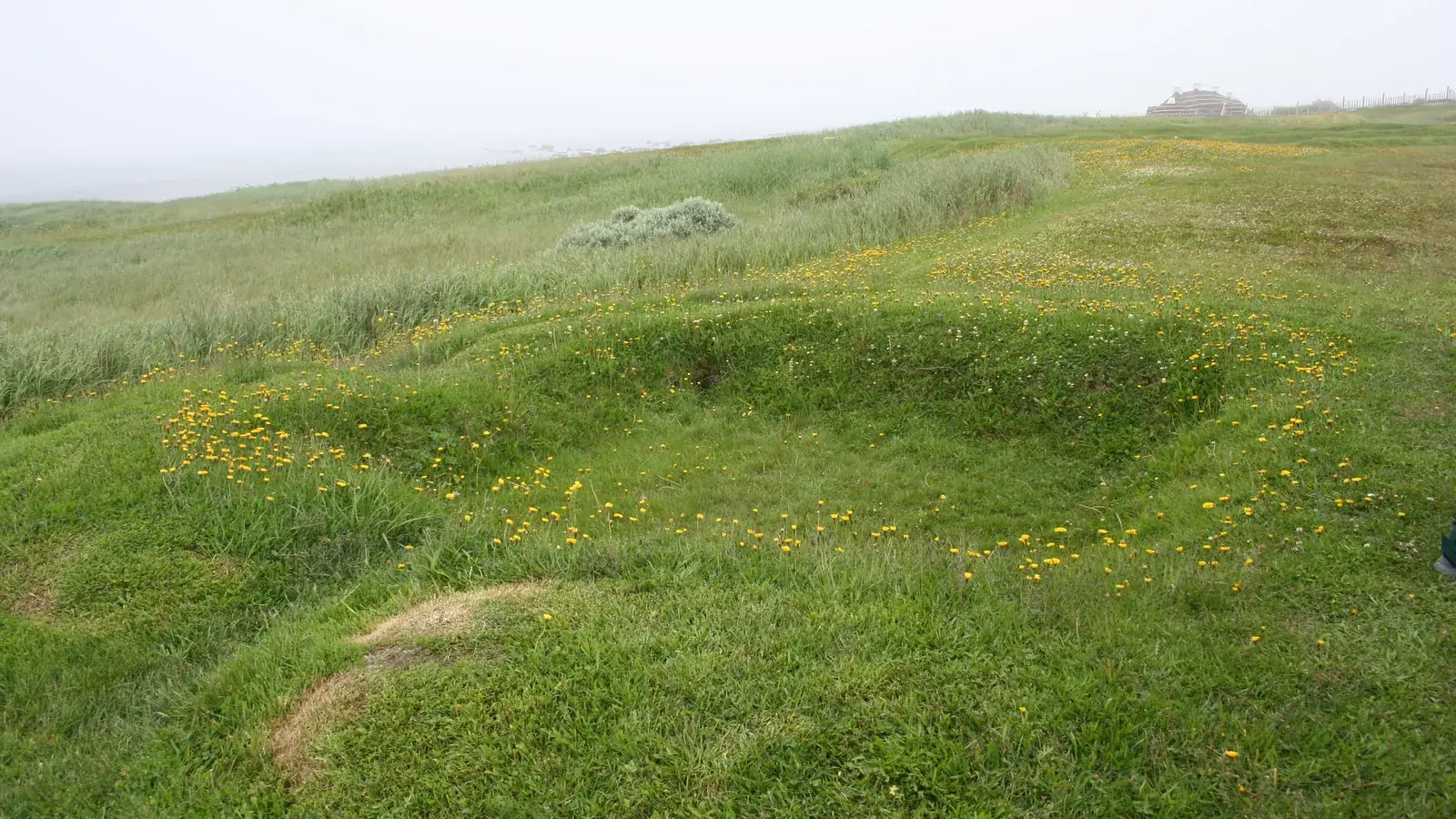
In 1960 the Norwegian explorer Helge Ingstad and his daughter Benedicte came to the village of L’Anse aux Meadows, and a local man, George Decker, led them to grass-covered mounds on a terrace above Epaves Bay, on the Strait of Belle Isle, according to Birgitta Wallace’s entry in The Canadian Encyclopedia. Ingstad’s wife, the archaeologist Anne Stine Ingstad, ran the first excavations from 1961 to 1968 and showed that the walls were Norse and belonged to the 11th century. Parks Canada took over the site in 1968, and UNESCO inscribed it as a World Heritage Site in 1978.
What the excavations found
The diggers traced eight buildings by their low sod walls, which UNESCO’s description lists as three dwellings, one forge and four workshops, timber-framed and roofed with turf cut from the bog, in the style of Iceland and Greenland. A small stone-and-clay furnace by the brook smelted iron from bog ore. Most of the roughly 800 objects were wood debris, among them a floor plank from a boat and nails thrown away during boat repair. From a bog on the site came three butternuts and a piece of butternut wood. Butternut trees grew no farther north than eastern New Brunswick, so someone from the camp had sailed south past Newfoundland and come back.
How a solar storm dates a log
Radiocarbon dating on its own could not pin the camp to a year. The Nature authors reviewed 55 earlier radiocarbon dates from the Norse layers and found that their ranges spread over the whole Viking Age, from 793 to 1066. The way out was an event recorded in tree rings around the world. Between late 992 and early 993 a burst of cosmic radiation, most likely a solar storm, raised atmospheric radiocarbon by about 9 parts per thousand; chroniclers in Germany, Korea and Iceland described red auroras that winter, according to NASA’s Earth Observatory. Every tree alive then took the surge into the ring it grew that year.
Margot Kuitems, the first author, sorted through the site’s wood scraps in a Parks Canada storeroom in Dartmouth, Nova Scotia, and picked three pieces that still carried their bark edge and bore the clean, low-angle cuts of metal blades, which the Indigenous people of the region did not make. Two were fir; the third was juniper or thuja; the ring patterns showed three different trees. The team ran 127 radiocarbon measurements, narrowed the bark rings to between 1019 and 1024 by standard calibration, then looked for the sudden change ring by ring. In all three pieces it sat in ring 29 counting in from the bark, the ring the paper matched to AD 992, which put the bark ring in AD 1021.
What AD 1021 does and does not mean
The paper described its result as the only secure calendar date for Europeans across the Atlantic before Columbus. It is the year three trees were felled, and no more. Michael Dee, who directed the research, told Smithsonian Magazine, “All we can really say is that they were definitely there in that year.” The paper closed the two ways the date could mislead. The wood could not have been worked before 1021, because the signal sat 29 rings in. It was unlikely to be driftwood cut long after, because water strips bark from a floating log and the odds of three scraps sharing one felling year by chance were tiny. The Groningen release added that the number of voyages and the length of the stay stayed unknown.
The sagas and the ground
Before 2021 the dates rested on the two Vinland sagas, the Saga of Erik the Red and the Saga of the Greenlanders. The manuscripts that survive were written around 1200 or 1300, centuries after the events. They told of Leif Eriksson, and later Thorfinn Karlsefni and his wife Gudrid, sailing from Greenland to lands they called Vinland, and of trade and fights with people the Norse called Skraelings. These are saga accounts. The Nature paper read the Saga of the Greenlanders as implying about 13 years between first arrival and final return, and the Saga of Erik the Red about three. Wallace wrote that the one place in the written record matching L’Anse aux Meadows in every respect was Straumfjord, the main base in Erik the Red’s Saga; the match is an argument, not a find. Dee said that most saga specialists would have expected a date in the 990s or around 1000.
How long they stayed and why they left
Wallace read the thin middens and the absence of rebuilding as a stay of about a decade, and Thomas McGovern of Hunter College told Smithsonian Magazine that the date fit her idea of “a fairly short, circa 1000 [C.E.] settlement event.” John Steinberg of the University of Massachusetts Boston drew a different line from the same number. If the Norse left Greenland around 1000, as the sagas suggest, he said, then the camp was used at least sporadically for perhaps 20 years rather than the three usually assumed, or else the three years came 15 years later than thought. Neither reading has won.
The reasons for leaving were in the ground before the date arrived. The camp had no barns, no pens and no sign of grazing, so it was a base for hauling lumber, furs and grapes back to Greenland, not a farm. Wallace’s entry calculated that building it took 60 men two months, out of a Greenland colony of about 400 people. One year, 1021, is now certain; the stay around it was short, and Greenland could not spare the hands to make it longer.
Key facts
- L’Anse aux Meadows sits at the tip of Newfoundland’s Great Northern Peninsula, in what is now Canada; Helge Ingstad was led to its mounds in 1960.
- Anne Stine Ingstad’s excavations of 1961 to 1968 exposed eight turf-walled buildings, later listed by UNESCO as three dwellings, one forge and four workshops.
- Three butternuts and butternut wood, from a tree that grew no farther north than eastern New Brunswick, show voyages south of Newfoundland.
- A cosmic-ray event of 992 to 993 raised atmospheric radiocarbon by about 9 parts per thousand and left a marker in tree rings worldwide.
- Kuitems and colleagues found that marker 29 rings in from the bark on three pieces of metal-cut wood, giving a felling year of AD 1021 (Nature, October 20, 2021).
- The date fixes one year of Norse activity, not arrival or departure; the paper called it the only secure calendar date for Europeans in the Americas before Columbus.
- Wallace estimated a stay of about a decade; Steinberg suggested sporadic use over perhaps 20 years.
FAQ
How do scientists know Vikings were in North America in 1021?
Three pieces of wood cut with metal tools at L'Anse aux Meadows carried their bark. Each held the radiocarbon surge of the cosmic-ray event of 992 to 993 at ring 29 counting in from the bark, so the trees were felled in AD 1021.
Was 1021 the year the Vikings arrived in America?
No. It is the year the trees were cut. Michael Dee of the University of Groningen said the team could only say the Norse were there in that year; first arrival and departure remain undated.
Why did the Vikings leave L'Anse aux Meadows?
The camp was a base for gathering lumber, furs and grapes, with no barns or grazing. Building it took some 60 men, from a Greenland colony of about 400, and the middens show a short stay.
Sources
- Nature — Margot Kuitems, Birgitta L. Wallace, Charles Lindsay et al., "Evidence for European presence in the Americas in AD 1021," Nature 601, 388–391 (published October 20, 2021).
- University of Groningen — "Europeans in the Americas 1000 years ago," news release (October 2021).
- Smithsonian Magazine — Brian Handwerk, "New Dating Method Shows Vikings Occupied Newfoundland in 1021 C.E." (October 20, 2021).
- The Canadian Encyclopedia — Birgitta Wallace, "L'Anse aux Meadows" (published November 28, 2006; last edited February 27, 2025).
- UNESCO World Heritage Centre — "L'Anse aux Meadows National Historic Site," inscribed 1978.
- NASA Earth Observatory — "Burst of New Evidence for Viking Travels" (November 16, 2021).
Cite this article
- APA
- Our Earth's History. (2026, September 19). When were Vikings in North America? A solar storm says AD 1021. Our Earth's History. https://ourearthshistory.com/europe/medieval/vikings-north-america-1021-solar-storm/
- Chicago
- Our Earth's History. “When were Vikings in North America? A solar storm says AD 1021.” Our Earth's History, September 19, 2026. https://ourearthshistory.com/europe/medieval/vikings-north-america-1021-solar-storm/.
- MLA
- “When were Vikings in North America? A solar storm says AD 1021.” Our Earth's History, 19 Sep. 2026, https://ourearthshistory.com/europe/medieval/vikings-north-america-1021-solar-storm/.
Text licensed CC BY-NC-ND 4.0. Found an error? Tell us.