Where did the Black Death start? Tombstones near Issyk-Kul

TL;DR — Ancient DNA from graves dated 1338 near Lake Issyk-Kul, in what is now Kyrgyzstan, held the strain from which every later Black Death lineage branched.
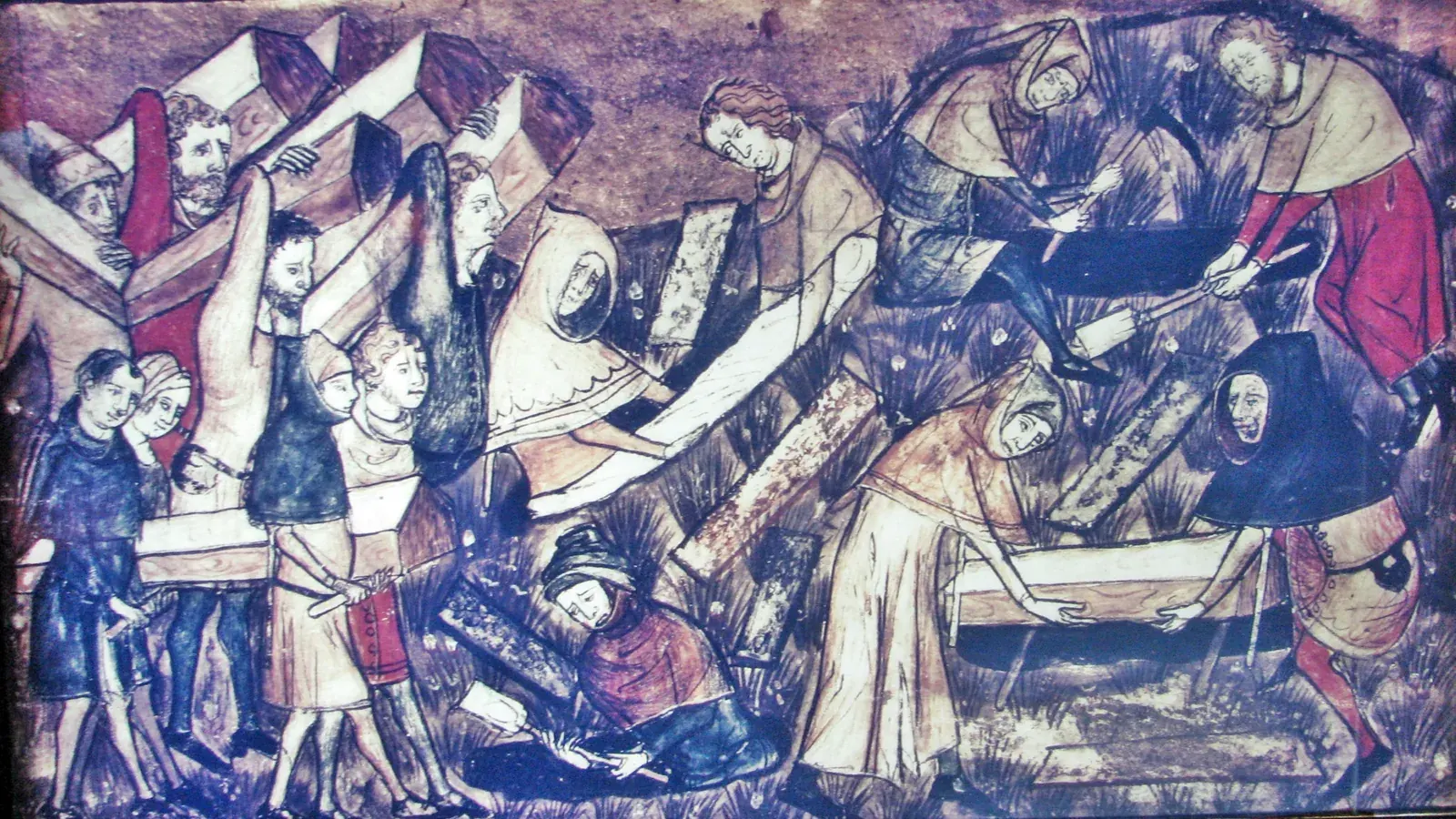
The Black Death began in central Asia, in a trading community near Lake Issyk-Kul in what is now Kyrgyzstan, where an epidemic killed scores of people in 1338 and 1339. A team led by Maria Spyrou of the University of Tübingen reported in Nature on June 15, 2022 that DNA from three people buried at Kara-Djigach carried Yersinia pestis, at the point where the later plague lineages split apart. Tombstones cut in Syriac gave the year of death and, for some, pestilence as the cause. Plague reached Messina in October 1347 by way of the Black Sea ports and moved through Europe until 1352, killing 30 to 50 percent of the population by most estimates.
Quick facts
- When
- Epidemic of 1338–39 near Lake Issyk-Kul · Caffa besieged 1346 · Messina October 1347 · Europe 1348–52 · study published June 15, 2022
- Where
- Kara-Djigach and Burana cemeteries, Chüy Valley, in what is now Kyrgyzstan; then the Black Sea ports, Sicily and the rest of Europe
- Who
- Maria Spyrou (Tübingen), Johannes Krause (Max Planck Institute for Evolutionary Anthropology), Philip Slavin (Stirling); Gabriele de' Mussi and Michele da Piazza as chroniclers
- Outcome
- Ancient Yersinia pestis from three burials of 1338 sits at the node of the plague diversification that produced the Black Death lineages
What the 1338 tombstones showed
Two cemeteries in the Chüy Valley, Kara-Djigach and Burana, were excavated between 1885 and 1892. Of 456 tombstones recorded at Kara-Djigach and 11 at Burana, an unusual share fell in 1338 and 1339, some giving the cause of death. In the translation published by the Max Planck Society, one opens with a year that converts to 1338 and goes on: “This is the tomb of the believer Sanmaq. [He] died of pestilence.” Pestilence covered many diseases.
Spyrou’s team took shotgun DNA from seven individuals exhumed at the two sites. Three, all from Kara-Djigach, carried Yersinia pestis, and the two best genomes were the same strain. Philip Slavin of the University of Stirling, a senior author, said the team had at last shown that the epidemic named on the stones was plague.
Where the strain sat on the plague family tree
Geneticists had already found that Yersinia pestis split into four branches in one burst, the Big Bang of plague diversity, dated no more closely than to between the tenth and fourteenth centuries. The Kyrgyz genomes fell at the node itself. “We found that the ancient strains from Kyrgyzstan are positioned exactly at the node of this massive diversification event,” Spyrou said in the Max Planck announcement. In the study’s comparison set, 130 of 203 modern genomes descended from it. Johannes Krause of the Max Planck Institute for Evolutionary Anthropology said the modern strains closest to the ancient one live in rodent plague reservoirs around the Tian Shan mountains, near the graves.
From the siege of Caffa to the harbor of Messina
In 1346 the army of the Golden Horde besieged Caffa, the Genoese port on the Crimean coast, now Feodosia. Gabriele de’ Mussi, a notary of Piacenza, wrote that the besiegers, dying of the disease, loaded corpses into catapults and lobbed them over the walls. He was not at Caffa. Mark Wheelis of the University of California, Davis, writing in Emerging Infectious Diseases in 2002, recorded that the notary’s signed deeds run through the first half of 1346 and that his text survives only in a copy of about 1367. Wheelis described the attack as plausible and as the best explanation for how plague got inside the walls, and wrote that it mattered little to the pandemic, since other Crimean ports and the caravan routes carried the disease anyway.
A Sicilian friar, Michele da Piazza, recorded the landfall in Europe about 1357. At the beginning of October 1347, he wrote, 12 Genoese galleys entered the harbor of Messina, and the men aboard bore an illness in their bones. The people of Messina fled inland, and the sickness went with them.
Through Europe, 1348 to 1352
By 1348 the plague had reached Genoa, Marseille and Valencia. Mark Cartwright’s account for World History Encyclopedia places France, Spain, Britain and Ireland in its path by the end of 1349, and Germany, Scandinavia, the Baltic and Russia between 1350 and 1352. Florence lost 50,000 of its 85,000 people, and Paris was said to have buried 800 dead a day at the worst of it.
Estimates for Europe run to 30 to 50 percent of the population, or 25 to 30 million dead. Ole J. Benedictow argued in History Today in March 2005 for about 60 percent, or 50 million deaths, a figure that has not displaced the lower range.
How ancient DNA settled the pathogen, 2010 and 2011
Whether Yersinia pestis had caused the Black Death was disputed into the 2000s, with other organisms proposed and with doubt over whether northern and southern Europe had suffered one disease. Stephanie Haensch, Barbara Bramanti and their co-authors reported in PLOS Pathogens in 2010 that signatures specific to Yersinia pestis turned up in skeletons from plague mass graves in northern, central and southern Europe, in two clades ancestral to modern strains.
The next year Kirsten Bos and colleagues published a draft genome in Nature from East Smithfield in London, a burial ground opened in late 1348 or early 1349 for the plague dead. They screened 46 teeth and 53 bones. The sequence differed from the ancestral node of all living human-pathogenic strains at two positions out of 1,694.
Quarantine, flagellants and the killing of Jews
Physicians had no bacteriology, and used distance instead. On July 27, 1377, the Major Council of Ragusa, the Adriatic port that is now Dubrovnik, passed a law holding arrivals from plague areas for a month on the islet of Mrkan or in the town of Cavtat. The English word quarantine descends from quarantino, the 40-day term other ports imposed later.
Other responses ran the other way. The flagellants of the Rhineland paraded through the streets whipping themselves and calling on sinners to repent. From late 1348 Jewish communities were accused of poisoning wells and killed in large numbers. The Encyclopaedia Judaica article by Haim Hillel Ben-Sasson records that the first confessions were extracted by torture in September 1348 at Chillon on Lake Geneva, that Pope Clement VI called the charge implausible in a bull of September 26, 1348, and that the killings and expulsions touched about 300 communities from Spain to Poland-Lithuania. At Strasbourg 2,000 Jews were burned in the Jewish cemetery. In many towns Jews were killed before the plague had arrived.
What followed the dying was a shortage of hands. Workers could ask for wages, serfdom weakened, and revolts broke out in Paris in 1358, Florence in 1378 and London in 1381.
Europe’s records had always opened in the middle of the story, at Caffa and at Messina, with a disease whose source was guessed at from China to the Russian steppe. The graves at Kara-Djigach supplied the beginning: a strain, a place and a year.
Key facts
- Tombstones at Kara-Djigach and Burana, in the Chüy Valley near Lake Issyk-Kul, record a spike of deaths in 1338 and 1339, some of them from pestilence.
- Spyrou and colleagues sampled seven individuals from the two sites; three carried Yersinia pestis DNA, and the two best genomes were the same strain.
- The ancient strain sits at the node of the plague diversification that produced the branches holding 130 of the 203 modern genomes in the study’s dataset.
- The Golden Horde besieged Caffa in 1346; the catapulted-corpse story comes from Gabriele de’ Mussi, who was not present, in a copy made about 1367.
- Michele da Piazza recorded 12 Genoese galleys entering Messina at the beginning of October 1347; the plague ran through Europe until 1352.
- Most estimates put the toll at 30 to 50 percent of Europe’s population, or 25 to 30 million; Ole J. Benedictow argued in 2005 for about 60 percent.
- Yersinia pestis was confirmed as the pathogen by Haensch and colleagues in 2010 and by a draft genome from East Smithfield, London, published by Bos and colleagues in 2011.
FAQ
Where did the Black Death start?
In central Asia. A 2022 study in Nature identified Yersinia pestis in three burials of 1338 at Kara-Djigach, near Lake Issyk-Kul in what is now Kyrgyzstan, and placed that strain at the root of the plague lineages that spread after 1346.
Did the Mongols really catapult plague corpses into Caffa?
The story comes from one chronicler, Gabriele de' Mussi of Piacenza, who did not witness the siege, and it survives in a copy of about 1367. Mark Wheelis wrote in 2002 that the attack was plausible and best explains the outbreak inside the city, and that plague was reaching Europe by other routes regardless.
How many people did the Black Death kill?
Most estimates give 30 to 50 percent of Europe's population, or 25 to 30 million people, between 1347 and 1352. Ole J. Benedictow argued for about 60 percent, or 50 million deaths.
Sources
- Nature — Maria A. Spyrou et al., "The source of the Black Death in fourteenth-century central Eurasia" (June 15, 2022).
- PubMed Central — full text of Spyrou et al., Nature 606 (2022), PMC9217749.
- Max-Planck-Gesellschaft — "Origins of the Black Death identified" (June 15, 2022).
- Smithsonian Magazine — Sarah Kuta, "Where Did the Black Death Start? Thanks to Ancient DNA, Scientists May Have Answers" (June 17, 2022).
- Medievalists.net — "The Black Death originated in present-day Kyrgyzstan, study finds" (June 16, 2022).
- Emerging Infectious Diseases (CDC) — Mark Wheelis, "Biological Warfare at the 1346 Siege of Caffa," vol. 8, no. 9 (September 2002).
- University of Szeged — Michael Platiensis on the Plague (1347), from Johannes Nohl, The Black Death, trans. C. H. Clarke (London, 1926).
- World History Encyclopedia — Mark Cartwright, "Black Death" (April 5, 2023).
- History Today — Ole J. Benedictow, "The Black Death: The Greatest Catastrophe Ever," vol. 55, no. 3 (March 2005).
- PLOS Pathogens — Stephanie Haensch et al., "Distinct Clones of Yersinia pestis Caused the Black Death" (2010).
- Nature — Kirsten I. Bos et al., "A draft genome of Yersinia pestis from victims of the Black Death" (2011).
- Encyclopaedia Judaica — Haim Hillel Ben-Sasson, "The Black Death (1348-1350)," via the Jewish Virtual Library.
- History — Dave Roos, "Social Distancing and Quarantine Were Used in Medieval Times to Fight the Black Death" (March 25, 2020).
Cite this article
- APA
- Our Earth's History. (2026, September 19). Where did the Black Death start? Tombstones near Issyk-Kul. Our Earth's History. https://ourearthshistory.com/europe/medieval/black-death-origin-kyrgyzstan-tombstones/
- Chicago
- Our Earth's History. “Where did the Black Death start? Tombstones near Issyk-Kul.” Our Earth's History, September 19, 2026. https://ourearthshistory.com/europe/medieval/black-death-origin-kyrgyzstan-tombstones/.
- MLA
- “Where did the Black Death start? Tombstones near Issyk-Kul.” Our Earth's History, 19 Sep. 2026, https://ourearthshistory.com/europe/medieval/black-death-origin-kyrgyzstan-tombstones/.
Text licensed CC BY-NC-ND 4.0. Found an error? Tell us.