Basel, June 1543: Vesalius's Fabrica, and the copy found in 2007

TL;DR — Vesalius’s Fabrica came off Oporinus’s press in Basel in June 1543, corrected Galen from human dissection, and its author’s annotated 1555 copy surfaced at auction in 2007.
The colophon reads “Basileae, ex officina Ioannis Oporini, anno salutis reparatae MDXLIII. Mense Iunio”: Basel, from the workshop of Johannes Oporinus, in the year of restored salvation 1543, in the month of June. The title page, as the U.S. National Library of Medicine transcribes it, runs “Andreae Vesalii Bruxellensis, scholae medicorum Patauinae professoris De humani corporis fabrica libri septem,” seven books on the fabric of the human body by Andreas Vesalius of Brussels, professor in the medical school of Padua. Vesalius was 28. He had finished the text in the summer of 1542, and the book corrected Galen from his own dissections. In 2007 a pathologist in Vancouver bought a 1555 copy at auction whose margins held well over a thousand corrections in Vesalius’s own hand.
Quick facts
- When
- December 31, 1514 (Vesalius born in Brussels) · 1537 (degree at Padua, chair the next day) · 1538 (Tabulae anatomicae sex) · summer 1542 (text finished) · January 1543 (Vesalius reaches Basel) · June 1543 (colophon of the Fabrica) · 1555 (second edition) · 1564 (death on Zakynthos) · 1943 (woodblocks destroyed in Munich) · 2007 (annotated 1555 copy bought at auction) · 2014 (Vesalius at 500 exhibition, Toronto)
- Where
- Padua, in the Republic of Venice; the workshop of Johannes Oporinus in Basel; the court of Charles V in the Netherlands and Spain; Hamburg (the 2007 sale); the Thomas Fisher Rare Book Library, University of Toronto
- Who
- Andreas Vesalius (Andreas van Wesel); Johannes Oporinus, printer; Jan van Calcar, artist of the 1538 plates; the emperor Charles V; Gerard Vogrincic, pathologist and collector; Vivian Nutton, historian of medicine
- Outcome
- A seven-book folio of human anatomy, printed from woodblocks carried over the Alps, that corrected Galen point by point from human dissection. A second edition followed in 1555. The author's own copy of that edition, with well over a thousand annotations for a third edition never printed, was recognized in 2007 and deposited in Toronto
Twenty-two years old at Padua, a chair the day after the degree
Andreas van Wesel, Vesalius in Latin, was born in Brussels on December 31, 1514. In 1529 he left for the university at Louvain, and from 1533 to 1536 he studied medicine in Paris. In 1537 he went to Padua, took his degree that year and, the day after graduating, was made professor of anatomy and surgery.
Anatomy was then taught, as Fabio Zampieri and three co-authors describe it in 2015, by three men: the lector, a professor who read from the book; the ostensor, who pointed; and the sector, the barber who cut. Vesalius’s first publication, the Tabulae anatomicae sex of 1538, six sheets drawn by Jan van Calcar, a pupil of Titian, still followed Galen. One plate showed the rete mirabile, a net of vessels at the base of the brain that Galen had found in cattle and placed in man.
Woodblocks over the Alps and a colophon dated June
Vesalius followed the woodblocks from Venice over the Alps to Basel to supervise the printing, arriving, by Zampieri’s account, in January 1543. Oporinus (1507–1568) printed the seven books as a folio 43 centimeters tall. The Venetian Senate and the emperor Charles V each granted a privilege against unauthorized copies.
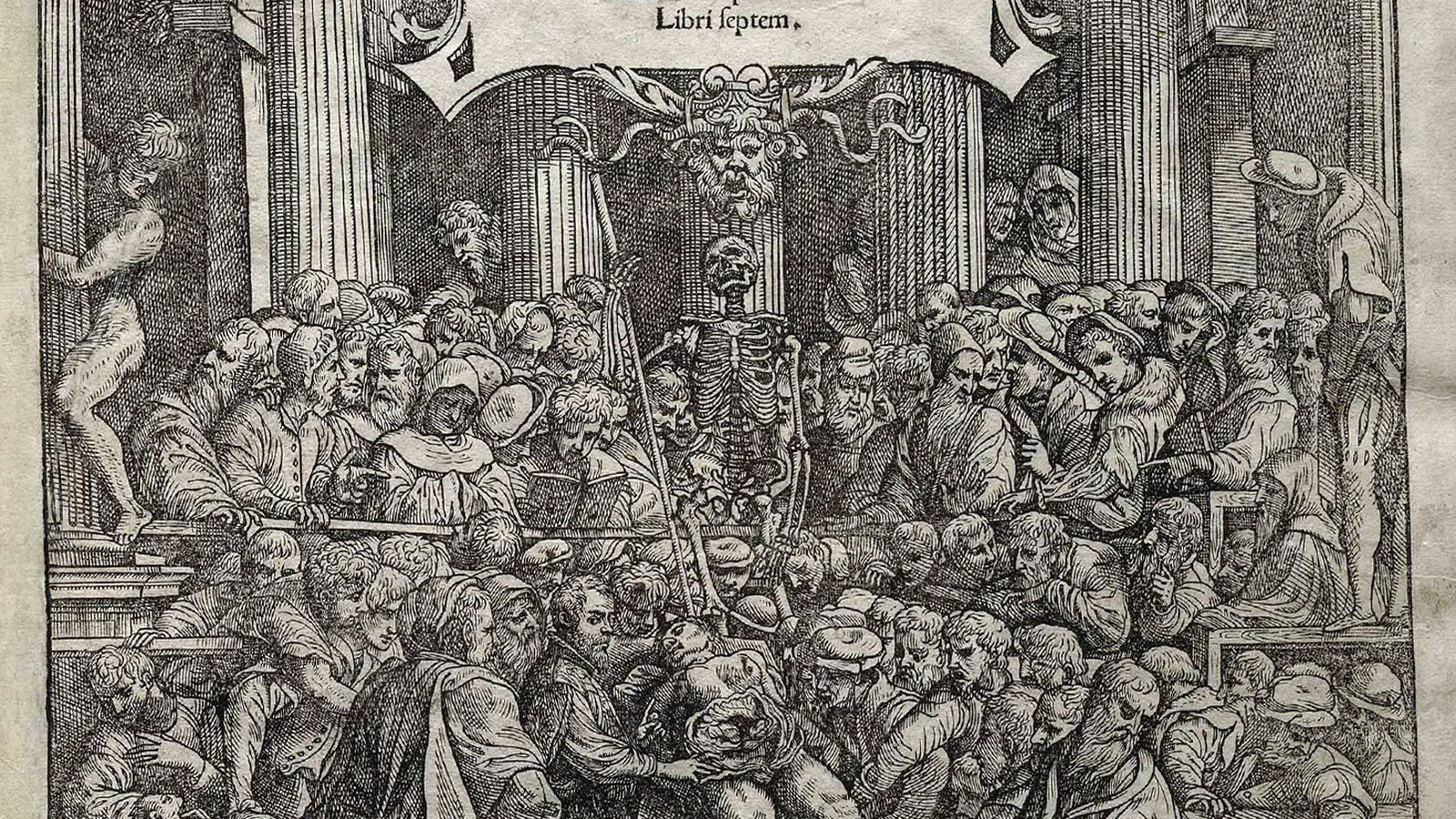
The title page shows Vesalius himself at a female cadaver in a crowded anatomical theater. The displaced dissectors squabble on the floor, the animals of Galen’s anatomy are pushed to the edges, and a skeleton hangs above the body where the professor’s lectern would stand. Zampieri reads the central figure as all three roles at once: lector by his title, ostensor with his left hand, sector with his right. Some, Zampieri among them, attribute the illustrations to van Calcar; the National Library of Medicine writes that later scholarship found several hands, known only as “the workshop of Titian.”

"The fabric of the ape's body": four corrections to Galen
The preface, addressed to Charles V, attacked the lecture-and-barber method. In the translation that Jinpo Xiang and Santhana Venkatesan print in the Journal of Anatomy in 2023, Vesalius called it “A detestable ceremony in which certain persons are accustomed to perform a dissection of the human body while others narrate the history of the parts: these latter from a lofty pulpit and with egregious arrogance sing like magpies of things they have no experience, but rather commit to memory from the books of others.” Zampieri’s paper prints the same passage in a different English rendering, with a crow on the pulpit in place of the magpies. Vesalius wrote that Galen “did not dissect the human body; and the fact is now evident that he described (not to say imposed upon us) the fabric of the ape’s body.”
Four corrections stand at the head of Zampieri’s list. The sternum has three parts, not the seven Galen gave it. The lower jaw is one bone, not two. The rete mirabile does not exist in humans. The nerves are not hollow. The 1538 plates had drawn the two carotid arteries rising from one common trunk, which is simian anatomy; for Zampieri that error proves the same point, that Galen cut up apes, never a man.
Charles V's household physician, and the edition of 1555
Within weeks of publication Vesalius presented the book to Charles V and was enrolled among the emperor’s household physicians; the rest of his life passed at court in the Netherlands and Spain. In 1546, in his letter on the China root, he wrote that he had burned “everything,” including the notes in the margins of his printed Galen. The second Fabrica appeared at Basel in 1555. Vivian Nutton, writing in Medical History in 2012, found its changes mostly matters of Latin style, with little new anatomy, though Vesalius pressed harder on Galen’s claim that blood passed through the wall between the two ventricles of the heart. In print he stayed careful: “In presenting reasons for the construction of the heart and the use of the parts I have in large degree fitted my discourse to the teachings of Galen, not because I believe them to be in entire agreement with the truth, but because I am yet hesitant to present a completely new use and function for those parts.” A condensed Epitome sold to students and was soon translated into German. Vesalius died in 1564 on Zakynthos, returning from a pilgrimage to Jerusalem.
Most of the woodblocks survived to print an edition of the illustrations in 1934 and were destroyed in the Allied bombing of Munich in 1943. A census published in 1984 by Michael Horowitz and Jack Collins counted 154 copies of the 1543 edition. The National Library of Medicine’s copy carries a manuscript poem by Philip Melanchthon; the Wellcome Collection in London catalogs another under the shelfmark EPB 6560.
Hamburg, 2007: an auction lot with more than a thousand annotations
Gerard Vogrincic, a pathologist and book collector in Vancouver, bought a 1555 Fabrica at auction in 2007; Nutton records that the sale was in Hamburg, from a German owner. By his own account the annotations had kept other bidders away. Sentences and whole paragraphs were struck out and rewritten in the margin in Latin; in the preface the name of Vesalius’s father, Andreas, was crossed out. Fewer than ten letters in Vesalius’s hand were known to survive. Vogrincic obtained photocopies of two from the Waller Collection at Uppsala University and found, in his words, “match after match.”
He wrote to Nutton, emeritus professor at University College London, who asked for images and, after examining the volume in person, confirmed the hand as Vesalius’s own. Nutton named the book “the ‘Toronto Vesalius’” and counted well over a thousand annotations and corrections, including instructions to the printer, for a third edition that was never printed. On Nutton’s advice Vogrincic deposited the book on loan at the Thomas Fisher Rare Book Library of the University of Toronto, where it was the centerpiece of the exhibition Vesalius at 500. Jacalyn Duffin and Jessica Duffin Wolfe reviewed that exhibition in the Canadian Medical Association Journal on August 5, 2014.
Key facts
- The colophon of the first edition reads “Basileae, ex officina Ioannis Oporini, anno salutis reparatae MDXLIII. Mense Iunio,” and the title page names “libri septem,” seven books (National Library of Medicine, call number WZ 240 V575dh 1543 OVR).
- Andreas Vesalius was born in Brussels on December 31, 1514; he studied at Louvain from 1529 and in Paris from 1533 to 1536, took his degree at Padua in 1537 and was made professor of anatomy and surgery the next day (Zampieri et al., 2015).
- He finished the text in Padua in the summer of 1542, reached Basel in January 1543, and held printing privileges from the Venetian Senate and Charles V (Zampieri et al., 2015).
- Vesalius wrote that Galen “did not dissect the human body” and described “the fabric of the ape’s body”; the sternum has three parts, not seven, the mandible is one bone, not two, the rete mirabile is absent in humans and the nerves are not hollow (Zampieri et al., 2015).
- The preface’s “detestable ceremony” passage exists in two published English renderings, magpies in Xiang and Venkatesan (2023) and a crow in Zampieri (2015).
- The second edition of 1555 changed mostly Latin style, with little new anatomy (Nutton, 2012); the Epitome was translated into German (CMAJ, 2014).
- Most woodblocks survived to print an edition of 1934 and were destroyed in the bombing of Munich in 1943; a census of 1984 by Horowitz and Collins counted 154 copies of the 1543 edition (CMAJ, 2014).
- In 2007 Gerard Vogrincic bought an annotated 1555 copy at auction; Vivian Nutton confirmed the hand as Vesalius’s, named it “the ‘Toronto Vesalius’” with well over a thousand annotations, and it was deposited at the Thomas Fisher Rare Book Library (Nutton, 2012; CMAJ, 2014).
FAQ
When and where was De humani corporis fabrica printed?
In Basel, at the workshop of Johannes Oporinus, in June 1543. The colophon gives the month, "Mense Iunio," and the book is a folio 43 centimeters tall with 659 numbered pages, according to the National Library of Medicine's description of its copy.
What did Vesalius correct in Galen?
According to Zampieri and his co-authors (2015), Vesalius showed that the sternum consists of three sections rather than seven, that the mandible is one bone rather than two, that the rete mirabile does not exist in humans and that nerves are not hollow. He wrote that Galen had described the body of an ape, not a man.
What is the Toronto Vesalius?
A copy of the 1555 second edition bought at auction in 2007 by Gerard Vogrincic, a Vancouver pathologist, and identified by Vivian Nutton as Vesalius's own working copy, with well over a thousand annotations for a third edition that was never printed. It is on loan at the Thomas Fisher Rare Book Library, University of Toronto.
Sources
- U.S. National Library of Medicine, Historical Anatomies on the Web, "Andreas Vesalius: De corporis humani fabrica libri septem, Bibliographic Information" (title-page transcription, colophon, collation and NLM copy notes, call number WZ 240 V575dh 1543 OVR).
- U.S. National Library of Medicine, Historical Anatomies on the Web, "Andreas Vesalius: Author & Title Description" (biography; illustrators and "the workshop of Titian").
- U.S. National Library of Medicine, Historical Anatomies on the Web, "Andreas Vesalius: De corporis humani fabrica libri septem" (exhibition home page: list of digitized openings from spine to colophon and printer's device).
- Fabio Zampieri, Mohamed ElMaghawry, Alberto Zanatta and Gaetano Thiene, "Andreas Vesalius: Celebrating 500 years of dissecting nature," Global Cardiology Science and Practice 2015(5): 66, PMC4762440 (open access, CC BY 4.0).
- Vivian Nutton, "Vesalius revised. His annotations to the 1555 Fabrica," Medical History 56(4), 2012, pp. 415–443, PMC3483767 (open access).
- Jacalyn Duffin and Jessica Duffin Wolfe, "The annotated Vesalius" (review of the exhibition Vesalius at 500, Thomas Fisher Rare Book Library), CMAJ 186(11), August 5, 2014, pp. 856–857, PMC4119151.
- Jinpo Xiang and Santhana Venkatesan, "The role of Vesalius and his contemporaries in the transfiguration of human anatomical science," Journal of Anatomy 242(2), 2023, pp. 124–131, PMC9877481 (open access, CC BY 4.0).
- Gerard Vogrincic, "A Clever Collector Makes an Astonishing Discovery," on Karger's site for the Fabrica (vesaliusfabrica.com), first-person account of the 2007 purchase and the handwriting comparison.
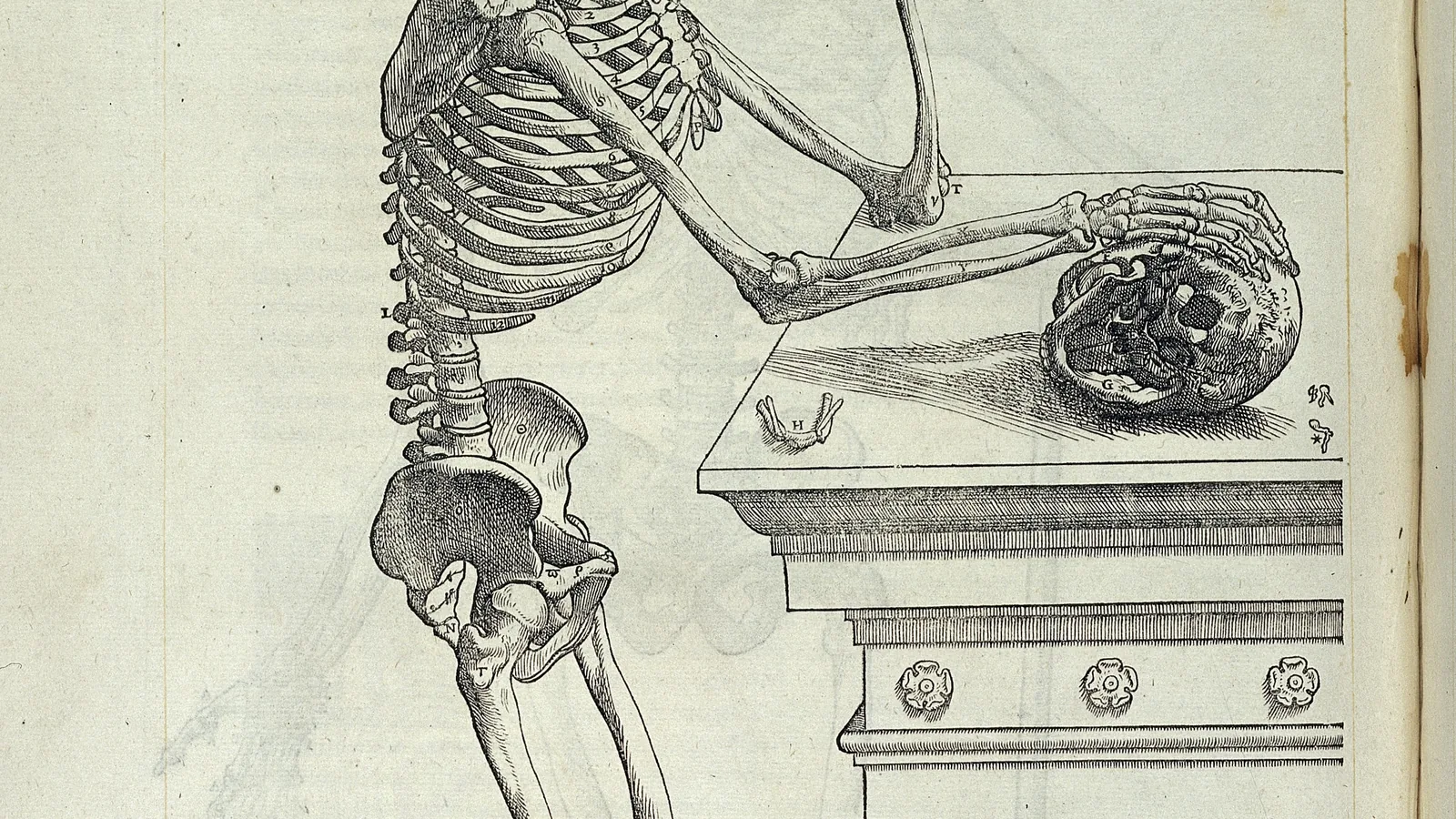
- Wellcome Collection, Catalogue API, work pahtkhab: "Vesalius, De humani corporis fabrica libri septem; Basileae, 1543; EPB/D 6560/D. Page 192: skeleton leaning against a wall" (CC BY 4.0).
Cite this article
- APA
- Our Earth's History. (2026, September 22). Basel, June 1543: Vesalius's Fabrica, and the copy found in 2007. Our Earth's History. https://ourearthshistory.com/europe/early-modern/vesalius-fabrica-june-1543-oporinus-basel-galen-sternum-toronto-2007/
- Chicago
- Our Earth's History. “Basel, June 1543: Vesalius's Fabrica, and the copy found in 2007.” Our Earth's History, September 22, 2026. https://ourearthshistory.com/europe/early-modern/vesalius-fabrica-june-1543-oporinus-basel-galen-sternum-toronto-2007/.
- MLA
- “Basel, June 1543: Vesalius's Fabrica, and the copy found in 2007.” Our Earth's History, 22 Sep. 2026, https://ourearthshistory.com/europe/early-modern/vesalius-fabrica-june-1543-oporinus-basel-galen-sternum-toronto-2007/.
Text licensed CC BY-NC-ND 4.0. Found an error? Tell us.