"I, Johan Fust, have borrowed 1,550 guilders": Gutenberg Bible, 1455

TL;DR — A Mainz notary’s record of 1455, Fust’s oath to 1,550 guilders lent to Gutenberg, is the sole contemporary source for a Bible printed in about 180 copies.
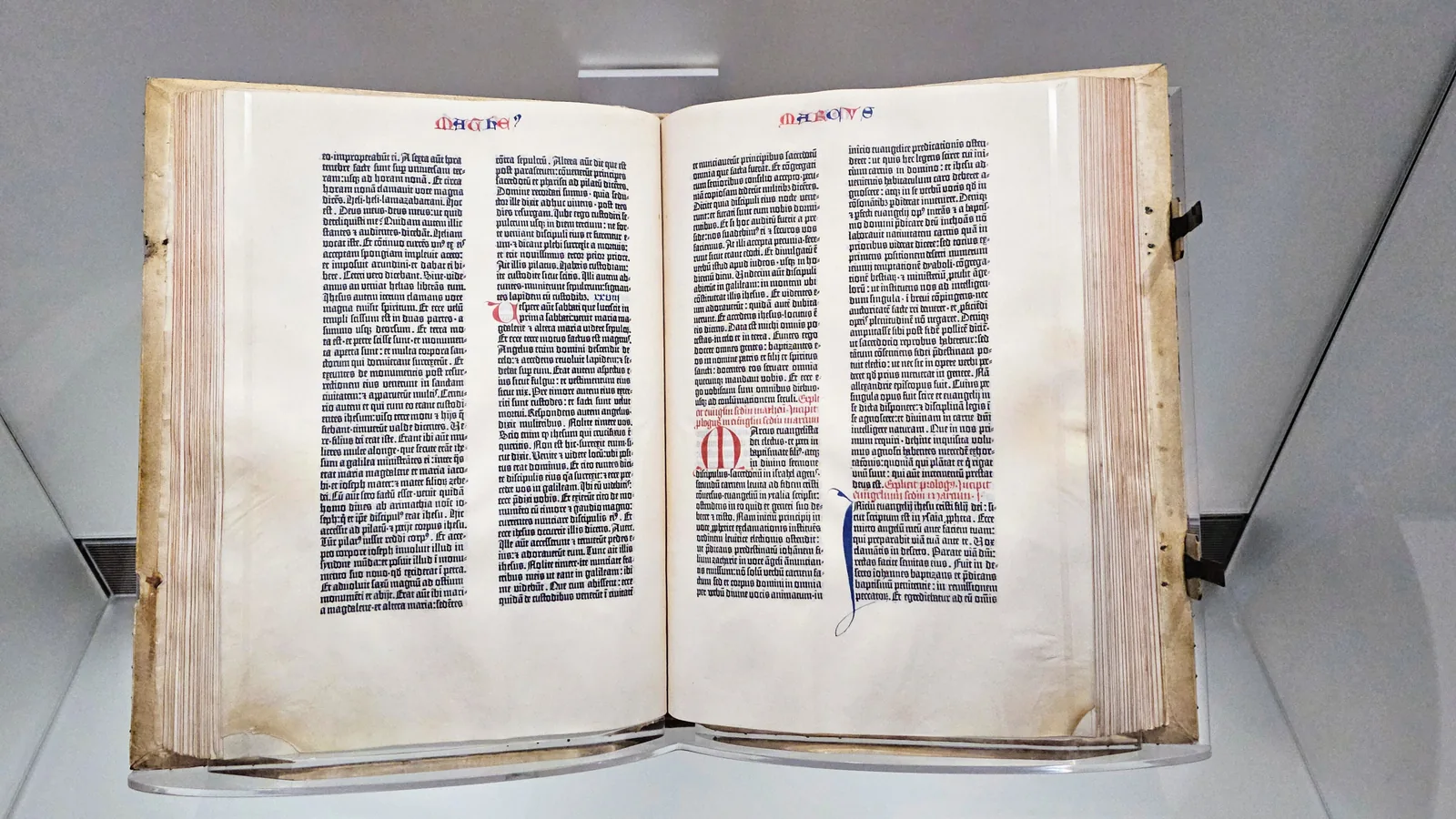
“I, Johan Fust, have borrowed 1,550 guilders, which have been received by Johan Gutenberg, and spent on our common work.” The words come from a notary’s record drawn up at Mainz on November 6, 1455, in Theodore Low De Vinne’s 1876 English text; the Göttingen University Library, which holds the parchment, calls it the only contemporary source for Gutenberg’s “work of the books.” That work was the Latin Bible with 42 lines to the column. Göttingen dates it to about 1454, not after August 1456, and estimates the run at about 180 copies, 140 on paper and 40 on vellum. By Göttingen’s count 49 complete or incomplete copies are known, two of them Leipzig copies still listed as missing; the Bayerische Staatsbibliothek in Munich says about 50. Twelve are on vellum.
Quick facts
- When
- December 12, 1439 (Dritzehn suit heard at Strasbourg) · 1454 and 1455 (printed dates on the Letters of Indulgence) · about 1454, not after August 1456 (the Bible printed, per Göttingen) · November 6, 1455 (Helmasperger Instrument drawn up at Mainz) · February 26, 1468 (Humery's undertaking, after Gutenberg's death) · 1741 (Instrument given to Göttingen) · 1886 (rediscovered by Dziatzko) · 1978 (Harry Ransom Center copy acquired)
- Where
- Mainz, on the Rhine in what is now Germany, in the refectory of the Franciscan convent; Strasbourg, then a free city of the Holy Roman Empire; Göttingen; Munich; Austin, Texas
- Who
- Johannes Gutenberg; Johann Fust and his brother Jacob Fust; Peter Schöffer; the notary Ulrich Helmasperger; George and Claus Dritzehn; Conrad Humery; Adolf, archbishop of Mainz; Johann David Köhler; Karl Dziatzko
- Outcome
- The court found for Fust on the first article of his claim; the Bible run is estimated at about 180 copies, 140 on paper and 40 on vellum; 49 complete or incomplete copies are known by Göttingen's count, about 50 by Munich's; Gutenberg's types passed to Humery, who undertook in 1468 to keep them in Mainz
A notary's record from a friars' refectory, November 6, 1455
The document opens like any notarial act: “on Thursday, the 6th of November, between eleven and twelve at noon, at Mentz, in the large dining-hall (refectorium) of the convent of bare-footed friars,” Jacob Fust, citizen of Mainz, appeared for his brother Johann, who was also present, and read out the court’s sentence on the first article of the claim: by written agreement he was to lend Gutenberg “about 800 florins in gold, with which he was to finish the work, and whether it would cost more or less was no matter to Fust.” He had then lent 800 guilders beyond the contract, and since Gutenberg had paid no interest on the first 800 for a single year, Fust had paid it himself, 250 guilders, borrowing “from Christians and Jews” to do so. Capital and interest together came to about 2,020 guilders. Fust took the oath “with raised fingers,” and Ulrich Helmasperger, a cleric of the diocese of Bamberg and imperial notary, signed.
Göttingen’s summary of the manuscript matches: Fust swore to 1,550 guilders advanced, borrowed by him at six percent, and wanted back with interest whatever had not gone into the work of the books. The judgment on that article went against Gutenberg; on Fust’s demand to dissolve the partnership the record says nothing. The parchment was given to Göttingen in 1741 by the historian Johann David Köhler, forgotten, and found again by Karl Dziatzko in 1886.
Strasbourg, December 12, 1439: an earlier court and a lost record
Gutenberg had answered in a Strasbourg court sixteen years earlier, over another partnership. The judge’s statement, dated December 12, 1439, begins: “We, Cune Nope, master and counselor at Strasburg, hereby make known . . . that George Dritzehen, our fellow-citizen, has appeared before us in proper person, and with a full power of attorney for his brother Claus Dritzehen, and has cited John Gensfleisch, of Mentz, called Gutenberg.” The late Andrew Dritzehn had paid for a share in Gutenberg’s “secrets and inventions,” and the testimony turned on that money and on pieces of equipment the witnesses called formen.
The record lay for more than three hundred years in the old Strasbourg tower called the Pfenningthurm, De Vinne wrote, until the keeper of the records, Wenkler, found it and Schoepflin printed it in his Vindiciae Typographicae. The originals, moved to the city library for safety, “were destroyed by the Prussians during the siege of that city in 1870.”
Forty-two lines, about 290 types, and a red-ink experiment
The Bible takes its name from its column of 42 lines, but the earliest sheets show something else. On leaf 5r of the Munich copy each column has 40 lines; the back of the leaf has 41, and only later pages reach 42. The 1920s auction catalog for the Melk Abbey copy explained the feature from the workshop: the type for the first pages “was cast on a slightly larger body, which, after a few pages had been set up, was filed down to size.”
Munich counts about 290 types in Gutenberg’s Textura, citing Gottfried Zedler’s study of 1934. Red headings and colored initials were added by hand by a rubricator, the “red-maker,” as was still standard for early printed books. On the 40-line leaves Gutenberg tried printing the heading of Genesis in red, and Munich’s reading is that he dropped the method for reasons of time and cost. De Vinne wrote that it “is possible that the last sheet was printed in 1456, but it is a more general belief that the work was completed in 1455.”
Dated indulgences, unbound prices, and 49 copies
The earliest printing with a printed date is not the Bible. De Vinne described the Letters of Indulgence, known in three settings of 30, 31 and 32 lines and dated 1454 or 1455, as “the first works with type-printed dates.” Pope Nicholas V had granted the indulgence to anyone who gave money between May 1, 1452, and May 1, 1455, for the defense of Cyprus against the Turks; near the deadline Paul Zappe, the king of Cyprus’s ambassador, had the forms printed rather than copied, with blanks for the buyer’s name. Eighteen copies were known to De Vinne.
What a Bible cost at first is less certain. De Vinne wrote that unbound copies “were sold at different times and places, not long after publication, for various sums ranging from twelve guilders to sixty crowns,” naming no document for the figures. His footnote gives a later market: at the sale of the Perkins library near London on June 6, 1873, a vellum copy fetched 3,400 pounds and a paper copy 2,690 pounds. Counts of survivors have moved too: the Melk catalog of the 1920s said “some forty-five copies are known, of which more than twenty are imperfect.” Göttingen’s 49 include four complete vellum copies, its own and those in London, Paris and Washington. The Harry Ransom Center in Austin, Texas, acquired its paper copy, two volumes in early bindings, in 1978, and describes it as “one of only 20 complete copies in the world that survive intact.”
Formen, types and tools: the Humery document of 1468
Gutenberg’s own end is fixed by another legal paper. In it Conrad Humery, a doctor and clerk of the town of Mainz, acknowledged that the archbishop Adolf had delivered to him “certain formen [matrices or moulds], characters [types], instruments, utensils, and other implements connected with printing, which John Gutenberg left after his death,” and pledged to use them only in Mainz and to sell them, at a fair price, to a citizen of Mainz before anyone else. It was made “in the year of our Lord 1468, on the Friday after Saint Matthew’s day [26th of February],” in De Vinne’s text, so Gutenberg had died before February 26, 1468.
The city that made him keep his types there keeps his name. The Gutenberg Museum stands at Reichklarastraße 1 in Mainz, and its Gutenberg Library at the Gutenberg-Carré holds over 100,500 titles on printing across seven centuries, open without charge to any reader.
Key facts
- The Helmasperger Instrument was drawn up at Mainz on November 6, 1455, by Ulrich Helmasperger, cleric of the diocese of Bamberg and imperial notary; Göttingen calls it the only contemporary source on Gutenberg and Fust.
- Fust swore to 1,550 guilders advanced to Gutenberg, borrowed at six percent; his total demand in De Vinne’s text was about 2,020 guilders, and the judgment on the first article went against Gutenberg.
- Göttingen dates the 42-line Bible to about 1454, not after August 1456, and estimates the run at about 180 copies, 140 on paper and 40 on vellum.
- Surviving copies: 49 complete or incomplete by Göttingen’s count, including two Leipzig copies still listed as missing, 12 of them on vellum; about 50 by the Bayerische Staatsbibliothek’s count; “some forty-five” in the Melk auction catalog of the 1920s.
- The Munich copy has 40 lines to the column on leaf 5r and 41 on 5v; the Bayerische Staatsbibliothek counts about 290 types in the Textura, after Zedler 1934, and records a red-printed heading on the 40-line leaves that was not continued.
- The Strasbourg record of December 12, 1439, in the Dritzehn suit was printed by Schoepflin and destroyed in the siege of 1870, according to De Vinne.
- The Letters of Indulgence of 1454 and 1455, in 30-, 31- and 32-line settings, were “the first works with type-printed dates” in De Vinne’s account; he knew 18 copies in 1876.
- Conrad Humery’s undertaking of February 26, 1468, describes printing equipment “which John Gutenberg left after his death”; the Harry Ransom Center’s paper copy, acquired in 1978, is “one of only 20 complete copies in the world that survive intact,” in its words.
FAQ
How many Gutenberg Bibles were printed and how many survive?
Göttingen University Library estimates about 180 copies, 140 on paper and 40 on vellum, and counts 49 surviving complete or incomplete copies, including two Leipzig copies still listed as missing; the Bayerische Staatsbibliothek gives about 50. Twelve of the survivors are on vellum, four of them complete: at Göttingen, London, Paris and Washington.
What does the Helmasperger Instrument say?
That on November 6, 1455, in the Franciscan refectory at Mainz, Johann Fust swore under oath that he had advanced 1,550 guilders to Gutenberg for their common work, money borrowed at six percent, and that the court had found for him on the first article of his claim. It gives no verdict on his demand to dissolve the partnership.
When did Gutenberg die?
No record gives the day. Conrad Humery's document, dated the Friday after Saint Matthew's day in 1468, which De Vinne gives as February 26, describes equipment "which John Gutenberg left after his death," so he had died before that date.
Sources
- Niedersächsische Staats- und Universitätsbibliothek Göttingen, Göttinger DigitalisierungsZentrum — "Gutenbergdigital: Die Göttinger Gutenbergbibel" (print run, surviving copies, the four complete vellum copies).
- Niedersächsische Staats- und Universitätsbibliothek Göttingen — "Das Helmaspergersche Notariatsinstrument" (the notary, the 1,550 guilders at six percent, Köhler's gift of 1741, Dziatzko's rediscovery of 1886).
- Theodore Low De Vinne, The Invention of Printing (New York, 1876); English text of the Helmasperger Instrument (from Hessels's translation), the Strasbourg record of December 12, 1439, the Humery document of 1468, the Letters of Indulgence, and prices; full text on the Internet Archive.
- Bayerische Staatsbibliothek, Munich — "Stabiliebling: Die Gutenberg-Bibel" (about 180 copies and about 50 surviving, the 40- and 41-line leaves, about 290 types after Zedler 1934, rubrication and the red-ink heading, Fust's two loans of 800 guilders).
- Harry Ransom Center, University of Texas at Austin — "The Gutenberg Bible" (paper copy in two volumes, acquired 1978, "one of only 20 complete copies").
- Anderson Galleries, New York — The Gutenberg Bible: The First Printed Book, the Melk Copy, described by Seymour de Ricci (auction catalog, 1920s); the count of some forty-five known copies and the 40-line first issue; full text on the Internet Archive.
- Landeshauptstadt Mainz, Gutenberg-Museum — "Gutenberg Library" (museum address at Reichklarastraße 1; the library of over 100,500 titles at the Gutenberg-Carré).
Cite this article
- APA
- Our Earth's History. (2026, September 22). "I, Johan Fust, have borrowed 1,550 guilders": Gutenberg Bible, 1455. Our Earth's History. https://ourearthshistory.com/europe/medieval/gutenberg-bible-1455-mainz-180-copies/
- Chicago
- Our Earth's History. “"I, Johan Fust, have borrowed 1,550 guilders": Gutenberg Bible, 1455.” Our Earth's History, September 22, 2026. https://ourearthshistory.com/europe/medieval/gutenberg-bible-1455-mainz-180-copies/.
- MLA
- “"I, Johan Fust, have borrowed 1,550 guilders": Gutenberg Bible, 1455.” Our Earth's History, 22 Sep. 2026, https://ourearthshistory.com/europe/medieval/gutenberg-bible-1455-mainz-180-copies/.
Text licensed CC BY-NC-ND 4.0. Found an error? Tell us.