Was Charlemagne surprised by his coronation in 800?

TL;DR — Four early accounts survive, and only Einhard’s says Charlemagne would have stayed away had he known — the other three describe a planned ceremony.
No one can say whether Charlemagne was surprised, because the four accounts written in the generation after December 25, 800, tell different stories. Einhard, his courtier and biographer, wrote that the king would not have entered St Peter’s that day had he known what Pope Leo III intended. The Royal Frankish Annals recorded a crown, an acclamation and a title, and nothing about surprise. The Lorsch Annals described a petition the king could not refuse, and the papal biography in the Liber Pontificalis gave the credit to the pope. Historians since have treated the disagreement itself as the evidence.
Quick facts
- When
- April 25, 799 (Leo III attacked) · July 799 (Paderborn) · December 25, 800 (coronation) · 812 (Byzantine envoys at Aachen) · January 28, 814 (death)
- Where
- St Peter's basilica in Rome; Paderborn in Saxony; the palace at Aachen, in what is now western Germany
- Who
- Charlemagne, king of the Franks; Pope Leo III; the empress Irene in Constantinople; Einhard and the court annalists who wrote the four accounts
- Outcome
- Charlemagne was called emperor and Augustus; Constantinople objected until a two-emperor settlement in 811–812; the four accounts still disagree on who planned the ceremony
The year before: a beaten pope at Paderborn
On April 25, 799, during a procession in Rome, a faction attacked Pope Leo III; later writers recorded that they blinded him and cut out his tongue and that he recovered. Leo fled across the Alps and in July 799 reached Charlemagne’s military assembly at Paderborn in Saxony. Janet Nelson, in her 2013 Raleigh Lecture to the British Academy, drew attention to one detail: envoys of the empress Irene from Constantinople were there too.
Charlemagne sent Leo home under escort and followed a year later, reaching Rome on November 24, 800. A synod heard the charges, the Frankish bishops declared that they could not judge the pope, and on December 23 Leo swore in St Peter’s that he was innocent. Christmas fell two days later.
Four accounts of one Mass in St Peter's
The Royal Frankish Annals, kept at the court and written soon after, gave the fullest description. In P. D. King’s 1987 translation, as the king “rose from prayer before the confessio of the blessed apostle Peter, pope Leo placed a crown upon his head, and from the entire people of the Romans came the acclamation: ‘To Charles, Augustus, crowned by God, great and pacific emperor of the Romans, life and victory!’” The title of patrician, the annals added, gave way to emperor and Augustus. No word suggests surprise.
Einhard, a courtier who wrote his Life of Charlemagne about 829, said in chapter 28 that the king received those titles, “to which he at first had such an aversion that he declared that he would not have set foot in the Church the day that they were conferred, although it was a great feast-day, if he could have foreseen the design of the Pope.” That sentence, in Samuel Epes Turner’s 1880 translation, is the sole basis for the surprise.
The Lorsch Annals, a monastic chronicle, told it as a petition. In King’s translation as Turberville printed it, the king was unwilling to refuse the request of the priests and the whole Christian people and received the name of emperor with the consecration of the pope; Romano observed that, taken at its word, this makes the pope’s prayer, not the crown or the shouts, what made him emperor. The Liber Pontificalis, the book of papal biographies written by the Roman clergy who staged the liturgy, placed the initiative with the pope, who crowned the king and then anointed his son Charles.
What the title meant, and what Constantinople said
The words mattered because Constantinople, still calling itself New Rome, held the only recognized imperial title. In 797 Irene had deposed and blinded her son Constantine VI, and the 1908 Catholic Encyclopedia recorded that aversion to a woman holding the imperial scepter bore on what followed. The same encyclopedia recorded that New Rome treated Leo’s act as schism and that Nicephorus I, who removed Irene in October 802, refused Charlemagne the imperial character.
Nelson described the settlement of 811 and 812 as a two-emperor solution: an Emperor of the Romans in the east and an emperor, without further definition, in the west. The Catholic Encyclopedia added that in 812 a Byzantine embassy at Aachen addressed Charlemagne as basileus, the Greek word for emperor.
What the empire looked like: Aachen, coins, script
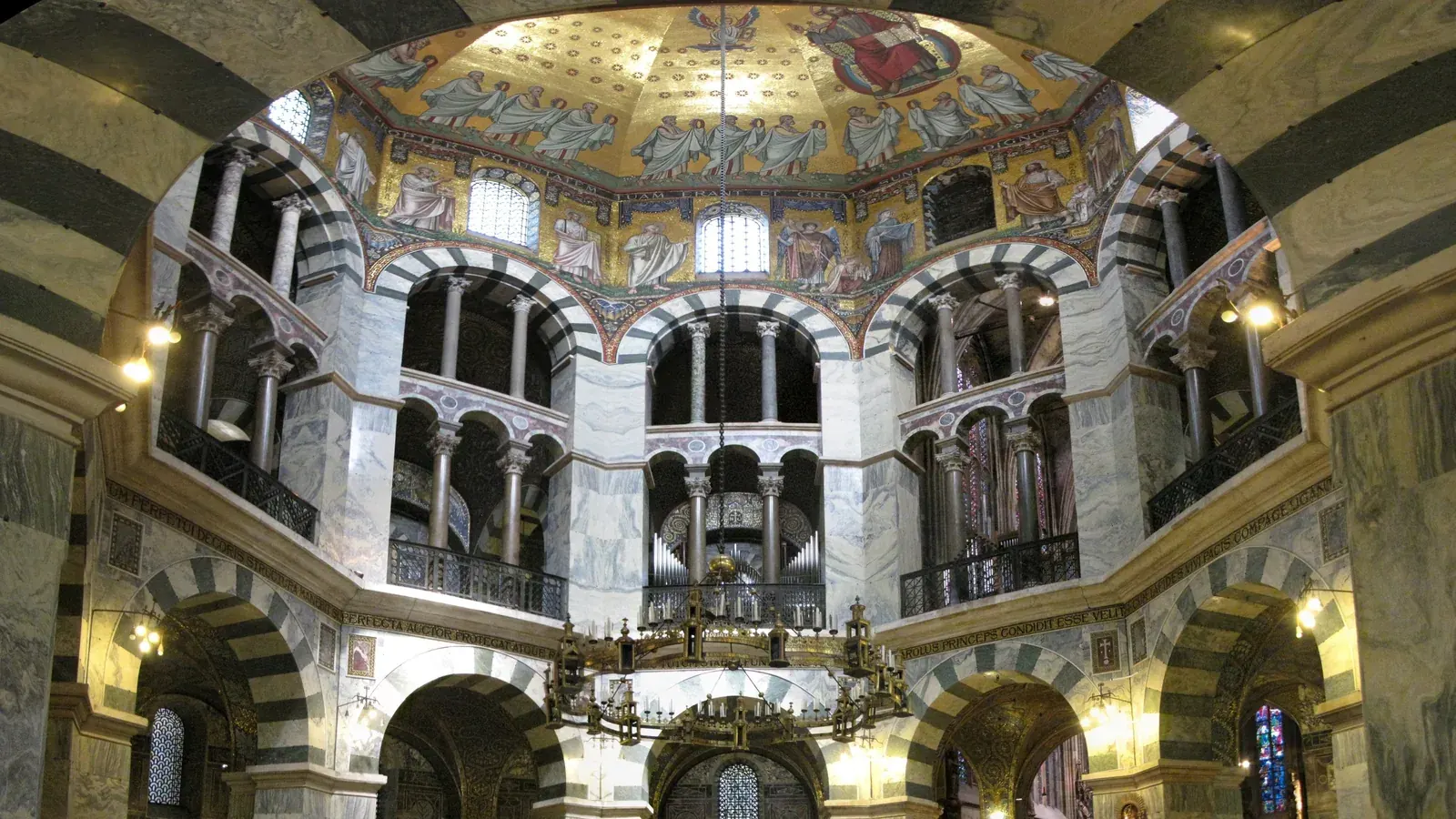
The emperor’s seat was Aachen, a royal estate in what is now western Germany. UNESCO’s entry for the cathedral dates the Palatine Chapel two ways: begun about 790 to 800 in its short description, built between 793 and 813 in its statement of value. Rosamond McKitterick, in a 2008 study of the palaces, read the Roman-style audience hall at Aachen as one of several that repeated an imperial image along the king’s itinerary.
After the recognition of 812, a few mints struck an imperial coinage, and Nelson’s caption to a Mainz denier gives the numbers: about 40 survive, at least 11 mints took part, and the issue may date from September 813 to January 814. The obverse reads KAROLUS IMP AUG around a laureled profile that Nelson called his only strictly contemporary portrait. Alcuin, drawn from York about 786, taught at Aachen, and the hand his circle spread, Caroline minuscule, is the ancestor of the lowercase letters on this page.
How historians read the disagreement
Nelson made the disagreement her subject in a 2007 essay, “Why are there so many different accounts of Charlemagne’s imperial coronation?”. John F. Romano of Benedictine College, writing in Mediaeval Studies in 2020, called the German label for Einhard’s version, Kaiser wider Willen, emperor against his will, a questionable assertion built on a literal reading of one sentence. Colby Turberville, in a 2013 Troy University journal, wrote that every annal shows the pope and the people expecting the event, and that the courtiers wanted a king who looked reluctant.
The 1908 Catholic Encyclopedia recorded an older debate: some read Einhard’s line as a refusal of imperial authority on a church footing, others as natural hesitation before a large step. Norman Cantor, quoted in World History Encyclopedia, described a well-rehearsed crowd, which makes the surprise the pope’s tactic.
Afterlife: 814, 1165 and a phrase
Charlemagne died on January 28, 814, and was buried in the chapel at Aachen. In 1165 the emperor Frederick Barbarossa had him canonized by the bishop of Liège, acting on authority delegated by the antipope Paschal III; the Catholic Encyclopedia recorded that the act was never ratified by the Universal Church, though his cult was permitted at Aachen.
The phrase most often attached to him is older. A Latin poem on Charlemagne and Pope Leo, written about 800 around the meeting at Paderborn, was the only text of its time to call the king pater Europae, father of Europe; its author is disputed. Nelson gave five reasons for accepting the label in Warsaw in 2001 and wrote in 2013 that she was no longer sure any specific claim for Charlemagne’s paternity of today’s Europe was plausible. The coronation, like the phrase, remains a record of what different writers wanted it to mean.
Key facts
- Pope Leo III was attacked in Rome on April 25, 799, and reached Charlemagne at Paderborn in July 799, where Byzantine envoys were also present.
- Charlemagne arrived in Rome on November 24, 800; Leo swore to his innocence on December 23; the coronation took place at Mass in St Peter’s on December 25.
- Four accounts survive from the following generation: the Royal Frankish Annals, Einhard’s Life (about 829), the Lorsch Annals and the Liber Pontificalis.
- Only Einhard wrote that the king would not have entered the church had he known the pope’s plan.
- Constantinople refused the title until a two-emperor settlement in 811–812; a Byzantine embassy at Aachen addressed him as basileus in 812.
- About 40 imperial coins survive from at least 11 mints, probably struck between September 813 and January 814.
- He died on January 28, 814; the canonization of 1165 came from the antipope Paschal III and was never confirmed by Rome.
FAQ
Who crowned Charlemagne emperor?
Pope Leo III placed the crown on his head during Mass in St Peter's basilica in Rome on December 25, 800, according to all four early accounts. The accounts differ on who planned the act.
Did Charlemagne know he was going to be crowned?
Einhard, writing about 829, said he would have stayed out of the church had he known. The court annals, the Lorsch annals and the papal biography describe a prepared ceremony, and Romano (2020) and Turberville (2013) both doubted that Einhard's line records what the king knew.
Was Charlemagne a saint?
He was canonized in 1165 at the wish of Frederick Barbarossa by the bishop of Liège under authority from the antipope Paschal III. The 1908 Catholic Encyclopedia recorded that the Universal Church never ratified the act, though his cult was allowed at Aachen.
Sources
- Fordham University, Internet History Sourcebooks Project — Einhard, The Life of Charlemagne, translated by Samuel Epes Turner (Harper & Brothers, 1880), ch. 28.
- The Alexandrian (Troy University) — Colby Turberville, "From Imperator to Holy Crusader: A Historiography of the Charlemagne Legend," vol. 2, no. 1 (2013), PDF; quotes the Royal Frankish Annals and Lorsch Annals in P. D. King's translation (1987).
- Mediaeval Studies 82 (2020), Pontifical Institute of Mediaeval Studies — John F. Romano, "The Coronation of Charlemagne as a Liturgical Event," PDF.
- Journal of the British Academy 2 (2014) — Jinty Nelson, "Charlemagne and Europe," Raleigh Lecture on History read November 12, 2013, PDF.
- New Advent — Thomas Shahan and Ewan Macpherson, "Charlemagne," The Catholic Encyclopedia, vol. 3 (Robert Appleton Company, 1908).
- UNESCO World Heritage Centre — "Aachen Cathedral," World Heritage List no. 3.
- The Metropolitan Museum of Art, Heilbrunn Timeline of Art History — Jean Sorabella, "Carolingian Art" (2008).
- World History Encyclopedia — Joshua J. Mark, "Charlemagne" (March 25, 2019).
Cite this article
- APA
- Our Earth's History. (2026, September 20). Was Charlemagne surprised by his coronation in 800? Our Earth's History. https://ourearthshistory.com/europe/medieval/charlemagne-coronation-800-surprised/
- Chicago
- Our Earth's History. “Was Charlemagne surprised by his coronation in 800?” Our Earth's History, September 20, 2026. https://ourearthshistory.com/europe/medieval/charlemagne-coronation-800-surprised/.
- MLA
- “Was Charlemagne surprised by his coronation in 800?” Our Earth's History, 20 Sep. 2026, https://ourearthshistory.com/europe/medieval/charlemagne-coronation-800-surprised/.
Text licensed CC BY-NC-ND 4.0. Found an error? Tell us.