Procopius's Buildings, Hagia Sophia and the dome that fell in 558
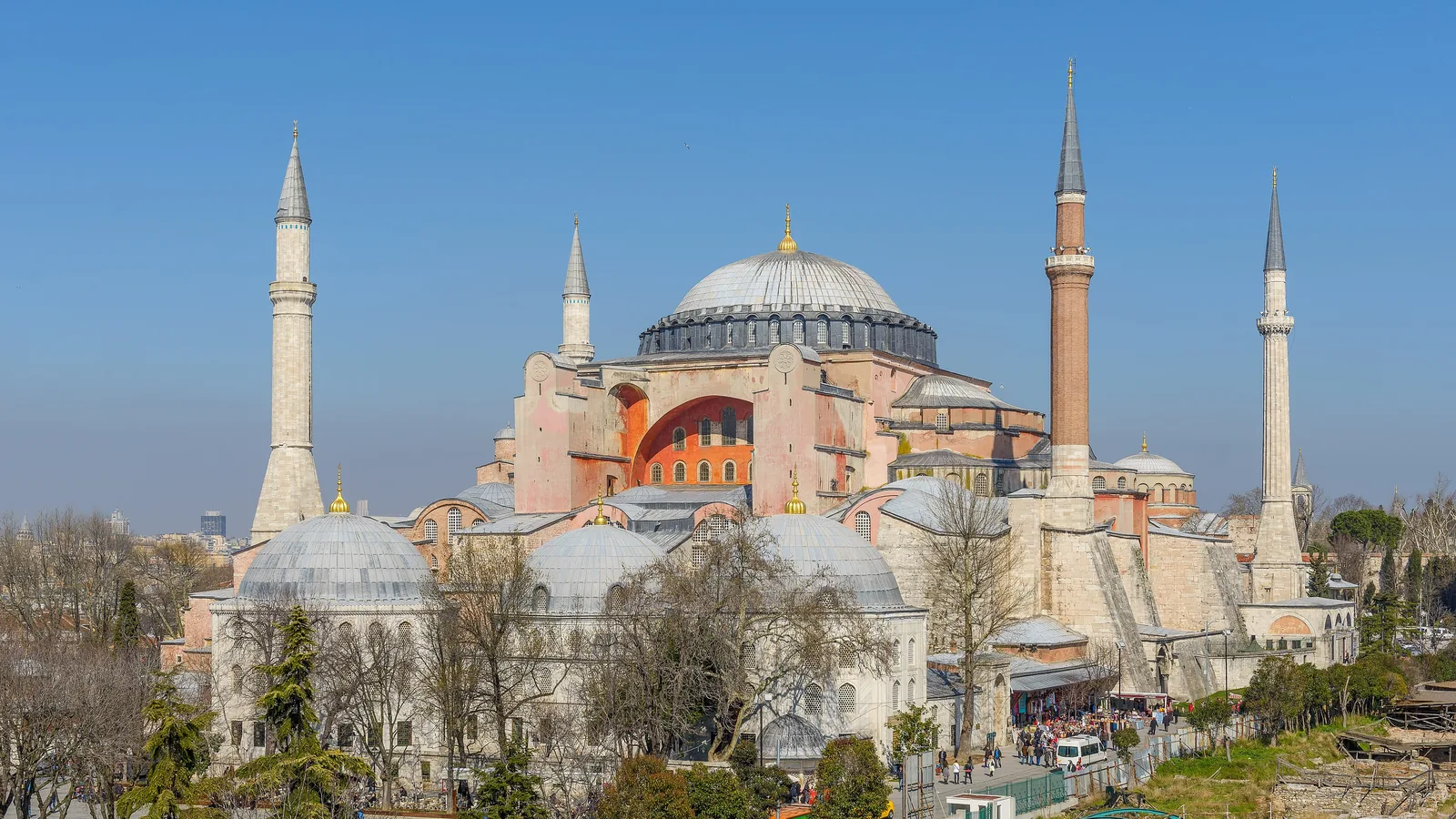

TL;DR — Rioters burned Constantinople’s Great Church in January 532; Justinian’s architects Anthemius and Isidorus finished a domed replacement in 537, and part of that dome fell in 558.
“So the whole church at that time lay a charred mass of ruins,” Procopius of Caesarea wrote of Constantinople’s cathedral after the Nika riot of January 532. His Buildings, a survey of the emperor Justinian’s construction work, then described the church that replaced it, designed by Anthemius of Tralles with Isidorus of Miletus. Dumbarton Oaks, Harvard’s Byzantine research library in Washington, dates the construction to five years, 532 to 537. The riot’s dead were counted differently: Procopius gave more than 30,000, the Chronicon Paschale 35,000. An engineering history published by the American Society of Civil Engineers (ASCE) states that part of the main dome collapsed by 558 and that Isidorus’s nephew completed a higher one in 562.
Quick facts
- When
- January 532 (Nika riot; the Great Church burns) · 532 to 537 (construction) · 537 (dedication) · 553 and 557 (earthquakes) · 558 (dome collapse) · 562 (new dome completed)
- Where
- Constantinople, capital of the Eastern Roman Empire on the Bosporus, now Istanbul in Turkey
- Who
- The emperor Justinian; the architects Anthemius of Tralles and Isidorus of Miletus; Isidorus the Younger; the historian Procopius of Caesarea; the patricians Hypatius and Pompeius
- Outcome
- A domed church replaced the burned basilica in about five years. Earthquakes cracked the eastern arch, part of the main dome collapsed by 558, and Isidorus the Younger completed a higher dome with 40 ribs in 562
January 532: the Great Church burns
The Chronicon Paschale, a Greek chronicle compiled at Constantinople whose entries end in 630, placed the rising “in the fifth year of the reign of Justinian, in the month January.” Procopius, in his History of the Wars, explained the name: the watchword the crowd passed around was Nika, which the Loeb translation glosses as “Conquer,” and “the insurrection has been called by this name up to the present time.”
His list of what burned began with “the sanctuary of Sophia and the baths of Zeuxippus” and went on to part of the imperial palace, the great colonnades as far as the market place named for Constantine, and the houses of wealthy men. The Chronicon Paschale wrote that the whole Great Church, “together with its awesome and marvellous columns was completely demolished on all four sides.” The date of the fire is not settled. In their 1989 translation, Michael and Mary Whitby noted that John Malalas put it on January 13, while the Chronicon appears to place it on Thursday, January 15.
The riot ended in the Hippodrome. Procopius wrote that “there perished among the populace on that day more than thirty thousand.” The Chronicon Paschale gave “35,000 citizens and visitors,” and the Whitbys listed other ancient totals of 50,000 in John Lydus and 80,000 in a chronicle under the name of Zachariah. Justinian’s nephews Boraedes and Justus dragged Hypatius, a nephew of the late emperor Anastasius, down from the throne and handed him over with his brother Pompeius. They were killed on Monday, January 19, and their bodies were thrown into the sea. The emperor then “undertook to build the Great Church zealously and better,” the chronicle continued, along with the palace and the burned public places of the city.
Anthemius of Tralles and Isidorus of Miletus
Procopius wrote that Justinian, “disregarding all questions of expense,” gathered artisans “from the whole world.” He called Anthemius “the most learned man in the skilled craft which is known as the art of building,” and wrote that he prepared the designs in advance. His partner was “Isidorus by name, a Milesian by birth.” The ASCE article, drawing on Richard Winston’s 2017 book, describes Anthemius as an architect and mathematician and Isidorus as a professor of physics and stereometry, the geometry of solid figures.
Winston’s figures, as the magazine reports them, put the start of work 39 days after the riot and the labor force at about 10,000 men. The building measured 220 by 250 feet. Its dome was 120.5 feet across and rose about 182.5 feet above the ground. The dedication followed in 537.
"Suspended from Heaven": Procopius on the dome
Procopius’s description moved from the ground up. Four piers stood at the center, “two on the north side and two on the south.” From them sprang four arches over the sides of a square, and the curved triangles of masonry between the arches, identified in a Loeb note as pendentives, carried a ring pierced with windows. Upon this circle, he wrote, “rests the huge spherical dome.” It seemed “not to rest upon solid masonry,” but to cover the space with a golden dome “suspended from Heaven.”
He gave one engineering detail. The stones of the piers, he said, were bound not with lime but with lead poured between them, which “hardened in the joints.” The Loeb editor disagreed in a footnote: “Procopius evidently misunderstood what he had been told about the way in which the lead was employed.” Paul the Silentiary, a poet at Justinian’s court, described sheets of lead laid in the joints instead.
For the treasure he offered a single measure: the inner sanctuary, where only priests could enter, “is embellished with forty thousand pounds’ weight of silver.”
Piers and columns that gave way before completion
The eastern arch had been built up from both sides but not yet closed when the piers beneath it “suddenly began to crack.” Procopius wrote that Anthemius and Isidorus, “terrified at what had happened,” took the problem to the emperor, and that Justinian ordered them to complete the curve of the arch. “For when it rests upon itself,” he said, “it will no longer need the props beneath it.” The Loeb editor read the props as the scaffolding or centering that held the arch during construction. Procopius anticipated doubt and added that many witnesses to the episode were still available.
The second failure came on the south and north arches. The columns under them, carrying the load, began to “throw off tiny flakes, as if they had been planed.” Justinian ordered the strained upper masonry removed and put back once the dampness of the masonry had abated, and Procopius wrote that “thereafter the structure stood secure.” The Loeb note on this passage calls the account “not entirely clear” and suggests the builders had used the side walls and galleries as permanent centering for the arches.
After the earthquakes of 553 and 557
The dome of 537 lasted a little over 20 years. According to the ASCE article, an earthquake in 553 weakened the crown of the eastern arch, and a second one four years later split it. Repairs failed, and by 558 part of the eastern semidome and a large portion of the main dome had fallen.
Anthemius and Isidorus had died by then. The new dome was overseen by Isidorus the Younger, the nephew of the first Isidorus, and completed in 562. He raised its crown by 20.5 feet to reduce the outward thrust and added 40 ribs.
Dumbarton Oaks published Robert L. Van Nice’s Saint Sophia in Istanbul: An Architectural Survey in two installments, in 1965 and 1986. Dumbarton Oaks records the building’s later changes of use: a mosque immediately after the Ottoman conquest of 1453, a museum by a decision of the Turkish Council of Ministers in 1934, and a mosque again in July 2020.
Key facts
- The Chronicon Paschale dates the Nika riot to January, in the fifth year of Justinian’s reign, which was AD 532.
- Procopius, in the Wars, listed “the sanctuary of Sophia and the baths of Zeuxippus” among the buildings destroyed by fire.
- Procopius counted more than 30,000 dead in the Hippodrome; the Chronicon Paschale gave 35,000; other ancient sources gave 50,000 and 80,000.
- Hypatius and Pompeius were killed on Monday, January 19, 532, according to the Chronicon Paschale.
- Anthemius of Tralles and Isidorus of Miletus were the architects named by Procopius in the Buildings.
- Dumbarton Oaks dates the construction to 532 to 537; the dedication took place in 537.
- Procopius recorded cracking piers under the eastern arch and flaking columns under the north and south arches during construction.
- The ASCE article dates the dome collapse to 558 and the new dome of Isidorus the Younger, 20.5 feet higher with 40 ribs, to 562.
FAQ
Who built Hagia Sophia?
The emperor Justinian ordered it after the Nika riot of 532 burned the earlier church. Procopius named the architects as Anthemius of Tralles and Isidorus of Miletus, and Dumbarton Oaks dates the construction to 532 to 537.
How many people died in the Nika riot?
The sources disagree. Procopius wrote that "more than thirty thousand" died on the last day, the Chronicon Paschale gave 35,000, and other ancient writers gave 50,000 and 80,000, as the Whitbys' 1989 translation notes.
When did the dome of Hagia Sophia collapse?
According to the ASCE article, earthquakes in 553 and 557 cracked and then split the eastern arch, and by 558 part of the eastern semidome and much of the main dome had collapsed. Isidorus the Younger completed a replacement dome in 562.
Sources
- Procopius, The Buildings, Book I, chapter 1, Loeb Classical Library translation (1940), with the Loeb editor's notes, on LacusCurtius (Bill Thayer, University of Chicago).
- Procopius, History of the Wars, Book I, chapter 24, Loeb Classical Library translation (1914), on LacusCurtius (Bill Thayer, University of Chicago).
- Chronicon Paschale 284–628 AD, translated with notes by Michael Whitby and Mary Whitby (Liverpool University Press, Translated Texts for Historians, 1989), Internet Archive full text.
- Dumbarton Oaks Research Library and Collection, "Hagia Sophia Resources," Byzantine Studies research page.
- Dumbarton Oaks Research Library and Collection, Rare Book Collection record: Robert L. Van Nice, Saint Sophia in Istanbul: An Architectural Survey (Dumbarton Oaks, 1965–1986).
- T. R. Witcher, "Tent of the Heavens," Civil Engineering (American Society of Civil Engineers), January 3, 2022.
Cite this article
- APA
- Song Letter. (2026, September 29). Procopius's Buildings, Hagia Sophia and the dome that fell in 558. Our Earth's History. https://ourearthshistory.com/europe/medieval/hagia-sophia-537-procopius-buildings-dome-558/
- Chicago
- Song Letter. “Procopius's Buildings, Hagia Sophia and the dome that fell in 558.” Our Earth's History, September 29, 2026. https://ourearthshistory.com/europe/medieval/hagia-sophia-537-procopius-buildings-dome-558/.
- MLA
- Song Letter. “Procopius's Buildings, Hagia Sophia and the dome that fell in 558.” Our Earth's History, 29 Sep. 2026, https://ourearthshistory.com/europe/medieval/hagia-sophia-537-procopius-buildings-dome-558/.
Get the week in history
One email a week: the new articles, and what was happening elsewhere at the same moment. Free, no ads, unsubscribe any time. How we handle your email.
Text licensed CC BY-NC-ND 4.0. Found an error? Tell us.