Two histories of Emperor Yang's canals, and a fivefold gap in 608

TL;DR — Emperor Yang’s canal orders of 605 to 610 survive in the Book of Sui and the Zizhi tongjian, which differ fivefold on the Yongji Canal’s workforce in 608.
In the third lunar month of 605, four days after ordering a new Eastern Capital at Luoyang, Emperor Yang of Sui called up the labor for the Tongji Canal. His annal in the Book of Sui (Suishu), compiled around 636, puts the order in one line: “發河南諸郡男女百餘萬,開通濟渠”. He raised more than a million men and women from the commanderies of Henan to open a canal from the Western Park to the Yellow River, and from Banzhu on the Yellow River to the Huai. In 608 the same annal records a second order, for the Yongji Canal to the north. Sima Guang’s Zizhi tongjian, finished around 1084, gives that order five times the workforce, and under 610 it adds a third canal, south of the Yangtze.
Quick facts
- When
- Third lunar month of 605 (Tongji Canal and Han Canal) · first month of 608 (Yongji Canal) · 610 (Jiangnan Canal, in the Zizhi tongjian) · 611 (the emperor sails north toward the Goguryeo war) · 618 (end of the Sui) · 1008 (Song grain shipments peak) · 1999 and 2012 (Liuzi excavations) · 2014 (World Heritage listing)
- Where
- From Luoyang along the Yellow River and the Bian to the Huai; from Shanyang to the Yangtze; north from the Qin River to Zhuo commandery; from Jingkou to Yuhang, in what is now Zhenjiang and Hangzhou
- Who
- Emperor Yang of Sui (r. 604–617); the official Huangfu Yi; Sima Guang, compiler of the Zizhi tongjian; the archaeologist Lin Liugen
- Outcome
- The Book of Sui gives over a million workers for both the Tongji Canal of 605 and the Yongji Canal of 608; the Zizhi tongjian agrees on 605 but gives over five million for 608 and records deaths of four or five in ten. The Tang and Song used the canals to ship grain, and excavations at Lingbi, Liuzi and Luoyang have uncovered channels, boats and granaries
605: the Tongji and Han canals
In the Book of Sui the line before the canal order moves tens of thousands of wealthy merchant households to the Eastern Capital; the line after it sends officials south of the Yangtze to build dragon boats and other vessels, tens of thousands of them. In the eighth month the emperor boarded a dragon boat for Jiangdu, now Yangzhou, and the annal describes the fleet as “舳艫相接,二百餘里”: the boats followed stem to stern for more than 200 li.
Ulrich Theobald’s Grand Canal entry for ChinaKnowledge.de traces the channel along the Bian River to the Huai at Xuyi, and gives it and the repaired Han Canal a width of 40 paces, enough for a large fleet.
Sima Guang's entry for 605
The Zizhi tongjian names the official in charge, Huangfu Yi, and agrees with the Book of Sui on the scale: people of Henan and Huaibei, “前後百餘萬”, more than a million over the course of the work. Its route runs through the Xingze marsh into the Bian, then into the Si River and the Huai. It adds more than 100,000 workers from Huainan for the Han Canal, from Shanyang to the Yangtze. The canal was 40 paces wide, it says, with an imperial road planted with willows along its banks and more than 40 detached palaces between Chang’an and Jiangdu.
In the same entry, officials of the Eastern Capital drove the work so hard that “役丁死者什四五”, four or five of every ten conscripts died, and the carts that carried the dead were in sight of one another on the roads east to Chenggao and north to Heyang. Emperor Yang’s annal in the Book of Sui, written some 450 years before Sima Guang, gives no death figure. Theobald writes only that “an insurmountable number of peasants, both men and women” were recruited.

Women on the Yongji Canal, 608
On the day yisi of the first month of 608, the Book of Sui records an edict raising “男女百餘萬”, more than a million men and women from the commanderies of Hebei, to open the Yongji Canal. It drew the Qin River south to the Yellow River and ran north to Zhuo commandery. The Zizhi tongjian gives the same day and nearly the same wording for the route. Its number is “五百餘萬”, more than five million, and it adds a line of its own: “丁男不供,始役婦人”, adult men were not enough, so women were put to the work for the first time. The Book of Sui had already named women in both the 605 and the 608 orders.
Theobald writes that the northern system “was important for the military campaign in 611 against the kingdom of Koryŏ,” the Korean state of Goguryeo. The Book of Sui records that in the second month of 611 the emperor sailed from Jiangdu into the Tongji Canal on his way to Zhuo commandery, and a week later issued an edict against Gao Yuan, the Goguryeo king.
From Jingkou to Yuhang, 610
The third canal appears only in the Zizhi tongjian, among its entries for 610, after the death of the minister Niu Hong in the twelfth month. The emperor ordered the Jiangnan Canal cut from Jingkou to Yuhang, more than 800 li, and “廣十餘丈”, over ten zhang wide, so that dragon boats could pass, with post palaces and rest stations along it; he meant to tour east to Kuaiji. Yan Huang and Shengdan Yang of Tsinghua University, writing in npj Heritage Science in 2023, also date the order to 610 and write that it followed “the existing canal channel” from Zhenjiang through Suzhou to Hangzhou. Theobald adds a last detail: “Yet in the end, Emperor Yang never carried out an inspection tour to Guiji.”
Theobald writes that Emperor Yang “was criticized for his extravagant spending for a third capital (Jiangdu 江都, i.e. Yangzhou 揚州) and the Grand Canal,” and that “Rebellions of peasants and revolts by the nobility brought an end to the Sui.” The dynasty ended in 618.
"Network transport" under the Tang and Song
Under the Tang emperors Gaozu (r. 618–626) and Taizong (r. 626–649), Theobald writes, 200,000 shi of grain a year went to Chang’an; under Gaozong (r. 649–683) the volume was raised to 2.5 million shi. Under the Song the grain reaching the capital “reached its peak in 1008 with 7 million shi,” carried in flotillas of ten to 30 boats, a system called gangyun, or “network transport.”
Excavations at Luoyang, Lingbi and Liuzi
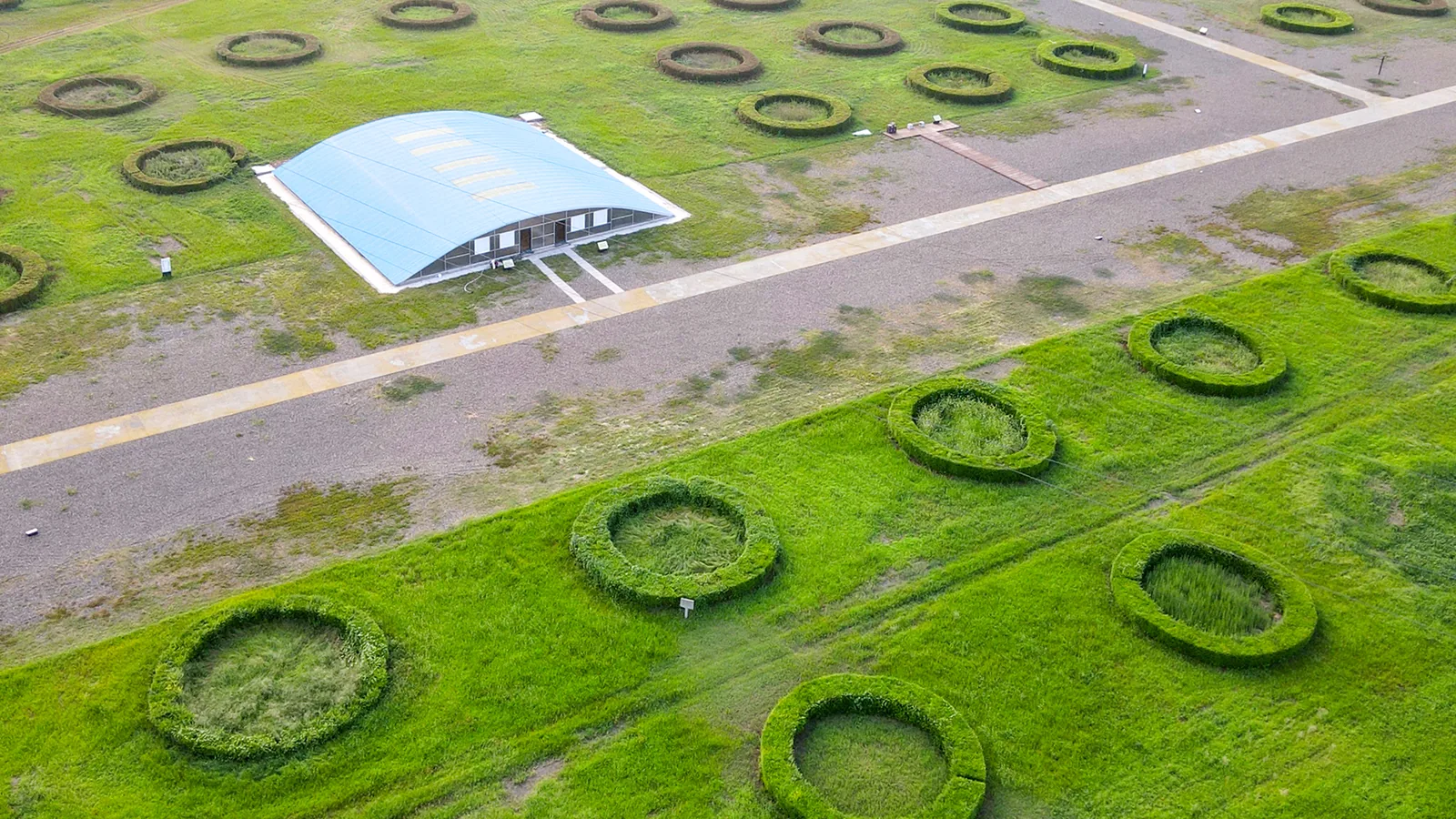
A Xinhua report republished by China’s National Development and Reform Commission in 2020 gives the Huiluo Granary site as a rectangle 1,140 meters east to west and 355 meters north to south, with 220 storage pits identified and about 700 estimated in all. Pit No. 3 alone could hold about 500,000 jin of grain, which site staff said would feed 1,400 people for a year.
Lin Liugen, who chairs the Chinese Archaeological Society’s committee on Grand Canal archaeology and conservation, wrote in 2024 that the Fengshan Avenue site at Lingbi, in Anhui, gave the first evidence that the Tongji Canal was made by widening a natural river channel, confirming the Book of Sui’s record of its opening. The dig also found timber banks built to narrow the stream.
Downstream, at Liuzi village in Suixi county, Huaibei, the county government lists what two excavations in 1999 and 2012 found on the old Tongji course: Tang and Song channels, dikes, a road and stone bridge piers, the first found on the Grand Canal, and nine wooden boats. The site was named one of China’s ten major archaeological discoveries of 1999. The State Council listed it for national protection in June 2001, and in 2014 it entered the World Heritage List.
Key facts
- In the third lunar month of 605 the Book of Sui records Emperor Yang raising more than a million men and women from Henan to open the Tongji Canal (Book of Sui, juan 3).
- The Zizhi tongjian names the official Huangfu Yi, gives the same figure for 605 and adds more than 100,000 workers from Huainan for the Han Canal (juan 180).
- The Zizhi tongjian gives the canal a width of 40 paces, an imperial road with willows and more than 40 detached palaces between Chang’an and Jiangdu (juan 180).
- The Zizhi tongjian states that four or five in ten conscripts died in 605; Emperor Yang’s annal in the Book of Sui has no such figure (juan 180; Book of Sui, juan 3).
- For the Yongji Canal of 608 the Book of Sui gives more than a million workers and the Zizhi tongjian more than five million, with women conscripted because men were too few (juan 3; juan 181).
- Under 610 the Zizhi tongjian records the Jiangnan Canal from Jingkou to Yuhang, more than 800 li long and over ten zhang wide (juan 181).
- Tang grain shipments to Chang’an rose from 200,000 shi a year to 2.5 million under Gaozong, and Song shipments peaked in 1008 at 7 million shi (ChinaKnowledge.de).
- The Liuzi canal site in Huaibei, excavated in 1999 and 2012, yielded nine wooden boats and stone bridge piers and entered the World Heritage List in 2014 (Suixi County People’s Government).
FAQ
How many people built the Sui Grand Canal?
The Book of Sui gives more than a million for the Tongji Canal in 605 and more than a million for the Yongji Canal in 608. The Zizhi tongjian agrees for 605, adds more than 100,000 for the Han Canal and gives more than five million for 608. No total for the whole system appears in either history.
How long was the Sui Grand Canal?
Figures differ by source. The Xinhua report republished by China's National Development and Reform Commission gives nearly 5,000 kilometers for the canal centered on Luoyang, from Beijing in the north to Hangzhou in the south. Theobald's ChinaKnowledge.de entry gives the Grand Canal as 1,794 kilometers. Neither states which stretches were measured.
Did the Grand Canal cause the fall of the Sui?
Theobald lists the canal and a third capital at Jiangdu as the spending for which Emperor Yang was criticized, and names rebellions of peasants and revolts by the nobility as what ended the dynasty in 618. The Tang went on using the canals to ship grain to Chang'an.
Sources
- Book of Sui (隋書), juan 3, Annals 3 (Emperor Yang, part 1): entries for the first year of Daye (605), the fourth year (608) and the seventh year (611), Chinese text on Wikisource.
- Sima Guang, Zizhi tongjian (資治通鑑), juan 180: entry for the first year of Daye (605), Chinese text on Wikisource.
- Sima Guang, Zizhi tongjian (資治通鑑), juan 181: entries for the fourth year (608), sixth year (610) and seventh year (611) of Daye, Chinese text on Wikisource.
- Ulrich Theobald, "da yunhe 大運河, The Grand Canal," ChinaKnowledge.de.
- Ulrich Theobald, "Sui Dynasty 隋 (581-618)," ChinaKnowledge.de.
- Yan Huang and Shengdan Yang, "Spatio-temporal evolution and distribution of cultural heritage sites along the Suzhou canal of China," npj Heritage Science 11, article 190 (2023).
- Xinhua (Wang Kewei and Qu Menglei, Zhengzhou, October 27, 2020), "河南洛阳:运河遗珠变明珠 千年古都焕发新活力," republished by the National Development and Reform Commission of China, December 21, 2020.
- Suixi County People's Government (濉溪县人民政府), "柳孜运河遗址" (Liuzi canal site), June 17, 2024.
- Lin Liugen, "大运河考古展现多彩历史画卷" (Grand Canal archaeology), National Humanity History (国家人文历史), June 23, 2024, from People's Daily Arts.
Cite this article
- APA
- Song Letter. (2026, September 29). Two histories of Emperor Yang's canals, and a fivefold gap in 608. Our Earth's History. https://ourearthshistory.com/east-asia/medieval/sui-grand-canal-605-tongji-yongji-book-of-sui/
- Chicago
- Song Letter. “Two histories of Emperor Yang's canals, and a fivefold gap in 608.” Our Earth's History, September 29, 2026. https://ourearthshistory.com/east-asia/medieval/sui-grand-canal-605-tongji-yongji-book-of-sui/.
- MLA
- Song Letter. “Two histories of Emperor Yang's canals, and a fivefold gap in 608.” Our Earth's History, 29 Sep. 2026, https://ourearthshistory.com/east-asia/medieval/sui-grand-canal-605-tongji-yongji-book-of-sui/.
Get the week in history
One email a week: the new articles, and what was happening elsewhere at the same moment. Free, no ads, unsubscribe any time. How we handle your email.
Text licensed CC BY-NC-ND 4.0. Found an error? Tell us.